Three building blocks for your checklists
Pool Founder has three related tools for standardizing what technicians do at each stop. Task templates (Task Templates in the sidebar) are the individual reusable checklist items — "Empty skimmer baskets", "Test water chemistry". Task groups (Task Groups in the sidebar) bundle task templates by job type so a whole checklist can be applied — and updated — across many jobs at once. Job templates (Job Templates in the sidebar) go one step further: they carry a rate, billing mode, and task checklist so new maintenance jobs can be created in seconds.
Start with Corey's weekly checklist
You don't have to build your checklist from scratch. Click Add Corey's weekly checklist (shown on the Task Templates and Task Groups pages when they're empty) or Use Corey's weekly checklist (shown in the job template editor's Tasks section — and in the guided-setup template questions — when there are no tasks yet). This is the real checklist Corey, Pool Founder's co-founder and a working pool tech, runs on his own routes. One click creates his 10 task templates — blow deck, check chemicals, skim/net pool, empty skimmer/strainer baskets, vacuum, balance chemicals, brush walls and floor, check equipment, backwash filter / clean cartridges, clean tiles — plus a ready-made Weekly Maintenance Checklist task group bundling them. Everything it creates is a normal template or group: rename, edit, or archive anything that doesn't match how your company works. Running it again never creates duplicates.
Task templates and task types
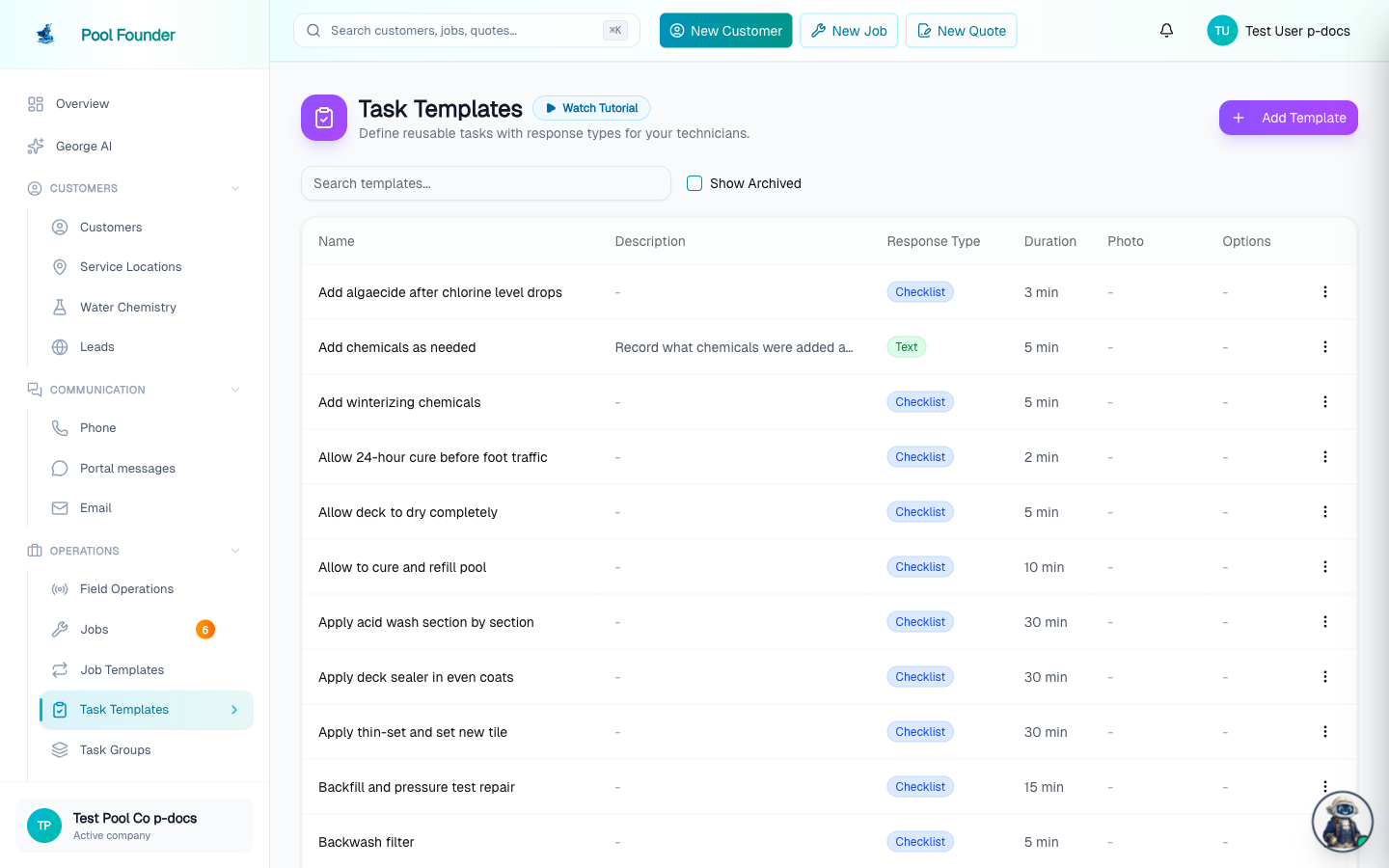
- 1Open Task Templates and click Add Template.
- 2Choose the task type: checkoff (a simple checkbox), text (the technician types an answer), multiple choice, or water chemistry (records readings).
- 3Set how often it repeats — "Every visit", or every N weeks for less frequent work like cleaning a filter every 4 weeks.
Click any template's row to edit it. The editor also has an Archive button for templates you no longer use — archived templates leave the pickers but can be restored anytime (tick Show Archived on the Task Templates page, open the template, and click Restore).
Tasks are attached to jobs when you create them (see Create jobs), through a task group, or through a job template. Technicians see them as the checklist on the mobile completion screen (see Complete a visit).
How "repeat every N weeks" actually works
A task set to repeat every N weeks (say, "clean filter every 4 weeks") does not run on a calendar. The timer runs from the last time the task was actually checked off:
- When the task is due, it appears on the visit checklist as normal.
- If the technician skips it, it is not lost — it stays due and shows again on every following visit until someone completes it.
- Only when it's checked off does the N-week countdown restart, measured from that completion.
- On off-weeks — visits where the task isn't due yet — it still appears on the checklist, greyed out as "Not due this visit", so technicians can see it's coming without being tempted to do it early.
This means an every-4-weeks filter clean that gets missed one week simply reappears the next week, and the next, until it's done. The interval never silently drifts past a skipped task.
On a maintenance job, a task can also carry a price, like a $45 filter clean every 12 weeks. The charge goes on the next maintenance invoice only for visits where the task is checked off, so a skipped task is not charged until it is done. Set the price on one job in its Edit Tasks dialog, or on a job template or task group so the jobs that get the task from it are priced too (see "Task prices on job templates and task groups" below). The task templates on the Task Templates page have no price. Billing details: maintenance billing modes.
Required tasks: what blocks completion and what doesn't
There are two different "required" concepts, and only one of them is enforced:
- Required on a specific job — set in that job's Edit Tasks dialog. This is enforced: the technician cannot finish that stop until the required task is done.
- The Required label on job templates and task groups — this is guidance only. It signals importance but does not block the technician from completing the visit.
If you need a task to hard-block completion, open the job itself and mark the task required in its Edit Tasks dialog.
Task groups: apply one checklist to many jobs
Open Task Groups to bundle task templates by job type — a "Weekly Full Service" group, a "Chem-Only" group, and so on. Click any group's row to open and edit it (the group's page also has an Archive button; restore archived groups via Show Archived). When you edit and save a group, the change can propagate to all matching existing jobs and to job templates whose task list matches the group — so templates built from a group stay in sync too. The save screen shows exactly how many jobs and templates would update.
Propagation only reaches jobs whose task list EXACTLY matches the group — same tasks, in the same order. A job where someone added, removed, or reordered a task has drifted out of the group and will not be updated by group edits.
To bring a drifted job back in sync: open that job's Edit Tasks dialog, re-apply the task group, and then re-add any extra tasks that job needs on top. From then on it matches the group again (until it's customized again).
Task prices follow the same rule as job templates. When your edit changes a task's price and you choose Update … using this group (for example "Update 3 jobs and 1 job template using this group"), a matching job's or job template's price for that task changes only if it still has the group's previous price. Custom prices are kept. The option adds "Custom task prices are kept." and counts the result, for example "1 job and 1 job template get the new task prices · 1 job keeps a custom price". A price-only edit asks too. After you click Save, job templates update right away and jobs update in the background.
Opening a group also shows a Usage panel covering the last 90 days of completed visits: for each task, how many visits it appeared on, how often it was completed versus skipped, and when it was last done. Tasks set to repeat every N weeks are labeled there, since they naturally show lower completion rates than every-visit tasks, and a task with a price shows it as a badge (for example "$45") to users who can view invoices.
Job templates: rate, billing, and tasks in one package
- Job Templates holds maintenance job templates — each one carries a rate, a billing mode, and a task checklist — so new jobs can be created fast instead of configured from scratch.
- Drag tasks to reorder them — in both the maintenance and work order template editors, each task row has a grip handle (up/down chevrons on small screens). The saved order is exactly the order technicians see, numbered 1 to N, in the mobile app — the same reorder UX as Task Groups and a job's Edit Tasks dialog.
- Applying a task group to a maintenance template adds the group's tasks in the order the group defines.
- Template edits can propagate to the jobs that were created from them. When saving an edited template, check "Apply changes to open jobs" and pick which settings to push — including "Tasks & order", which rewrites each linked job's checklist to match the template's tasks and order (per-job tweaks like body-of-water assignments, optional overrides, and per-task frequencies are kept for tasks that stay).
- Templates can also carry default recurring charges (edit a template → "Recurring charges" section). They pre-fill on new jobs from that template, and "Apply changes to open jobs" pushes them to linked jobs. A template with no recurring charges leaves each job's own charges alone.
- Templates power bulk scheduling too: "Apply to pools" on a template opens Add Service in Bulk, which applies the template to many service locations at once.
Task prices on job templates and task groups
A job template or task group can carry a price for any of its tasks, like $45 for a filter clean. In the job template editor's Tasks section, and on a task group's page, each task has a $ box (it says "Price") beside its frequency. Type an amount, or leave it blank for no charge (prices can be $0 to $10,000). Only users with the View invoices permission see the box, and technicians never see prices in the app.
Those are the only places besides the job itself. The task templates on the Task Templates page, seasonal schedule segments, and work order templates have no task prices.
How template and group prices reach jobs
- New jobs from a template copy its task prices. That covers Load template on the new maintenance job form, Add Service in Bulk and customer imports that assign a template, Convert & Schedule on a lead, and creating a job from a template in the mobile app. A job created from an accepted quote fills its unpriced tasks from the quote's job template.
- Applying a task group (on the new maintenance job form, in a job template, or in a job's Edit Tasks dialog) gives the tasks it adds the group's price. In Edit Tasks, tasks already on the job keep their own price, and Replace All keeps the price of each task that stays.
- Once a price is on a job, it belongs to that job. Change it in the job's Edit Tasks dialog and it becomes a custom price that later template and group edits leave alone (see "Pushing job-template edits to existing jobs" below).
- Billing is unchanged. A priced task is still charged only on visits where it is checked off, on the job's next maintenance invoice, and it is never taxed.
Job templates don't say which body of water a task is for, so their prices pair with a job's tasks in order. If a job with a pool and a spa has Filter Clean twice but the template lists it once, only the first Filter Clean gets the template's price, so nothing is charged twice. Set the second one's price in the job's Edit Tasks dialog if you charge for both.
Inside a job template: pricing, chemicals, and fees
Open Job Templates and click New maintenance template (or click an existing card to edit it). Beyond the name and rate, a template carries the full billing setup for jobs created from it:
- Billing mode — Per Visit, Monthly, or Bill Externally. The rate field follows along: "Rate per visit ($)", "Monthly rate ($)", or "Rate for reference ($)" for externally billed work.
- Chemical Billing — three modes: Chemicals billed separately (everything used bills as additional line items), All chemicals included in price (nothing extra is billed — though chemicals marked "Always Charge" in your catalog still bill), and Specific chemicals included (set included amounts per visit; overages and other chemicals bill separately).
- Pass credit card fees to customer — adds a fee covering Stripe's 2.9% + $0.30 only when the customer pays by credit card, capped at 3% of the invoice (2% in Colorado and Oklahoma). Debit cards and ACH are never surcharged, and state surcharge restrictions are enforced automatically.
- Recurring charges — fixed extra charges billed alongside the base rate on every invoice (a flat chemical fee, equipment rental). They pre-fill on jobs created from the template.
Billing schedule and "Bill ahead"
The Billing schedule section sets when jobs from this template invoice automatically: Manual invoicing, After a set number of visits, Monthly on a set day, or Weekly on a set day. Start dates belong on each job — templates only set the cadence.
For monthly-flat templates there is also a Bill ahead checkbox: it bills the upcoming month's service upfront, with the previous month's chemicals on the same invoice. See maintenance billing modes for how each schedule plays out.
Service Terms
The Service Terms box holds terms shown to the customer on the invoice pay page — they must check "I agree to the Service Terms" before they can pay. Terms are saved onto each invoice when it's created, so editing them later only affects new invoices, never ones already sent.
Duplicate, archive, and usage stats
- Each template card has a menu with Edit, Duplicate (creates a copy and opens it for editing), and Archive. Archived templates move to the Archived view, stay out of the pickers, and come back with Restore.
- Cards show usage stats — "Used by N jobs · last used X ago" — and the editor shows how many open jobs currently use the template.
- The page has a search box and sorting by Name (A–Z) or Recently created.
Pushing job-template edits to existing jobs
By default, editing a template does not change jobs already created from it. When a template is in use, the editor shows an "Apply changes to N open jobs created from this template" checkbox. Check it and a list of settings appears — tick only the ones you want pushed:
- Rate — replaces each job's own price with the template rate. Uncheck it to keep every job's individual pricing.
- Billing mode & schedule — billing mode, billing schedule, and bill-ahead move together (they have to: an externally billed job must not keep a billing date).
- Chemical billing, Recurring charges, Pass credit card fees, and Seasonal schedule (on seasonal templates) — each pushes on its own.
- Tasks & order (when the template has tasks) — rewrites each job's checklist to match the template's tasks and order. Tasks that stay keep their per-job settings and price; tasks it adds take the template's price.
- Task prices (when the template has tasks, and only for users who can view invoices) — "Jobs still on this template's old price get the new one. Custom prices are kept." It changes prices only, never adds or removes tasks.
All settings are ticked by default, so leaving the list alone pushes everything as before. The confirmation dialog names exactly what you chose. Anything you unticked — plus notes, preferred days, and route assignments — is never touched.
This is how you apply template changes to open jobs without changing their prices — switching a whole book of jobs to Bill Externally, or changing their chemical billing, while keeping the different prices you negotiated per pool: check "Apply changes", untick Rate (and Task prices, to leave task prices alone too), and save.
Task prices never overwrite a custom price
With Task prices ticked, a job's task price changes only if it still equals the template's previous price for that task. Any other price is a custom one, and it is kept. For example, you raise Filter Clean on your Weekly Service template from $45 to $50 and save with Task prices ticked:
- Jobs still at $45 move to $50.
- A customer you gave a custom $35 stays at $35.
- New jobs created from the template get $50.
The same rule covers adding and removing prices. Giving an unpriced task a $45 price fills it on jobs where that task has no price (a custom price stays), and removing a template price clears it only on jobs still at the old price. The confirm dialog counts the result before anything changes, for example "1 job gets the new task prices · 1 keeps a custom price" (or "No existing task prices change."), with the note "Jobs still on the old price get the new one. Custom prices are kept."
Work order templates
The Job Templates page has a Maintenance / Work Order toggle. Work order templates pre-fill line items, tasks, and deposit settings on new one-time jobs (a pump replacement, a filter rebuild). Click New work order template to build one with:
- Line items — description, optional details, and an amount each, with a live subtotal.
- Discounts — flat $ or %, each with its own description.
- Tasks — drag rows by the grip handle to set the order technicians see — plus a "Show tasks to the customer on the quote" checkbox.
- Time at stop (minutes) — under Basics, how long the visit takes, from 1 to 720 minutes. When you schedule many work orders at once on Work orders to schedule, it decides how much of the technician's workday each one takes. With no time set, the total of the tasks' estimated times is used, or 60 minutes when there are no tasks. New work orders made from the template copy this time.
- Require a deposit before scheduling — a flat dollar amount the customer pays through their portal before the job starts (see work order billing and deposits).
- Pass credit card fees to customer, internal notes, and Service Terms — same behavior as on maintenance templates.
Work order template edits only affect work orders created afterwards. Unlike maintenance templates, there is no option to push changes to existing work orders. The one exception is the visit time: a work order created before the template had one uses the template's current time when it's scheduled from Work orders to schedule.
Note templates
A fourth building block: Note Templates (Note Templates in the sidebar) are reusable message templates for technician job notes — a "Shock Treatment" or "Green Pool Cleanup" write-up techs can drop into a visit's notes instead of typing it out every time.
- Click Add Template and fill in the two fields: Label (the short name techs pick from) and Message (the full text added to the notes).
- The search box matches both the label and the message text.
- Each row's menu has Edit and Delete. Delete is permanent — the confirm dialog warns "This action cannot be undone." Note templates are hard-deleted, unlike job templates, which are archived and restorable.
Frequently asked questions
If an every-4-weeks task isn't completed on its visit, is it lost?
No. The interval runs from the last actual completion, not the calendar. A skipped task stays due and reappears on every following visit until someone checks it off — only then does the 4-week countdown restart.
Why didn't my task group edit update one of my jobs?
Group edits only propagate to jobs whose task list exactly matches the group (same tasks, same order). A job with an extra, missing, or reordered task has left the group. Re-apply the group in that job's Edit Tasks dialog, then re-add its extra tasks.
Can I change the billing mode on many jobs without wiping their different prices?
Yes. Edit the job template, check "Apply changes to N open jobs", then untick <strong>Rate</strong> in the list of settings that appears. Every linked job takes the new billing mode, schedule, or chemical billing while keeping the price it already had. There is no bulk price editor on the Jobs page — to change prices themselves you either push the template rate to all linked jobs (same rate for every one) or edit each job individually.
Can I change the order of tasks in a job template?
Yes — drag task rows by the grip handle in the template editor (maintenance and work order templates both support it; small screens get up/down chevrons instead). Technicians see the tasks in exactly that order, numbered 1 to N, in the mobile app. Task Groups and a job's Edit Tasks dialog reorder the same way. To push the new order (and any added or removed tasks) to jobs already created from the template, check "Apply changes to open jobs" when saving and select "Tasks & order".
Does marking a task Required stop technicians from finishing the stop?
Only when it's marked required on the specific job, in that job's Edit Tasks dialog. The Required label on job templates and task groups is guidance only and does not block completion.
Will changing a template price change a customer I gave a custom price?
No. When you push a job template edit with <strong>Task prices</strong> ticked under "Apply changes to open jobs", a job's task price changes only if it still equals the template's old price. Raise Filter Clean from $45 to $50 and jobs at $45 move to $50, while a customer you set to $35 stays at $35. New jobs from the template get $50. Saving a task group edit to matching jobs and job templates follows the same rule.
Do task templates have prices?
No. The task templates on the Task Templates page have no price. Put the price on the task inside a job template or task group (the $ box beside its frequency), or on one job in its Edit Tasks dialog. Seasonal schedule segments and work order templates have no task prices either.