The Structure Decision Nobody Puts in the Purchase Agreement
After a pool route acquisition, the deal is signed and the customer list is yours. Now you have to decide what that business is inside yours. You have three real choices: fold the customers into your company under your name, keep the old name as a brand while your same techs serve them, or run it as its own location with its own team and books.
The choice decides what customers see on their next invoice, whose phone rings, how autopay moves over, and how much office work you take on. This guide gives you a decision framework, then walks through the consequences of each path. Finding, valuing and checking a deal are covered in our guide to buying pool routes, route valuation and the acquisition checklist.
What Are Your Options After Buying a Pool Route or Company?
You can merge the acquired customers into your company under your name, keep the acquired name as a brand that your existing team services, or run the business as a separate location with its own team, routes, prices and books. Most small route buys fit the first two. The third fits whole companies.
| 1. Merge under your name | 2. Keep it as a brand | 3. Separate location | |
|---|---|---|---|
| What customers see | Your name, logo and invoices | The old name, logo and colors | The old name, run as its own shop |
| Who does the work | Your techs, your routes | Your techs, your routes | Its own team and routes |
| Prices and billing | Your price list and billing | Your company settings and billing | Its own prices, settings and billing |
| Office work | Lowest: one of everything | Low: one company, two faces | Highest: two companies to run |
| Best for | Small routes with little name loyalty | A known local name your team will serve | A company in another city or state |
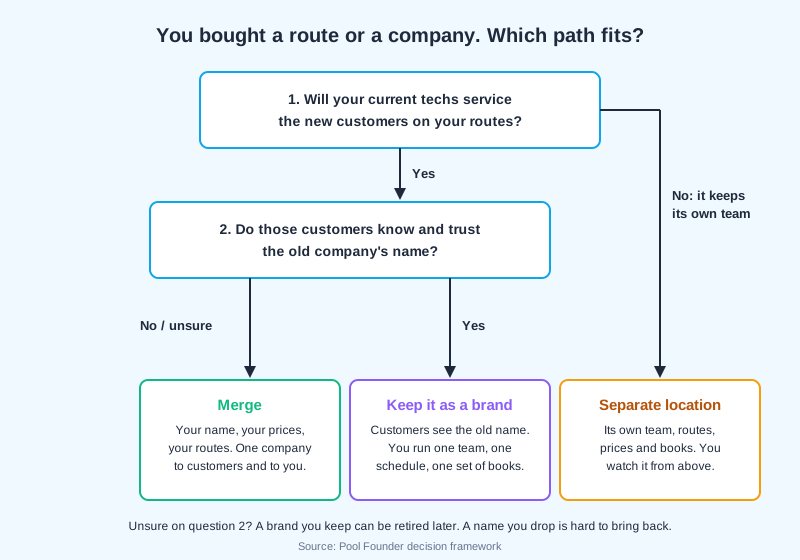
How Do You Choose Between Merging, a Brand and a Separate Location?
Ask two questions. First, will your current techs service these customers on your routes? If not, it is a separate location. Second, do the customers know and trust the old name? If they do, keep it as a brand. If the name means little to them, merge them under yours and keep things simple.
Choose a merge when...
- You bought a route, not a company: a customer list from a solo operator who is retiring or moving.
- Customers knew the tech by first name, not the business by its name.
- The stops fit into your existing route days and service area.
- The old name has few reviews, no real website, or a reputation you would rather not carry.
Choose a brand when...
- The acquired company has a name customers recognize, good reviews, or trucks people see around town.
- Your techs will service its pools on your routes, so you do not want a second schedule or a second set of books.
- You want to change the name slowly, or never, without rushing the customers.
- You run two names on purpose, for example a premium brand and a value brand in the same area.
Choose a separate location when...
- The company is in another city or state, far from your routes.
- It comes with its own techs and office, and they will keep running it day to day.
- Its prices, service packages or local rules differ enough that sharing one set of settings would cause mistakes.
- You want to see its numbers on their own, for example to judge how the purchase is paying off.
When you are unsure, start with a brand. You can move brand customers over to your own name later, a few at a time. A name you dropped on day one, and the trust that came with it, is much harder to bring back.
What Do Larger Pool Service Buyers Do With the Acquired Name?
Most of the groups buying pool service companies keep the acquired name, at least at first. Trade press coverage of recent deals shows brands kept as a matter of policy, with the parent name added later if at all. Full renames happen too, but they tend to be phased in over a long stretch.
- Pool Service Partners: when it bought B&B in 2025, Pool & Spa News reported the firm would keep operating under its current brand, "as is standard for companies acquired by Pool Service Partners."
- Azureon: its January 2025 announcement said Pelican Pools "will continue to retain its brand and operate under its existing leadership."
- Cabana: Pool & Spa News reported in September 2026 that H&H Pool Services would keep its existing brand, "although the Cabana name could eventually be incorporated into it."
- Pool Troopers: when the company formerly called Bay Area Pools & Spas moved to a national name, Gary Crayton told Pool & Spa News the Bay Area name would stay on local trucks for a while, because it "has a lot of power from a brand standpoint."
These are big groups with marketing budgets, and they still keep the old names. For a 5 to 30 tech company, the lesson is the same: the name is part of what you paid for. Do not throw it away by accident in week one. For the bigger picture on who is buying, see our look at pool service consolidation.
How Do You Keep Acquired Customers During the Handover?
Change as little as customers can see at once. With a brand or a separate location, the name, logo and invoice look stay the same, so the only change is who shows up. With a merge, customers get a new name and a new tech together, so the introduction from the seller matters even more.
| Path | What changes for the customer | What to say |
|---|---|---|
| Merge | New name, new tech, new invoice look | Who you are, why the seller picked you, what stays the same |
| Brand | New tech, maybe new owner news | Same company name, new owner, same service day |
| Separate location | Little or nothing at first | Usually the same as a brand, or nothing if the team stays |
Whatever you pick, keep service days and rates steady through the first months, and change one thing at a time. The week-by-week plan, seller introductions and data move are in our post-acquisition integration guide.
What Happens to the Phone Number, Google Listing and Email?
Keep the acquired company's phone number working, because customers will keep calling it for years. The FCC's porting rules let business customers keep a number when they change providers in the same area. Its Google listing and email address also carry customer trust, so plan for each one before closing, not after.
- Phone number. Put the number in the purchase agreement and port it to your provider. The FCC says to keep the current service active until the new one is set up, and that the old company cannot refuse to port a number once you have asked the new one to move it. With a merge, forward it to your main line. With a brand or a separate location, keep it answering under the old name.
- Google Business Profile. Get ownership of the listing at closing. Google's guidelines say the name on a profile should reflect the business's real-world name, so the listing should follow whatever name you actually trade under. Read those guidelines before renaming or retiring a listing with years of reviews on it.
- Email and website. Get the domain and the inbox in the deal. Customers reply to old emails for months. Point the old website at your site with a short "now part of" note, or keep it running if you keep the brand.
How Do You Move Billing and Autopay Without Losing Payments?
Autopay is the hardest part of any handover. Saved cards belong to the seller's payment processor account, and the card numbers cannot be emailed in a spreadsheet. You either have the processor move them under its security rules, which takes time, or you ask each customer to enter their card again.
- Moving saved cards. Stripe, for example, has a copy tool for moving payment data between two Stripe accounts. From another processor, the old processor sends an encrypted export to Stripe. Stripe says imports usually finish within 10 business days of receiving valid data, but the old processor's export can take anywhere from days to months. Card security codes never transfer.
- Expect some declines. Stripe warns that a new merchant account can see a temporary rise in declined payments because card issuers do not recognize it yet. Watch the first autopay run closely.
- Re-enrolling instead. On a small route, asking customers to add a card through a payment link on their first invoice is often faster than a processor migration.
- Check the card statement name. Stripe notes that clear statement descriptors reduce chargebacks and disputes. If you keep a brand but charge cards through your own account, tell those customers what name will appear on their statement before the first charge.
Settle in writing who collects for service done before the closing date and who refunds prepaid months. Customers do not care about the split. They care about being charged twice.
What If the Two Books of Business Have Different Prices?
Price gaps are normal after an acquisition, and your structure decides how hard they are to manage. A merge or a brand puts both books under one set of company settings, so you plan a path toward one price list. A separate location keeps its own prices, which suits a market where rates truly differ.
- Acquired rates lower than yours: hold them steady through the handover, then raise them in planned steps. Our guide on raising pool service prices covers the notice and wording.
- Acquired rates higher than yours: keep them. Do not cut prices just to make the books match.
- A different market altogether: another city with different rates, chemical costs or drive times is a strong sign the business should be its own location with its own prices.
What Happens to the Seller's Staff?
Staff usually decide the structure for you. If the seller's techs are leaving, their customers join your routes, and the choice is only merge or brand. If a full team is staying on, especially in another area, a separate location lets them keep working the way they know while you watch the numbers.
- Techs joining your crew: put them on your routes, your checklists and your pay plan from day one, and pair them with your own techs for the first weeks so the work matches your standard.
- A team staying in place: keep their manager, routes and days. Change how they report to you, not how they clean pools.
- The seller staying on for a while: agree in writing on how long, what they are paid, and who customers should call.
When Does a Later Rebrand Make Sense?
Retire an acquired brand when it stops earning its keep: customers think of you, not the old name, you are paying to market two names, or the old name has a bad reputation. Do it in stages. People quoted in a 2022 Pool & Spa News piece on renaming suggest running both names together before the new one takes over.
~18 months
suggested phase-in for a drastic company name change, starting with the new name as a tagline under the old one
Source: Brett Lloyd Abbott, quoted in Pool & Spa News, "How to Change Your Company Name Without Losing Brand Equity" (2022)
- 1Endorse first. Add a line like "Old Name, a Your Company company" to invoices, reports and trucks.
- 2Market the change. In the same Pool & Spa News piece, Joseph Christoforo suggests about 90 days of marketing focused on the rebrand: website, social media and email to customers.
- 3Rebuild reviews. He also recommends getting at least 10 new reviews in the first 30 to 60 days after the change, so the renamed business does not look brand new online.
- 4Move customers in groups. Switch the most loyal customers first and watch for cancellations before moving the rest.
What About the Legal Entity, DBA and Taxes?
The way the business looks to customers and the way it is set up legally are separate decisions. Whether you bought assets or the whole entity, whether to keep the old LLC, and how to handle taxes are questions for your attorney and CPA. The SBA advises buyers to hire both, so bring them in before closing.
- Trading under the old name: the SBA says most states require you to register a DBA (an assumed or trade name) when you operate under a name other than your legal one, and the rules vary by state, county and city.
- Licenses and permits: the SBA says you need to get them from the current owner or apply for them yourself. Check your state and county rules for pool service work.
- Insurance: tell your carrier about the new name, the new customers and any new trucks or staff before you start servicing them.
Nothing here is legal or tax advice. It is the list of questions to take to your attorney and CPA so the customer-facing plan and the legal setup line up.
How Do You Set Up Each Path in Pool Founder?
In Pool Founder, a merge means adding the customers to your company. A brand is set up in Settings → Branding → Other brands, and your team keeps working as one company. A separate location is its own Pool Founder account, grouped with your others into markets under an organization that Pool Founder support sets up.
Path 1: Merge
The acquired customers become regular customers in your company, with your name on everything. Pool Founder does the import for you, free, from spreadsheets, Skimmer, Pool Brain, Jobber or QuickBooks.
Path 2: Keep it as a brand
- 1Go to Settings → Branding, scroll to Other brands and click Add a brand.
- 2Enter the Brand name and upload its logo and colors. If the acquired customers share a tag, tick it under Customers with these tags (optional) to give the brand to all of them at once, or pick the brand in the Brand row on each customer.
- 3Optionally give the brand its own Portal address, Reply-to email and Phone line (for example its old number, ported over).
- 4Click Save brand.
You stay one company: same team, routes, schedule, prices and settings. Those customers see the brand's name, logo and colors on service reports, invoices, quotes, emails, the pay page and their portal. To move a customer over to your main name later, change the Brand row on their page. Full steps are in the branding help article.
A few things stay your company's: what customers' card statements say (your Stripe account's name), your main business line, and texts, which keep your company name unless you turn on Use this name in texts once that name is on your texting registration.
Path 3: A separate location
Each location is its own Pool Founder account, with its own team, customers, routes, invoices and settings. An organization groups the locations into markets, for example Georgia and Florida. Its Overview shows customers, technicians, stops today, collected this month and open quotes for each market and each location. An owner or administrator can click Open on any location and work in it as themselves, and the change history records them. Details are in the markets help article.
Know the limits before you choose path 3. Organizations are set up by Pool Founder support, not by you. There is no combined customer list, schedule or invoice list across locations; you open a location to see its own. Each location keeps its own settings, prices and billing. If your same team serves the acquired customers, a brand is the better fit.
Pool Founder is built by a working pool tech with 15+ years on routes, so the setup follows the question that matters on a route: who is going to clean these pools next week? Answer that first, and the right path in the software follows.
Ready to streamline your pool service business?
Pool Founder gives you route optimization, automated invoicing, chemical tracking, and everything else you need to run a more profitable pool business.
Frequently Asked Questions
Should I keep the name of the pool company I bought or rebrand it?
Keep it if customers know and trust it, especially at first. Pool Service Partners keeps acquired brands as standard practice, and Azureon kept the Pelican Pools brand after buying it. If the name carries little weight, as with many small routes, merging customers under your name is simpler. A later rebrand works best phased in, with both names shown together for a while.
Can my team service customers from two different company names?
Yes. Keeping the acquired name as a brand lets your same techs service those pools on your routes while customers keep seeing the old name, logo and colors on their reports and invoices. You still run one schedule and one set of books. In Pool Founder this is Settings, Branding, Other brands.
When should an acquired pool company be its own location?
When it has its own team, its own routes and its own books, usually because it is in another city or state. A separate location keeps its own prices, settings and billing, and you check on it from above. If your existing techs will do the work, a brand is usually the better fit.
Can I keep the phone number of the pool route I bought?
Usually yes. Under the FCC's number porting rules, business customers can keep a number when switching providers in the same area. Include the number in the purchase agreement, keep the old service active until the port is done, then forward it to your line or keep it answering under the old name.
How do I move autopay customers from the seller to me?
Either have the payment processor transfer the saved cards under its security rules or ask customers to enter their card again. Stripe, for example, says imports usually finish within 10 business days of receiving valid data, though the old processor's export can take days to months. On small routes, re-enrolling through a payment link is often faster.
Do I need a DBA to run an acquired company under its old name?
Often, yes. The SBA says most states require you to register a DBA (assumed or trade name) when you do business under a name other than your legal one, and the rules vary by state, county and city. Ask your attorney or CPA how it fits with how the purchase was structured.
Sources & References
- Pool & Spa News - How to Change Your Company Name Without Losing Brand Equity (2022)
- Pool & Spa News - Rebrand Your Company With a Successful Name Change (2015)
- Pool & Spa News - B&B Joins Pool Service Partners (2025)
- Pool & Spa News - More About the Acquisition of David Hawes' H&H Pool Services (2026)
- O2 Investment Partners - Azureon Expands Northeast Coverage with Acquisition of Pelican Pools (2025)
- FCC - Porting: Keeping Your Phone Number When You Change Providers
- Google Business Profile - Guidelines for representing your business
- Stripe Docs - Import payment data to Stripe
- Stripe Docs - Statement descriptors
- U.S. Small Business Administration - Choose your business name
- U.S. Small Business Administration - Buy an existing business or franchise