Why Most Pool Service Owners Wait Too Long to Raise Prices
If you haven't raised your pool service prices in the last 12 months, you took a pay cut. The Consumer Price Index rose 2.7% in 2025 according to the Bureau of Labor Statistics, which means your $150/month customer effectively paid you $145.95 in 2024 dollars. Florida's minimum wage jumped to $14/hour in January 2026 and will hit $15/hour by September. Chemical costs remain 40-60% above pre-pandemic levels. Every month you wait, your margins shrink.
Yet according to the Skimmer 2025 State of Pool Service Report, while 76% of pool service professionals planned price increases for 2025, a huge number still delayed or underpriced their adjustments. The hesitation is understandable. You spent years building your route, and the thought of a customer calling to cancel over a $10 increase is painful. But the math almost always works in your favor, and this guide will show you exactly why.
Corey Adams, Pool Founder co-founder and 15-year pool service veteran, has implemented annual price increases across routes of 60-100+ pools. His rule: "If you're scared to raise prices, you're probably two years overdue." This guide is built on that real-world experience plus industry data from the Skimmer State of Pool Service Report, BLS inflation data, and the Cabana 2025 Pool Service Pricing Study.
When Should You Raise Pool Service Prices?
Raise your pool service prices at least once per year, ideally in the first two weeks of April. Annual increases of 3-7% keep pace with inflation and rising costs while remaining small enough that most customers accept without complaint. Waiting two or three years and then hitting customers with a 15-20% jump creates sticker shock and significantly higher cancellation rates.
Why Is April the Best Month for a Price Increase?
April works for three reasons. First, it falls before the peak summer season when competition is most likely to poach your customers. Second, customers are distracted by tax season. Third, your service quality from the spring startup is fresh in their minds. The worst time to raise prices is June through August, when every other pool company is actively marketing for new customers and a dissatisfied client can switch with a single phone call.
What Triggers Should Prompt a Price Increase?
- Annual cost-of-living adjustment: CPI rose 2.7% in 2025 and is running at 2.4% year-over-year as of February 2026 (Bureau of Labor Statistics). Your prices should at minimum match inflation.
- Minimum wage increases: Florida's minimum wage hit $14/hour in January 2026 and reaches $15/hour in September 2026. If you employ techs, your labor costs are rising whether you raise prices or not.
- Chemical cost spikes: Trichlor prices remain 40-60% above 2019 levels. A $5/bag increase across 80 pools is $400/month in additional cost you're absorbing.
- Fuel price changes: The national average for regular gasoline was $3.07/gallon in February 2026 (BLS). If fuel spikes, pass the increase through.
- You haven't raised prices in 18+ months: You're overdue. Period.
| Trigger | Suggested Increase | Timing |
|---|---|---|
| Annual inflation adjustment | 3-5% ($5-8 on $150/mo) | Every April |
| Minimum wage increase | 5-7% ($8-10 on $150/mo) | Within 60 days of wage change |
| Chemical cost spike | Dollar-for-dollar pass-through | Immediately with 30-day notice |
| No increase in 2+ years | 8-12% ($12-18 on $150/mo) | Next April, stagger by tier |
| New service added (reports, photos) | 5-10% ($8-15 on $150/mo) | When feature launches |
How Much Should You Raise Pool Service Prices?
Most successful pool service companies raise prices 3-5% annually, which translates to $5-8/month on a typical $150 service. This keeps pace with inflation and cost increases while staying small enough that the majority of customers accept it without pushback. Larger increases of 8-12% should be reserved for situations where you're significantly below market rate or haven't adjusted in over two years.
Should You Use a Flat Dollar or Percentage Increase?
Both approaches work, but they send different messages. A flat dollar increase ($10 across all service tiers) feels simpler and fairer to customers. A percentage increase (5% across the board) maintains your margin spread between service tiers. Corey's approach: use a flat dollar amount for annual inflation adjustments and a percentage for market-rate corrections. If your $125 customer and your $200 customer both get a $10 increase, the lower-tier customer absorbs an 8% jump while the higher-tier customer sees only 5%.
What Are Current Pool Service Market Rates in 2026?
Before setting your increase, know where you stand relative to the market. According to the Cabana 2025 Pool Service Pricing Study, which analyzed data from over 1,000 pool service companies nationwide, the national average for basic pool cleaning is approximately $140/month. Regional rates vary significantly.
| Market | Average Monthly Rate | Premium Markets |
|---|---|---|
| Florida (statewide) | $143/mo | Naples/Fort Myers: $157/mo |
| California (statewide) | $195/mo | LA/OC/Bay Area: $230/mo |
| Texas (statewide) | $198/mo | Austin: $218/mo |
| Arizona (statewide) | $130/mo | Scottsdale: $140/mo |
| National average | $140/mo | Varies by metro |
If your rate is more than 15% below the market average for your area, you have room for a larger correction. Corey has seen operators charging $100/month in markets where $150 is standard. That's not being competitive, that's leaving $50/month per pool on the table. On an 80-pool route, that's $48,000 per year.
What Customer Churn Should You Expect After a Price Increase?
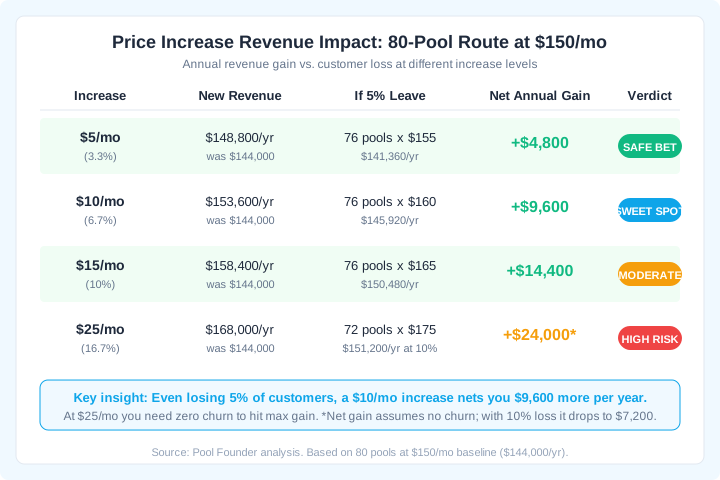
Expect to lose 2-5% of customers on a well-communicated 3-7% price increase. That's 2-4 customers on an 80-pool route. Here's the critical insight: even if you lose 5% of your customers after a 10% price increase, you still come out ahead on total revenue. The customers who leave over a $10/month increase are almost always the most price-sensitive, highest-maintenance accounts on your route.
Why Is Losing a Few Customers Actually Good for Your Business?
The customers who cancel over a $5-10 monthly increase are telling you something important: they value price over your service quality. These are the same customers who call to complain about every invoice, demand extra visits without paying, and leave one-star reviews when their gate code doesn't work. Letting them go frees up route capacity for customers who value what you do. Corey's experience: "Every time I raised prices, the 2-3 customers who left were the ones my techs dreaded visiting. Within a month, I'd fill those spots with better accounts."
How Do You Calculate Your Break-Even Churn Rate?
The break-even formula is straightforward. Divide your percentage increase by the sum of your percentage increase plus 100. For a 10% increase: 10 / (10 + 100) = 9.1%. That means you can lose up to 9.1% of your customers and still earn the same total revenue as before the increase. Anything below that loss rate, and you come out ahead.
| Price Increase | Break-Even Churn | Typical Actual Churn | Net Result |
|---|---|---|---|
| 3% ($5/mo) | 2.9% | 1-2% | Almost always positive |
| 5% ($8/mo) | 4.8% | 2-3% | Positive in most cases |
| 7% ($10/mo) | 6.5% | 3-5% | Usually positive |
| 10% ($15/mo) | 9.1% | 5-8% | Positive if well-communicated |
| 15%+ ($23+/mo) | 13%+ | 8-15% | Risky without strong justification |
How Do You Communicate a Price Increase Without Losing Trust?
Send a written notice 30-60 days before the new rate takes effect. Email is the best channel because it provides a timestamp, allows you to track who opened it, and gives customers time to process without putting them on the spot. Lead with the value you provide, state the new rate clearly, and give a specific effective date. Never apologize for raising prices. You're running a business, not asking for a favor.
What Should a Pool Service Price Increase Letter Include?
- Gratitude: Thank them for being a customer (one sentence, not three paragraphs)
- Value reminder: Briefly mention what they receive (weekly service, water testing, chemical balancing, service reports)
- The reason: Rising costs of chemicals, labor, fuel, or insurance. Be specific, not vague.
- The new rate: State the exact new monthly amount and the effective date
- No action required: Make it clear the change is automatic unless they contact you
- Contact info: Give them a way to reach you with questions
Sample Pool Service Price Increase Email
Subject: Update to Your Monthly Pool Service Rate<br/><br/>Hi [Customer Name],<br/><br/>Thank you for trusting [Company Name] with your pool care. We appreciate your continued business.<br/><br/>As you may know, the cost of pool chemicals, fuel, and labor has continued to rise over the past year. To maintain the service quality you expect, including weekly maintenance, chemical balancing, and detailed service reports, we are adjusting your monthly rate.<br/><br/>Effective May 1, 2026, your new monthly rate will be $[new amount] (previously $[old amount]).<br/><br/>No action is needed on your part. If you have any questions, feel free to reply to this email or call us at [phone number].<br/><br/>Thank you for being part of the [Company Name] family.<br/><br/>[Your Name]<br/>[Company Name]
Should You Call Your Top Customers Before Sending the Letter?
Yes. Your top 20% of customers likely account for a disproportionate share of your revenue, especially if they have multiple properties, refer new business, or pay for premium services. Give them a personal phone call before the email goes out. This shows respect and gives them a chance to ask questions in a private conversation. Corey's script for these calls: "Hey [Name], I wanted to give you a heads-up before you see an email from us. We're doing our annual rate adjustment. Your rate is going from $150 to $160 starting May 1st. It's the first increase in [X months] and it reflects rising chemical and labor costs. I wanted you to hear it from me first." Most will simply say "no problem" and move on.
How Do You Frame a Price Increase Around Value, Not Cost?
The biggest mistake pool service owners make with price increases is leading with apologies and cost justifications. "We're sorry, but due to rising costs we have to..." positions you as a victim. Instead, frame the increase around the value your customer receives. You're not raising prices because costs went up. You're maintaining the service quality that keeps their pool safe, clean, and ready to swim every day of the year.
What Language Works Best in a Price Increase Notice?
| Weak Framing (Cost-Focused) | Strong Framing (Value-Focused) |
|---|---|
| "Due to rising costs, we must increase..." | "To continue delivering the service quality you expect..." |
| "We apologize for this inconvenience..." | "We're committed to keeping your pool in top condition..." |
| "Inflation has forced us to..." | "Your new rate reflects [specific improvements]..." |
| "We have no choice but to..." | "This adjustment ensures we maintain our standards..." |
How Do Service Reports Help Justify Price Increases?
If you send branded service reports after every visit showing water chemistry readings, photos, and work completed, your price increase practically justifies itself. Customers who see a detailed record of what you do every week are far less likely to question a $10/month increase than customers who never hear from you between invoices. This is one of the strongest retention tools in pool service. Before you raise prices, make sure your customers actually see the value they're getting.
Corey's rule: "Never raise prices in a vacuum. In the 60 days before an increase, make sure every customer is getting service reports, their water chemistry is dialed in, and your techs are leaving the pool deck spotless. When the email hits their inbox, the last thing on their mind should be 'what am I even paying for?'"
Step-by-Step: How to Roll Out a Price Increase
A structured rollout minimizes cancellations and maximizes revenue. Follow this process, which has been refined over dozens of price increases across real pool routes. The entire process takes about 45 days from start to finish.
- 1Week 1: Audit your pricing. Pull your customer list and compare each account against current market rates. Identify customers who are significantly underpriced (more than 15% below market) and flag them for a larger adjustment.
- 2Week 1: Calculate your numbers. Decide on a flat dollar or percentage increase. Run the break-even churn calculation. Know your worst-case scenario before you send a single email.
- 3Week 2: Call your top 20% customers. Give your highest-value accounts a personal heads-up. These calls take 2-3 minutes each and dramatically reduce cancellation risk on your best accounts.
- 4Week 2: Send the email. Use the template above. Send it on a Tuesday or Wednesday morning when open rates are highest. Track opens and replies.
- 5Week 3: Follow up with non-openers. If someone hasn't opened the email within 7-10 days, send a brief follow-up or mention it during their next service visit.
- 6Week 4-6: Handle responses. Most customers won't respond at all. For those who push back, offer a brief explanation. For those who cancel, let them go gracefully. They'll often come back within 90 days after trying a cheaper competitor.
- 7Week 6+: New rate takes effect. Update your billing system. Fill any open route spots with new customers at the updated rate.
Start with your least profitable customers first. This is advice from multiple industry experts. If you lose a few accounts during the rollout, they'll be the ones with the lowest margins. You perfect your process on accounts where the stakes are lowest, then apply the polished approach to your most valuable customers.
What Costs Justify a Pool Service Price Increase in 2026?
You don't need to justify every dollar to your customers, but you should know the numbers yourself. Here are the cost increases hitting pool service businesses in 2026, based on government data and industry reporting. These are real numbers you can reference in your price increase communication if needed.
| Cost Category | 2024-2026 Trend | Source |
|---|---|---|
| General inflation (CPI) | 2.4% year-over-year (Feb 2026) | Bureau of Labor Statistics |
| Florida minimum wage | $12/hr (2024) to $14/hr (Jan 2026) to $15/hr (Sep 2026) | Florida Statute |
| Gasoline (regular) | $3.07/gallon national average (Feb 2026) | BLS Average Price Data |
| Trichlor tablets | 40-60% above pre-pandemic (2019) levels | Pool Magazine, Service Industry News |
| Social Security COLA | 2.8% increase for 2026 | U.S. Congress Joint Economic Committee |
How Do You Calculate Your True Cost Per Pool Stop?
Most owners underestimate their cost per stop because they only count chemicals and labor. Your real cost includes: tech wages plus payroll taxes (typically 20-25% above base wage), chemicals per stop ($3-7), fuel and vehicle costs ($2-5 per stop depending on route density), insurance allocation, equipment depreciation, and your overhead (software, phone, accounting, marketing). For a Florida-based company paying techs $18/hour with 20 pools per day, the loaded cost per stop is typically $18-25 before the owner takes a dollar.
If you're charging $150/month (roughly $37.50 per weekly visit) and your cost per stop is $22, your gross margin is $15.50 per visit, or 41%. A $10/month increase pushes that to $18, or 45%. That 4-point margin improvement across 80 pools is the difference between a business that grows and one that treads water.
Common Price Increase Mistakes That Cost You Customers
After 15 years in pool service, Corey has seen every pricing mistake in the book. Avoid these, and your price increase will go smoothly. Make any of them, and you'll lose more customers than the math says you should.
- Waiting too long between increases. A $25 jump after three years hurts more than three $8 increases over the same period. Annual adjustments train your customers to expect them.
- Raising prices during peak season (June-August). Competition is fiercest and customers can easily switch. April or October are far better months.
- Apologizing repeatedly. One acknowledgment is fine. Three paragraphs of apology tells customers you think the increase is unfair too.
- No written notice. Verbal-only increases lead to disputes. Always put it in writing with a specific date and dollar amount.
- Raising prices before fixing service quality issues. If your techs are showing up late, skipping stops, or leaving dirty decks, fix that first. A price increase on bad service is a cancellation trigger.
- Treating every customer the same. Your $125 customer and your $300 commercial account need different communication approaches. Segment your list.
- Not filling cancellation spots quickly. Have a waitlist or marketing plan ready. The worst outcome is losing 4 customers and taking 3 months to replace them at the old rate.
Ready to streamline your pool service business?
Pool Founder gives you route optimization, automated invoicing, chemical tracking, and everything else you need to run a more profitable pool business.
Frequently Asked Questions
How often should I raise pool service prices?
At least once per year. Annual increases of 3-5% are standard in the pool service industry and match general inflation. According to the Skimmer 2025 State of Pool Service Report, 76% of pool professionals planned price increases for 2025. Companies that skip years end up needing larger, more disruptive increases later.
What is the average pool service price increase for 2026?
Most pool service companies are implementing increases of 3-7% in 2026, which translates to $5-10/month on a typical $140-150 service. This range reflects the 2.4% annual CPI increase (BLS, February 2026), rising minimum wages in states like Florida ($14 to $15/hour), and continued elevated chemical costs. Companies that haven't raised prices since 2024 may need a larger 8-12% adjustment.
How many customers will I lose if I raise prices?
A well-communicated 3-7% increase typically results in 2-5% customer loss, or about 2-4 customers on an 80-pool route. The math works in your favor: if you raise prices 10% and lose 5% of customers, your total revenue still increases. The customers who leave are usually the most price-sensitive, least profitable accounts on your route.
Should I raise prices by a flat dollar amount or a percentage?
Flat dollar increases ($10 across all tiers) feel fairer to customers and are simpler to communicate. Percentage increases (5% across the board) maintain your margin spread between service levels. For routine annual adjustments, a flat dollar amount works well. For market-rate corrections where you're significantly underpriced, use a percentage to maintain proportional pricing.
What is the best month to raise pool service prices?
Early April is widely considered the best timing for pool service price increases. It falls before peak summer competition, customers are focused on tax season, and your spring startup service quality is fresh in their minds. Avoid June through August when competitors are actively marketing and customers can easily switch. For year-round markets like Florida, January or April both work well.
How much notice should I give customers before a price increase?
Give 30-60 days written notice before the new rate takes effect. Send an email (which provides a delivery timestamp), follow up with customers who haven't opened it within 7-10 days, and call your top 20% of customers personally before the email goes out. This approach shows respect and dramatically reduces cancellation rates on your most valuable accounts.
Sources & References
- Bureau of Labor Statistics — Consumer Price Index, 2025 in Review
- Bureau of Labor Statistics — Consumer Price Index Summary, February 2026
- Bureau of Labor Statistics — Average Gasoline Prices (February 2026)
- U.S. Congress Joint Economic Committee — CPI Inflation FY2025 and 2026 COLA
- Florida State University HR — Florida Minimum Wage Changes Through 2026
- Cabana Pool Service — 2025 Pool Service Pricing Study
- Pool Magazine — Skimmer's State of Pool Service 2025: Key Findings and Trends
- AQUA Magazine — Increasing Pool Service Rates Without Losing Customers
- Service Industry News — Survey Reveals Pool Service Prices Rising
- Pool Magazine — Why Are Chlorine Prices Still So High?