Every Pool You Do Not Verify Is a Pool You Might Lose
Buying a pool route or pool service business can be the fastest way to grow. But a bad acquisition can set you back years. The difference between a good deal and a disaster comes down to due diligence: verifying every claim, testing every assumption, and protecting yourself in the purchase agreement.
Pool routes typically sell for 6x to 12x monthly recurring revenue, which means a 100-pool route billing $15,000 per month could cost $90,000 to $180,000. At those numbers, skipping due diligence is gambling with real money.
2-4 weeks
typical due diligence period for a pool route acquisition, according to industry brokers
Source: Sealey Business Brokers / BizBuySell 2026
Use this 25-point checklist to verify everything before you write the check.
How Do You Verify the Financial Numbers?
Financials are where most problems hide. Do not take the seller's word for revenue or profit. Verify with documentation.
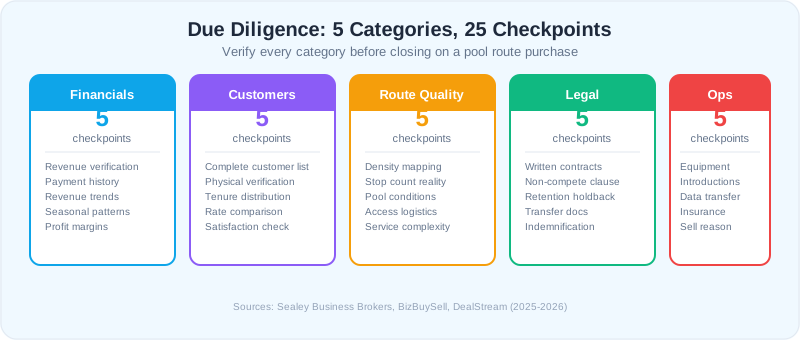
- 11. Monthly revenue verification. Request 12 to 24 months of bank statements or payment processor reports. Match deposits to the claimed revenue. Discrepancies are the number one red flag.
- 22. Customer payment history. Ask for aging reports or payment records for each account. Identify customers who are 30, 60, or 90+ days past due. Chronic non-payers reduce the effective value of the route.
- 33. Revenue trend direction. Is revenue growing, flat, or declining over the past 12 months? Declining revenue requires a bigger discount or a clear explanation.
- 44. Seasonal revenue pattern. Understand the revenue cycle. If the route is in a seasonal market, check winter vs. summer billing differences.
- 55. Profit margin verification. Revenue without profit is just activity. Verify chemical costs, labor costs, vehicle costs, and other expenses to confirm the actual margin.
How Do You Verify the Customer Base?
The customer list is what you are buying. Every pool should be verified, every rate confirmed, and every assumption tested.
- 16. Complete customer list. Get a list with names, addresses, service day, monthly rate, contract status, and how long each customer has been on the route. Missing data signals poor record-keeping.
- 27. Physical pool verification. Visit a random sample of at least 20% to 25% of the pools. Confirm they exist, are in serviceable condition, and match the described service frequency.
- 38. Customer tenure distribution. How many customers have been on the route for 1+ years? 3+ years? 5+ years? Long tenure means stable revenue. A route full of new customers (under 6 months) is risky.
- 49. Service rate comparison. Compare the rates being charged to current market rates in that area. Rates significantly below market mean room to raise prices. Rates above market mean churn risk.
- 510. Customer satisfaction check. If possible, speak with 5 to 10 customers anonymously or through a broker. Ask about service quality and whether they plan to continue.
How Do You Evaluate Route Quality?
Not all routes are equal. Density, drive time, and pool conditions dramatically affect profitability and your daily workload.
- 111. Route density mapping. Plot every customer on a map. Calculate the average drive time between stops. Dense routes (under 5 minutes between stops) are worth more than spread-out routes (15+ minutes between stops).
- 212. Daily stop count. How many pools per day does the current operator service? Is that number sustainable? If the seller claims 25 stops per day but the route covers 40 miles, the math does not work.
- 313. Pool condition assessment. During your physical visits, note equipment age, surface condition, and any deferred maintenance. Pools with failing equipment lead to expensive repair conversations with new customers.
- 414. Access logistics. Check for gated communities requiring codes, locked backyards needing keys, or properties with difficult access. Get gate codes and keys as part of the transfer.
- 515. Service complexity. Differentiate between simple residential pools and complex commercial, spa, or specialty installations. Complex pools take longer and require more expertise.
What Contracts and Legal Protections Do You Need?
The purchase agreement is your safety net. Weak agreements leave you exposed when customers leave or claims surface after closing.
- 116. Written service contracts. How many customers are under written contracts vs. verbal agreements? Contracted customers are stickier and more valuable. Request copies of all existing contracts.
- 217. Non-compete clause. The seller must agree not to service pools in the same territory for at least 2 to 3 years within a defined geographic radius. Without this, the seller can take the money and start competing immediately.
- 318. Customer retention guarantee. Negotiate a holdback of 10% to 20% of the purchase price, released after 60 to 90 days based on customer retention. If 15 of 100 customers cancel within the first 60 days, the holdback covers your loss.
- 419. Transfer documentation. The agreement should list exactly what transfers: customer accounts, service records, gate codes, chemical logs, equipment (if included), and any existing warranties.
- 520. Liability indemnification. The seller should indemnify you against claims arising from their service before the sale date. Outstanding complaints, water damage claims, or chemical injury claims should remain the seller's responsibility.
Never close on a pool route purchase without a non-compete clause and a retention holdback. These two protections are non-negotiable. Walk away from any deal where the seller refuses both.
What Operational Details Should You Check?
The final five items cover practical details that affect your day-one operations after taking over the route.
- 121. Equipment included in sale. Get a detailed list of any equipment transferring with the sale: vehicles, trailers, chemical storage, testing equipment. Note the condition and remaining useful life of each item.
- 222. Seller introduction plan. The seller should personally introduce you to every customer, either through joint visits, a signed letter, or a phone call. Customers who meet the new operator during a warm handoff are far less likely to cancel.
- 323. Data and software transfer. If the seller uses pool service software, confirm whether the data (customer records, service history, chemical logs) can be exported and transferred to your system.
- 424. Insurance and licensing verification. Confirm the seller has active business insurance and any required state or local licenses. If they are operating without insurance, that is a significant risk factor for undisclosed claims.
- 525. Reason for selling. Understand why the seller is exiting. Retirement, health issues, or relocation are neutral. Financial distress, customer problems, or a desire to "get out fast" should make you investigate deeper.
What Does a Good vs. Bad Deal Look Like?
After going through this checklist, you should be able to categorize the deal. Here is what the data tells you.
| Indicator | Good Deal | Red Flag |
|---|---|---|
| Revenue documentation | Bank statements match claims | Verbal estimates only |
| Customer tenure | 70%+ over 1 year | Majority under 6 months |
| Route density | Under 5 min between stops | Over 15 min between stops |
| Contract coverage | 60%+ on written contracts | All verbal / handshake |
| Non-compete offered | Yes, 2-3 year radius | Seller refuses |
| Retention guarantee | 10-20% holdback for 90 days | No holdback offered |
| Payment history | 90%+ current | 25%+ past due |
| Seller introduction | Personal introductions planned | "I'll send an email" |
Corey Adams has a simple rule: "If the seller cannot produce bank statements and refuses a retention holdback, walk away. Those two things should be the easiest parts of the deal. If they are fighting you on the basics, imagine what else they are hiding."
Ready to streamline your pool service business?
Pool Founder gives you route optimization, automated invoicing, chemical tracking, and everything else you need to run a more profitable pool business.
Frequently Asked Questions
How long does due diligence take when buying a pool route?
A thorough due diligence process takes 2 to 4 weeks. This includes requesting and reviewing financial documents, visiting a sample of pools, mapping route density, checking customer payment history, and negotiating the purchase agreement. Rushing this process to save a few days can cost you thousands in undiscovered problems.
What percentage of customers should I expect to lose after buying a pool route?
Industry experience suggests 5% to 15% customer churn in the first 90 days after a route acquisition. Well-handled transitions with personal introductions from the seller see the low end (5% to 8%). Poor transitions without introductions or with price changes see the high end (12% to 15% or more). A retention holdback in the purchase agreement protects you from above-normal churn.
Should I use a broker to buy a pool route?
For small route purchases under $50,000, you can handle the transaction directly with a good purchase agreement template reviewed by an attorney. For larger purchases or full business acquisitions, a broker can help you find deals, verify financials, and structure the transaction. Some brokers specialize in pool service transactions specifically.
What is a fair retention holdback when buying a pool route?
A standard retention holdback is 10% to 20% of the purchase price, held in escrow for 60 to 90 days. If customer retention falls below the agreed threshold during that period, the holdback covers the lost revenue. For example, on a $100,000 route purchase, you might hold back $15,000 for 90 days and release it pro-rata based on how many customers remain.
How many pools should I physically inspect before buying a route?
Visit at least 20% to 25% of the pools on the route. If the route has 100 pools, inspect 20 to 25 randomly selected properties. Check that the pool exists, assess equipment condition, verify the address matches the customer list, and note any deferred maintenance. If you find problems in more than 30% of your sample, expand your inspection to 50% or more.