One queue for everything that needs a second look
The Technician Alerts page (formerly called "Technician Issues" — same page) lists everything in one queue: problems technicians reported from the field, plus alerts the system detects automatically after every completed visit. Auto-detected alerts carry an "Auto" badge showing which detector fired — "Auto · Chemistry", "Auto · Time on Job", or "Auto · Chemical Usage" — and serious ones are also badged Critical (a depleted sanitizer reading, meaning free chlorine below your minimum, is marked Critical). Filter the queue by status, search it, and click a row for details.
All automatic detectors are OFF by default — a solo operator would just get noise about their own visits. Turn on the ones you want via the Alert Settings button.
Everything in this queue is internal. Issues a technician reports and alerts the detectors raise go only to your owners and administrators — they are never sent to the customer, never appear in the service report email or the customer portal, and are never texted. There is no setting that changes this.
The three automatic detectors
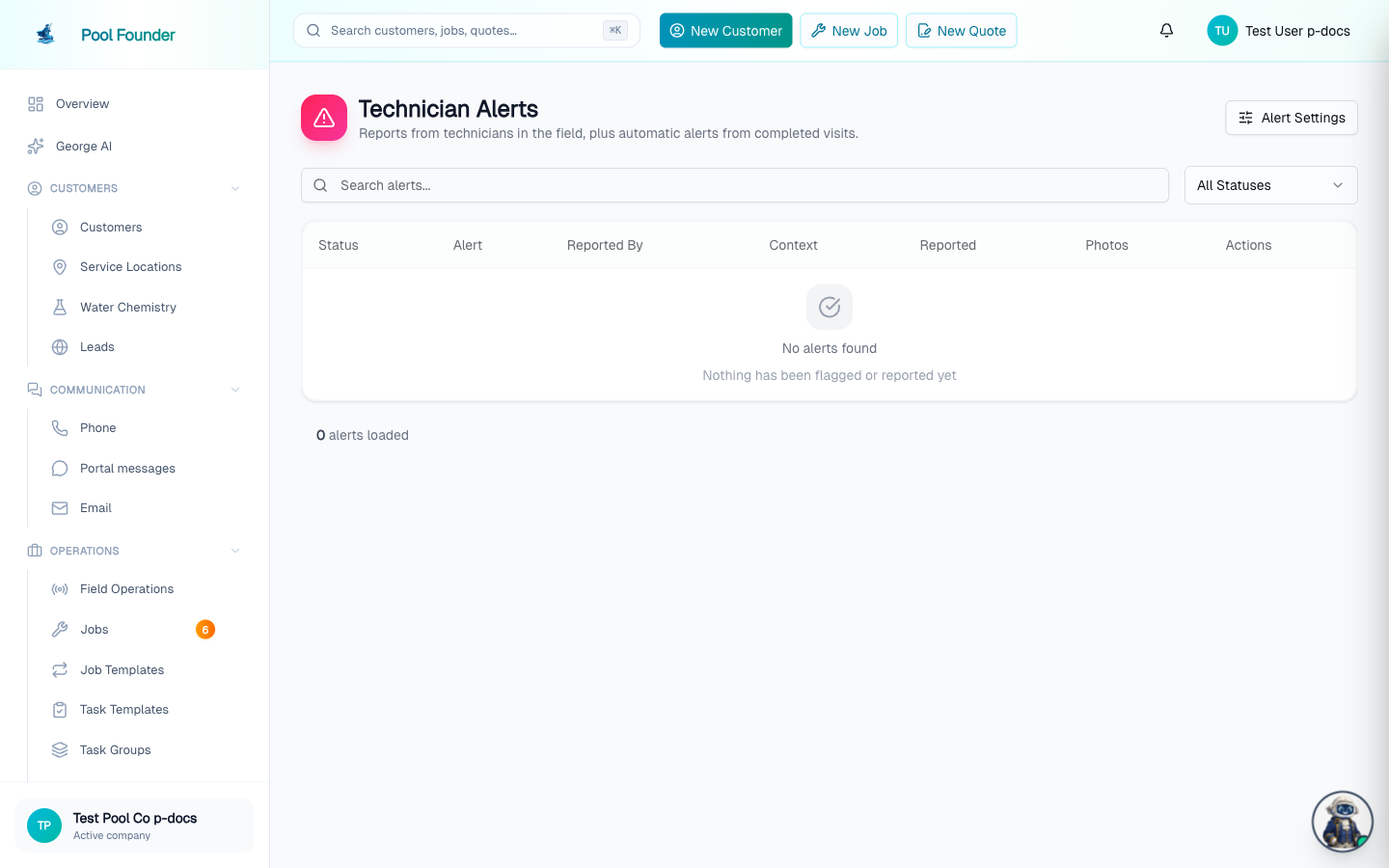
After every completed visit, the system checks three things and files an auto-detected alert when something is off:
- 1Water chemistry out of range — a reading outside your company's acceptable ranges. A depleted sanitizer reading (free chlorine below the minimum) is marked Critical.
- 2Time on job — time spent far above or below that job's historical median.
- 3Abnormal chemical usage — any of three signals: the visit's chemical cost passed a hard per-visit dollar cap you set (off until you set one), the visit's chemical cost was far above the job's typical cost, or an individual chemical's quantity was way outside its history for that pool.
Once a detector is on, detection runs automatically after every completed visit — there is nothing to trigger manually.
What an alert looks like, and what you can do with it
- Auto-detected alerts open with a "What was flagged" card comparing what was recorded against what's expected — e.g. pH 8.5 vs an acceptable 7.0–8.0, or 60 minutes on a job that typically takes 20.
- Acknowledge Alert marks it seen; Mark as Resolved (with optional notes) closes it.
- Create Job starts a work order at that location straight from the alert.
Alert Settings: every knob
Click the Alert Settings button (top right of the Technician Alerts page) to configure what counts as abnormal:
- Toggle each of the three detectors on or off individually (water chemistry ranges / time on job / chemical usage).
- Set the time thresholds — how far above or below the job's typical time (as a % of typical) triggers an alert.
- "Flag any visit over ($)" — a hard per-visit chemical-cost cap that works even on pools with no history. Leave it blank to turn it off.
- Set the cost multiplier (how far above a job's typical chemical cost is flagged) and the quantity sensitivity (how far outside a chemical's history for that pool counts).
- Edit the per-parameter chemistry min/max ranges that define "in range" for the chemistry detector.
- Notify admins — controls whether flagged visits also send admins a notification. Alerts are filed in the queue either way.
The default chemistry ranges are:
| Parameter | Default acceptable range |
|---|---|
| pH | 7.0 – 8.0 |
| Free chlorine | 0.5 – 10 ppm |
| Alkalinity | 50 – 180 ppm |
Other parameters have defaults too — every range is editable per parameter in Alert Settings.
History requirements: what works from day one
- History-based checks — time on job, and chemical cost or quantity vs typical — need at least 3 prior visits on that job before they start comparing.
- Chemistry range checks and the "Flag any visit over ($)" dollar cap work from the very first visit — they compare against your configured ranges and cap, not against history.
Alerts on the mobile app and on completions
- The same alerts queue is in the technician mobile app: Route tab → the "Technician Alerts" card (it sits under "Report an Issue" in the actions list). It requires the alerts read permission — useful for owners who work in the field. The mobile queue has Open / Acknowledged / Resolved / All filters, and users with the manage permission can Acknowledge or Mark as Resolved right from the phone.
- Push notifications for new alerts deep-link straight to the alert.
- When a technician reports an issue from the field, owners and administrators get a high-priority notification for that too — in-app and by push, plus an email when the push cannot reach their phone. The customer whose pool it concerns is not notified and cannot see the report.
- Completion detail views also surface alerts inline (visible with the alerts read permission): the web completion detail page (Completed Jobs → open a completion) shows a red "flagged on this visit" banner linking to each alert, and the mobile completion detail screen shows an "Alerts on This Visit" section.
Permissions for reading and managing alerts are role-based — see Roles & permissions.
Frequently asked questions
Why am I not getting any automatic alerts?
All three detectors are off by default. Open Technician Alerts → Alert Settings and turn on the ones you want. Once on, history-based checks (time on job, usage vs typical) also need at least 3 prior visits on a job before they start comparing; chemistry ranges and the dollar cap apply from the first visit.
What makes an alert Critical?
A depleted sanitizer reading — free chlorine below your configured minimum — is marked Critical.
If I turn off "Notify admins", do alerts still get created?
Yes. The Notify admins toggle only controls whether a flagged visit also sends admins a notification — the alert is filed in the queue either way.
Do issues my technicians report get sent to the homeowner as well as our office?
No — only your office. A technician-reported issue goes to owners and administrators (in-app notification and push, plus an email when the push can't reach their phone). It is never added to the customer's service report email, never shown in the customer portal, and never texted to the customer, and there is no setting to change that. If the homeowner should know, tell them directly or have the technician mention it in the visit notes that go on the service report.
Can I see alerts from my phone?
Yes — the Route tab in the technician mobile app has a "Technician Alerts" card (under "Report an Issue") that opens the same queue, with Open/Acknowledged/Resolved/All filters. It requires the alerts read permission; acknowledging or resolving from the phone requires the manage permission.