Granular, role-based access
The Roles & Permissions page holds granular role-based permissions for dashboard users. Every employee is assigned a role when you add them (see Employees, time tracking, and payroll), and the role decides what they can see and do — on the web dashboard and in the technician mobile app alike.
Permission-gated buttons and rows are simply hidden from people without the permission — for example, the "Void" button next to a recorded payment doesn't appear at all without the void-invoices permission. The mobile app gates its rows the same way: each row in the Route tab's actions list is permission-gated, and a heading only appears when at least one of its rows does, so a plain technician sees a much shorter list than an owner.
Create a custom role
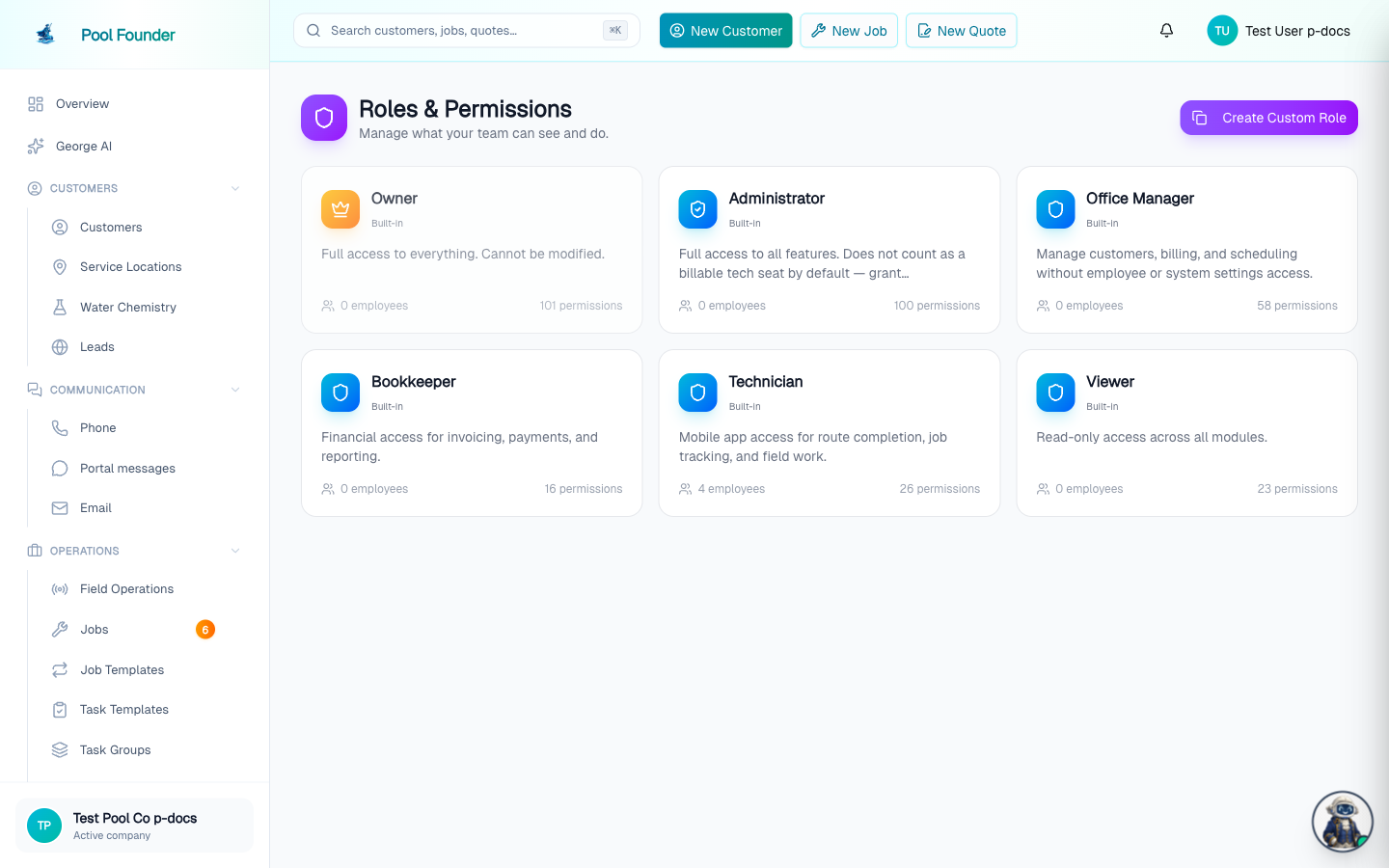
- 1Open the Roles page.
- 2Click Create Custom Role.
- 3Give the role a name and description, optionally clone from an existing role as a starting point, then pick its permissions.
- 4Assign the role to employees on the Employees page — the role field is part of the Add Employee form.
Built-in roles include Owner, Administrator, Office Manager, and Bookkeeper. Some sensitive permissions belong only to Owners and Administrators by default — for example, connecting the company Stripe account is something an Office Manager or Bookkeeper cannot do.
What each permission gates
These are the permissions you'll run into most often around the product, and what each one unlocks:
| Permission | What it gates |
|---|---|
| Manage phone & AI front desk | Changing assistant settings, per-conversation assistant controls (auto-reply / draft-for-approval / take over), standing instructions, and the mobile app's "Forward Your Calls" screen. Owners and admins by default. |
| Respond to customer inquiries | Replying to texts in the Phone inbox and approving or dismissing the assistant's drafted replies. |
| Inbox read access | Reading the Phone inbox. On mobile, roles with inbox read access see the Comms tab (texts, portal threads, and calls). |
| Approve scheduling | Approving or declining the assistant's proposed appointments — from the "N visits need approval" banner at the top of the Phone inbox, inline on a lead's page, and on the mobile Approvals screen. |
| View website leads | Seeing the Leads section, including the "Leads" button in the mobile app's Route tab. |
| Browse customer directory | The searchable Customers list on the technician app (Route tab → Actions → Customers). Office and admin roles have it; the built-in technician role does not, so a field tech cannot download the company book. They still see contact info on the stop they're servicing. |
| Manage website leads | Lead quick actions: editing a lead's details, Convert to Customer, Schedule Walkthrough, Mark Contacted, Mark Converted, and Archive/Restore. The lead page's Convert & Schedule button (Route Fit) also needs Create customers, Create service locations, and Create jobs — plus Edit routes to place the stop on a route, which is also what shows the ranked route options. Same on the web and in the mobile app, where this permission also gates the New Lead action and the Route Fit card. |
| Manage API keys | The API page under Company Settings — creating and revoking API keys and reading the endpoint docs. Owners and admins by default. |
| Manage referrals | The Referrals page — both the Refer & Earn program and your own customer referral program. Owners and admins by default. |
| Connect the company Stripe account | Connecting Stripe to accept payments. Only Owners and Administrators have it by default. |
| Call customers as the business | The "Call" button on a customer's page (web) and the phone icon in a mobile text thread, which place the call showing the business number as caller ID (the company also needs a business number). |
| Send text broadcasts | The Broadcasts tab of the Phone section — texting one service update to a filtered group of customers. Owners and Administrators by default; Office Manager and Bookkeeper do not have it, and without it the tab does not appear at all. It is deliberately separate from the email-blast permission, so granting one never grants the other. See text broadcasts. |
| void-invoices | Voiding an invoice and voiding recorded manual payments — the "Void" button is hidden without it. |
| create-invoices | Creating custom invoices, including the "Create Invoice" button in the mobile app. |
| view-invoices | Browsing invoices, including the mobile app's full invoice list and per-customer invoice cards. |
| update-customers | Recording who referred a new customer via the "Referred by…" pill on the customer's page. |
| Delete notes | The trash icon on customer, job, and service location notes — on the web and in the mobile app — which permanently removes the note and its photos. Owners, Administrators, and Office Managers have it by default; the built-in Technician role does not, so technicians can add notes but not delete them (not even their own). Adding a note needs no permission. |
| transfer | Transferring jobs between technicians and days, and the "Reschedule Stops" banner for missed stops on a closed route. |
| alerts (read) | Viewing Technician Alerts — the mobile "Technician Alerts" card and the alerts shown inline on completion detail views. |
| alerts (manage) | Acknowledging alerts and marking them resolved, including from the mobile app. |
| work-orders | Creating work orders from the mobile app's Route tab. |
One special case: the Manage referrals permission is held only by the built-in Owner and Administrator roles. It does not appear in the custom-role editor, so it can't be added to a custom role — the Referrals page stays owner/admin-only.
How gating shows up day to day
- On the web dashboard, actions someone isn't allowed to take are hidden, not greyed out — if a teammate says a button "isn't there", check their role's permissions first.
- In the mobile app, the Route tab's actions list only shows the rows the role allows, grouped under headings that disappear entirely when none of their rows apply.
- Field access follows the same rules — for example, working leads from a truck needs "View website leads", and approving an assistant-proposed booking from the phone needs "Approve scheduling".
Frequently asked questions
Can technicians create jobs or work orders?
Not by default. Creating a maintenance job or work order needs the "Create jobs" permission (work orders also need "Manage work orders"), and the built-in Technician role has neither. That covers the web dashboard, the mobile app's Work Order and Maintenance Job rows and Create chips, and turning an unplanned stop into a work order. Owners, Administrators, and Office Managers have both. To let a specific group of technicians create jobs, clone the Technician role, add those permissions, and assign the new role.
Can technicians delete notes?
Not by default. Deleting a customer, job, or service location note needs the "Delete notes" permission, which Owners, Administrators, and Office Managers have and the built-in Technician role does not, so a technician can add notes but not remove them, including their own. To let certain technicians delete notes, clone the Technician role, add "Delete notes", and assign the new role.
Why can't my office manager connect Stripe?
Connecting the company Stripe account is limited to Owners and Administrators by default — an Office Manager or Bookkeeper cannot connect Stripe. This is a deliberate safeguard on a sensitive action.
A button my teammate needs is missing. Is that a bug?
Usually not — permission-gated buttons and rows are hidden entirely when the role lacks the permission. Check their role on the Roles page and either switch them to a role that has it or create a custom role that does.
Can I start a new role from an existing one?
Yes. Create Custom Role lets you clone from an existing role, then adjust the name, description, and individual permissions from there.
Do permissions apply to the mobile app too?
Yes — the technician mobile app gates its rows the same way as the web dashboard. Each row in the Route tab's actions list is permission-gated, so a plain technician sees a much shorter list than an owner.