Key Takeaway
15-45%
Net profit margin range for pool cleaning businesses, depending on whether you have employees or run routes yourself
Source: IBISWorld, Sageworks/Abrigo, KMF Business Advisors
$75K-$120K
Realistic annual net income for a small owner-operated pool route
Source: KMF Business Advisors 2026
$8.8 Billion
U.S. swimming pool cleaning services market size, growing 4.2% annually
Source: IBISWorld 2025
Yes, a pool cleaning business is profitable. It consistently outperforms most comparable home-service trades on a margin basis. But "profitable" covers a wide range. A solo operator running 50 tight, well-priced pools can clear 40%+ net margins and take home $75,000 or more per year. A 200-pool operation with three techs and scattered routes might net 15% and leave the owner wondering where the money went. The gap between those outcomes comes down to three things: pricing discipline, route density, and chemical cost control.
This guide breaks down the real economics at three operation sizes, with every cost line sourced from industry data, broker reports, and 15 years of Corey Adams running pool routes in Florida. Whether you are evaluating starting a pool service business or trying to figure out why your existing one is not making the money it should, these numbers give you a clear target to measure against.
All profit margins in this article refer to net profit (owner take-home after all expenses) unless labeled as gross margin. Data reflects 2025-2026 estimates from IBISWorld, Sageworks/Abrigo, KMF Business Advisors, BusinessDojo, and pool route broker reports.
How Much Money Can You Make With a Pool Cleaning Business?
A pool cleaning business can generate $50,000 to $200,000+ in annual owner income depending on operation size, pricing, and whether you are on the truck yourself. Solo operators running 50-80 pools typically earn $75,000 to $120,000 per year according to KMF Business Advisors, a Florida-based business brokerage that specializes in pool service transactions. A 2-3 truck operation servicing 150-200+ pools can produce $200,000 to $400,000+ in Seller's Discretionary Earnings (SDE), the standard measure brokers use when valuing pool routes.
Those numbers are achievable because pool service has structural advantages most trades do not. Revenue is recurring and monthly. Customers rarely switch providers unless service quality drops. And the work itself, weekly chemical maintenance and cleaning, has low variable cost once you own the equipment. The Skimmer 2026 State of Pool Service Report, based on a survey of 1,600+ pool professionals and data from 35,000+ Skimmer users, found that more than 80% of pool pros expect higher revenue in 2026.
| Operation Size | Annual Revenue | Owner Income | Source |
|---|---|---|---|
| Solo (50-80 pools) | $90K-$150K | $75K-$120K | KMF Business Advisors |
| Small team (100-150 pools) | $180K-$270K | $50K-$90K | BusinessDojo, broker data |
| Multi-crew (200+ pools) | $360K-$500K+ | $100K-$200K+ | KMF Business Advisors |
Notice the dip at the "small team" level. Revenue doubles from 50 to 100 pools, but owner income can actually decrease because labor absorbs most of the gain. This is the most dangerous phase for pool service owners. More on this in the 100-pool breakdown below.
What Are the Profit Margins for a Pool Cleaning Business?
Net profit margins for pool cleaning businesses range from <b>15% to 45%</b> depending primarily on whether the owner is on the truck. Companies with employees average <b>15-25% net margins</b> according to IBISWorld and Sageworks/Abrigo financial data. Owner-operators who personally service pools hit <b>35-45%</b> because they eliminate labor, the single largest expense at 30-38% of revenue.
For context, those margins beat most comparable home-service trades. HVAC companies average 8-10% net margins. Plumbing runs 10-20%. Landscaping sits at 5-12%. Even pest control, one of the better-margin trades, only hits 18-28%. Pool service earns higher margins primarily because of recurring monthly billing, low per-visit material costs, and high customer retention.
| Business Type | Net Profit Margin | Source |
|---|---|---|
| Pool Service (with employees) | 15-25% | IBISWorld, Sageworks/Abrigo |
| Pool Service (owner-operator) | 35-45% | Broker data, industry surveys |
| HVAC | 8-10% | Pryse industry benchmarks |
| Plumbing | 10-20% | Pryse industry benchmarks |
| Pest Control | 18-28% | Pryse industry benchmarks |
| Landscaping | 5-12% | Pryse industry benchmarks |
The 15-25% range for companies with employees is the industry average, not the ceiling. Well-run operations with tight routes, bulk chemical purchasing, and disciplined pricing regularly achieve 25-35% even with payroll. The operators stuck at 12-15% are almost always making one of three mistakes: underpricing, over-driving between stops, or spending too much on chemicals because they never track usage per pool.
What Does It Actually Cost to Service Each Pool?
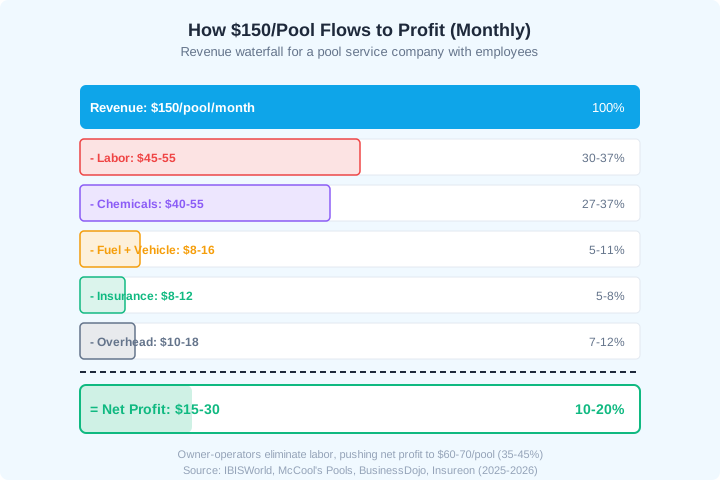
The true cost of a single weekly pool stop ranges from <b>$30 to $41</b> when you include every expense category. Most pool service owners track what they charge per pool but never calculate what each stop actually costs. That blind spot is where margin disappears, because you cannot fix what you do not measure.
How Much Does Labor Cost Per Pool Visit?
Labor is the largest expense at <b>$10-15 per stop</b> for companies with technicians. Pool techs earn an average of $17-21 per hour according to ZipRecruiter and PayScale 2025 data. A technician spending 20-30 minutes per stop including drive time, at $19/hour plus 25-30% for payroll taxes, workers comp, and benefits, puts the fully loaded labor cost at $10-15 per visit. Solo operators eliminate this entirely, which is the single biggest reason their margins are 15-20 points higher.
What Do Chemicals Cost Per Pool Per Month?
Chemical costs average <b>$40-65 per pool per month</b> for professional service companies. That includes $25-35 for chlorine or tablets, $10-12 for muriatic acid, $5-8 for soda ash, $8-10 for sodium bicarbonate, and $5-8 for algaecide and specialty products. These figures align with McCool's Pools' published cost breakdown and HomeGuide's 2026 maintenance cost data. Buying chemicals in bulk from distributors cuts costs by 15-25%, which on a 100-pool route saves $3,600-$9,750 per year.
What About Fuel, Insurance, and Overhead?
Fuel and vehicle expenses run <b>$2-4 per stop</b> covering gas, maintenance, and depreciation. Pool techs typically drive 60-100 miles per day. Insurance adds <b>$2-3 per stop</b>, with general liability averaging $800/year and workers comp averaging $1,627/year for cleaning businesses according to Insureon. Overhead including software, licensing, phone, and admin runs <b>$3-5 per stop</b> for small operations.
| Cost Category | Per Stop (Weekly) | Per Pool (Monthly) | % of Revenue |
|---|---|---|---|
| Labor (with employees) | $10-15 | $40-60 | 30-37% |
| Chemicals | $10-14 | $40-65 | 27-37% |
| Fuel + Vehicle | $2-4 | $8-16 | 5-11% |
| Insurance | $2-3 | $8-12 | 5-8% |
| Overhead | $3-5 | $10-18 | 7-12% |
| **Net Profit** | **$4-8** | **$15-30** | **10-20%** |
Profitability at 50 Pools: The Solo Operator
A solo operator servicing 50 pools at $150/month generates <b>$7,500 in monthly revenue</b>, or $90,000 annually. With no labor expense, the biggest cost categories are chemicals ($2,250-2,750/month), fuel and vehicle ($400-750/month), insurance ($200-350/month), and overhead ($200-400/month). That leaves roughly <b>$3,000-3,800/month in net profit</b>, or about <b>40-44% net margin</b>.
| Category | Monthly Cost | % of Revenue |
|---|---|---|
| Revenue (50 pools x $150) | $7,500 | 100% |
| Chemicals | $2,250-$2,750 | 30-37% |
| Fuel + Vehicle | $400-$750 | 5-10% |
| Insurance (GL + auto) | $200-$350 | 3-5% |
| Overhead (software, phone, supplies) | $200-$400 | 3-5% |
| **Net Profit** | **$3,250-$3,800** | **~40-44%** |
The 40%+ range is realistic and well-documented by pool route brokers and industry surveys. Owner-operators eliminate labor, the largest cost category. The trade-off is a hard ceiling on growth. One person can realistically service 12-15 pools per day with tight routing, or 60-75 per week at most. Once you hit that ceiling, the only way to grow is to hire, which compresses margins significantly.
At 50 pools, your margin lives or dies on chemical cost discipline and route density. A solo operator paying retail for chemicals and driving 15 minutes between stops is at 32%. The same operator buying wholesale and keeping drive times under 7 minutes is at 44%. That gap is roughly $10,800 per year on the same revenue.
Profitability at 100 Pools: The First Hire
At 100 pools with an average of $150/month, revenue hits <b>$15,000/month ($180,000 annually)</b>. But margins compress. Adding one full-time tech at $40,000-$50,000/year plus payroll taxes and workers comp drops net margin to <b>20-28%</b>, yielding roughly <b>$36,000-$50,400 in annual net profit</b>. Revenue doubled from the 50-pool tier, but profit only increased by about $10,000-$15,000.
This is the phase where most pool service owners feel the squeeze. Certified pool technicians earn $40,000-$55,000 annually according to BusinessDojo, and that cost hits before you factor in workers comp ($1,627/year per Insureon) and employment taxes (7.65% FICA plus state unemployment). At 100 pools, the owner is typically still on a truck servicing 50-60 pools while the tech handles the rest.
| Category | Monthly Cost | % of Revenue |
|---|---|---|
| Revenue (100 pools x $150) | $15,000 | 100% |
| Tech Labor (1 FT + owner on routes) | $3,500-$4,500 | 23-30% |
| Chemicals | $4,500-$5,500 | 30-37% |
| Fuel + Vehicle (2 trucks) | $800-$1,400 | 5-9% |
| Insurance (GL + WC + auto) | $450-$650 | 3-4% |
| Overhead | $450-$750 | 3-5% |
| **Net Profit** | **$3,000-$4,200** | **~20-28%** |
Corey's take from 15 years running routes: "The jump from 50 to 100 pools is where owners either figure out their numbers or start losing money without realizing it. You doubled your revenue but added a truck payment, a tech's salary, workers comp, and twice the chemical bill. If you did not raise prices to cover those costs, you are working harder for less."
Profitability at 200 Pools: The Multi-Crew Operation
At 200 pools and $150/month average, annual revenue reaches <b>$360,000</b>. With 2-3 technicians, total labor runs $100,000-$140,000/year. Chemical costs at bulk rates run $96,000-$120,000/year. Fuel, insurance, and overhead add another $42,000-$60,000. That leaves <b>$80,000-$124,000 in annual net profit</b>, or roughly <b>22-34% net margin</b> depending on how tight the operation runs.
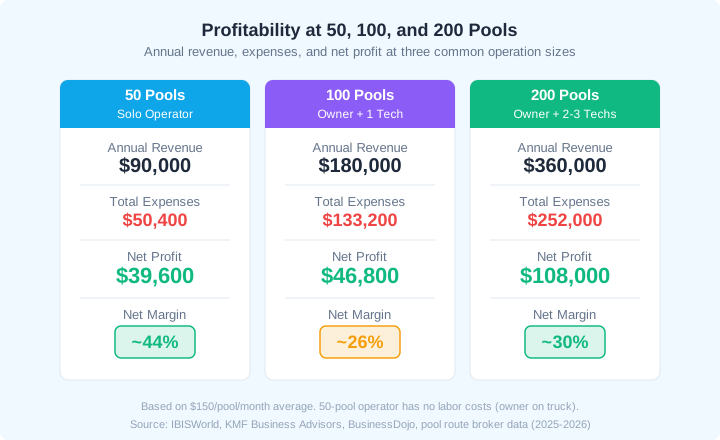
At 200 pools, scale advantages start kicking in. Bulk chemical purchasing saves 15-25% compared to retail pricing. Route density improves because you can cluster techs into tight geographic zones. Insurance costs as a percentage of revenue drop because premiums do not scale linearly with pool count. And repair and equipment upsells, which carry 40-60% gross margins according to industry data, start adding meaningful revenue. KMF Business Advisors reports that repair and replacement work can represent 15-30% of total revenue at this size.
| Category | Monthly Cost | % of Revenue |
|---|---|---|
| Revenue (200 pools x $150) | $30,000 | 100% |
| Tech Labor (2-3 FT) | $8,300-$11,700 | 28-39% |
| Chemicals (bulk pricing) | $8,000-$10,000 | 27-33% |
| Fuel + Vehicle (3-4 trucks) | $1,500-$2,200 | 5-7% |
| Insurance | $700-$1,000 | 2-3% |
| Overhead | $800-$1,200 | 3-4% |
| **Net Profit** | **$6,700-$10,300** | **~22-34%** |
The wide range (22% to 34%) is the difference between an average operation and a well-run one. The operators at 30%+ have three things in common: routes grouped by neighborhood with under 8 minutes of drive time between stops, chemical costs under $50/pool/month through distributor relationships, and repair revenue making up at least 15% of total income.
What Separates a 15% Margin Operation From a 35% One?
The difference between struggling and thriving on the same pool count comes down to five controllable factors. On a 100-pool route at $150/month, the gap between 15% and 35% net margin is <b>$36,000 per year</b> in take-home income. Here is where that money goes.
Are You Underpricing Your Service?
The national average for residential pool service in 2026 is $100-175/month according to HomeAdvisor and HomeGuide. Operators charging $100/month in a market where the average is $150 are giving up $50/pool/month, which is $60,000/year on 100 pools. Most of that flows straight to the bottom line. The Skimmer 2026 report found that most pool pros plan modest price increases under 10%, but many have not raised prices in two or more years while chemical and fuel costs climbed. Check our pool service pricing guide for market-rate benchmarks.
Is Your Route Density Costing You Money?
Route density is the single biggest efficiency lever according to virtually every industry source. A technician who drives 5 minutes between stops instead of 15 minutes can service 3-5 more pools per day. That is $300-$750 in additional daily revenue with almost no increase in cost. Tight routes also mean less fuel, less vehicle wear, and more time at pools instead of in the truck. Target under 8 minutes average drive time between stops. Every minute over 8 costs roughly $0.50 in fuel plus the opportunity cost of lost stops.
Are You Tracking Chemical Usage Per Pool?
Chemicals represent 27-37% of revenue, the second-largest expense after labor. Yet most operators never track how much product goes into each pool. Pools with persistent water chemistry issues can consume 2-3x the normal chemical volume. If you are not identifying those pools and either repricing them or fixing the underlying issue, they are dragging your average margin down. Buying in bulk from a distributor instead of retail cuts 15-25% off the chemical line item. On 100 pools, that is $5,400-$9,750 per year straight to profit.
Are Repair Upsells Part of Your Revenue?
Repair and equipment replacement work carries 40-60% gross margins, significantly higher than routine chemical maintenance. KMF Business Advisors reports that well-managed operations generate 15-30% of total revenue from repairs and replacements. On a $180,000/year operation, that is $27,000-$54,000 in high-margin revenue that many owners leave on the table because they do not have a system for identifying and quoting repair needs during routine stops.
How Much Time Are You Losing to Admin?
Time spent on scheduling, invoicing, and customer follow-up is unbillable time that does not generate revenue. If you are spending 8-10 hours per week on admin that could be automated, that is effectively a full day per week you could be servicing pools or growing the business. Automating billing and scheduling typically saves 5-10 hours per week and eliminates the invoicing delays that create cash flow gaps.
Is a Pool Cleaning Business a Good Business to Start?
Pool cleaning is one of the strongest small business opportunities in home services based on the financial data. The combination of high margins, recurring revenue, low startup costs, and growing demand is hard to match. The U.S. pool service market is valued at $8.8 billion according to IBISWorld and growing at 4.2% annually. There are 10.4 million residential pools in the U.S. requiring regular maintenance, and the Skimmer 2026 report confirms that demand continues to outpace the supply of qualified operators.
Startup costs range from $2,000 for a lean bootstrap launch to $20,000-$25,000 for a fully equipped standard startup. Compared to a plumbing or HVAC business requiring $50,000-$100,000+ in specialized equipment and licensing, the barrier to entry is low. And unlike project-based trades where revenue stops between jobs, pool service generates predictable monthly income from day one.
The risk factors are real but manageable. Seasonality affects Northern markets where pools close for winter. Customer acquisition takes 3-6 months to build a full route. And the transition from solo operator to employer is where many businesses stall because margins compress when you add payroll. But for someone willing to build tight routes, price correctly, and manage costs, the financial upside is well documented.
Pool Founder's profitability dashboard calculates cost per stop and margin per route automatically. Connect your chemical costs, set tech pay rates, and see exactly which routes make money and which ones are dragging your margin down. No spreadsheets, no guessing.
Free starter kit
Start a pool service business with the numbers already run.
A short email series from an owner who started with $1,200 and a used truck. No software pitch, just the four things that decide whether year one works.
- Startup cost breakdownEvery line item from $2K bootstrap to fully equipped
- Pricing calculatorThe minimum you can charge per visit and still profit
- First-10-customers playbookDoor hangers, referrals, and the phone script that closes
- Licensing & insurance checklistWhat your state requires and which insurers pay claims
Already running routes? Try Pool Founder free
Frequently Asked Questions
How much does the average pool cleaning business owner make?
The average pool cleaning business owner earns $80,000 to $100,000 per year according to aggregated industry data. Solo operators running tight routes of 50-80 pools can earn $75,000 to $120,000 annually. Owners of 2-3 truck operations servicing 150-200+ pools can earn $200,000 to $400,000+ in Seller's Discretionary Earnings according to KMF Business Advisors.
What is a good profit margin for a pool service business?
A good net profit margin for a pool service business is 15-25% with employees, according to IBISWorld and Sageworks/Abrigo. Owner-operators who service pools personally typically achieve 35-45% because they eliminate labor costs. Pool service margins outperform most comparable trades including HVAC (8-10%), plumbing (10-20%), and landscaping (5-12%).
How many pools do you need to be profitable?
A single pool technician needs 10-20 weekly stops to cover basic expenses and reach minimal profitability according to BusinessDojo. Most solo operators become comfortably profitable at 40-50 pools. The sweet spot for solo profitability is 60-75 pools per week, which maximizes income before needing to hire help.
How much does it cost per pool visit for the business?
The total cost per weekly pool service visit ranges from $30 to $41 including labor ($10-15), chemicals ($10-14), fuel and vehicle ($2-4), insurance ($2-3), and overhead ($3-5). Solo operators who eliminate the labor cost bring per-visit costs down to $18-26 per stop, significantly increasing profit per pool.
Is pool cleaning more profitable than other service businesses?
Yes. Pool cleaning businesses earn higher net margins than most comparable home-service trades. Pool service nets 15-25% with employees (35-45% for solo operators), compared to HVAC at 8-10%, plumbing at 10-20%, landscaping at 5-12%, and pest control at 18-28% according to Pryse industry benchmarking data. The advantage comes from recurring monthly revenue and low per-visit variable costs.
Why do margins drop when you hire your first employee?
Labor is the single largest expense for pool service companies at 30-37% of revenue. When a solo operator earning 40%+ margins hires their first technician at $40,000-$50,000 per year plus payroll taxes and workers comp, net margins typically drop to 20-28%. Revenue doubles from adding more pools, but labor absorbs most of the gain. The key is to not hire until you have enough accounts to keep the new tech fully utilized from day one.
Sources & References
- IBISWorld - Swimming Pool Cleaning Services in the US Industry Report 2025
- KMF Business Advisors - Pool Service Business Profitability: 7 Income Truths 2026
- BusinessDojo - Profitability of Pool Technician Services 2026
- McCool's Pools - Why Professional Pool Service Costs What It Does
- Insureon - Pool and Spa Cleaning Services Insurance Costs
- HomeGuide - Pool Maintenance Costs 2026
- Pryse - Profit Margin Benchmarks for Service Businesses
- ZipRecruiter - Pool Technician Salary 2025
- PayScale - Pool Technician Hourly Pay 2025
- Skimmer - 2026 State of Pool Service Report