Key Takeaway
15 - 45%
Net profit margin range for pool service companies depending on size and structure
Source: IBISWorld, Sageworks/Abrigo, industry surveys
$30 - $41
Total cost per weekly pool stop including labor, chemicals, fuel, insurance, and overhead
Source: McCool's Pools, BusinessDojo
$8.8 Billion
U.S. swimming pool cleaning services market size in 2026
Source: IBISWorld
Most pool service owners have a general sense that they are "doing okay" but cannot tell you their actual profit margin within five points. That gap between feeling profitable and knowing your numbers is where money disappears. The difference between a 15% net margin and a 35% one on the same 100-pool route is roughly $36,000 per year in take-home income.
This article breaks down real profit margin benchmarks at three company sizes: 50 pools (solo operator), 100 pools (small team), and 200 pools (multi-crew operation). Every number comes from industry data, broker reports, and 15 years of Corey Adams running pool routes in Florida. If you are trying to figure out whether your margins are healthy or where your money is leaking, these benchmarks give you a measuring stick.
Profit margins in this article refer to net profit margin (what the owner takes home after all expenses) unless otherwise specified as gross margin. All data reflects 2025-2026 estimates from IBISWorld, Sageworks/Abrigo, pool route brokers, and operator surveys.
What Is a Good Profit Margin for a Pool Service Business?
A good net profit margin for a pool service business is <b>15-25%</b> according to financial data from Sageworks/Abrigo and IBISWorld. Owner-operators who run their own routes consistently hit <b>35-45%</b> because they eliminate the single largest expense: labor. That range is wide on purpose. Where you land depends on whether you are on a truck, how tight your routes are, and how well you control chemical costs.
For context, pool service margins outperform most comparable trades. HVAC companies average 8-10% net margins. Plumbing sits at 10-20%. Landscaping companies report 5-12%. Pest control runs 18-28%. Pool service is one of the best-margin field service businesses you can run, primarily because recurring monthly revenue creates predictable cash flow and chemical-only visits have extremely low variable cost.
| Trade | Net Profit Margin | Source |
|---|---|---|
| Pool Service | 15-25% (with employees) | IBISWorld, Sageworks/Abrigo |
| Pool Service (owner-operator) | 35-45% | Industry surveys, broker data |
| HVAC | 8-10% | Pryse, industry benchmarks |
| Plumbing | 10-20% | Pryse, industry benchmarks |
| Pest Control | 18-28% | Pryse, industry benchmarks |
| Landscaping | 5-12% | Pryse, industry benchmarks |
Corey ran routes for 15 years before co-founding Pool Founder. His take: "The owners I saw struggling at 12-15% margins were almost always underpricing, over-driving between stops, or spending too much on chemicals because they never tracked usage per pool. Fix those three things and you pick up 10 points of margin without adding a single customer."
How Much Does Each Pool Stop Actually Cost?
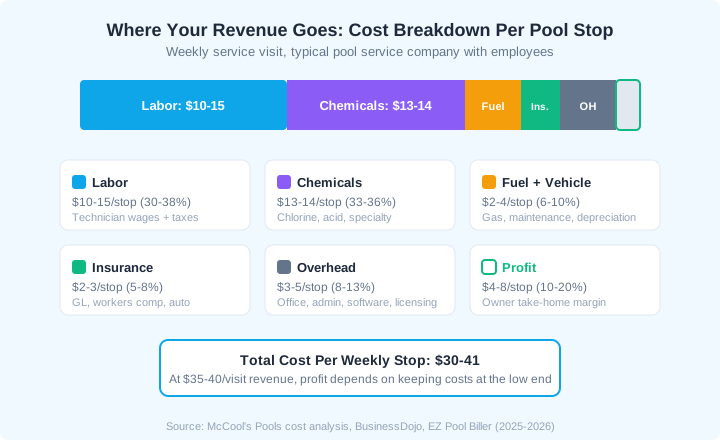
The true cost of a single weekly pool service stop ranges from <b>$30 to $41</b> when you account for every expense category. Most owners track revenue per pool but never calculate cost per stop, which means they cannot identify which pools are profitable and which ones are losing money after drive time, chemicals, and overhead.
What Does Labor Cost Per Pool Stop?
Labor is the largest single expense at <b>$10-15 per stop</b> for companies with employees. Pool technicians earn an average of $17-21 per hour according to ZipRecruiter and PayScale 2025 data, with the national median at roughly $19 per hour. A technician spending 20-30 minutes per stop (including drive time) at $19/hour plus payroll taxes and workers comp puts labor cost at $10-15 per visit. Solo operators eliminate this cost entirely, which is why their margins are dramatically higher.
What Do Chemicals Cost Per Pool Per Month?
Chemical costs average <b>$55-65 per pool per month</b> for professional service companies, which breaks down to roughly $13-16 per weekly visit. That includes $25-35 for chlorine or tablets, $10-12 for muriatic acid, $5-8 for soda ash, $8-10 for sodium bicarbonate, and $5-8 for algaecide and specialty products. These figures come from McCool's Pools' published cost breakdown and align with Angi's 2026 maintenance cost data. Bulk purchasing can reduce chemical costs by 15-25% at scale.
What About Fuel, Insurance, and Overhead?
Fuel and vehicle expenses run <b>$2-4 per stop</b> covering gas, maintenance, and depreciation. Pool techs typically drive 60-100 miles per day across their routes. Insurance adds <b>$2-3 per stop</b>, with general liability averaging $800/year and workers comp averaging $1,627/year for cleaning businesses according to Insureon. Overhead including office costs, software, licensing, and admin runs <b>$3-5 per stop</b> for small operations.
| Cost Category | Per Stop (Weekly) | Per Pool (Monthly) | % of Revenue |
|---|---|---|---|
| Labor (with employees) | $10-15 | $40-60 | 30-38% |
| Chemicals | $13-14 | $55-65 | 33-36% |
| Fuel + Vehicle | $2-4 | $8-16 | 6-10% |
| Insurance | $2-3 | $8-12 | 5-8% |
| Overhead | $3-5 | $12-20 | 8-13% |
| Profit | $4-8 | $16-32 | 10-20% |
Profit Margins at 50 Pools: The Solo Operator
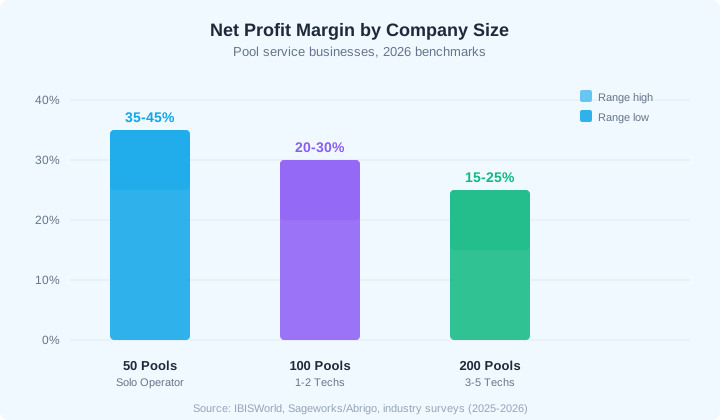
A solo operator servicing 50 pools at $150/month generates <b>$7,500 in monthly revenue</b> ($90,000 annually). With no labor expense, the biggest cost categories are chemicals ($2,750-3,250/month), fuel and vehicle ($400-800/month), insurance ($150-250/month), and overhead ($200-400/month). That leaves <b>$2,800-4,000/month in net profit</b>, or roughly <b>35-45% net margin</b>.
| Category | Monthly Cost | % of Revenue |
|---|---|---|
| Revenue (50 pools x $150) | $7,500 | 100% |
| Chemicals | $2,750 - $3,250 | 37-43% |
| Fuel + Vehicle | $400 - $800 | 5-11% |
| Insurance (GL + auto) | $250 - $350 | 3-5% |
| Overhead (software, phone, supplies) | $200 - $400 | 3-5% |
| Net Profit | $2,700 - $3,800 | 35-45% |
The 35-45% range is realistic for a well-run solo route. The data from pool route brokers and BusinessDojo confirms that owner-operators who personally service pools can achieve 40% or higher because labor, the single largest cost category at 30-38% of revenue, drops to zero. The trade-off is a hard ceiling on growth. One person can realistically service 12-15 pools per day, or 60-75 per week with tight routing.
At 50 pools, your margin is almost entirely determined by chemical cost discipline and route density. A solo operator who pays retail for chemicals and drives 15 minutes between stops is at 30%. The same operator buying wholesale and keeping drive times under 7 minutes is at 42%. That gap is $10,800/year on the same revenue.
Profit Margins at 100 Pools: The First Hire
At 100 pools, most owners have hired their first technician or are splitting routes with a helper. Revenue at $150/month average hits <b>$15,000/month ($180,000 annually)</b>. But margins compress. Adding one full-time tech at $40,000-$50,000/year plus payroll taxes and workers comp drops net margin to <b>20-30%</b>, yielding roughly <b>$36,000-$54,000 in annual net profit</b>.
This is the phase where most pool service owners feel the squeeze. Revenue doubled from 50 pools, but profit did not double because labor absorbed the gains. Certified pool technicians earn $40,000-$55,000 annually according to BusinessDojo, and that cost hits before you factor in workers comp ($1,627/year per Insureon) and employment taxes.
| Category | Monthly Cost | % of Revenue |
|---|---|---|
| Revenue (100 pools x $150) | $15,000 | 100% |
| Tech Labor (1 FT + owner on routes) | $3,500 - $4,500 | 23-30% |
| Chemicals | $5,000 - $5,500 | 33-37% |
| Fuel + Vehicle (2 trucks) | $800 - $1,400 | 5-9% |
| Insurance (GL + WC + auto) | $500 - $750 | 3-5% |
| Overhead | $500 - $800 | 3-5% |
| Net Profit | $3,000 - $4,500 | 20-30% |
Why Does the 100-Pool Margin Dip Feel So Painful?
Because at 50 pools you were keeping 35-45 cents of every dollar. At 100 pools with an employee, you are keeping 20-30 cents. Even though gross dollars went up ($36,000-$54,000 vs $32,400-$45,600), your margin percentage dropped 10-15 points. You are working just as hard, managing more complexity, and taking home a smaller share of a bigger pie. This is exactly the stage where tracking per-route profitability matters most.
Corey built Pool Founder specifically for this phase. "I watched guys at 80-120 pools burn out because they had no visibility into which routes were profitable. They would hire a tech, put them on a scattered route with 20-minute drive times, and wonder why margins tanked. The fix is not more pools. It is tighter routes and knowing your cost per stop."
Profit Margins at 200 Pools: Scaling Into a Real Business
At 200 pools, you are running a real operation with 3-5 technicians, dedicated routes, and meaningful overhead. Revenue at $150/month average hits <b>$30,000/month ($360,000 annually)</b>. Net profit margins typically settle at <b>15-25%</b>, which translates to <b>$54,000-$90,000 in annual net profit</b>. Industry data from IBISWorld and Sageworks/Abrigo places this range as the standard for pool service companies with employees.
| Category | Monthly Cost | % of Revenue |
|---|---|---|
| Revenue (200 pools x $150) | $30,000 | 100% |
| Tech Labor (3-4 FT techs) | $10,000 - $14,000 | 33-47% |
| Chemicals (bulk pricing) | $8,500 - $10,000 | 28-33% |
| Fuel + Vehicle (3-4 trucks) | $1,800 - $3,000 | 6-10% |
| Insurance (full coverage) | $1,000 - $2,000 | 3-7% |
| Overhead (office, admin, software) | $1,500 - $2,500 | 5-8% |
| Net Profit | $4,500 - $7,500 | 15-25% |
Where Do Economies of Scale Actually Kick In?
The biggest scale advantage at 200 pools is chemical purchasing power. If you cut chemical costs by just $5 per pool per month across 200 pools, that is $12,000/year flowing straight to profit. Bulk purchasing from distributors typically saves 15-25% compared to retail pricing. Insurance costs also spread more efficiently since a $2,000/year GL policy covering 200 pools costs $0.83/pool/month versus $1.33/pool/month at 50 pools.
The scale disadvantage is labor management. At 200 pools with 3-4 techs, your labor line is $120,000-$168,000/year. One unproductive tech running a poorly routed schedule can cost you $15,000-$20,000/year in wasted drive time and low pool-per-day counts. Route density becomes the single most important variable at this size.
What Separates a 15% Margin Operation From a 35% One?
The difference between a 15% and 35% net margin on the same revenue is not luck or market conditions. It comes down to five controllable factors: route density, chemical cost management, pricing discipline, labor efficiency, and admin overhead. Operators who control all five consistently land in the top quartile of profitability.
How Much Does Route Density Affect Profit?
Route density is the single biggest lever on profitability according to pool route broker data. A technician who drives 5 minutes between stops instead of 15 minutes can service 3-5 more pools per day. On a 5-day week at $35-40 per visit in revenue, that is $525-$800 per week in additional revenue from the same labor cost. Over a year, tight routing adds $27,000-$41,600 in revenue per tech with zero additional expense.
How Do Top Operators Control Chemical Costs?
Chemical costs are the second largest expense at 28-43% of revenue. Top operators keep this at the low end by buying in bulk from distributors (saving 15-25%), tracking chemical usage per pool, and adjusting dosing based on actual water chemistry instead of dumping a standard amount. A pool that is consistently balanced needs less chemical intervention than one where problems compound week to week.
What Role Does Pricing Play in Margins?
Most pool service companies charge $100-200 per month for weekly residential service according to HomeGuide and Angi 2026 data. The operators stuck at 15% margins are usually charging at the bottom of that range while their costs are average. A $25/month price increase across 100 pools is $30,000/year in pure margin. According to industry surveys, services charging below $115/month cannot sustain professional-grade chemical applications and proper insurance coverage.
| Factor | 15% Margin Operator | 35% Margin Operator |
|---|---|---|
| Avg. drive time between stops | 12-18 minutes | 5-8 minutes |
| Chemical sourcing | Retail / hardware store | Bulk distributor |
| Monthly price per pool | $100-120 | $140-175 |
| Pools per tech per day | 8-10 | 13-16 |
| Admin hours per week | 8-12 hours | 2-4 hours |
| Repair/upsell revenue | Minimal | 20-30% of total revenue |
Repair and equipment work carries 50-70% gross margins according to BusinessDojo, compared to 40-50% for standard maintenance. Operators who actively identify and sell repair work during service visits can add 20-30% to total revenue at significantly higher margins than base maintenance.
How Does Pool Service Compare to Other Field Service Margins?
Pool service companies earn higher net margins than most comparable field service trades. According to Pryse benchmarking data covering multiple service industries, pool service sits in the top tier alongside pest control and specialized cleaning services. The primary advantage is recurring revenue. A pool needs service every single week, which eliminates the feast-or-famine revenue cycles that plague HVAC, plumbing, and electrical contractors.
| Industry | Gross Margin | Net Margin | Revenue Model |
|---|---|---|---|
| Pool Service | 40-55% | 15-25% | Recurring monthly |
| Pest Control | 45-60% | 18-28% | Recurring monthly/quarterly |
| HVAC | 30-50% | 8-10% | Project + seasonal |
| Plumbing | 50-70% | 10-20% | On-demand + project |
| Electrical | 40-55% | 6-14% | Project-based |
| Landscaping | 35-55% | 5-12% | Seasonal recurring |
The gross margin for full-service pool maintenance runs 40-50% according to BusinessDojo, with chemical-only plans reaching 60% due to minimal labor requirements. The gap between gross and net margin (15-30 points) is almost entirely overhead, admin, and vehicle costs. Lean operations that keep overhead to 20-25% of revenue protect more of that gross margin than bloated ones running 35-40%.
How to Track and Improve Your Pool Service Margins
You cannot improve a margin you are not measuring. The operators running 30%+ margins all share one trait: they know their cost per stop for every route, every week. Here are the five numbers every pool service owner should track monthly.
- 1<b>Revenue per pool per month.</b> Industry average is $125-175 for residential weekly service. If you are below $140, you are likely underpriced for 2026 costs.
- 2<b>Chemical cost per pool per month.</b> Target $45-55 with bulk purchasing. Above $65 means you are overspending on chemicals or have pools with persistent water issues consuming extra product.
- 3<b>Pools per tech per day.</b> A trained tech on tight routes should hit 13-16 pools per day. Below 10 means your routes are too spread out or stops are taking too long.
- 4<b>Drive time between stops.</b> Target under 8 minutes average. Every minute over 8 is costing you roughly $0.50 in fuel plus the opportunity cost of another stop.
- 5<b>Admin hours per week.</b> If you are spending more than 4 hours on scheduling, invoicing, and customer communication, you are losing money on unbillable time. Automating billing and scheduling typically saves 5-10 hours per week.
Pool Founder's profitability dashboard calculates cost per stop and margin per route automatically. You connect your chemical costs, set tech pay rates, and it shows you exactly which routes are making money and which ones are dragging your margin down. No spreadsheets required.
Free starter kit
Start a pool service business with the numbers already run.
A short email series from an owner who started with $1,200 and a used truck. No software pitch, just the four things that decide whether year one works.
- Startup cost breakdownEvery line item from $2K bootstrap to fully equipped
- Pricing calculatorThe minimum you can charge per visit and still profit
- First-10-customers playbookDoor hangers, referrals, and the phone script that closes
- Licensing & insurance checklistWhat your state requires and which insurers pay claims
Already running routes? Try Pool Founder free
Frequently Asked Questions
What is the average profit margin for a pool service business?
The average net profit margin for pool service companies with employees is 15-25%, according to IBISWorld and Sageworks/Abrigo financial data. Owner-operators who service pools personally typically achieve 35-45% net margins because they eliminate labor costs, which represent 30-38% of revenue for companies with technicians.
How much profit does a pool service company make per pool?
At an average monthly rate of $150 per pool, a pool service company with employees nets $4-8 per weekly stop in profit, or roughly $16-32 per pool per month. Solo operators without labor costs net significantly more at $25-40 per pool per month. Profitability per pool varies significantly based on route density, chemical costs, and pricing.
How many pools can one technician service per day?
A trained pool technician on well-routed stops can service 13-16 pools per day. With tight route density (under 8 minutes between stops), the upper end is achievable. Scattered routes with 12-18 minute drive times typically limit a tech to 8-10 pools per day, which directly reduces profitability.
What are the biggest expenses for a pool service business?
The two largest expenses are labor (30-38% of revenue for companies with employees) and chemicals (28-43% of revenue). Together they consume 60-80% of every dollar earned. Fuel and vehicle costs add 6-10%, insurance 5-8%, and overhead 8-13%. Controlling labor efficiency and chemical purchasing are the highest-impact moves for improving margins.
Is a pool cleaning business more profitable than HVAC or plumbing?
Yes, on a net margin basis. Pool service companies average 15-25% net margins with employees (35-45% for solo operators), compared to 8-10% for HVAC and 10-20% for plumbing according to industry benchmarking data from Pryse. The key advantage is recurring monthly revenue, which provides stable cash flow without the seasonal or project-based volatility of other trades.
How much do pool chemicals cost per pool per month?
Professional pool service companies spend $55-65 per pool per month on chemicals at retail pricing, which includes chlorine ($25-35), muriatic acid ($10-12), soda ash ($5-8), sodium bicarbonate ($8-10), and specialty products ($5-8). Bulk purchasing from distributors can reduce total chemical costs by 15-25%, bringing the range to $42-55 per pool per month.
Sources & References
- IBISWorld - Swimming Pool Cleaning Services in the US Industry Report 2025
- BusinessDojo - Profitability of Pool Technician Services 2026
- McCool's Pools - Pool Service Cost Breakdown
- Insureon - Pool and Spa Cleaning Services Insurance Costs
- Pryse - Profit Margin Benchmarks for Service Businesses
- HomeGuide - Pool Maintenance Costs 2026
- Angi - How Much Does It Cost to Maintain a Pool 2026
- Tower Business Brokers - The Economics of Pool Route Ownership
- PoolDial - Average Revenue of a Pool Service Business 2026
- ZipRecruiter - Pool Technician Salary 2025
- PayScale - Pool Technician Hourly Pay 2025