Why Does Pool Service Pricing Make or Break Your Business?
Pricing determines whether a pool service company clears a 30% net margin or quietly bleeds cash on every route stop, directly controls customer acquisition and retention rates, and remains the single most under-analyzed decision in an industry where 50% of new businesses fail within five years. A $10 miscalculation per pool across an 80-pool route costs $800 per week, $41,600 per year, and the difference between a thriving operation and one that cannot afford to replace a broken truck.
Most pool service owners set their initial rates by copying a competitor, adding a gut-feel markup, and never revisiting that number even as fuel costs rise 15-20% and chemical prices fluctuate seasonally. According to the Skimmer 2025 State of Pool Service Report, 76% of pool service professionals planned price increases for 2025, suggesting widespread recognition that current rates were not keeping pace with rising costs. The data gap between what owners think they earn per stop and what they actually net after all costs is the primary driver of stagnant businesses that work harder every year for the same or less take-home pay.
This guide uses 2026 rate data from HomeAdvisor, HomeGuide, the Cabana 2025 Pool Service Pricing Study, and the Skimmer State of Pool Service Report. All figures represent residential pool service unless otherwise noted.
How Much Should You Charge for Pool Service in 2026?
The national average for recurring full-service residential pool maintenance in 2026 falls between $100 and $175 per month according to HomeAdvisor and HomeGuide, translating to $25-44 per weekly visit, though actual rates swing from $80 in high-competition Sun Belt markets to $225+ in seasonal Northeast markets where companies compress twelve months of revenue into seven. These benchmarks reflect weekly chemical maintenance with testing, brushing, skimming, and filter basket cleaning as the standard service scope.
$100-175/mo
National average full-service residential pool rate in 2026
Source: HomeAdvisor, HomeGuide, Cabana 2025 Pool Service Pricing Study
Your specific rate should reflect three variables: your regional market (competition density and cost of living), your cost per stop (labor, chemicals, drive time, overhead), and your target margin. Pricing purely by what competitors charge ignores the second and third variables entirely. A company running tight 15-minute routes in a dense subdivision has fundamentally different economics than one driving 20 minutes between rural estates.
What Are the Average Pool Service Rates by Region?
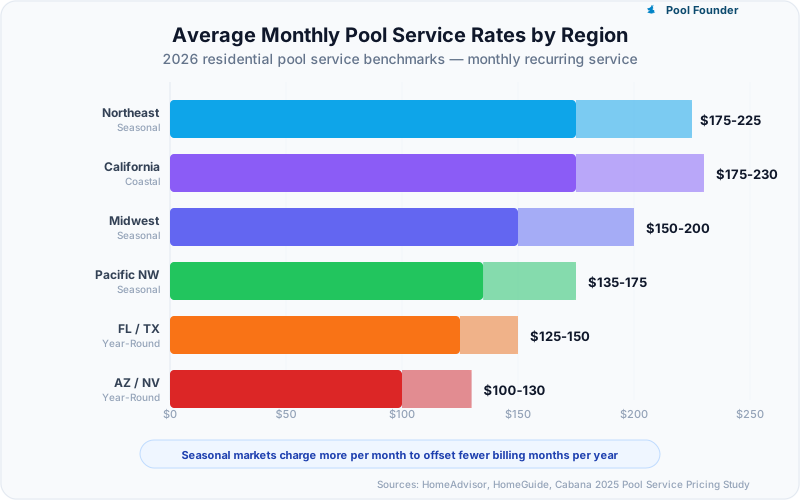
Regional pricing varies by as much as 125% from the cheapest markets to the most expensive, driven by season length, labor costs, and pool density that determines how many stops a technician can complete per day. Florida and Texas year-round markets support lower monthly rates because companies bill twelve months, while Northeast operators must recover the same annual revenue in just seven to eight billing months. Our market-based route pricing guide breaks this down further.
| Region | Monthly Rate | Per-Visit Rate | Season Length | Typical Route Size |
|---|---|---|---|---|
| Florida / Texas (Year-Round) | $125-150/mo | $31-38/visit | 12 months | 18-22 pools/day |
| Arizona / Nevada | $100-130/mo | $25-33/visit | 10-12 months | 20-25 pools/day |
| California Coastal | $175-230/mo | $44-58/visit | 11-12 months | 14-18 pools/day |
| Northeast (NY, NJ, CT, MA) | $175-225/mo | $44-56/visit | 7-8 months | 12-16 pools/day |
| Midwest (IL, OH, MI) | $150-200/mo | $38-50/visit | 6-8 months | 12-16 pools/day |
| Pacific Northwest (OR, WA) | $135-175/mo | $34-44/visit | 6-9 months | 10-15 pools/day |
California Coastal commands the highest rates in the country despite year-round service, with the Cabana 2025 Pool Service Pricing Study reporting a statewide average of $195/month reaching $230 in premium markets like LA County and the Bay Area. Arizona and Nevada sit at the low end because extreme pool density allows technicians to service 20-25 pools per day, spreading fixed costs across more stops and enabling profitable service even at $100/month.
How Does Pool Size and Type Affect Pricing?
Pool volume, surface type, and attached features like spas or water features add 15-60 minutes of additional service time and $3-12 in extra chemical cost per visit, requiring corresponding price adjustments that many operators fail to charge. A 40,000-gallon pool with an attached spa requires roughly twice the chemical dosage and 30-40% more service time than a standard 15,000-gallon residential pool. Our pricing by pool type guide covers adjustments for every configuration.
| Pool Type | Monthly Rate Range | Extra Time vs. Standard | Key Pricing Factor |
|---|---|---|---|
| Standard Residential (10-20K gal) | $100-175/mo | Baseline | Market rate baseline |
| Large Residential (25-40K gal) | $165-225/mo | +10-15 min | Higher chemical volume |
| Pool + Spa Combo | $155-210/mo | +8-12 min | Separate water chemistry |
| Saltwater Pool | $140-195/mo | +5-10 min | Salt cell inspection, specialized chemicals |
| Pool + Water Features | $165-230/mo | +10-20 min | Additional plumbing checks, debris |
| Commercial (HOA, Hotel) | $500-1,800/mo | +30-90 min | Liability, compliance, volume |
Commercial accounts deserve special attention. Pool Troopers reports commercial pool maintenance costs of $833-$1,667 per month ($10,000-$20,000 annually), with HOA and hotel pools carrying significantly higher liability requirements, more frequent service schedules (often 3-7 days per week), and health department compliance obligations. Price commercial accounts based on hours of labor required per week, not by comparing to residential rates.
What Are the Three Main Pool Service Pricing Models?
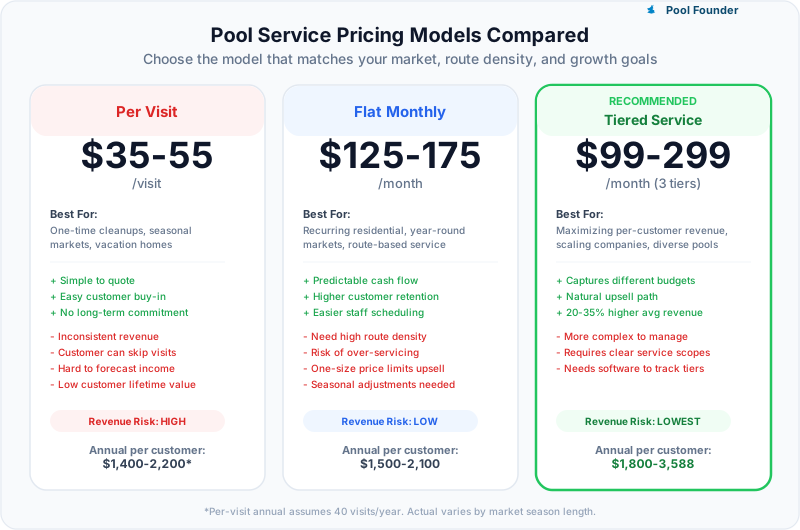
Pool service companies primarily use three pricing models, each with distinct revenue characteristics: flat monthly billing generates predictable cash flow but limits per-customer revenue, per-visit pricing offers flexibility but creates feast-or-famine income cycles, and tiered service plans maximize average revenue per customer by 20-35% through structured upsell paths. The model you choose shapes your entire business from customer acquisition to employee scheduling to year-end profitability.
How Does Flat Monthly Pricing Work?
Flat monthly pricing charges every residential customer the same recurring rate regardless of visit count, typically $100-175 per month for weekly service, and produces the most predictable revenue forecasting of any model with higher customer retention rates compared to per-visit billing. The math is straightforward: 100 customers at $150/month equals $15,000 in guaranteed monthly revenue before you service a single pool.
The primary advantage is cash flow predictability. You know exactly what revenue is coming in next month, which makes hiring decisions, equipment purchases, and growth planning dramatically easier. Banks and lenders also favor recurring revenue businesses when evaluating loan applications. The recurring model also creates natural switching costs for customers. Canceling a monthly service relationship feels more significant than simply not scheduling the next one-time visit.
The downside is revenue ceiling per customer. Every pool pays the same rate regardless of size, complexity, or required effort. You may end up over-servicing a 30,000-gallon pool with constant algae issues at the same price as a pristine 12,000-gallon pool that takes eight minutes. Flat pricing also makes it harder to capture revenue from customers willing to pay more for premium service. That is exactly why the tiered model has become increasingly popular.
When Should You Use Per-Visit Pricing?
Per-visit pricing works best for one-time services like green-to-clean ($200-500 per HomeGuide), seasonal openings ($250-400 for inground pools per HomeGuide), and markets where customers refuse monthly commitments, but it creates 40-60% revenue volatility month-to-month and makes it nearly impossible to build a predictable business or retain quality employees. Charge $35-55 per standard residential visit, $55-85 for larger or more complex pools, and significantly more for one-time recovery work. Our monthly vs per-visit breakdown compares both models side by side.
Per-visit is appropriate in three scenarios. First, genuinely seasonal markets where pools are closed five or more months per year and customers resist paying during the off-season. Second, one-time and specialty services like acid washes, filter replacements, and equipment startups. Third, new companies building an initial customer base who want a low-commitment entry point to convert customers to monthly later. In every other situation, monthly billing outperforms per-visit on total revenue, retention, and business valuation.
If you currently use per-visit pricing, start transitioning recurring customers to monthly billing. Present it as a cost savings: "Your average annual spend at $45/visit for 40 visits is $1,800. On our monthly plan, you pay $140/month ($1,680/year) and get priority scheduling plus guaranteed weekly service." The customer saves money, you gain predictability.
What Makes Tiered Service Pricing So Effective?
Tiered pricing segments customers into three service levels (typically Basic, Standard, and Premium), captures 20-35% more average revenue per customer than flat pricing, and gives every customer a natural upgrade path that increases lifetime value by $400-900 per year. Companies using tiered pricing report that 15-25% of customers choose the premium tier and 40-50% choose standard, meaning the majority of your base is paying above your previous flat rate.
| Tier | Monthly Price | Included Services | Target Customer |
|---|---|---|---|
| Basic | $99-129/mo | Weekly chemical service, skimming, basket cleaning, water testing | Budget-conscious, small/simple pools |
| Standard | $149-199/mo | Everything in Basic + brushing, filter rinse (monthly), equipment check, priority scheduling | Most residential customers (largest segment) |
| Premium | $229-299/mo | Everything in Standard + quarterly filter deep clean, DE/cartridge service, equipment inspection report, salt cell cleaning, priority emergency response | Large pools, pool/spa combos, customers who want worry-free service |
The psychology behind tiered pricing is well-documented. When presented with three options, customers overwhelmingly choose the middle tier. This means your "Standard" tier should be priced at what you want most customers to pay. The Basic tier exists as an anchor that makes Standard look like a good value, and Premium exists for customers who genuinely want comprehensive service and are willing to pay for it. A company with 100 customers on tiered pricing (20 Basic at $115, 45 Standard at $175, 35 Premium at $265) generates $19,250/month versus $15,000 on flat $150 pricing. That is a 28% revenue increase with the same customer count.
28%
Revenue increase example when switching from flat $150/mo pricing to tiered service plans
Source: Calculated: 20 Basic at $115, 45 Standard at $175, 35 Premium at $265 vs. 100 flat at $150
How Do You Calculate Your True Cost Per Pool Stop?
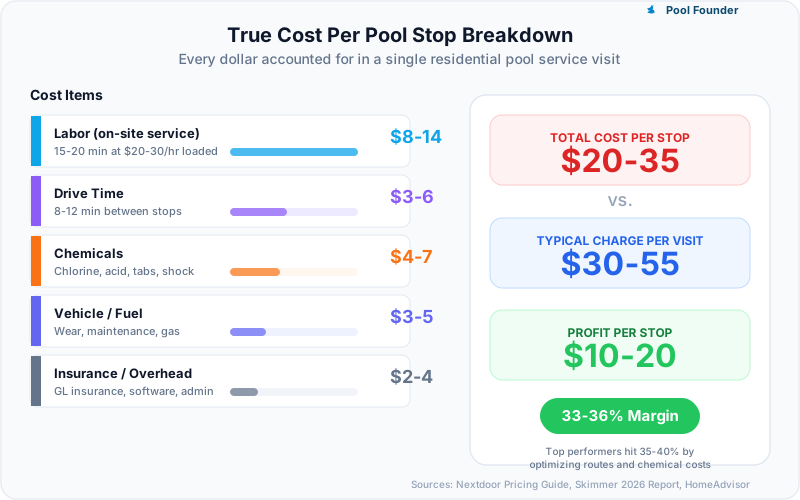
The true cost per pool stop equals (labor + drive time + chemicals + vehicle costs + overhead allocation) divided by daily stops completed, and for the average residential pool company in 2026, that total falls between $20 and $35 per stop depending on route density, chemical costs, and labor rates. Most operators only account for chemicals and on-site labor time, missing $6-12 per stop in hidden costs that silently destroy margins.
Start with the formula, then track actuals for 30 days to find your real number. Broad estimates are useful for benchmarking, but your specific route geography, chemical supplier pricing, and technician efficiency create a unique cost profile. Two companies in the same zip code can have cost-per-stop differences of $10+ based on route optimization alone.
What Are the Hidden Costs Most Pool Companies Miss?
Drive time between stops costs $3-6 per pool at average technician wages, represents 20-30% of total daily labor cost, and is the single largest "invisible" expense that pool companies fail to include in per-stop calculations. A technician earning $20/hour who spends 10 minutes driving between stops burns $3.33 in labor alone before adding $1.50-2.50 in fuel and vehicle wear per transit.
| Cost Item | Range Per Stop | Annual Impact (80 pools/wk) | Often Tracked? |
|---|---|---|---|
| On-site labor (15-20 min) | $8-14 | $33,280-58,240 | Yes |
| Drive time (8-12 min between stops) | $3-6 | $12,480-24,960 | Rarely |
| Chemicals (chlorine, acid, tabs) | $4-7 | $16,640-29,120 | Sometimes |
| Vehicle fuel + wear | $3-5 | $12,480-20,800 | Rarely |
| Insurance allocation (GL per stop) | $1-2 | $4,160-8,320 | Almost never |
| Software, admin, scheduling | $0.50-1 | $2,080-4,160 | Almost never |
| Callbacks/rework (5-8% rate) | $0.50-2 | $2,080-8,320 | Rarely |
| TOTAL COST PER STOP | $20-35 | $83,200-145,600 |
Callbacks deserve specific attention. Industry data suggests a 5-8% callback rate for pool service companies, meaning roughly 4-6 out of every 80 weekly stops require a return visit for missed issues, customer complaints, or water chemistry corrections. Each callback costs the full labor and drive time of a regular stop but generates zero additional revenue. At an average callback cost of $25-35, a company running 80 pools per week loses $5,200-10,920 annually to rework alone.
Track your actual cost per stop for one full month. Record time on-site, drive time between each stop, chemicals used per pool, and any callbacks. Most owners who do this exercise for the first time discover their true cost per stop is $5-10 higher than they estimated.
What Profit Margin Should a Pool Service Company Target?
A healthy pool service company should target 15-25% net profit margin on maintenance routes according to BusinessDojo and ServiceTitan research, top-performing solo operators consistently achieve 30-40% by optimizing route density and chemical purchasing, while companies below 10% are typically one major equipment failure or customer loss away from unprofitability. The Skimmer 2026 State of Pool Service Report confirms service gross profits in the 15-40% range, with repair margins reaching 30-60%.
15-25%
Target net profit margin for pool service maintenance routes
Source: BusinessDojo, Skimmer 2026 State of Pool Service Report
30-40%
Net profit margin achieved by top-performing solo pool service operators
Source: ServiceTitan, BusinessDojo
The gap between average and top performers comes down to three factors. First, route density: companies running 18-22 pools per day in tight geographic zones spend 40-50% less on drive time than companies averaging 12-15 pools per day across spread-out routes. Second, chemical purchasing: buying in bulk from distributors versus retail markup saves $1-3 per pool per visit. Third, callback reduction: companies using digital service verification with photos and chemical readings cut callback rates from 8% to under 3%.
If your net margin is below 15%, do not add more pools. Adding volume to an unprofitable per-stop model simply scales losses. Fix your cost structure and pricing first. Raise prices on underpriced accounts, tighten routes geographically, and eliminate unprofitable outlier pools before pursuing growth.
When Should You Raise Your Pool Service Prices?
Pool service companies should raise prices at least once per year to keep pace with 3-5% annual increases in labor, fuel, and chemical costs, yet industry surveys show that 45% of independent operators go two or more years without a price increase and 20% have not raised rates in three-plus years. Every year you skip a price increase, your real margin shrinks by 3-5 percentage points while your workload stays the same or grows.
The best time to implement annual increases is 60-90 days before your busy season begins. For year-round markets, January or February works well because customers are less likely to switch providers right before peak season. For seasonal markets, send price increase notices in early spring, 30-60 days before the first scheduled service. Avoid raising prices mid-season or immediately after a service issue, as both create negative associations.
How Much Should You Raise Prices Each Year?
Annual price increases of 3-8% are sustainable for most pool service markets, align with cumulative inflation on labor and materials, and produce less than 5% customer churn when communicated properly with 30-60 days advance notice. BLS Consumer Price Index data shows services inflation of approximately 4% year-over-year, while the Skimmer 2026 State of Pool Service Report found most pool companies planning increases under 10% for 2026.
| Increase Amount | Dollar Impact ($150/mo base) | Expected Churn | When Appropriate |
|---|---|---|---|
| 3-5% | $4.50-7.50/mo | 1-3% | Standard annual adjustment, stable costs |
| 5-8% | $7.50-12/mo | 3-5% | Rising input costs, below-market rates |
| 8-12% | $12-18/mo | 5-10% | Significantly underpriced, added value/services |
| 12-20% | $18-30/mo | 10-20% | Major market correction, only with added value |
| 20%+ | $30+/mo | 15-30% | Not recommended in a single increase; phase over 2 years |
If you discover you are significantly underpriced (more than 15% below market), do not try to correct the gap in a single increase. Phase it over two increases, 6-12 months apart. A customer who might accept $12/month this spring and another $10 in the fall will often cancel rather than absorb a $22 single increase. The phased approach retains 85-90% of customers versus 70-80% for a single large jump.
Run the math before worrying about churn. If you raise prices 8% and lose 5% of customers, your revenue still increases by about 3%. But your costs dropped by 5% (fewer pools to service), so your profit increases by roughly 8%. Losing unprofitable or price-sensitive customers while raising margins on remaining accounts is a net positive.
How Do You Communicate a Price Increase Without Losing Customers?
Price increase communication that leads with value justification, provides 30-60 days written notice, and includes a specific effective date retains 90-95% of customers, while companies that surprise customers or fail to explain the reason lose 2-3x more accounts. The key is framing the increase as necessary and reasonable, not apologetic.
Use this template structure for your price increase letter or email. Lead with appreciation: "Thank you for being a valued customer for [X years]." State the facts: "Due to increases in chemical costs (up 12% this year), fuel, and labor, we are adjusting our service rates." Be specific: "Your new monthly rate will be $[amount], effective [date, 30-60 days out]." Add value: "We have also added [specific improvement: digital service reports, chemical tracking, priority scheduling] to your service." Close with contact info: "If you have any questions, please call me directly at [number]."
Never apologize for raising prices. Phrases like "unfortunately we have to" or "we regret" signal that you feel guilty, which makes customers more likely to push back. State the increase as a business fact, justify it with real cost data, and move on. Industry benchmarks from Recurly show annual customer churn rates of 4-6.5% for service businesses, and companies that communicate price increases proactively see significantly lower attrition than those that surprise customers.
90-95%
Customer retention rate when price increases include 30-60 day notice and value justification
Source: Recurly churn benchmarks, Bain & Company retention research
How Do You Price Add-On Services for Maximum Revenue?
Add-on services like filter deep cleans, acid washes, and green-to-clean recoveries can boost customer lifetime value by 20-40% annually according to Harvard Business Review research on upselling effectiveness, carry profit margins of 50-70% (nearly double standard maintenance margins), and represent the fastest path to increasing revenue without adding a single new customer to your route. The average pool service customer spends $0 on add-ons because they were never offered any.
The critical mistake most pool companies make is treating add-ons as reactive services. They wait for a customer to call about a green pool or a broken filter instead of proactively recommending seasonal services during routine visits. A technician who recommends a quarterly filter deep clean during a regular stop converts at 30-40%, generating $75-150 in additional revenue per customer per quarter with 15-20 minutes of added labor.
What Are the Most Profitable Pool Service Add-Ons?
Filter deep cleaning is the highest-volume add-on at $75-150 per service with 60-70% profit margins, followed by green-to-clean recovery at $250-450 per job with 55-65% margins, because both leverage existing chemical knowledge and equipment with minimal additional capital investment. Here is a complete breakdown of the most common add-on services ranked by profit margin.
| Service | Price Range | Time Required | Profit Margin | Frequency |
|---|---|---|---|---|
| Filter Deep Clean (cartridge) | $75-125 | 20-30 min | 60-70% | Quarterly |
| DE Filter Service (teardown) | $125-200 | 45-60 min | 55-65% | Semi-annual |
| Acid Wash | $300-700 | 3-5 hours | 50-60% | Every 3-5 years |
| Green-to-Clean Recovery | $200-500 | 2-4 hours + follow-up | 55-65% | As needed |
| Salt Cell Cleaning | $75-125 | 20-30 min | 65-75% | Quarterly |
| Tile/Waterline Cleaning | $200-400 | 2-4 hours | 55-65% | Annual |
| Equipment Diagnosis/Minor Repair | $85-150/hr | 30-90 min | 45-55% | As needed |
| Seasonal Opening (winterized pools) | $250-400 | 60-90 min | 55-65% | Annual |
| Seasonal Closing/Winterization | $250-500 | 60-90 min | 55-65% | Annual |
Salt cell cleaning stands out as the highest-margin, lowest-effort add-on. It takes 20-30 minutes, requires only muriatic acid and water, and 85% of that price is pure labor margin. With saltwater pools representing 25-30% of the residential market, a company with 25 saltwater pool customers doing quarterly cell cleans generates $7,500-12,500 in additional annual revenue at 65-75% margin.
How Should You Bundle Add-On Services?
Service bundles increase add-on attach rates from 15-20% (when offered individually) to 35-50% (when bundled at a perceived discount), generate $300-600 in additional annual revenue per customer, and reduce the selling effort from multiple conversations to a single seasonal offer. Bundle pricing should offer a 10-15% discount versus a la carte pricing to create urgency without destroying margins.
Three bundles work consistently well across markets. The "Spring Startup" bundle ($200-350) includes filter deep clean, salt cell clean (if applicable), full equipment inspection, and a chemical rebalance. The "Mid-Season Refresh" bundle ($150-250) includes tile/waterline cleaning, filter rinse, and equipment check. The "Winterization" bundle ($200-350) for seasonal markets includes closing service, cover installation, and chemical treatment. Offer these proactively to your entire customer base via email or text 30 days before the relevant season.
If you use tiered pricing, build the most popular add-ons directly into your Premium tier. Quarterly filter cleans, salt cell service, and equipment inspections bundled into a $229-299/month tier often cost the customer less than purchasing separately, while guaranteeing you a higher monthly rate and better retention.
How Can Software Help You Price Pool Services More Accurately?
Manual pricing based on gut instinct leads to systematic undercharging because owners do not track true cost per stop, cannot measure drive time between pools, and have no visibility into per-customer chemical consumption patterns that vary by 40-60% between easy and difficult pools. Pool service software closes this data gap by automatically recording service duration, chemical usage, and route efficiency at every stop.
When you can see that Pool #47 consistently takes 28 minutes (versus your 18-minute average), requires 40% more chemicals than the route average, and generates a callback every six weeks, you have the data to either reprice that account or drop it. Conversely, when you see that a cluster of 12 pools in one subdivision averages just 14 minutes per stop with minimal chemical use, you know that adding five more pools in that neighborhood is pure profit at current rates.
Pool Founder tracks chemical usage per pool, logs service time from clock-in to clock-out at each stop, calculates drive time between route stops, and generates per-customer profitability data that makes pricing decisions data-driven instead of guess-driven. Route optimization alone can reduce daily drive time by 20-35%, which directly reduces your cost per stop by $1.50-3.00 and converts wasted windshield time into additional billable stops.
The most expensive pricing mistake is not knowing your numbers. If you cannot answer "what is my average cost per pool stop?" within $2, you are pricing blind. Software that tracks service time, chemical use, and drive time per stop gives you that answer and updates it automatically every week.
Ready to streamline your pool service business?
Pool Founder gives you route optimization, automated invoicing, chemical tracking, and everything else you need to run a more profitable pool business.
Frequently Asked Questions
How much does pool service cost per month in 2026?
Full-service residential pool maintenance costs $100-175 per month nationally in 2026 according to HomeAdvisor and HomeGuide. Rates vary significantly by region: Sun Belt year-round markets average $100-150/month, California coastal areas average $175-230/month (Cabana 2025 Pricing Study reports a $195 statewide average), and seasonal Northeast markets average $150-225/month. Factors that push pricing higher include large pool volume, saltwater systems, pool/spa combos, and premium service tiers that include filter maintenance and equipment checks.
What is the average profit margin for a pool service company?
The average pool service company operates at 15-25% net profit margin on maintenance routes according to BusinessDojo, with the Skimmer 2026 State of Pool Service Report reporting service gross profits of 15-40%. Top-performing solo operators achieve 30-40% net margins by optimizing route density, purchasing chemicals in bulk, reducing callbacks through digital service verification, and using tiered pricing that captures 20-35% more revenue per customer. Companies below 10% net margin should focus on repricing and cost reduction before adding volume.
Should I charge monthly or per visit for pool cleaning?
Monthly billing is superior for recurring pool service in almost every scenario. Monthly pricing produces predictable cash flow, higher customer retention rates, and makes your business more valuable for future sale or lending purposes. Reserve per-visit pricing for one-time services (green-to-clean at $200-500 per HomeGuide, acid wash at $300-700, seasonal opening at $250-400) and initial customer acquisition in markets where monthly commitments face strong resistance. Consider tiered monthly pricing (Basic/Standard/Premium) to capture 20-35% more average revenue per customer.
How much should I charge for a green pool cleanup?
Green-to-clean pool recovery typically costs $200-500 for residential pools according to HomeGuide, depending on severity, pool size, and required chemical treatment. Light green (visible bottom) runs $200-300. Moderate green (cannot see bottom, no debris) runs $300-400. Severe green (black/swamp-like, heavy debris) runs $400-500+, with black algae cases potentially reaching $700-800. These prices should include the initial shock treatment, follow-up visits for chemical adjustment and vacuuming, and a final balance. Profit margins on green-to-clean work typically range from 55-65% because chemical cost is proportionally lower than the labor premium you charge.
When is the best time to raise pool service prices?
The best time to raise prices is 60-90 days before your peak season begins. For year-round markets, January or February is ideal. For seasonal markets, send notices in early spring before the first scheduled service. Provide 30-60 days written notice, justify the increase with specific cost data (chemical prices up X%, fuel up Y%), and add a value component like digital service reports or improved scheduling. Annual increases of 3-8% produce less than 5% customer churn when communicated properly.
How do I price commercial pool service accounts?
Commercial pool service (HOA, hotel, apartment, fitness center) should be priced based on labor hours per week, not by comparison to residential rates. Calculate the total weekly hours required (including drive time), multiply by your fully-loaded labor rate ($45-65/hour including overhead), add chemical costs at actual usage, and apply a 25-35% margin. Pool Troopers reports commercial maintenance costs of $833-$1,667/month ($10,000-$20,000 annually), with smaller HOA pools starting around $500/month and large commercial facilities reaching $1,800+/month. Always carry appropriate commercial liability insurance and confirm health department compliance obligations before quoting.
What's the minimum I should charge per pool stop?
No pool stop should be priced below $30 for the simplest residential pool in the tightest route, and most operators should set a floor of $35-45 per visit ($140-180/month). This floor is based on the irreducible cost per stop: even a fast 12-minute service with minimal chemicals and short drive time still costs $18-25 in labor, fuel, chemicals, and overhead. Below $30, you are losing money on every visit when all costs are accurately counted. If market conditions seem to demand lower pricing, the issue is route density or market selection, not your pricing.
How do I compete on price without a race to the bottom?
Competing on price is almost always a losing strategy in pool service because margins are already thin and the lowest-price provider is typically the first to fail. Instead, compete on value: digital service reports with photos (customers pay 10-15% more for transparency), guaranteed same-day service windows (not "we will be there sometime this week"), proactive chemical monitoring that prevents problems, and responsive communication through text or app updates. Companies that differentiate on service quality and communication routinely charge 15-25% above market rate with higher retention than discount competitors. The customers who choose providers solely on price are also the fastest to cancel and most likely to generate complaints.
Sources & References
- Angi Pool Maintenance Cost Guide
- HomeGuide Pool Cleaning Service Cost Guide
- Cabana 2025 Pool Service Pricing Study
- Skimmer 2025 State of Pool Service Report
- Pool Troopers Commercial Pool Maintenance Cost
- BusinessDojo Pool Service Market & Pricing Data
- BLS Consumer Price Index
- Recurly Churn Rate Benchmarks
- Bain & Company Customer Retention Research
- Nextdoor Pool Service Pricing Guide