Why Is 2026 One of the Best Years to Start a Pool Service Business?
The U.S. residential pool base has reached 10.4 million units, the $8.8 billion pool service industry is growing at 4.2% CAGR, and 80% of pool professionals reported revenue growth in the Skimmer 2026 State of Pool Service Report. These three tailwinds converge to make 2026 one of the most favorable entry points for new pool service operators in the past decade, particularly as homeowners increasingly prefer professional maintenance over DIY care.
Starting a pool service business requires less capital than almost any other home-service trade, demands no college degree or expensive certifications in most states, and offers a clear path from solo operator earning $50,000-$85,000 net to multi-crew business owner within three to five years. The barrier to entry is low, but the barrier to doing it well, building efficient routes, pricing correctly, and retaining customers, separates the 50% of businesses that fail in five years from those that build lasting, sellable companies. If you are considering starting part-time, our side hustle to full-time guide maps the transition.
This guide covers every step from initial investment to your first 50 customers, using 2026 data from IBISWorld, HomeGuide, the Skimmer State of Pool Service Report, BLS, and PHTA. All cost figures reflect residential pool service unless otherwise noted.
How Much Does It Cost to Start a Pool Service Business?
A lean pool service startup costs $2,000-$10,000 using used equipment and a personal vehicle, a typical setup runs $10,000-$25,000 with new tools and a dedicated truck, and a well-equipped launch with branding and backup gear reaches $25,000-$50,000. These ranges make pool service one of the lowest-barrier home-service businesses to launch, with most successful operators starting in the $10,000-$15,000 range according to HomeGuide and BusinessDojo startup cost data.
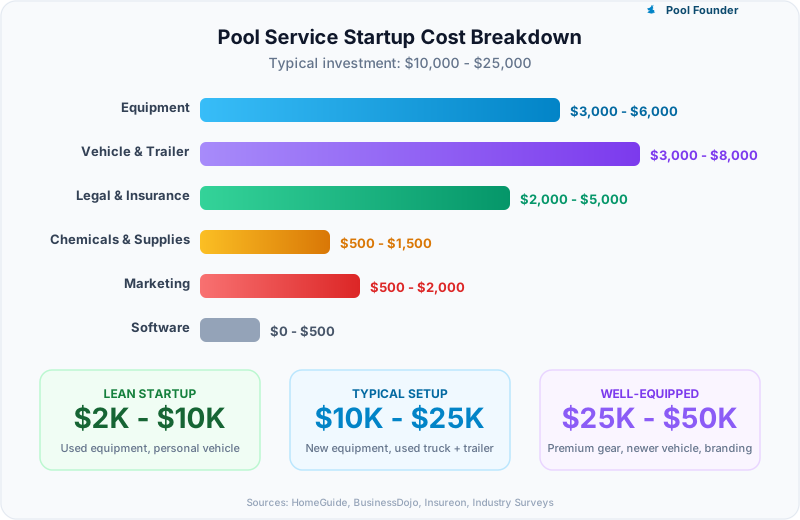
$10K-$25K
Typical startup cost for a new pool service business
Source: HomeGuide, BusinessDojo, Industry Surveys
What Equipment Do You Need to Start?
Pool service equipment costs $3,000-$6,000 for a complete professional kit, with the test kit, pole and attachments, and chemical inventory representing the three largest line items that directly affect service quality and speed at every stop. Our equipment startup checklist covers every item you need.
| Equipment | Cost Range | Notes |
|---|---|---|
| Telescopic pole (16 ft) | $80-$150 | Get a high-quality one; you use it at every stop |
| Skimmer net, brush, vacuum head | $60-$120 | Attachments for your telescopic pole |
| Leaf rake (deep bag) | $30-$50 | Essential for fall and storm cleanups |
| Pool vacuum / leaf canister | $200-$400 | Pressure-side canister saves significant time |
| Test kit (Taylor K-2006) | $80-$120 | FAS-DPD test kit is the industry standard |
| Chemical startup inventory | $300-$600 | Chlorine, acid, stabilizer, algaecide, shock |
| Portable pump | $250-$500 | For draining and lowering water levels |
| Tool bag / organizer | $50-$100 | Keeps truck organized between stops |
| Safety gear (gloves, goggles) | $30-$60 | Chemical-rated gloves and splash goggles |
| Backup parts inventory | $200-$400 | O-rings, baskets, valves for common repairs |
Buy the best telescopic pole and test kit you can afford. These two items are used at every single stop and directly impact your service speed and accuracy. Cheap poles bend, cheap test kits give unreliable readings, and both cost you more in callbacks and reputation damage than the $50-100 premium for professional-grade versions.
What Vehicle Should You Use?
A used pickup truck ($5,000-$12,000) paired with a small utility trailer ($1,000-$2,500) is the most cost-effective vehicle setup for a startup, offering sufficient chemical storage, visible branding surface area, and the ability to haul larger equipment for repair jobs. Cargo vans work but limit your ability to carry oversized equipment and restrict chemical ventilation.
| Option | Cost | Pros | Cons |
|---|---|---|---|
| Used truck + trailer | $6,000-$14,500 | Versatile, great for branding, chemical ventilation | Trailer requires practice backing, parking in tight neighborhoods |
| Cargo van | $8,000-$18,000 | All-in-one, secure storage, professional look | Limited equipment capacity, poor chemical ventilation, higher fuel cost |
| SUV / personal vehicle | $0 (existing) | No upfront cost, lean startup | Unprofessional image, chemical spill risk, limited capacity |
What Legal Steps Are Required Before You Service Your First Pool?
Forming an LLC ($35-$500 depending on state), obtaining a business license ($50-$400), and securing general liability insurance ($800-$2,000/year) are the three non-negotiable legal requirements before servicing your first pool. Skipping any of these exposes you to personal financial liability, regulatory fines, and uninsurable losses that can end your business with a single incident.
Should You Form an LLC or Sole Proprietorship?
An LLC costs $35-$500 to form depending on the state, provides personal liability protection that keeps a lawsuit from reaching your home and savings, and is strongly recommended over a sole proprietorship for any business that involves working on other people's property with chemicals. The LLC filing fee is a one-time cost that provides the single most important legal protection available to a small business owner.
| Factor | LLC | Sole Proprietorship |
|---|---|---|
| Personal liability protection | Yes, separates personal and business assets | None, personal assets at risk |
| Formation cost | $35-$500 (varies by state) | $0 (automatic when you start operating) |
| Annual maintenance | $0-$800/year (state filing fees) | None |
| Tax flexibility | Can elect S-Corp taxation at higher income | Self-employment tax on all profit |
| Professional credibility | Stronger for commercial accounts and insurance | Adequate for residential only |
What Licenses and Certifications Do You Need?
Licensing requirements vary dramatically by state, with Florida requiring a Certified Pool/Spa Contractor license for any repair work, California requiring a C-61/D-35 contractor license for work over $500, and Texas requiring no state license for basic pool maintenance. Checking your specific state and county requirements before day one prevents costly fines and work stoppages.
| State | License Required | Certification | Typical Cost |
|---|---|---|---|
| Florida | CPC license for repairs; maintenance exempt | CPO recommended | $200-$500 |
| California | C-61/D-35 for work over $500 | CPO recommended | $300-$600 |
| Texas | No state license for maintenance | CPO recommended | $50-$150 (local permits) |
| Arizona | ROC license for repairs over $1,000 | CPO recommended | $200-$400 |
| Georgia | No state license for maintenance | CPO recommended | $75-$200 (local permits) |
| Nevada | Business license required | CPO recommended | $100-$300 |
The Certified Pool Operator (CPO) certification from PHTA costs $300-$400 and takes two days. While not legally required in most states for basic maintenance, it significantly improves your credibility, insurance rates, and ability to win commercial accounts. It pays for itself within the first month of operation.
What Insurance Do You Need on Day One?
General liability insurance ($800-$2,000/year) and commercial auto insurance ($1,200-$2,400/year) are the two mandatory policies for a pool service startup, with total first-year insurance costs running $2,000-$4,800 depending on coverage limits and driving record. Operating without these policies is a business-ending risk that no responsible operator should take.
| Policy | Annual Cost | What It Covers |
|---|---|---|
| General liability | $800-$2,000 | Property damage, bodily injury at customer homes |
| Commercial auto | $1,200-$2,400 | Vehicle accidents while on the job |
| Workers comp (when you hire) | $1,500-$3,000 | Employee injuries, required in most states |
| Inland marine (optional) | $200-$500 | Tools and equipment in transit |
How Much Can You Earn Running a Pool Service Business?
A solo pool service operator typically nets $50,000-$85,000 in the first full year of operation, with gross revenue of $57,000-$130,000 depending on pool count and market rates according to industry benchmarks from the Skimmer 2026 Report and SpringBoard Pool Routes data. The wide range reflects the massive impact that route density, pricing discipline, and market selection have on take-home pay.
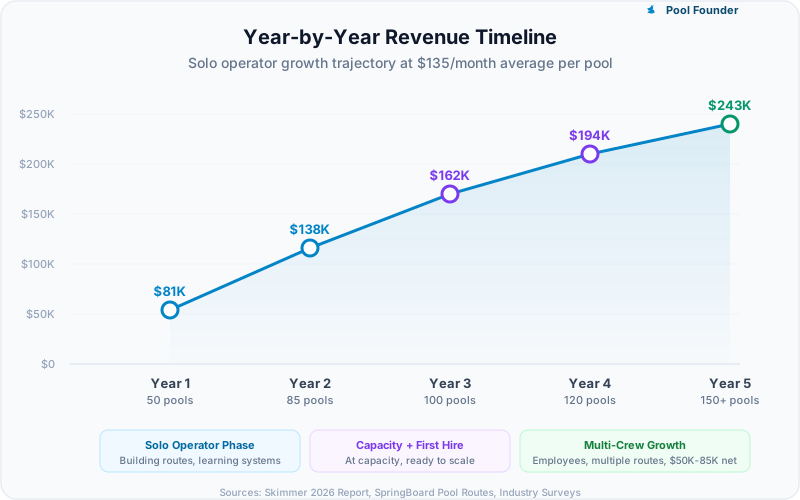
What Does a Realistic Year-by-Year Revenue Timeline Look Like?
Year 1 gross revenue of $57,000-$86,000 from 40-60 recurring pools at $100-$150/month average is a realistic benchmark, scaling to $113,000-$162,000 by Year 2 with 70-100 pools, and reaching solo operator capacity of $130,000-$194,000 by Year 3 with 80-120 pools. These figures assume year-round service markets; seasonal operators should discount by 30-40%.
| Year | Pool Count | Gross Revenue | Net Income (Est.) | Milestone |
|---|---|---|---|---|
| Year 1 | 40-60 | $57K-$86K | $35K-$55K | Building routes, learning systems |
| Year 2 | 70-100 | $113K-$162K | $55K-$85K | Approaching solo capacity |
| Year 3 | 80-120 | $130K-$194K | $60K-$95K | At capacity or first hire |
| Year 4 | 100-150 | $162K-$243K | $50K-$85K | First employee, margins dip temporarily |
| Year 5 | 150-200+ | $243K-$324K | $70K-$120K | Two routes, owner steps off truck |
Year 4 net income often drops temporarily when you hire your first employee. The labor cost, workers comp, vehicle, and training expenses hit before the new revenue from expanded capacity fully kicks in. This is normal. Plan for 2-3 months of tighter margins during the transition.
What Profit Margins Should You Expect?
Solo operators running tight routes typically achieve 20-40% net margins, small teams with 1-3 employees operate at 10-20% net, and the overall industry average hovers around 5% because it includes poorly managed and heavily leveraged operations. Your margin depends more on route density and pricing discipline than on volume.
| Business Stage | Net Margin | Key Driver |
|---|---|---|
| Solo operator (tight routes) | 20-40% | Low overhead, no labor cost, dense routes |
| Small team (1-3 employees) | 10-20% | Labor is 35-50% of revenue |
| Larger operation (4-10+) | 5-15% | Office staff, vehicles, insurance scale up |
| Industry average (all sizes) | ~5% | Includes underperformers and over-leveraged ops |
How Much Is a Pool Route Worth If You Sell?
Pool routes sell for 6-12x monthly recurring revenue, making a 100-pool route billing $135/month worth $81,000-$162,000 as a sellable asset according to SpringBoard Pool Routes and industry broker data. This valuation multiple is one of the strongest wealth-building aspects of pool service, turning every new customer into both monthly cash flow and long-term equity.
6-12x Monthly Revenue
Pool route sale multiple (100 pools at $135/mo = $81K-$162K)
Source: SpringBoard Pool Routes, Route Brokers
How Do You Get Your First 50 Customers?
Door hangers in pool-dense neighborhoods cost $15-$30 per acquired customer, Nextdoor posts generate free local leads within the first week, and Google Local Service Ads produce steady $25-$75 leads once your profile is verified. These three channels, combined with a $25-$50 referral credit, are enough to reach 50 recurring customers within 4-6 months for most new operators. Our guide on getting your first 10 customers covers the fastest methods in detail.
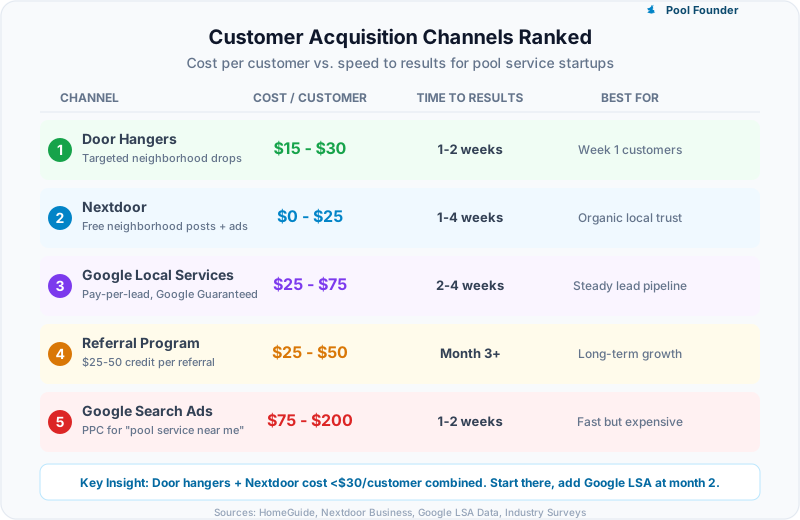
What Are the Fastest Customer Acquisition Channels?
Door hangers distributed in neighborhoods with visible pools convert at 1-3% and deliver customers within days, Nextdoor business posts reach thousands of homeowners for free, and Google Local Service Ads place your business at the top of search results for $25-$75 per lead. The fastest path to 50 customers uses all three simultaneously in the first 30 days.
| Channel | Cost per Customer | Time to First Lead | Best For |
|---|---|---|---|
| Door hangers (targeted) | $15-$30 | 1-7 days | Immediate first customers |
| Nextdoor posts | $0 (organic) | 1-14 days | Free local credibility |
| Google Local Service Ads | $25-$75 | 2-4 weeks (after verification) | Consistent lead pipeline |
| Referral program ($25-$50 credit) | $25-$50 | Month 2+ (need existing base) | Highest-quality leads, lowest churn |
| Google Search Ads (PPC) | $75-$200 | 1-3 days | Fast but expensive; scale later |
| Facebook/Instagram ads | $50-$150 | 1-2 weeks | Brand awareness in specific zip codes |
How Long Does It Take to Build a Full Route?
Most new operators acquire 5-10 customers in weeks 1-4 through aggressive door-to-door marketing, reach 35-50 pools by month 6 as referrals and online leads compound, and hit solo operator capacity of 60-80 recurring pools by month 12. This timeline assumes active marketing effort every week, not passive waiting for phone calls.
| Timeline | Pool Count | Monthly Revenue | Key Activity |
|---|---|---|---|
| Weeks 1-4 | 5-10 | $675-$1,350 | Door hangers, Nextdoor, friends and family |
| Month 2-3 | 15-30 | $2,025-$4,050 | Google LSA live, first referrals coming in |
| Month 4-6 | 35-50 | $4,725-$6,750 | Referral program active, route density improving |
| Month 7-9 | 50-65 | $6,750-$8,775 | Organic Google ranking building |
| Month 10-12 | 60-80 | $8,100-$10,800 | Approaching solo capacity, considering first hire |
How Should You Price Your Pool Service From Day One?
New pool service operators should price at or slightly above the local market average ($100-$175/month for full-service residential), use tiered pricing (Basic/Standard/Premium) to capture 20-35% more revenue per customer, and never discount below their cost-per-stop floor of $30-$45 per visit. Pricing is the single highest-leverage decision in your business because every $10 per pool per month across 80 pools is $9,600 per year in pure profit.
$9,600/year
Additional profit from $10/month price increase across 80 pools
Source: Industry calculation
For a comprehensive breakdown of pricing models, regional benchmarks, and step-by-step cost-per-pool calculations, see our Pool Service Pricing Guide which covers everything from per-visit rate setting to annual price increase strategies.
What Is the Biggest Pricing Mistake New Pool Companies Make?
Underpricing to acquire customers quickly creates a customer base that resists all future price increases, traps you at unsustainable margins, and attracts the most price-sensitive customers who churn fastest. The pool owners who choose you at $80/month when your cost requires $120 will leave the moment someone offers $75, while the customers who value service quality at $140/month stay for years.
It is easier to lower a price than to raise one. Start at or above market rate. You can always offer a first-month discount to close hesitant prospects without permanently anchoring a low rate. The customers you attract at full price are better customers in every measurable dimension: lower churn, fewer complaints, more referrals, and higher willingness to add services.
What Does a Typical Day Look Like for a Pool Service Owner?
A solo pool service operator typically starts at 7:00-7:30 AM, services 15-22 pools per day with 12-20 minutes per stop, finishes the route by 3:00-4:00 PM, and spends 30-60 minutes on invoicing, scheduling, and customer communication in the evening. This schedule runs five days per week with one day reserved for repairs, estimates, and catch-up work.
| Time | Activity | Duration |
|---|---|---|
| 6:30 - 7:00 AM | Load truck, check chemical inventory, review route | 30 min |
| 7:00 - 7:15 AM | Drive to first stop | 15 min |
| 7:15 AM - 12:00 PM | Service pools (8-11 stops) | ~5 hours |
| 12:00 - 12:30 PM | Lunch, restock chemicals if needed | 30 min |
| 12:30 - 3:30 PM | Service pools (7-11 stops) | ~3 hours |
| 3:30 - 4:00 PM | Drive home, unload, organize truck | 30 min |
| Evening (30-60 min) | Invoicing, customer replies, scheduling | 30-60 min |
The physical reality: you will be outdoors in heat, cold, and rain. You will carry 50-pound buckets of chlorine. You will kneel on pool decks, reach into skimmer baskets with spiders, and occasionally deal with green pools that take three visits to clear. This is physical, outdoor work that rewards people who enjoy working with their hands and prefer varied days over desk jobs.
Route optimization software can save 45-90 minutes per day by reducing drive time between stops. That reclaimed time converts directly into 3-5 additional billable pools per week, worth $1,500-$3,000+ per month in additional revenue.
When Should You Hire Your First Employee?
The right time to hire your first pool technician is when you consistently service 80-100 pools per week, turn away new customer requests, and maintain stable margins above 20% for at least three consecutive months. Hiring too early burns cash on labor before revenue supports it; hiring too late caps your growth and leads to burnout that damages service quality.
For a detailed breakdown of technician salaries by state, interview questions, 30-day training programs, and retention strategies, see our guide on How to Hire & Train Pool Service Technicians.
How Do You Know You Are Ready to Scale?
Three signals indicate readiness to hire: you are turning down new customers or pushing start dates out more than two weeks, your weekly pool count exceeds 80 with no room to add stops, and your net margin has remained above 20% for at least three months. Meeting all three simultaneously means you have the demand, the capacity constraint, and the financial cushion to absorb hiring costs.
| Signal | Threshold | Why It Matters |
|---|---|---|
| Turning down work | 2+ new requests declined per week | Proves demand exceeds your capacity |
| Route saturation | 80+ pools, 5 full days | No room to add customers without sacrificing quality |
| Stable margins | 20%+ net for 3 consecutive months | Financial cushion absorbs training period costs |
| Cash reserves | $10,000-$15,000 in operating capital | Covers first 2-3 months of employee cost before new revenue |
What Software Do You Need to Run a Pool Service Business?
Pool service software that handles customer management, route optimization, invoicing, and chemical tracking costs $0-$200/month and replaces the paper-based, spreadsheet-driven operations that consume 5-10 hours per week in administrative overhead. The right software pays for itself within the first week by eliminating missed stops, automating invoices, and optimizing routes that reduce daily drive time by 20-35%. Our pool service software comparison ranks the 13 leading platforms, and there are dedicated breakdowns of pool service scheduling software and pool service invoicing software if one of those is your bottleneck.
| Feature | Why It Matters | Time Saved per Week |
|---|---|---|
| Route optimization | Reduces drive time 20-35%, adds 3-5 billable stops/week | 45-90 min/day |
| Automated invoicing | Bills go out on time, every time, with no manual entry | 2-4 hours/week |
| Chemical tracking | Digital logs for every stop, liability protection | 1-2 hours/week |
| Customer portal | Customers see service reports, reducing support calls 40-60% | 1-3 hours/week |
| GPS check-in/out | Proof of service, technician accountability, time tracking | Reduces callbacks 25-40% |
Pool Founder combines route optimization, CRM, invoicing, chemical logging, and customer communication in a single platform designed specifically for pool service operators. The mobile app works offline for technicians in the field, syncs automatically when connectivity returns, and integrates with QuickBooks for accounting. Starting with the right software from day one prevents the painful migration from spreadsheets that most operators face at the 40-60 pool mark.
The most expensive software is the one you do not use. Pick a platform before you service your first pool, enter every customer from day one, and build the habit of logging every service stop. Operators who start with paper and "plan to switch later" typically lose 20-30% of their service history in the transition.
Free starter kit
Start a pool service business with the numbers already run.
A short email series from an owner who started with $1,200 and a used truck. No software pitch, just the four things that decide whether year one works.
- Startup cost breakdownEvery line item from $2K bootstrap to fully equipped
- Pricing calculatorThe minimum you can charge per visit and still profit
- First-10-customers playbookDoor hangers, referrals, and the phone script that closes
- Licensing & insurance checklistWhat your state requires and which insurers pay claims
Already running routes? Try Pool Founder free
Frequently Asked Questions
How much does it cost to start a pool cleaning business?
A pool cleaning business can be started for as little as $2,000-$10,000 with used equipment and a personal vehicle. The typical startup invests $10,000-$25,000 for new professional equipment, a used truck with trailer, LLC formation, insurance, initial chemical inventory, and basic marketing materials. A well-equipped launch with branding, backup equipment, and a newer vehicle runs $25,000-$50,000. The largest cost categories are vehicle ($3,000-$14,500), equipment ($3,000-$6,000), and insurance ($2,000-$4,800/year).
How much do pool service business owners make?
Solo pool service operators typically net $50,000-$85,000 per year servicing 60-100 pools. First-year operators usually earn $35,000-$55,000 as they build their route. By Year 3, a solo operator at full capacity can gross $130,000-$194,000 with net margins of 20-40%. Business owners who scale to 2-3 routes with employees can earn $70,000-$120,000+ net while working fewer hours on the truck. Pool routes also build equity, with businesses selling for 6-12x monthly recurring revenue.
Do you need a license to clean pools?
Requirements vary by state. Basic pool maintenance (chemical testing, cleaning, skimming) does not require a state license in most states including Texas, Georgia, and Nevada. However, Florida requires a Certified Pool/Spa Contractor (CPC) license for any repair work, California requires a C-61/D-35 contractor license for jobs over $500, and Arizona requires an ROC license for repairs over $1,000. Most states require a general business license ($50-$400). The Certified Pool Operator (CPO) certification from PHTA ($300-$400) is recommended in all states for credibility and insurance benefits.
How many pools can one person service per day?
A solo operator can service 15-22 residential pools per day depending on route density, pool condition, and service scope. In dense suburban routes with pools close together, experienced technicians hit 20-22 pools at 12-15 minutes each. In spread-out rural areas, 12-16 pools per day is typical because drive time eats into service capacity. The industry average is 16-18 pools per day for a full-service weekly maintenance route. Route optimization software can add 2-4 stops per day by reducing drive time.
Is a pool service business profitable?
Pool service is one of the most profitable home-service businesses at the solo operator level, with net margins of 20-40% on maintenance routes. The recurring revenue model (customers pay monthly regardless of whether you visit once or four times) creates predictable cash flow that most project-based businesses cannot match. The Skimmer 2026 Report shows 80%+ of pool professionals experiencing revenue growth. The primary profitability risks are underpricing, poor route density (too much drive time), and scaling labor costs faster than revenue when hiring.
How long does it take to build a pool route?
Most new operators acquire 5-10 customers in the first month through door hangers and Nextdoor, reach 35-50 pools by month 6 as referrals and Google Local Service Ads compound, and hit solo capacity of 60-80 pools by month 10-12. Building to full capacity (80-100 pools) in under 12 months requires consistent weekly marketing effort, not just waiting for the phone to ring. Operators who buy an existing route ($40,000-$100,000 for 40-60 accounts) skip the building phase entirely.
What equipment do I need to start a pool cleaning business?
The essential equipment list includes: telescopic pole ($80-$150), skimmer net and brush attachments ($60-$120), leaf rake ($30-$50), pool vacuum or leaf canister ($200-$400), Taylor K-2006 test kit ($80-$120), chemical startup inventory ($300-$600), portable pump ($250-$500), tool organizer ($50-$100), and safety gear ($30-$60). Total equipment cost runs $3,000-$6,000 for a professional-grade kit. The two items worth investing in most are the telescopic pole and test kit, which are used at every single stop.
Can you start a pool business with no experience?
Yes, many successful pool service business owners started with no prior industry experience. The technical skills (water chemistry, equipment maintenance, cleaning procedures) can be learned in 2-4 weeks through a combination of CPO certification ($300-$400, 2 days), YouTube training videos, chemical manufacturer guides, and hands-on practice on 5-10 pools. The business skills (pricing, routing, customer service, invoicing) are equally important and often more transferable from other industries. Starting with maintenance-only service (no repairs) keeps the learning curve manageable while you build expertise.
Sources & References
- IBISWorld Swimming Pool Cleaning Industry Report
- Skimmer 2026 State of Pool Service Report
- Bureau of Labor Statistics Occupational Outlook
- HomeGuide Pool Service Cost Guide
- BusinessDojo Pool Service Startup Guide
- Insureon Small Business Insurance Cost
- Pool & Hot Tub Alliance (PHTA)
- ZenBusiness LLC Formation Guide
- RubyHome U.S. Pool Statistics
- SpringBoard Pool Route Valuation
- Angi Pool Maintenance Cost Guide