Trichlor Tablets Are the Most Convenient Way to Chlorinate a Pool. They Are Also the Biggest Source of CYA Problems on Your Route.
Trichlor tablets are 55% cyanuric acid by weight. Every tab you drop in a skimmer or feeder adds chlorine and CYA simultaneously, and while the chlorine gets consumed, the CYA stays behind. A pool starting the season at 30 ppm CYA can blow past the PHTA recommended maximum of 50 ppm in under five months on tabs alone. By end of season, that pool may need a partial drain costing your customer $50-150 in water and costing you 1-2 hours of unbillable truck time.
Corey Adams, Pool Founder co-founder and 15-year pool service veteran, ran an all-trichlor route for his first three years in business. "I was draining 15-20 pools every summer for high CYA. Once I understood the math, I switched most of my route to liquid chlorine and that number dropped to 3-4 drains a season. The tabs are not the enemy. Using them without a plan is." This guide covers the chemistry, the cost math, the route management strategy, and the customer conversation every pool service professional needs to have about trichlor.
This article builds on our comprehensive CYA guide. If you need a full breakdown of the FC/CYA ratio, the chlorine lock myth, and partial drain calculations, read our Cyanuric Acid Guide for Pool Service Professionals first.
How Much CYA Do Trichlor Tablets Actually Add?
Trichlor (trichloroisocyanuric acid) contains 90% available chlorine and 55% cyanuric acid by weight. Every pound of trichlor dissolved in 10,000 gallons of water adds approximately 6 ppm of CYA. A standard 3-inch tablet weighs 8 ounces, so each tablet adds roughly 3.2 ppm of CYA to a 10,000-gallon pool. For a typical 15,000-gallon residential pool, each tablet adds about 2.1 ppm of CYA.
How Fast Does CYA Accumulate on a Tabs-Only Pool?
A residential pool using 2 trichlor tablets per week will see CYA rise 3-4 ppm per month. At 3 or more tablets per week, that rate jumps to 5 ppm per month or higher. A pool that starts spring at 30 ppm CYA will cross the PHTA 50 ppm recommended maximum by mid-summer on a 2-tab regimen, and can exceed 80 ppm by end of season on a 3-tab regimen. Evaporation concentrates CYA further because the CYA stays behind as water leaves the pool.
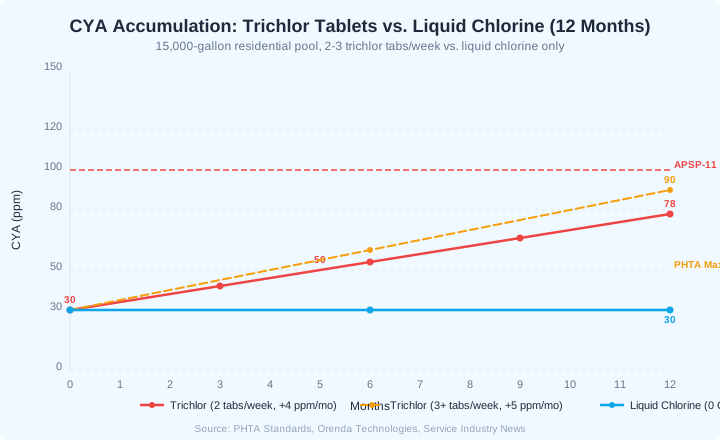
| Weekly Tab Count | CYA Rise/Month (15k gal) | Months to Hit 50 ppm | Months to Hit 80 ppm |
|---|---|---|---|
| 2 tabs | ~3-4 ppm | ~5-6 months | ~12+ months |
| 3 tabs | ~5 ppm | ~4 months | ~10 months |
| 4+ tabs | ~6-7 ppm | ~3 months | ~7-8 months |
These rates assume no water replacement from rain, splash-out, or backwash. In practice, water dilution from those sources slows the rise slightly, but not enough to prevent the problem over a full season.
The Hidden Cost of Trichlor: Drains, pH Correction, and Equipment Damage
Trichlor looks cheap at the point of purchase, but the downstream costs add up. High CYA forces partial drains. Trichlor has a pH of 2.8, roughly 10,000 times more acidic than plain water, so you need to add more sodium bicarbonate or soda ash to maintain alkalinity and pH. And when concentrated tablet water flows through equipment from a skimmer, it accelerates corrosion on heater elements, pump seals, and salt cells.
What Does a CYA-Related Partial Drain Actually Cost?
A partial drain on a 15,000-gallon pool at 80 ppm CYA targeting 40 ppm requires draining 7,500 gallons (50%). At average municipal water rates of $5-10 per 1,000 gallons, the water cost alone is $38-75. Add 1-2 hours of tech time, rebalancing chemicals after refill (alkalinity, pH, chlorine, CYA top-up), and the total cost to your business or customer runs $75-175 per drain. Multiply that across 15-20 pools per season and you are looking at $1,100-3,500 in drain-related costs annually.
How Does Trichlor Damage Pool Equipment?
Placing trichlor tablets directly in the skimmer basket creates a slug of highly acidic water (pH 2.8) that flows through the pump, filter, and heater every time the system cycles on. Over months, this eats away at copper heat exchangers, rubber gaskets, and O-rings. Proper use requires an inline chlorinator or floating feeder to meter the tablet dissolution, but many service companies skip this step for convenience.
| Hidden Cost | Per Occurrence | Annual (20-drain route) |
|---|---|---|
| Partial drain (water + labor) | $75-175 | $1,500-3,500 |
| pH/alkalinity correction chemicals | $3-8/pool/month | $360-960 |
| Heater/equipment repairs (accelerated) | $200-800/repair | Varies |
| Shock cost at high CYA (40% of CYA) | 2-3x normal cost | Varies |
"The biggest hidden cost is shocking," Corey says. "At 80 ppm CYA you need to hit 31 ppm free chlorine for breakpoint. That is three times the chlorine you would need at 30 ppm CYA. You are burning through product just to overcome the stabilizer you added with the tabs."
Trichlor vs. Liquid Chlorine: The Real Cost Comparison
On a per-pound-of-available-chlorine basis, trichlor and liquid chlorine are closer in cost than most people think. The real difference is in total cost of ownership, which includes the pH correction, drain costs, and equipment wear that trichlor creates. Liquid chlorine adds zero CYA, has a high pH of ~13 (which offsets acid additions), and does not accelerate equipment corrosion.
How Do Trichlor and Liquid Chlorine Compare on Price Per Pound of Available Chlorine?
A 50-pound bucket of trichlor tabs averages $150-220 in 2025-2026, depending on region and supplier. That is $3.00-4.40 per pound of product, but trichlor is 90% available chlorine, so the cost per pound of actual chlorine is $3.33-4.89. Liquid chlorine (12.5% sodium hypochlorite) runs $3.50-5.50 per gallon depending on location, delivering about 1.1 pounds of available chlorine per gallon, or $3.18-5.00 per pound of actual chlorine. The raw chlorine cost is nearly identical.
| Factor | Trichlor Tablets | Liquid Chlorine (12.5%) |
|---|---|---|
| Cost per lb available Cl | $3.33-4.89 | $3.18-5.00 |
| CYA added | 6 ppm per lb/10k gal | 0 ppm |
| pH effect | 2.8 (very acidic) | ~13 (basic) |
| Acid/base correction needed | Soda ash or bicarb | Muriatic acid |
| Annual drain costs | $1,500-3,500 | $0 |
| Shelf life | 5+ years (dry) | ~6 months (degrades) |
| Truck logistics | Light, compact | Heavy, 2x4 cases or drums |
When Is Trichlor Actually the Right Choice?
Trichlor is not universally bad. It is the right tool in specific situations: pools that need a CYA boost at season start (tabs build CYA while chlorinating), vacation holds where no one is available to add liquid weekly, inline chlorinators on timers for pools visited less frequently, and areas where liquid chlorine supply is unreliable. The key is using tabs intentionally, not as the default for every pool on your route year-round.
The true cost advantage of liquid chlorine is not at the product level. It is the $1,500-3,500 per year in avoided drains, the reduced acid spend, and the lower equipment repair bills. Factor those in and liquid wins on total cost of ownership for most routes.
How to Manage CYA Across Your Entire Route
Managing CYA on a pool-by-pool basis is reactive. Managing it across your entire route is a system. The goal is knowing the CYA status of every pool at all times so you can make proactive chlorine source decisions instead of scrambling when a pool turns green or a customer asks why they need a drain.
What Is the Best CYA Testing Schedule for a Service Route?
Test CYA monthly on every pool that uses trichlor or dichlor. Test quarterly on pools using liquid chlorine or salt water generators since their CYA should remain stable. Always test at season start, after any water additions or drains, and when you take over a new pool. Use a turbidity-based test (like the Taylor K-1766 slide comparator) rather than test strips for accuracy above 50 ppm.
How Do You Decide Which Pools Get Tabs vs. Liquid?
- Pools under 30 ppm CYA at season start: use trichlor tabs until CYA reaches 40-50 ppm, then switch to liquid chlorine for the rest of the season.
- Pools already at 40-50 ppm CYA: liquid chlorine only. No tabs.
- Pools above 50 ppm CYA: liquid chlorine only and schedule a partial drain when convenient.
- Salt water pools: liquid chlorine supplementation only when SWG cannot keep up. Never tabs.
- Vacation holds or infrequent visits: trichlor in a floating feeder with a cap set to slow dissolution, but retest CYA after the hold period ends.
How Do You Track CYA Trends Across 50-100+ Pools?
Spreadsheets break down past about 30 pools. You need service software that logs CYA as part of every chemical reading and flags when a pool crosses a threshold. That way you catch the trend at 50 ppm instead of discovering it at 90 ppm when the customer calls about a green pool.
Pool Founder logs CYA with every chemical reading and flags pools that cross 50 ppm in the service report. You and the customer both see the trend before it becomes a problem. That visibility is the difference between a proactive drain conversation and an emergency algae call.
Supply Chain Reality: Trichlor Availability and Price Volatility
Trichlor supply has been volatile since the 2020 BioLab facility fire in Westlake, Louisiana, which knocked one of the largest U.S. trichlor manufacturers offline for over two years. The plant rebuilt at a cost of $250 million and reopened in late 2022, but a second BioLab incident in September 2024 at a Georgia facility added fresh uncertainty. Pool service companies that depend entirely on trichlor tablets are exposed to supply disruptions that liquid chlorine routes largely avoid.
How Have Trichlor Prices Changed Since 2020?
Before the 2020 fire, a 50-pound bucket of trichlor cost $70-80, roughly $1.40-1.60 per pound. By 2022, that same bucket hit $200-250 in many markets. Prices have moderated since then, with 2025-2026 averages settling around $150-220 depending on region. Southwest markets tend to see the lowest prices (as low as $145/bucket reported), while coastal and Northeast markets remain higher. Liquid chlorine prices have been comparatively stable.
| Period | 50-lb Trichlor Bucket | Price/lb | Supply Status |
|---|---|---|---|
| Pre-2020 | $70-80 | $1.40-1.60 | Stable |
| 2021-2022 (shortage) | $200-250 | $4.00-5.00 | Severe shortage |
| 2023-2024 | $145-200 | $2.90-4.00 | Improving |
| 2025-2026 | $150-220 | $3.00-4.40 | Pockets of tightness |
Building your route around a single chlorine source is a business risk. Companies that can flex between trichlor and liquid chlorine based on price and availability have more margin stability than companies locked into one product.
How to Talk to Customers About the Trichlor CYA Problem
Most pool owners have never heard of cyanuric acid. They know chlorine and pH, maybe alkalinity. When you tell them their pool needs a $75-150 partial drain because of a chemical they have never heard of, the conversation can go sideways fast. The key is framing CYA in terms they already understand: "Your chlorine is not working as hard as it should, and here is why."
What Is the Best Way to Explain CYA to a Homeowner?
Corey uses a simple analogy: "I tell customers that CYA is like sunscreen for chlorine. A little bit protects the chlorine from burning off in the sun. But if you keep piling on sunscreen, eventually it blocks the chlorine from doing its job. The chlorine tabs we use add a little bit of sunscreen every week, and over time it builds up. The only way to reduce it is to replace some of the water." That explanation takes 30 seconds and gets a nod almost every time.
How Do You Justify the Cost of a Partial Drain?
- 1Show them the CYA test result compared to the recommended range (30-50 ppm). Visual evidence is persuasive.
- 2Explain that high CYA means their chlorine is not killing bacteria effectively, which is a health issue.
- 3Point out that they are spending more on chlorine than necessary because high CYA forces higher dosing.
- 4Frame the drain as preventive maintenance, not a failure: "This is normal maintenance that keeps your water healthy and your chlorine costs down."
- 5Offer to switch to liquid chlorine after the drain to prevent the problem from recurring.
How Do You Handle the "My Last Pool Guy Never Did This" Objection?
"That is actually why you are seeing this problem," Corey responds. "Most pool companies use tabs exclusively because they are convenient. They never test CYA, so it climbs for years without anyone noticing. We test it regularly because catching it early saves you money." That reframe turns the objection into a selling point for your service quality. The customer sees that you are doing something their previous company did not.
Include CYA in your service reports. When the customer can see the number trending up month over month, the drain conversation practically has itself. Pool Founder includes CYA in every chemical reading on the customer-facing service report, so homeowners see the trend in real time.
Making the Switch: Transitioning a Route from Tabs to Liquid Chlorine
Switching from trichlor to liquid chlorine is not an overnight decision. It changes your truck setup, your per-stop workflow, and your chemical ordering. The good news is you do not have to go all-in at once. Most service companies transition pool by pool based on CYA levels, starting with the highest-CYA pools and working down.
What Changes When You Switch to Liquid Chlorine on a Route?
- <b>Truck weight increases.</b> Liquid chlorine is heavy. A 4x1-gallon case of 12.5% sodium hypochlorite weighs about 40 pounds. You will need to plan for cargo capacity.
- <b>Shelf life matters.</b> Liquid chlorine degrades to about 50% potency within 6 months. Order only what you can use in 30-60 days for best results.
- <b>Per-stop time goes up slightly.</b> Pouring liquid takes 1-2 minutes longer than dropping tabs. Over 30 stops, that is 30-60 minutes per day.
- <b>pH management changes.</b> Liquid chlorine has a pH of ~13, so you will add slightly more muriatic acid. But you stop needing soda ash to offset trichlor acidity, so pH chemical costs roughly net out.
- <b>CYA stops climbing.</b> This is the entire point. No more end-of-season drain emergencies.
What Is the Recommended Transition Plan?
- 1Test CYA on every pool on your route. Sort them into three tiers: under 40 ppm, 40-60 ppm, and over 60 ppm.
- 2Switch all pools over 60 ppm CYA to liquid chlorine immediately and schedule partial drains.
- 3Switch pools at 40-60 ppm CYA to liquid chlorine. No drain needed yet if the FC/CYA ratio is maintained.
- 4For pools under 40 ppm CYA, you can continue tabs until CYA reaches 50 ppm, then switch to liquid.
- 5At season start the following year, add pure CYA (stabilizer) separately to reach 30-40 ppm, then maintain with liquid chlorine for the rest of the season.
This staged approach lets you adjust your truck setup and ordering gradually. Within one season, most of your route will be on liquid and your CYA-related drains will drop significantly.
Ready to streamline your pool service business?
Pool Founder gives you route optimization, automated invoicing, chemical tracking, and everything else you need to run a more profitable pool business.
Frequently Asked Questions
How much CYA does one trichlor tablet add to a pool?
One standard 3-inch trichlor tablet (8 oz) adds approximately 3.2 ppm of CYA to a 10,000-gallon pool, or about 2.1 ppm to a 15,000-gallon pool. Trichlor is 55% cyanuric acid by weight. Over a season of 2-3 tabs per week, CYA can rise 30-50+ ppm from tabs alone.
Is liquid chlorine more expensive than trichlor tablets?
On a per-pound-of-available-chlorine basis, they are nearly identical. Trichlor runs $3.33-4.89 per pound of available chlorine, while liquid chlorine (12.5% sodium hypochlorite) runs $3.18-5.00 per pound. However, trichlor has hidden costs: partial drains ($75-175 each), extra pH correction chemicals, and accelerated equipment corrosion. When factoring total cost of ownership, liquid chlorine is typically cheaper for routes over a full season.
When should I switch a pool from trichlor tabs to liquid chlorine?
Switch to liquid chlorine when CYA reaches 40-50 ppm. Below 30 ppm, trichlor tabs serve double duty by adding both chlorine and the CYA the pool needs. Once CYA is in the 40-50 ppm range, the pool has enough stabilizer and every additional tab just pushes CYA higher with no benefit. Continue with liquid chlorine for the rest of the season to keep CYA stable.
Are there trichlor tablets without cyanuric acid?
No. Trichlor (trichloroisocyanuric acid) contains CYA as part of its molecular structure. It is chemically impossible to separate the two. If you need a tablet form of chlorine without CYA, calcium hypochlorite (cal-hypo) tablets are available, but they dissolve faster, add calcium hardness, and are not a direct replacement for trichlor in standard feeders.
How do I explain CYA buildup to a customer who has never heard of it?
Use the sunscreen analogy: CYA is like sunscreen for chlorine. A little bit protects chlorine from the sun, but too much blocks it from doing its job. The chlorine tabs add a small amount of this "sunscreen" every week, and over time it builds up. The only way to lower it is to replace some of the water. Show them the test result and the recommended range (30-50 ppm) for visual proof.
Why did trichlor tablet prices go up so much after 2020?
The 2020 BioLab facility fire in Westlake, Louisiana, destroyed one of the largest U.S. trichlor manufacturing plants. The facility was offline for over two years and cost $250 million to rebuild. Prices spiked from $70-80 per 50-pound bucket to $200-250 during the shortage. Prices have moderated to $150-220 in 2025-2026 but remain well above pre-fire levels. A second BioLab incident in September 2024 added further supply uncertainty.
Sources & References
- PHTA Fact Sheet on Cyanuric Acid (2022)
- Orenda Technologies: Minimal CYA, Pillar 4
- Orenda Technologies: Avoid Over-Stabilization
- HASA: Liquid Chlorine vs. Tablets, A Guide for Pool Pros
- Service Industry News: For Every Tab, We Add 3.2 ppm CYA (2023)
- Service Industry News: Liquid Chlorine Prices Rise, Trichlor Prices Fall (2023)
- California Pool Association: Chlorine Tablet Shortage 2025
- Service Industry News: BioLab Suffers Chemical Incident (2024)
- Montana DPHHS: Fact Sheet on Cyanuric Acid and Stabilized Chlorine Products
- PMC: Chlorinated Cyanurates, Review of Water Chemistry and Associated Drinking Water Implications