Stop Guessing. Start Diagnosing Pool Chemistry Problems Like a Pro.
Every pool tech has been there: you show up to a stop and the water looks wrong. Cloudy, green, foamy, stained. You know something is off, but the question is what, and more importantly, what do you do first? The wrong fix wastes chemicals, wastes time, and can make the problem worse. The right fix starts with a diagnosis, not a guess.
This guide is a decision-tree reference for the most common pool chemistry problems you will encounter on a residential route. For each issue, we walk through the same process: identify the symptom, run the right test, read the results, and apply the correct fix. Corey Adams, Pool Founder co-founder and 15-year pool service veteran, has diagnosed thousands of these problems in the field. "Nine times out of ten, the pool is telling you exactly what is wrong. You just have to know which test to run and what the numbers mean."
Bookmark this page. It is designed as a quick-reference guide you can pull up on your phone at a pool stop. Each section starts with the symptom you are seeing and walks you straight to the fix.
How Does the Decision-Tree Approach Work?
A decision tree is a structured diagnostic process: start with what you can see (the symptom), run a specific test to narrow down the cause, interpret the results, and then apply the targeted fix. This approach prevents the most expensive mistake in pool service, which is throwing chemicals at a problem without understanding the root cause. The PHTA (Pool & Hot Tub Alliance) recommends systematic water testing before any chemical adjustment.

The flowchart above covers the five most common problems. The sections below go deeper into each one, plus three additional issues (scaling, foam, and high chlorine demand) that require their own diagnostic paths.
Always test water before adding chemicals. A $10 DPD test tells you more than $50 worth of shock thrown in blind. Every experienced pool tech has learned this the hard way at least once.
Cloudy Water: What Is Causing It and How Do You Fix It?
Cloudy pool water is the most common complaint from homeowners and usually comes down to one of four causes: inadequate filtration, low free chlorine, high pH causing calcium carbonate precipitation, or early-stage algae. The fix depends entirely on which cause you are dealing with, and running the wrong fix (like adding clarifier to a filtration problem) wastes time and money.
What Should You Test When the Water Is Cloudy?
Start with four readings: free chlorine, pH, total alkalinity, and filter pressure. Free chlorine below 1 ppm in a stabilized pool points to early algae or chloramine buildup. pH above 7.8 causes calcium carbonate to come out of solution, creating a hazy appearance. Filter pressure 8-10 PSI above the clean baseline means the filter is not trapping particles effectively.
| Test Result | Likely Cause | Fix |
|---|---|---|
| FC below 1 ppm | Early algae or chloramine | Shock to 10 ppm FC, brush walls |
| pH above 7.8 | Calcium precipitation | Add muriatic acid to lower pH to 7.4 |
| Filter PSI 8-10 above clean | Dirty or channeled filter | Backwash sand/DE, clean or replace cartridge |
| All readings normal | Fine particles (post-storm, pollen) | Add pool clarifier, run pump 24 hours |
"The biggest mistake I see new techs make with cloudy water is reaching for clarifier first," Corey says. "Clarifier is a band-aid. If your chlorine is at zero, you have an algae bloom starting and no amount of clarifier will fix that. Test first, then decide. I have seen guys dump $30 worth of clarifier into a pool that needed $5 worth of liquid chlorine."
How Long Does It Take to Clear Cloudy Pool Water?
With the correct diagnosis and treatment, most cloudy water clears within 24-48 hours. The key is running the pump continuously during treatment, not just during normal filter hours. If the water is still cloudy after 48 hours of continuous filtration and correct chemistry, the filter media itself may need replacement. Sand filters lose effectiveness after 5-7 years, and cartridge filters should be replaced every 1-2 years depending on use.
Green Water: How Do You Kill an Algae Bloom?
Green water means algae has established itself in the pool. The shade of green tells you how far along the bloom is: light green or teal means early stage, dark green means moderate, and swamp green where you cannot see the bottom means a full bloom. The treatment approach scales with severity, but the process is the same: lower pH first, then superchlorinate, then filter aggressively.
What Is the Step-by-Step Process for Clearing a Green Pool?
- 1Test free chlorine, CYA, and pH. If FC is at 0, you have confirmed the algae bloom is active.
- 2Lower pH to 7.2 with muriatic acid. Chlorine is up to 3x more effective at pH 7.2 than at 7.8 because more of it exists as hypochlorous acid (HOCl), the active sanitizing form.
- 3Calculate your shock target based on CYA. At 30 ppm CYA, shock to 12 ppm FC. At 50 ppm CYA, shock to 20 ppm FC. At 80+ ppm CYA, you may need a partial drain first because the amount of chlorine required becomes impractical.
- 4Brush all walls, steps, and floor before or immediately after shocking. Algae clings to surfaces and brushing exposes it to the chlorine.
- 5Run the pump and filter continuously for 24-48 hours. Backwash or clean the filter every 8-12 hours during this period as it captures dead algae.
- 6Retest FC every 8-12 hours. If FC drops back to 0 within hours, the bloom is consuming chlorine faster than you added it. Re-shock to the target level.
- 7The pool is clear when FC holds overnight (loses less than 1 ppm in 8 hours) and the water is visibly clear.
| Algae Severity | Appearance | Shock Target FC | Expected Clear Time |
|---|---|---|---|
| Light (early) | Teal/hazy green | 10-15 ppm | 24-36 hours |
| Moderate | Solid green | 20-25 ppm | 36-48 hours |
| Severe (swamp) | Cannot see bottom | 30+ ppm | 48-72 hours |
What If the Pool Keeps Turning Green After Treatment?
Recurring algae blooms almost always point to one of three issues. First, CYA is too high and the tech is not maintaining enough free chlorine to match the FC/CYA ratio. Second, the filter is not functioning properly and dead algae is recirculating instead of being captured. Third, phosphates above 500 ppb are feeding new algae growth faster than chlorine can kill it. Test all three before retreating, because shocking a pool with 100 ppm CYA and a bad filter is just burning money.
Never add algaecide as your primary treatment for green water. Algaecide is a preventive, not a cure. Copper-based algaecides at the wrong pH can cause staining, and quat-based algaecides cause foaming. Chlorine is the cure. Algaecide is the maintenance tool after the pool is clear.
pH Drift: Why Does pH Keep Rising (or Falling) and How Do You Stabilize It?
pH drift is when the pool pH consistently moves in one direction between service visits, requiring repeated correction. Some pH movement is normal, but if you are adding muriatic acid every single week and pH is still back at 7.8+ by the next visit, there is an underlying cause that acid alone will not fix. The most common driver of persistent high pH is total alkalinity that is too high, acting as a buffer that pushes pH upward.
What Causes pH to Keep Rising?
- Total alkalinity above 120 ppm acts as a strong upward buffer, pushing pH higher between visits. This is the most common cause.
- Salt water generators (SWGs) produce sodium hydroxide as a byproduct of chlorine generation, which raises pH. SWG pools commonly need acid at every service visit.
- New plaster or pebble surfaces leach calcium hydroxide for 6-12 months after application, driving pH up.
- Water features like fountains, waterfalls, and spillovers cause aeration that off-gases CO2, raising pH. The more water movement, the faster pH climbs.
- Liquid chlorine (sodium hypochlorite) has a pH of approximately 13 and raises pool pH slightly with each dose.
What Causes pH to Keep Dropping?
- Total alkalinity below 60 ppm provides insufficient buffer, allowing pH to swing low easily.
- Trichlor tablets are acidic (pH around 2.8) and lower pH with every tablet that dissolves. Heavy trichlor use is the primary cause of chronically low pH.
- Heavy rainfall dilutes alkalinity and introduces acidic water (rain is naturally around pH 5.6).
- CO2 injection systems for pH control can overcorrect if not properly calibrated.
| pH Problem | First Check | Likely Cause | Fix |
|---|---|---|---|
| pH always high (7.8+) | TA level | TA above 120 ppm | Lower TA to 80-100 ppm with muriatic acid |
| pH rises within days | SWG runtime | SWG byproduct | Reduce SWG output or add acid on schedule |
| pH always low (below 7.2) | Chlorine source | Trichlor tablets | Switch to liquid chlorine, raise TA to 80+ |
| pH swings wildly | TA level | TA below 60 ppm | Raise TA to 80-100 ppm with sodium bicarbonate |
Corey has a rule for his techs: "If you are adding acid to the same pool every week and nothing changes, stop adding acid and test the alkalinity. Nine out of ten times, TA is the real problem. Drop the TA to 80-90 ppm and the pH stops climbing on its own. One adjustment saves you five weeks of acid."
Chlorine effectiveness depends directly on pH. At pH 7.2, about 63% of free chlorine is in the active HOCl form. At pH 7.8, only about 28% is active. At pH 8.0, less than 20% is active. A pool at 3 ppm FC and pH 8.0 has less sanitizing power than a pool at 1.5 ppm FC and pH 7.2.
Chlorine Demand: Why Does Chlorine Disappear and How Do You Fix It?
Chlorine demand is when free chlorine drops to zero within hours of adding it, no matter how much you dose. This is different from normal chlorine consumption. In a properly balanced pool, FC should drop 1-2 ppm per day in summer sun. If you add 5 ppm and it is gone by the next morning, the pool has a demand problem. The cause is almost always a high load of organic or nitrogen-based contaminants that consume chlorine faster than you can add it.
What Are the Most Common Causes of High Chlorine Demand?
- Heavy bather load that introduced sweat, sunscreen, body oils, and nitrogen compounds. Pool parties are a common trigger.
- Nitrogen contamination from lawn fertilizer runoff, especially after rain washes fertilizer into the pool.
- Chloramine buildup where combined chlorine (CC) exceeds 0.5 ppm, indicating chlorine is bound to contaminants and not sanitizing.
- Low or zero CYA allowing UV light to destroy chlorine within 2 hours on a sunny day.
- Contaminated source water from wells or municipal supplies that contain organic material or ammonia.
How Do You Diagnose and Treat Chlorine Demand?
Test free chlorine (FC) and combined chlorine (CC) using a DPD test kit, not test strips. If CC is above 0.5 ppm, the pool needs breakpoint chlorination: add chlorine equal to 10 times the CC reading. For example, if CC is 1.0 ppm, you need to raise FC by 10 ppm above the current level to reach breakpoint and destroy the chloramines.
If CC is low but FC still disappears rapidly, check CYA. A pool with zero CYA in full sun will lose 90% of its free chlorine in 2 hours from UV degradation alone. Add stabilizer to reach 30-50 ppm. If CYA is already in range and CC is low, the pool likely has a heavy organic load from an identifiable source (fertilizer, storm debris, heavy use) and needs repeated shocking until FC holds.
| Symptom | Key Test Result | Diagnosis | Fix |
|---|---|---|---|
| FC drops to 0 overnight | CC above 0.5 ppm | Chloramine buildup | Breakpoint shock: 10x the CC level |
| FC gone within hours (sunny day) | CYA at 0 ppm | UV burnoff | Add CYA to 30-50 ppm |
| FC gone despite CYA in range | CC low, phosphates high | High organic/nutrient load | Repeated shocking until FC holds overnight |
| Strong chlorine smell, FC reads low | CC above 1.0 ppm | Severe chloramine | Breakpoint shock + partial drain if CC above 3 ppm |
The "chlorine smell" that homeowners complain about is not from too much chlorine. It is from chloramines (combined chlorine). The fix is more chlorine, not less. Breakpoint chlorination destroys chloramines and eliminates the smell. This is counterintuitive to homeowners, so explain it clearly when you bill for the extra shock treatment.
Pool Staining: How Do You Identify Metal vs. Organic Stains?
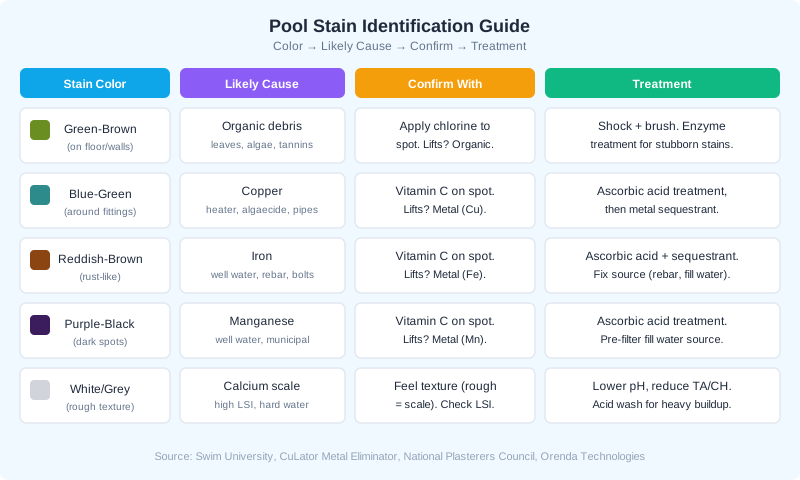
Pool stains fall into two categories: metal stains caused by dissolved metals precipitating onto surfaces, and organic stains caused by leaves, algae, berries, or other biological matter. The treatment for each is completely different, and using the wrong approach can make stains permanent. The good news is that a simple two-chemical field test tells you which type you are dealing with in under 60 seconds.
How Do You Test Whether a Stain Is Metal or Organic?
Carry a vitamin C tablet (ascorbic acid) and a chlorine tablet or granular trichlor in your test kit. Hold the vitamin C tablet against the stain for 30 seconds. If the stain lightens or disappears, it is a metal stain. If vitamin C does nothing, place a chlorine tablet on the stain for 30 seconds. If chlorine lifts it, the stain is organic. If neither works, you are likely dealing with calcium scale, not a stain.
What Metals Cause Which Stain Colors?
The stain color points directly to the metal source. Copper produces blue-green or teal stains and typically comes from corroded copper heater elements, copper-based algaecides used at low pH, or copper plumbing. Iron produces reddish-brown or rust-colored stains and enters from well water, corroded rebar in gunite pools, or rusted metal accessories. Manganese creates purple-black stains and usually comes from well water or certain municipal supplies.
How Do You Remove Metal Stains?
- 1Lower chlorine to 0-1 ppm. High chlorine reoxidizes metals and causes restaining during treatment.
- 2Add ascorbic acid (vitamin C) at a rate of 1 pound per 10,000 gallons. Distribute evenly around the pool.
- 3Run the pump for 30 minutes to circulate. Stains should lift within 1-2 hours.
- 4Add a metal sequestrant (phosphonate-based, not phosphate-based) to bind dissolved metals and prevent restaining.
- 5Slowly raise chlorine back to normal levels over 2-3 days. Rapid chlorine increases can reoxidize metals.
- 6Identify and fix the metal source: replace corroded heater elements, install a pre-filter on well water fill lines, or stop using copper-based algaecides.
Never shock a pool with visible metal stains. Superchlorination oxidizes dissolved metals and drives them deeper into plaster and pebble surfaces, making stains harder to remove. Lower chlorine first, treat the stain, then address sanitization.
Scaling and Calcium Buildup: What Causes It and How Do You Prevent It?
Calcium scale appears as white or grey crusty deposits on pool surfaces, tile lines, and inside plumbing and equipment. Unlike stains, scale has a rough, sandpaper-like texture. It forms when the Langelier Saturation Index (LSI) rises above +0.3, meaning the water is oversaturated with calcium carbonate. The three primary factors that push LSI into scaling territory are high pH, high total alkalinity, and high calcium hardness.
How Do You Diagnose a Scaling Problem?
Run your finger across the deposit. If it feels rough or gritty, it is scale. Stains are smooth to the touch. Calculate the LSI using pH, water temperature, calcium hardness, total alkalinity, and TDS. An LSI above +0.3 confirms the water is scale-forming. You can calculate LSI manually or use a digital calculator. The ideal LSI range is -0.3 to +0.3.
| LSI Value | Water Condition | Action |
|---|---|---|
| Below -0.3 | Corrosive (etching surfaces) | Raise CH or pH |
| -0.3 to +0.3 | Balanced | No action needed |
| Above +0.3 | Scale-forming | Lower pH, reduce TA, or dilute CH |
| Above +0.6 | Aggressive scaling | Immediate correction required |
How Do You Remove Existing Scale and Prevent New Buildup?
For tile-line scale, muriatic acid applied directly with a pumice stone or scale-specific tile cleaner is the standard approach. For plaster or pebble surfaces with heavy scaling, a professional acid wash may be needed. To prevent new scale, keep the LSI between -0.3 and +0.3 by managing the three controllable factors: lower pH to 7.2-7.4, keep TA at 80-100 ppm, and dilute calcium hardness if it exceeds 400 ppm.
Heated pools and pools with water features are more prone to scaling because warmer water temperature reduces calcium solubility, pushing LSI higher. SWG pools often have both high pH (from the chlorine generation process) and elevated calcium, creating a double scaling risk. Corey flags this pattern often: "Every SWG pool I have ever taken over from another company has scale on the cell. High pH plus high calcium plus warm water is the scaling trifecta. If you are not managing LSI on your salt pools, you are replacing cells every 2 years instead of 5."
For a detailed breakdown of the Langelier Saturation Index, including the full calculation formula and adjustment strategies for every parameter, see our LSI guide for pool professionals.
Pool Foam: What Causes It and Is It a Chemistry Problem?
Foam on the pool surface is caused by surfactants, which are compounds that lower surface tension and allow air to mix with water into persistent bubbles. Unlike the other problems in this guide, foam is rarely a water chemistry issue. It is almost always a contaminant issue. The surfactants come from an external source, and the fix is identifying and removing that source.
What Are the Most Common Causes of Pool Foam?
- Body products: sunscreen, lotions, hair products, and laundry detergent residue on swimsuits are the most common source of pool foam.
- Algaecide overuse: quaternary ammonium (quat) algaecides are surfactants by design. Overdosing or adding algaecide to a pool that does not need it causes foam that can persist 24-48 hours.
- Cheap or off-brand chemicals: some low-quality pool chemicals contain fillers that act as surfactants. Stick with commercial-grade products.
- Low calcium hardness: water below 150 ppm calcium hardness is more prone to foaming because soft water holds surfactants longer.
- Air leak in suction plumbing: a leak on the suction side of the pump introduces air into the return lines, creating bubbles that look like foam in the pool.
How Do You Fix Pool Foam?
For body-product and algaecide foam, time and filtration are the primary fix. Run the pump continuously and the foam will dissipate as the filter removes the surfactants, typically within 24-48 hours. Adding a pool-specific enzyme product accelerates the breakdown of oils and organic surfactants. For persistent foam, a partial drain and refill dilutes the surfactant concentration.
If foam appears without any obvious chemical or bather source, check the pump for air leaks. Look for bubbles in the pump strainer basket. Air leaks on the suction side (loose fittings, cracked pump lid O-ring, or low water level exposing the skimmer throat) push air into the returns and create surface foam. This is an equipment issue, not a chemistry issue, and no chemical will fix it.
Ask homeowners to shower before swimming and to wash new swimsuits before the first use. Laundry detergent residue in brand-new swimsuits is one of the most common foam triggers, and homeowners never suspect it.
Run a pool route?
The business side of what you just read.
Pricing, chemical costs, and the tools owners use to keep the numbers straight.
- Commercial pool service pricing2026 rate tables and the cost-plus formula
- Chemical cost per poolWhat chemicals actually cost per stop
- Chemical tracking softwareLog readings and dosing from the pool deck
- Pool service softwareRoutes, invoicing, and service reports in one app
- Free profit & rate calculatorsProfit per pool, minimum rate, break-even
Frequently Asked Questions
What is the fastest way to diagnose a pool chemistry problem?
Start with a full water test: free chlorine, combined chlorine, pH, total alkalinity, CYA, and calcium hardness. Compare results to ideal ranges (FC 2-4 ppm, pH 7.2-7.6, TA 80-120 ppm, CH 200-400 ppm, CYA 30-50 ppm). The parameter furthest out of range is almost always connected to the visible symptom.
Why is my pool cloudy even though the chemicals are balanced?
If all chemical readings are within range, the issue is usually filtration. Check your filter pressure against the clean baseline. If pressure is 8-10 PSI above clean, the filter needs backwashing or cleaning. Also check run time, as the pump should run at least 8 hours per day in summer. Finally, sand filter media older than 5-7 years may need replacement even if pressure reads normal.
How do I tell the difference between metal stains and organic stains?
Hold a vitamin C tablet (ascorbic acid) against the stain for 30 seconds. If the stain lightens, it is a metal stain. If vitamin C has no effect, try a chlorine tablet for 30 seconds. If chlorine lifts the stain, it is organic (leaves, algae, tannins). If neither works, the deposit is likely calcium scale, not a stain, and you can confirm by checking for a rough texture.
What does it mean when pool chlorine disappears overnight?
Rapid chlorine loss (more than 2 ppm overnight) indicates chlorine demand. Test combined chlorine (CC). If CC is above 0.5 ppm, chloramines are consuming your free chlorine and you need breakpoint chlorination (dose at 10x the CC reading). If CC is low, check CYA. Zero CYA in full sun causes 90% chlorine loss in 2 hours from UV degradation. Add stabilizer to 30-50 ppm.
Why does my pool pH keep going up every week?
Persistent high pH is most commonly caused by total alkalinity above 120 ppm, which acts as an upward buffer. Salt water generators also raise pH because the chlorine generation process produces sodium hydroxide. New plaster surfaces leach calcium hydroxide for 6-12 months. Lower TA to 80-100 ppm first, then address other sources. This usually stops the weekly acid cycle.
How do I know if my pool has a scaling problem vs. a staining problem?
Run your finger across the deposit. Scale has a rough, gritty, sandpaper-like texture because it is calcium carbonate crystals that have formed on the surface. Stains (both metal and organic) are smooth and flush with the pool surface. Calculate the LSI to confirm: a value above +0.3 confirms scale-forming conditions.
Sources & References
- PHTA (Pool & Hot Tub Alliance) Water Chemistry Guidelines
- PHTA-11 Standard for Water Quality in Public Pools and Spas
- HASA: Shock, Oxidation, Superchlorination, and Breakpoint Chlorination
- Orenda Technologies: Understanding Calcium Carbonate Scale
- Orenda Technologies: Understanding the Langelier Saturation Index
- Swim University: How to Identify and Remove Pool Stains
- Pool & Spa News: Chlorine Demand
- Trouble Free Pool: Calcium Saturation Index (CSI)
- Pool Chemistry Training Institute: High Chlorine Demand Causes
- Natare: Guide to Common Pool Problems and Chemical Levels