Cyanuric Acid Is the Most Misunderstood Chemical in Pool Service. Here Is What Actually Matters.
Cyanuric acid (CYA) is the single parameter that causes the most confusion, the most unnecessary drains, and the most arguments between pool techs and chemical suppliers. The ideal CYA range for residential pools is 30-50 ppm according to the PHTA (Pool & Hot Tub Alliance), but the real question is not "what should CYA be?" It is "what does CYA mean for the chlorine I am already adding?" Because CYA without context is just a number on a test strip.
Corey Adams, Pool Founder co-founder and 15-year pool service veteran, has drained hundreds of pools for high CYA. "Half the time, the pool did not actually need to be drained. The tech just did not know the relationship between CYA and free chlorine. Once you understand the ratio, you stop panicking at 60 ppm and start making smarter dosing decisions." This guide covers everything a pool service professional needs to know about CYA, from the chemistry that matters to the field decisions that save you time and money.
This guide is written for pool service professionals, not homeowners. It assumes you understand free chlorine, combined chlorine, and basic water balance. If you are looking for homeowner-level CYA advice, this will still help, but the dosing recommendations and business considerations are aimed at working techs and route operators.
What Is Cyanuric Acid and Why Does It Matter?
Cyanuric acid (also called stabilizer or conditioner) is a chemical compound that bonds with free chlorine in pool water to protect it from ultraviolet degradation. Without CYA, sunlight destroys up to 90% of free chlorine within two hours. With 30 ppm of CYA, chlorine lasts 3-5 times longer under the same sun exposure. That is the entire purpose of CYA: making your chlorine investment last.
How Does CYA Protect Chlorine from Sunlight?
When CYA is present in pool water, it forms a reversible bond with hypochlorous acid (HOCl), the active sanitizing form of chlorine. This bond creates a "reservoir" of protected chlorine that UV light cannot reach. As the small amount of unbound active chlorine gets consumed by bacteria, algae, or UV rays, CYA releases more chlorine from the reservoir to maintain equilibrium. The process is continuous and automatic.
The trade-off is that CYA also reduces the percentage of chlorine that is actively sanitizing at any given moment. At 30 ppm CYA, roughly 3% of your free chlorine is in the active HOCl form. At 100 ppm CYA, less than 1% is active. This is why the relationship between CYA and free chlorine levels is the most important number in residential pool chemistry.
What Are the Recommended CYA Levels for Different Pool Types?
The ideal CYA level depends on your chlorine source and pool type. The PHTA recommends 30-50 ppm for standard residential pools. The CDC Model Aquatic Health Code limits commercial pools to 15 ppm maximum. Saltwater pool manufacturers typically recommend 60-80 ppm to protect the chlorine generated by the salt cell.
| Pool Type | Ideal CYA (ppm) | Maximum CYA (ppm) | Source |
|---|---|---|---|
| Residential (liquid chlorine) | 30-50 | 50 | PHTA |
| Residential (trichlor tabs) | 30-50 | 50 | PHTA |
| Saltwater (SWG) | 60-80 | 80 | SWG manufacturers |
| Commercial/public | 0-15 | 15 | CDC Model Aquatic Health Code |
The PHTA APSP-11 Standard sets an absolute maximum of 100 ppm CYA for any residential pool. Above 100 ppm, chlorine effectiveness drops so significantly that adequate sanitation becomes nearly impossible regardless of how much chlorine you add.
The FC/CYA Ratio: The Most Important Number in Pool Chemistry
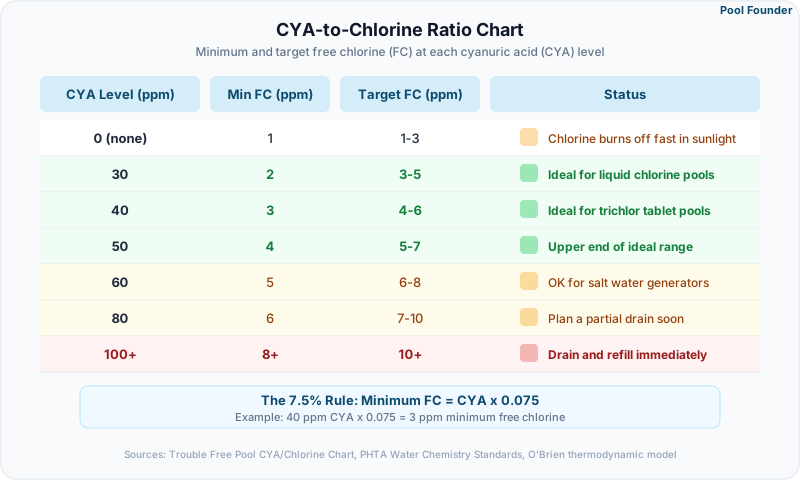
The minimum free chlorine level should be maintained at 7.5% of the cyanuric acid level to prevent algae growth and maintain adequate sanitation. This is called the 7.5% Rule, and it is supported by the O'Brien thermodynamic model of chlorine/CYA equilibrium. At 40 ppm CYA, that means maintaining at least 3 ppm free chlorine. At 80 ppm CYA, you need at least 6 ppm.
Why Is the FC/CYA Ratio More Important Than CYA Alone?
A pool at 60 ppm CYA with 5 ppm free chlorine is better sanitized than a pool at 30 ppm CYA with 1 ppm free chlorine. The CYA number alone does not tell you whether the pool is safe. The ratio tells you whether enough active chlorine is available to kill bacteria and prevent algae. This is the single biggest knowledge gap in residential pool service, and it is why some pools with "normal" CYA still turn green while pools with "high" CYA stay crystal clear.
Corey has seen this play out hundreds of times on routes. "I will get a call from a homeowner saying their pool guy let the CYA get too high at 55 ppm and they want us to drain it. I test the water, see 55 CYA with 4 ppm free chlorine, and that pool is perfectly fine. The ratio is right. The previous company was probably running 1-2 ppm chlorine at that same CYA, and that is why they had algae problems."
| CYA (ppm) | Minimum FC (ppm) | Target FC (ppm) | Shock Level (ppm) |
|---|---|---|---|
| 30 | 2 | 3-5 | 12 |
| 40 | 3 | 4-6 | 16 |
| 50 | 4 | 5-7 | 20 |
| 60 | 5 | 6-8 | 24 |
| 80 | 6 | 7-10 | 31 |
| 100+ | 8+ | 10+ | Drain first |
When you shock a stabilized pool, the shock target is roughly 40% of CYA, not a flat 10 ppm. A pool at 50 ppm CYA needs to reach 20 ppm FC to achieve breakpoint chlorination. This is another reason high CYA costs you money: shocking becomes significantly more expensive.
How Does CYA Accumulate? The Trichlor and Dichlor Problem
CYA accumulates in pool water because it does not evaporate, does not break down from sunlight, and is not removed by standard filtration. The primary source of CYA buildup is the ongoing use of stabilized chlorine products, specifically trichlor tablets and dichlor granular chlorine. Every pound of trichlor adds approximately 6 ppm of CYA per 10,000 gallons. Every pound of dichlor adds approximately 9 ppm of CYA per 10,000 gallons.
How Fast Do Trichlor Tablets Raise CYA?
Trichlor is 55% cyanuric acid by weight. For every 10 ppm of chlorine you add using trichlor, you are also adding 6 ppm of CYA. A typical residential pool (15,000 gallons) using 2-3 trichlor tablets per week can see CYA rise 3-5 ppm per month. A pool that starts the season at 30 ppm CYA can easily exceed 50 ppm within 4-5 months and blow past 80 ppm by end of season if trichlor is the only chlorine source.
| Chlorine Source | CYA Added per 10 ppm Cl (per 10,000 gal) | CYA Content by Weight |
|---|---|---|
| Trichlor tablets | 6 ppm | 55% |
| Dichlor granular | 9 ppm | 57% |
| Liquid chlorine (sodium hypochlorite) | 0 ppm | 0% |
| Cal-hypo (calcium hypochlorite) | 0 ppm | 0% |
| Salt water generator | 0 ppm | 0% |
Why Do So Many Pool Companies Still Use Trichlor Exclusively?
Convenience. Trichlor tablets are easy. Drop them in a floater or inline feeder, and they dissolve slowly over the week. No mixing, no measuring, no liquid jugs in the truck. The problem is that convenience has a hidden cost: CYA buildup that eventually forces a partial drain costing the customer $50-150 in water and requiring 1-2 hours of your time.
"We switched most of our route to liquid chlorine three years ago," Corey says. "Yes, it is heavier and messier. But our CYA-related drain requests dropped by 80%. We went from draining 15-20 pools per summer to maybe 3-4. The time savings on not doing those drains more than made up for the hassle of hauling liquid chlorine."
Evaporation concentrates CYA further. When water evaporates from a pool, the CYA stays behind in the remaining water. A pool that loses 1-2 inches per week to evaporation in summer is effectively increasing its CYA concentration even without adding any stabilized chlorine.
For a deeper dive into managing trichlor across your entire route, including the cost comparison with liquid chlorine and how to talk to customers about the problem, see our Trichlor Tablet Management Guide.
When and How to Lower CYA: The Partial Drain Guide
The only reliable method to lower cyanuric acid is dilution, which means partially draining the pool and refilling with fresh water. No chemical product on the market reliably removes CYA from pool water despite marketing claims. Some enzyme-based products show limited effectiveness in lab conditions, but the presence of chlorine in the water slows the degradation process by roughly 50%, making real-world results inconsistent at best.
How Do You Calculate How Much Water to Drain?
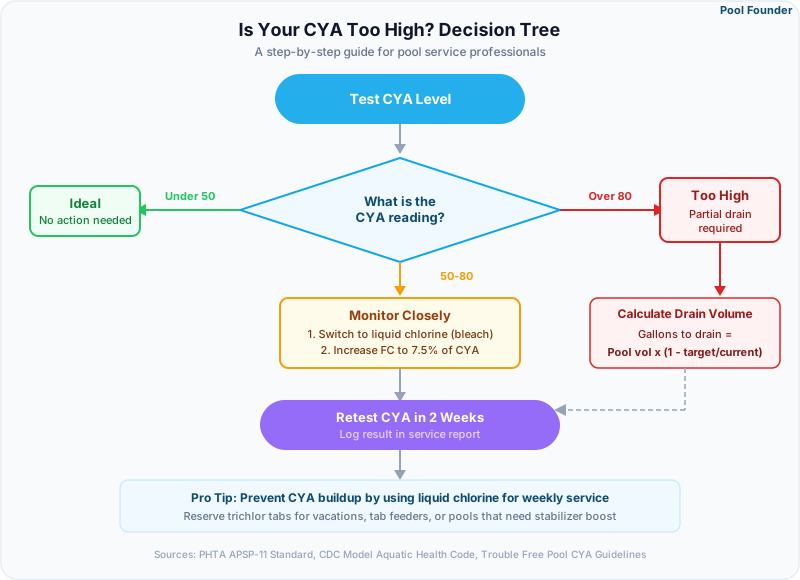
The drain calculation is straightforward: Gallons to Drain = Pool Volume x (1 - Target CYA / Current CYA). For a 15,000-gallon pool at 100 ppm CYA with a target of 40 ppm, you need to drain 15,000 x (1 - 40/100) = 9,000 gallons, or 60% of the pool. After refilling, run the pump for at least 4 hours to fully mix the water before retesting.
| Current CYA | Target CYA | % to Drain | Gallons (15,000 gal pool) |
|---|---|---|---|
| 60 ppm | 40 ppm | 33% | 5,000 |
| 80 ppm | 40 ppm | 50% | 7,500 |
| 100 ppm | 40 ppm | 60% | 9,000 |
| 150 ppm | 40 ppm | 73% | 11,000 |
What Is the Best Way to Drain a Pool for CYA Reduction?
Use a submersible pump or your multiport valve set to "waste" to drain the pool. Never fully drain a gunite or fiberglass pool without accounting for hydrostatic pressure, especially in areas with high water tables. Draining more than 50% at once increases the risk of the pool shell popping out of the ground. For pools needing 60%+ reduction, consider doing two partial drains on separate days.
- 1Test CYA with a reliable turbidity-based test (not test strips, which lose accuracy above 50 ppm)
- 2Calculate drain volume using the formula above
- 3Check local water discharge regulations before draining to storm drains
- 4Drain to the calculated level using a submersible pump or waste setting
- 5Refill with fresh water from the garden hose or fill service
- 6Run the pump for 4+ hours to mix thoroughly
- 7Retest CYA, free chlorine, pH, and alkalinity, as fresh water will change all parameters
- 8Rebalance chemistry starting with alkalinity, then pH, then chlorine
Bill the customer for partial drains. This is skilled work that takes 1-2 hours and protects their equipment. A reasonable charge is $75-150 depending on pool size and local water costs. Most homeowners understand the need when you explain that their chlorine is not working effectively.
The Chlorine Lock Myth: What the Science Actually Says
"Chlorine lock" is a widely repeated claim that high CYA levels permanently bind all chlorine, making it completely unable to sanitize. This is a myth. The chlorine-CYA bond is reversible. As active chlorine is consumed, CYA releases more from the reservoir to maintain chemical equilibrium. There is no CYA level at which chlorine becomes permanently "locked up."
Where Did the Chlorine Lock Myth Come From?
The origin traces back to scientific papers by Anderson (1965) and Fitzgerald and Der Vartanian (1967) that reported CYA reduced the bactericidal activity of chlorine. However, those experiments used distilled water with artificially cultured bacteria in controlled lab conditions. One of the researchers explicitly cautioned against extending the results to real swimming pool operation. The pool industry ran with the headline without reading the fine print.
What Is Actually Happening at High CYA Levels?
High CYA does not "lock" chlorine. It reduces the percentage of free chlorine that is in the active HOCl form at any given moment. At 100 ppm CYA, you might have 8 ppm of free chlorine on your test kit, but less than 0.08 ppm of that is active HOCl. The chlorine is there, it is just working much slower. The solution is not to panic about "chlorine lock." The solution is to either increase free chlorine to maintain the 7.5% ratio or drain to lower CYA.
Corey puts it simply: "If a tech tells me a pool has chlorine lock, I ask them two questions. What is the CYA? What is the free chlorine? Every single time, the free chlorine is too low for the CYA level. Fix the ratio, and the pool clears up. There is no magic. Just math."
Some chemical manufacturers still market products that claim to "break chlorine lock." These products are typically non-chlorine oxidizers (potassium monopersulfate) that address chloramine buildup, which is a real but entirely different problem from high CYA. They do not lower CYA or change the CYA-chlorine equilibrium.
CYA Management Strategies for Pool Service Routes
Managing CYA across a full route requires a system, not just testing when a pool turns green. The most efficient approach is preventing buildup through chlorine source selection, testing CYA on a regular schedule, and logging results so you can spot trends before they become problems.
How Often Should Pool Techs Test CYA?
Test CYA monthly on pools using stabilized chlorine (trichlor or dichlor). Test CYA quarterly on pools using liquid chlorine or salt water generators, since their CYA should remain stable unless fresh stabilizer is added. Always test CYA after adding stabilizer, after a significant drain and refill, and at season start.
How Can You Prevent CYA Buildup in the First Place?
- Use liquid chlorine (sodium hypochlorite) as your primary sanitizer. It adds zero CYA.
- Reserve trichlor tablets for specific situations: vacation holds, inline feeders on timer, or pools that need a CYA boost.
- Add CYA separately as stabilizer (pure cyanuric acid) at the start of season to reach your target, then maintain with liquid chlorine.
- Track CYA readings in your service software so you can identify which pools are trending up and address them before they pass 50 ppm.
- For salt water pools, add CYA once to reach 60-80 ppm, then let the SWG handle chlorine production with no additional CYA input.
How Should You Handle Newly Acquired Pools with Unknown CYA?
When you take over a pool from another company or a DIY homeowner, test CYA on the first visit. It is common to find pools at 80-150+ ppm because the previous operator used trichlor exclusively for years. This is a good opportunity to explain the CYA issue to the customer, schedule a partial drain, and set up a proper chlorine program going forward. Many new customer relationships have started with the simple act of explaining CYA to a homeowner who never heard of it.
Pool Founder logs CYA as part of every chemical reading. When a pool crosses 50 ppm, the service report flags it for the tech and the customer, so you can schedule a drain before it becomes urgent. Tracking trends across your route gives you visibility into which pools need attention before they turn green.
CYA and Health Codes: What Pool Pros Need to Know
If you service any commercial pools, public pools, or HOA community pools, CYA regulations are significantly stricter than residential guidelines. The CDC Model Aquatic Health Code (MAHC), updated in 2016, recommends that CYA levels in commercial pools not exceed 15 ppm. This limit was established specifically to ensure effective hyperchlorination response during fecal incidents involving Cryptosporidium.
Why Is the CDC Limit So Much Lower Than Residential Guidelines?
Cryptosporidium is extremely resistant to chlorine. The contact time required to inactivate Crypto at elevated CYA levels becomes impractically long. At 50 ppm CYA, hyperchlorination to 20 ppm free chlorine takes roughly 28 hours to achieve Crypto inactivation. At 15 ppm CYA or below, the same process takes approximately 8 hours. In a commercial pool that may need to reopen within 24 hours, that difference is critical.
Do These Limits Apply to Residential Pools?
The 15 ppm CDC limit is a recommendation for public and commercial aquatic facilities, not a legal requirement for residential pools. However, some states have adopted the MAHC standards into their health codes. Michigan, for example, issues a closure order when CYA exceeds 80 ppm in a public pool. If you service commercial pools, check your state and county health department requirements. Requirements vary significantly by jurisdiction.
For pool companies servicing both residential and commercial pools: keep your commercial pools on liquid chlorine only, with CYA at 15 ppm or below. Use trichlor on residential pools only when needed, and educate your techs on which pools get which chlorine source.
Run a pool route?
The business side of what you just read.
Pricing, chemical costs, and the tools owners use to keep the numbers straight.
- Commercial pool service pricing2026 rate tables and the cost-plus formula
- Chemical cost per poolWhat chemicals actually cost per stop
- Chemical tracking softwareLog readings and dosing from the pool deck
- Pool service softwareRoutes, invoicing, and service reports in one app
- Free profit & rate calculatorsProfit per pool, minimum rate, break-even
Frequently Asked Questions
What is the ideal CYA level for a residential pool?
The ideal CYA range for residential pools is 30-50 ppm according to the PHTA (Pool & Hot Tub Alliance). Saltwater pools can run 60-80 ppm per SWG manufacturer recommendations. The absolute maximum under the APSP-11 Standard is 100 ppm, above which chlorine effectiveness drops dramatically.
How do you lower cyanuric acid in a pool?
The only reliable method to lower CYA is partial drain and refill with fresh water. Use the formula: Gallons to Drain = Pool Volume x (1 - Target CYA / Current CYA). For a 15,000-gallon pool at 100 ppm CYA targeting 40 ppm, drain 9,000 gallons (60%). No chemical product reliably removes CYA despite marketing claims.
Is chlorine lock a real thing?
No. "Chlorine lock" is a myth. High CYA reduces the percentage of free chlorine that is actively sanitizing, but the chlorine-CYA bond is reversible. As active chlorine is consumed, CYA releases more to maintain equilibrium. The real issue is an improper FC/CYA ratio, not locked chlorine. Fix the ratio by increasing FC to at least 7.5% of CYA, or drain to lower CYA.
How much CYA do trichlor tablets add to a pool?
Trichlor is 55% CYA by weight. For every 10 ppm of chlorine added via trichlor, 6 ppm of CYA is added to the water. A typical residential pool using 2-3 tabs per week can see CYA rise 3-5 ppm per month. Over a full season, that can push CYA from 30 ppm past 80 ppm.
What is the FC/CYA ratio and how do you use it?
The FC/CYA ratio, also called the 7.5% Rule, states that the minimum free chlorine level should be 7.5% of the CYA level. At 40 ppm CYA, maintain at least 3 ppm FC. At 60 ppm CYA, maintain at least 5 ppm FC. This ratio is more important than the CYA number alone for determining whether a pool is properly sanitized.
Can you use CYA reducer products instead of draining?
CYA reducer products use enzymes or bacteria to biologically break down cyanuric acid. Lab research shows they can degrade over 70% of CYA within 72 hours under ideal conditions. However, chlorine in pool water reduces their effectiveness by about 50%. For most pool service companies, a partial drain is faster, cheaper, and more predictable than enzyme-based treatments.
Sources & References
- PHTA Fact Sheet on Cyanuric Acid (2022)
- CDC Model Aquatic Health Code, Second Edition (2016)
- Orenda Technologies: The CDC's Limit for Cyanuric Acid in Swimming Pools
- Trouble Free Pool: The Free Chlorine and Cyanuric Acid Relationship
- Wojtowicz, J.A.: Build-up of Cyanuric Acid in Swimming Pools (JSPSI V4N2)
- PMC: Chlorinated Cyanurates: Review of Water Chemistry and Associated Drinking Water Implications
- Michigan EGLE: Maximum Disinfectant Residuals and Operational Ranges
- Montana DPHHS: Fact Sheet on Cyanuric Acid and Stabilized Chlorine Products