Pool Water Chemistry Is Not Seven Separate Numbers. It Is One Connected System.
Pool water chemistry has seven core parameters: free chlorine, pH, total alkalinity, calcium hardness, cyanuric acid, total dissolved solids, and temperature. The PHTA (Pool & Hot Tub Alliance) and the CDC Model Aquatic Health Code both publish recommended ranges for each one. But the ranges alone do not tell the full story, because every parameter affects at least two others. A pH reading of 7.6 means something completely different at 30 ppm CYA than it does at 80 ppm CYA. A calcium hardness of 250 ppm is fine in 85-degree water and potentially corrosive in 60-degree water.
Corey Adams, Pool Founder co-founder and 15-year pool service veteran, has tested thousands of pools across every scenario. "I used to just chase individual numbers. Keep chlorine at 3, pH at 7.4, alkalinity at 100. It worked most of the time, but when something went wrong, I did not understand why. Once I learned how the parameters interact, everything clicked. I could look at a set of readings and immediately know what the water was doing and what it was about to do." This guide is the complete chemistry reference for working pool professionals. Every number is sourced from PHTA standards, the CDC, or verified industry data.
This is a PILLAR reference article. It covers all seven major parameters at professional depth. For deep dives on specific topics, see our guides on cyanuric acid, the Langelier Saturation Index, green pool recovery, and chemistry troubleshooting, all linked throughout this article.
What Are the Ideal Ranges for Every Pool Chemistry Parameter?
The ideal ranges for pool water chemistry are: free chlorine 1-4 ppm (adjusted by CYA level), pH 7.2-7.8, total alkalinity 80-120 ppm, calcium hardness 200-400 ppm, cyanuric acid 30-50 ppm for residential pools, total dissolved solids below 2,500 ppm, and water temperature tracked for LSI calculations. These ranges come from the PHTA ANSI/PHTA/ICC-11 standard and the CDC Model Aquatic Health Code (5th Edition, 2024). The chart below is a quick-reference card you can save to your phone.
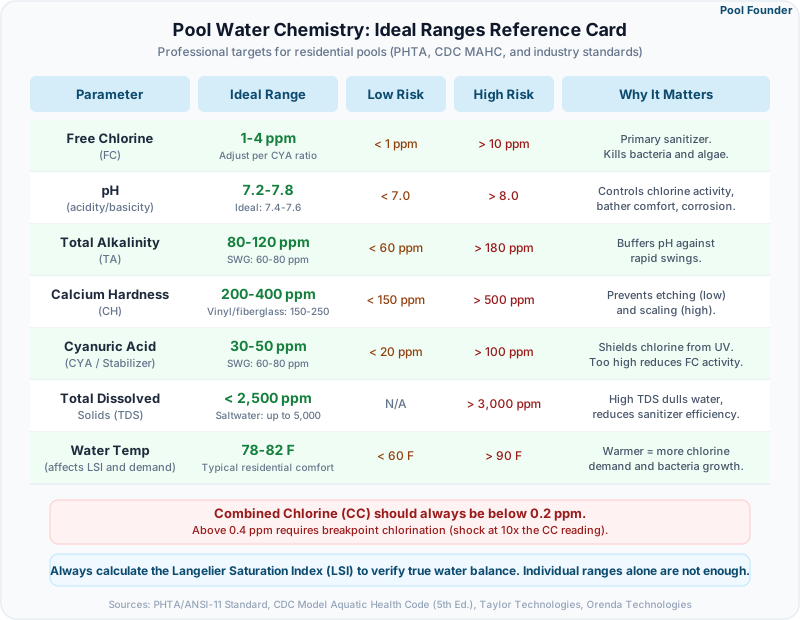
These ranges are starting points, not absolutes. The Langelier Saturation Index (LSI) is the only way to confirm whether your water is truly balanced. You can have every individual parameter inside the "ideal" range and still have corrosive or scale-forming water.
How Do Residential and Commercial Pool Ranges Differ?
Commercial and public pools follow stricter standards than residential pools. The CDC Model Aquatic Health Code (5th Edition) requires free chlorine of 2-4 ppm in commercial pools, limits CYA to 90 ppm maximum, and mandates that free chlorine above 10 ppm while bathers are present is a violation requiring immediate closure. Residential pools have more flexibility because bather loads are lower and health department oversight varies by jurisdiction.
| Parameter | Residential Range | Commercial Range | Source |
|---|---|---|---|
| Free Chlorine | 1-4 ppm | 2-4 ppm | PHTA / CDC MAHC |
| pH | 7.2-7.8 | 7.2-7.8 | PHTA / CDC MAHC |
| Total Alkalinity | 80-120 ppm | 80-120 ppm | PHTA |
| Calcium Hardness | 200-400 ppm | 200-400 ppm | PHTA |
| Cyanuric Acid | 30-50 ppm (80 SWG) | 90 ppm max | PHTA / CDC MAHC |
Free Chlorine: How Much Do You Actually Need?
Free chlorine (FC) is the active sanitizer in pool water. It exists in two forms: hypochlorous acid (HOCl), which does the actual killing, and hypochlorite ion (OCl-), which is far less effective. The ratio between these two forms is controlled entirely by pH. At pH 7.2, about 63% of free chlorine is in the active HOCl form. At pH 7.8, only about 28% is active. This is why pH control and chlorine dosing are inseparable decisions.
What Is the Difference Between Free, Combined, and Total Chlorine?
Free chlorine is what has not yet reacted with contaminants. Combined chlorine (CC), also called chloramines, is chlorine that has already bonded with nitrogen-based compounds like sweat, urine, and body oils. Total chlorine is the sum of free and combined. For professionals, the critical number is combined chlorine: it should always be below 0.2 ppm. Above 0.4 ppm, most health departments require breakpoint chlorination. The Indiana State Department of Health recommends superchlorination when combined chlorine reaches 0.2 ppm or greater.
Breakpoint chlorination requires dosing at approximately 10 times the combined chlorine level. If your CC reads 0.5 ppm, you need to raise FC by 5 ppm above your current level to reach breakpoint. Under-dosing makes the problem worse by creating more chloramines. Our professional pool shock guide covers breakpoint dosing in full detail.
Why Does the FC/CYA Ratio Matter More Than FC Alone?
A pool with 3 ppm free chlorine and 80 ppm CYA has less active sanitizer than a pool with 2 ppm free chlorine and 30 ppm CYA. This is because cyanuric acid bonds with chlorine to protect it from UV, but that bond also reduces the percentage of chlorine that is actively killing pathogens. The minimum FC should be maintained at 7.5% of the CYA level to prevent algae and maintain adequate sanitation. At 40 ppm CYA, that means at least 3 ppm FC. At 80 ppm CYA, you need at least 6 ppm FC. Our full cyanuric acid guide covers this ratio in detail with dosing charts for every CYA level.
| CYA Level (ppm) | Minimum FC (ppm) | Target FC (ppm) | Notes |
|---|---|---|---|
| 0 (none) | 1 | 1-3 | No UV protection, chlorine burns fast |
| 30 | 2 | 3-5 | Ideal for liquid chlorine pools |
| 50 | 4 | 5-7 | Upper end of PHTA residential range |
| 80 | 6 | 7-10 | Typical for saltwater generators |
| 100+ | 8+ | 10+ | Partial drain recommended |
pH: Why Is 7.4 to 7.6 the Professional Sweet Spot?
The PHTA acceptable range for pH is 7.2 to 7.8, but experienced pool professionals target 7.4 to 7.6 because that range balances three competing demands: chlorine effectiveness (which improves as pH drops), bather comfort (the pH of human tears is approximately 7.4), and surface protection (lower pH accelerates plaster etching). At pH 7.4, about 52% of free chlorine is in the active HOCl form. That is the best practical trade-off between sanitizing power and everything else.
What Causes pH to Rise or Fall in Pool Water?
pH rises naturally in almost every pool due to outgassing of carbon dioxide from the water surface, especially in pools with high total alkalinity, water features, or aeration. Saltwater chlorine generators (SWGs) also drive pH up because the electrolysis process produces sodium hydroxide as a byproduct. Liquid chlorine (sodium hypochlorite) temporarily raises pH when first added, though the net long-term effect is roughly neutral. Trichlor tablets are acidic with a pH of about 2.8, so they pull pH down over time.
"Most of the pools on my routes need acid added weekly to bring pH down," Corey says. "It is rare to have a pool where pH drops on its own unless they are using trichlor tabs heavily. If a pool consistently has rising pH, the first thing I check is the alkalinity level. High TA is the number one driver of pH drift upward."
How Does pH Affect Chlorine Effectiveness?
This is one of the most important relationships in pool chemistry. At pH 7.0, approximately 73% of free chlorine is in the powerful HOCl form. At pH 8.0, that drops to about 21%. That means chlorine is roughly 3.5 times more effective at pH 7.0 than at pH 8.0, even if the FC reading on your test kit is identical. A pool reading 3 ppm FC at pH 8.0 has the equivalent sanitizing power of about 0.9 ppm FC at pH 7.0. This is why you cannot evaluate chlorine without knowing the pH.
| pH | % Active HOCl | Relative Sanitizing Power | Practical Impact |
|---|---|---|---|
| 7.0 | 73% | Very High | Great sanitation, risk of corrosion |
| 7.2 | 63% | High | Lower end of acceptable range |
| 7.4 | 52% | Good | Ideal: comfort + efficacy balance |
| 7.6 | 40% | Moderate | Still acceptable for most pools |
| 7.8 | 28% | Low | Upper limit, chlorine significantly weaker |
Total Alkalinity: What Does It Actually Do and Why Does It Drift?
Total alkalinity (TA) measures the water's ability to resist pH changes, a property called buffering capacity. The PHTA recommends 80-120 ppm for most pools. The primary buffering agents in pool water are bicarbonate ions (HCO3-), which neutralize acids by binding hydrogen ions. When TA is too low (below 60 ppm), pH becomes unstable and can swing dramatically from a single chemical addition or a rainstorm. When TA is too high (above 180 ppm), pH becomes stubbornly resistant to adjustment and tends to drift upward.
Why Do Saltwater Pools Need Lower Alkalinity?
Saltwater chlorine generators constantly produce sodium hydroxide (a strong base), which pushes pH upward. High alkalinity amplifies this drift because the buffering system holds pH in place as it rises, requiring more acid to bring it back down. Many SWG pool operators find that a lower TA target of 60-80 ppm reduces acid consumption significantly while still providing enough buffering to prevent wild swings. The Trouble Free Pool community and Orenda Technologies both recommend this lower range for SWG pools. For a complete breakdown of salt system chemistry, see our salt pool chemistry guide.
How Do You Adjust Alkalinity Without Crashing pH?
Muriatic acid and sodium bisulfate both lower TA and pH simultaneously. The technique for selectively lowering TA while minimizing pH impact is called "slug dosing" or "column dosing." You pour acid slowly in one spot with the pump off (or at a low flow rate) to concentrate the acid's effect on alkalinity. After circulation, pH recovers faster than TA because CO2 exchange naturally raises pH. To raise TA without significantly affecting pH, add sodium bicarbonate (baking soda). It raises TA with only a minor pH increase.
Total alkalinity also factors into the Langelier Saturation Index. The LSI formula uses "corrected alkalinity," which subtracts a portion of the CYA contribution from the TA reading. If your pool has high CYA, the true buffering alkalinity may be lower than your TA test shows.
Calcium Hardness: When Does It Protect Surfaces and When Does It Destroy Them?
Calcium hardness (CH) measures the concentration of dissolved calcium in pool water. The PHTA recommends 200-400 ppm for plaster/concrete pools and 150-250 ppm for vinyl-liner and fiberglass pools. Calcium hardness is the most misunderstood parameter on many routes because techs learn the range but not the consequence. Low calcium water is aggressive: it leaches calcium from plaster, grout, and stone to satisfy itself, causing etching, pitting, and surface degradation. High calcium water deposits excess calcium on tile lines, heat exchangers, and salt cells as white scale.
How Does Water Temperature Change Calcium Hardness Requirements?
Cold water holds less calcium in solution than warm water. A pool with 200 ppm calcium hardness at 85 degrees Fahrenheit may be perfectly balanced, but the same pool at 60 degrees in winter becomes undersaturated and corrosive. This is why the Langelier Saturation Index includes a temperature factor. In cooler climates or during winter months, you may need to raise calcium hardness above your summer target to maintain a balanced LSI. This is the single biggest reason pools develop etching and plaster damage over winter, even though "nothing changed" in the chemistry.
What Raises and Lowers Calcium Hardness?
Calcium chloride (CaCl2) is the standard product for raising calcium hardness. It dissolves quickly and takes effect within one circulation cycle. There is no chemical that selectively removes calcium from pool water. The only way to lower calcium hardness is dilution: partial drain and refill with lower-calcium source water. In hard-water areas like Arizona, Nevada, and parts of Texas, fill water itself may contain 300+ ppm calcium, which makes maintaining a target range more challenging. Reverse osmosis water treatment trailers are another option that avoids draining.
Always test your fill water for calcium hardness before calculating adjustments. If your tap water is 400 ppm calcium, draining and refilling will not solve a high CH problem. You need an alternative water source or RO treatment.
Cyanuric Acid: The UV Shield That Changes Everything About Chlorine
Cyanuric acid (CYA), also called stabilizer or conditioner, protects free chlorine from ultraviolet degradation. Without CYA, sunlight destroys up to 90% of free chlorine within two hours. With 30 ppm CYA, chlorine lasts 3-5 times longer. The PHTA recommends 30-50 ppm for standard residential pools and the CDC Model Aquatic Health Code caps CYA at 90 ppm for commercial aquatic venues. Most saltwater generator manufacturers recommend 60-80 ppm.
Why Does CYA Build Up Over Time?
CYA does not degrade, evaporate, or get consumed by normal pool chemistry. It only leaves the pool through splash-out, backwash, and water loss. Trichlor tablets (the most common chlorine source for residential pools) contain approximately 54% CYA by weight. Every pound of trichlor adds roughly 6 ppm of CYA to a 10,000-gallon pool. Over a season of weekly trichlor use, CYA accumulates relentlessly. This is the most common reason pools end up at 80, 100, or even 150+ ppm CYA. The only solution is dilution through partial drain and refill.
Our detailed cyanuric acid guide covers the FC/CYA ratio table, drain calculations, and the science of CYA at professional depth. The PHTA APSP-11 standard sets an absolute maximum of 100 ppm CYA for any residential pool.
Total Dissolved Solids: When Should You Actually Worry About TDS?
Total dissolved solids (TDS) measures every dissolved substance in pool water: salts, minerals, metals, chemicals, and organic compounds. For standard freshwater pools, the recommended maximum is 2,500 ppm according to industry consensus. Saltwater pools typically run 3,000-5,000 ppm TDS because the salt itself (sodium chloride) accounts for most of the reading. TDS cannot be lowered by chemicals. The only solution is dilution through partial drain and refill.
Does High TDS Actually Cause Problems in Residential Pools?
TDS is the most debated parameter among pool professionals. The traditional recommendation has been to drain when TDS exceeds 1,500 ppm above startup fill water, but modern pool chemistry experts (including Orenda Technologies and the Trouble Free Pool community) argue that TDS by itself is not a useful metric. What matters is what the dissolved solids are. High calcium TDS is a scaling risk. High CYA TDS reduces sanitizer effectiveness. High salt TDS is normal for SWG pools. Chasing a TDS number without understanding its composition often leads to unnecessary drains.
"I used to drain pools when TDS hit 2,000 ppm because that is what the old training said," Corey says. "Now I look at the individual readings. If calcium is high, I address calcium. If CYA is high, I address CYA. I have pools at 2,200 ppm TDS that have perfect water because the individual components are all in range. TDS is a symptom, not a cause."
Water Temperature: The Hidden Variable That Changes Everything
Water temperature is not a parameter you adjust with chemicals, but it affects every other parameter in the system. Warmer water increases chlorine demand because bacteria and algae reproduce faster in heat, and chemical reactions accelerate. Warmer water also holds more calcium in solution (increasing the LSI toward the positive/scaling direction), while colder water becomes more corrosive. The LSI calculation includes a temperature factor that can shift the index by 0.3-0.5 points between summer and winter.
How Does Temperature Affect Chlorine Demand on a Route?
A pool at 90 degrees Fahrenheit consumes chlorine significantly faster than the same pool at 70 degrees. This is not because heat directly destroys chlorine, but because the biological and chemical demand increases. Algae, bacteria, and other microorganisms reproduce more rapidly in warm water, creating more work for chlorine. Organic contaminants from higher bather loads (more swimmers in summer) add to the demand. Professional route operators should plan for 30-50% higher chlorine consumption during peak summer months compared to spring and fall.
Why Does Temperature Matter for the Langelier Saturation Index?
The LSI temperature factor ranges from approximately 0.0 at 32 degrees Fahrenheit to 0.7 at 104 degrees Fahrenheit. That swing alone can move a pool from balanced to corrosive. A pool with pH 7.4, TA 80, CH 200, and water temperature of 84 degrees might calculate an LSI of -0.1 (slightly corrosive but acceptable). Drop that water temperature to 55 degrees and the LSI becomes -0.6 (actively corrosive). This is why winter pool damage happens even without visible chemistry changes. Our full LSI guide covers the calculation and adjustment strategies.
How Do Pool Chemistry Parameters Interact With Each Other?
Pool water chemistry is a system, not a checklist. Every parameter interacts with at least two others, and adjusting one always affects the rest. Understanding these interactions is what separates a professional who diagnoses problems from a tech who chases numbers. The most critical interactions are: pH controls chlorine activity, total alkalinity buffers pH, calcium hardness plus pH plus temperature determines the LSI, and CYA determines the minimum FC needed for sanitation.
What Are the Most Common Interaction Mistakes?
The most common mistake is adjusting one parameter without accounting for its effect on others. Adding acid to lower pH also lowers alkalinity. Raising alkalinity with sodium bicarbonate also raises pH slightly. Adding calcium hypochlorite to shock raises pH and adds calcium. Trichlor lowers pH but adds CYA. Every chemical you add touches multiple parameters, and ignoring the side effects leads to a cycle of constant chasing.
| Adjustment | Primary Effect | Side Effect | Watch Out For |
|---|---|---|---|
| Add muriatic acid | Lowers pH | Also lowers TA | TA can crash if overdosed |
| Add sodium bicarb | Raises TA | Slight pH increase | pH may drift above 7.8 |
| Add trichlor tabs | Adds FC | Adds CYA, lowers pH | CYA accumulates over season |
| Add cal-hypo shock | Raises FC | Raises pH and CH | Calcium buildup in hard water |
| Add liquid chlorine | Raises FC | Temporary pH rise | Net pH effect is roughly neutral |
What Is the Correct Order for Adjusting Multiple Parameters?
When multiple parameters are off, adjust in this order: (1) check and adjust CYA first, because it determines your FC target and affects the LSI alkalinity correction, (2) adjust total alkalinity, because it buffers pH and you need stable TA before pH will hold, (3) adjust pH, because now TA is buffering correctly, (4) adjust calcium hardness to bring the LSI into range, and (5) adjust free chlorine to meet the FC/CYA ratio target. Following this sequence prevents the common cycle of chasing one parameter only to knock another out of range.
The Langelier Saturation Index (LSI) is the single calculation that ties pH, temperature, calcium hardness, total alkalinity, and CYA together into one number. If you only learn one advanced concept from this guide, learn the LSI. Our detailed guide covers the formula, lookup tables, and adjustment strategies.
What Testing Methods Should Pool Service Professionals Use?
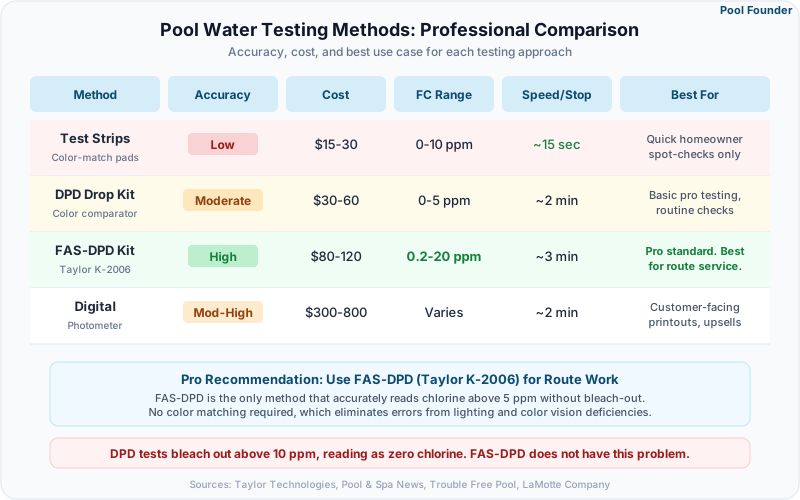
The four testing methods available to pool professionals are test strips, DPD drop kits, FAS-DPD titration kits, and digital photometers. For professional route work, the FAS-DPD method (typically the Taylor K-2006 kit) is the industry standard. FAS-DPD measures free chlorine accurately from 0.2 ppm up to 20 ppm by counting drops of titrant until the sample changes from pink to clear. There is no color matching required, which eliminates errors from poor lighting and color vision deficiencies.
Why Do DPD Tests Bleach Out at High Chlorine Levels?
Standard DPD color-comparator tests have a critical flaw above approximately 10 ppm free chlorine. The excess chlorine destroys the DPD indicator dye, causing the sample to turn clear instead of dark pink. A tech reads this as zero chlorine when the actual level might be 15 or 20 ppm. This "bleach-out" phenomenon is documented by Taylor Technologies and is the primary reason professionals should use FAS-DPD for any pool that has been recently shocked or is running high chlorine. FAS-DPD does not suffer from bleach-out because it uses a titration endpoint rather than color intensity.
Are Digital Photometers Worth the Investment?
Digital photometers (like the LaMotte Spin Lab or various handheld photometers) produce a printed result that looks impressive to customers, which makes them useful for upselling chemical treatments and justifying service charges. However, accuracy is not guaranteed to be higher than FAS-DPD titration. Studies and field comparisons on Pool & Spa News and in the Trouble Free Pool community have shown variances in alkalinity and calcium readings compared to titration kits. Photometer accuracy depends heavily on regular calibration, which many field units lack. For customer presentations and sales, a photometer is a great tool. For treatment decisions, validate against FAS-DPD.
Replace your Taylor K-2006 reagents every year. Expired reagents produce inaccurate results. Store reagents out of direct sunlight and above freezing. A $90 kit with fresh reagents is more accurate than a $500 photometer with expired tablets.
How Should You Record and Track Water Chemistry on a Route?
Testing water at every pool stop means nothing if the readings disappear into a forgotten notebook or get entered into a spreadsheet three days later. Professional chemistry tracking requires recording all parameters at the time of testing, comparing each reading against historical data for that specific pool, and flagging trends before they become problems. A pool that is drifting 5 ppm of CYA per month is heading for a drain in three months, and that is information you need to see now, not after the pool turns green.
Pool Founder tracks every water chemistry reading your techs enter in the field and stores the full history for each pool. When a reading falls outside the ideal range, it flags immediately on the service report. Over time, you can see patterns: which pools drift toward high CYA (trichlor users), which ones fight pH rise (SWG pools), and which ones need extra calcium in winter. That data turns reactive chemistry into proactive maintenance, which means fewer callbacks, fewer green pools, and more trust from customers.
Our chemistry troubleshooting decision tree covers the diagnostic process for every common water problem: cloudy water, green water, pH drift, chlorine demand, staining, scaling, and foam. Bookmark it as a quick-reference guide for the field.
Run a pool route?
The business side of what you just read.
Pricing, chemical costs, and the tools owners use to keep the numbers straight.
- Commercial pool service pricing2026 rate tables and the cost-plus formula
- Chemical cost per poolWhat chemicals actually cost per stop
- Chemical tracking softwareLog readings and dosing from the pool deck
- Pool service softwareRoutes, invoicing, and service reports in one app
- Free profit & rate calculatorsProfit per pool, minimum rate, break-even
Frequently Asked Questions
What is the most important pool chemistry parameter to test?
Free chlorine combined with pH. Free chlorine tells you the sanitizer level, but pH determines how much of that chlorine is actually active. A pool with 3 ppm FC at pH 7.8 has less sanitizing power than a pool with 2 ppm FC at pH 7.2, because chlorine activity drops as pH rises. Always test and evaluate them together.
How often should a pool service professional test water chemistry?
Test free chlorine and pH at every service visit. Test total alkalinity, calcium hardness, and CYA at least monthly, or anytime readings seem inconsistent. Test TDS annually or when water clarity declines without an obvious cause. After heavy rain, a pool party, or chemical treatments, retest within 24 hours.
Why does my pool pH keep rising even after I add acid?
Persistent pH rise is almost always caused by high total alkalinity, CO2 outgassing (common with water features, spillovers, and aeration), or a saltwater chlorine generator producing sodium hydroxide. Lower your TA to 70-80 ppm if you are fighting constant pH rise. For SWG pools, a TA of 60-80 ppm often solves the issue.
Can I use test strips instead of a drop test kit for professional service?
Test strips are not recommended for professional service decisions. They cannot accurately measure FC above 5-10 ppm, they require subjective color matching, and their accuracy is significantly lower than FAS-DPD titration. The Taylor K-2006 FAS-DPD kit is the minimum standard for professional pool testing and measures chlorine from 0.2 to 20 ppm.
What is the Langelier Saturation Index and why does it matter?
The Langelier Saturation Index (LSI) is a single calculated value that tells you whether pool water is balanced, corrosive, or scale-forming. It combines pH, water temperature, calcium hardness, total alkalinity (corrected for CYA), and TDS into one number. The target is -0.3 to +0.3. Individual parameter ranges cannot tell you if water is truly balanced because they do not account for how the parameters interact.
How do I know when a pool needs a partial drain versus a chemical adjustment?
A partial drain is required when a parameter can only be lowered through dilution: CYA above 80-100 ppm, calcium hardness above 500 ppm, or TDS above 2,500 ppm (freshwater pools). These substances cannot be removed by chemical treatment. If the issue is pH, alkalinity, or free chlorine, chemical adjustment is always the first option. Never drain more than one-third of the pool volume at once to avoid hydrostatic pressure damage.
Sources & References
- PHTA/ANSI/ICC-11 2026 American National Standard for Water Quality in Public Pools and Hot Tubs/Spas
- CDC Model Aquatic Health Code, 5th Edition (December 2024)
- Taylor Technologies: FAS-DPD Testing for Accurate Free & Combined Chlorine
- Taylor Technologies: Understanding and Managing Calcium Hardness in Pool & Spa Water
- Orenda Technologies: Total Alkalinity vs. pH and Their Roles in Water Chemistry
- Orenda Technologies: Why Swimming Pool Temperature Matters
- Pool & Spa News: Methods and Limitations of Routine Pool Water Testing
- Indiana State Department of Health: How to Shock the Pool (Breakpoint Chlorination)
- PHTA and ICC Publish Revised Water Quality Standard (Pool Pro Magazine)