Why Are You Still Running Your Business on Paper?
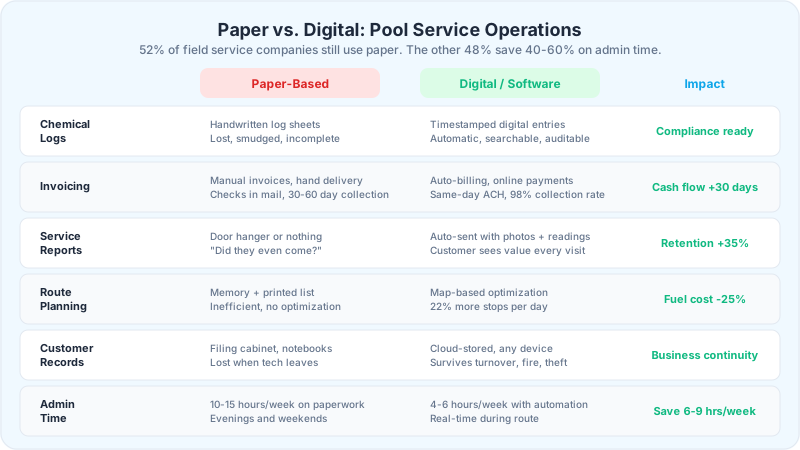
52% of field service companies still rely on paper, pens, and manual processes according to Quixy research. In pool service, that means handwritten chemical logs that get wet and smudged, invoices delivered by hand or mailed weeks late, and customer records stored in a filing cabinet that burns if the office burns. Meanwhile, businesses that adopt digital workflows report reducing administrative time by 40-60% and achieving productivity improvements of 24% within the first year.
Going paperless is not about technology for its own sake. It is about eliminating the friction that slows down every part of your operation. A chemical reading logged on paper has to be manually transferred to a report. An invoice written by hand has to be mailed, tracked, and reconciled. A route planned from memory gets slower every time you add a customer. Digital systems eliminate all of these manual steps, and the savings compound across every customer, every route, and every month.
Corey Adams, Pool Founder co-founder and 15-year pool service veteran: "I ran on paper for my first 5 years. Clipboard in the truck, handwritten invoices, chemical logs in a binder. I spent 10-12 hours a week on admin work. When I went digital, that dropped to 4 hours. Those 6 extra hours became 10 more pools on my route, which added $1,500/month in revenue."
What Does Paper Cost Your Pool Service Business?
The cost of paper is not the paper itself. It is the time spent writing, filing, searching, and re-entering information that already exists somewhere else. For a 60-pool operation, paper-based processes cost 6-10 hours per week in administrative overhead, which translates to $15,000-$25,000 per year in lost productive time at a $50/hour opportunity cost.
| Paper Process | Weekly Time Cost | Annual Cost (at $50/hr) | Digital Alternative |
|---|---|---|---|
| Handwriting chemical logs | 2-3 hours | $5,200-$7,800 | Digital logging in pool software (90 sec/stop) |
| Creating and sending invoices | 2-3 hours | $5,200-$7,800 | Auto-billing generates and sends invoices |
| Route planning and directions | 1-2 hours | $2,600-$5,200 | Route optimization with one-click navigation |
| Filing and finding customer records | 1-2 hours | $2,600-$5,200 | Cloud database searchable in seconds |
| Phone tag for scheduling changes | 1-2 hours | $2,600-$5,200 | Automated notifications and customer portal |
40-60%
reduction in administrative time when field service businesses adopt digital workflows and automation
Source: Fieldproxy Digital Transformation Guide 2026
How Do You Digitize Chemical and Service Logs?
Chemical logs are the most immediate win when going paperless. Paper logs are the number one compliance failure during health department inspections for commercial pools, and they are the number one source of "I do not know what my pool guy does" complaints from residential customers. Digital chemical logs solve both problems simultaneously.
What Digital Chemical Logging Looks Like
- Technician arrives at the pool, opens the mobile app, and taps the customer
- Enters chemical readings (free chlorine, pH, alkalinity, CYA) with pre-set input fields
- App auto-calculates dosing recommendations based on pool volume and current readings
- Technician logs chemical additions (what, how much)
- Takes a photo of the pool (optional but recommended)
- Marks service tasks as complete (skim, brush, vacuum, empty baskets, backwash)
- Hits complete. The service report auto-generates and sends to the customer.
- All data is timestamped, GPS-verified, and stored in the cloud permanently
Total time per stop: 60-90 seconds of data entry, compared to 3-5 minutes of handwriting the same information on a paper log sheet. Across 15 stops per day, that saves 30-50 minutes daily. Over a 5-day week, you save 2.5 to 4 hours. Over a year, that is 130 to 200 hours of productive time recovered.
Digital logs have one advantage paper can never match: they cannot be backdated. When a timestamp shows the reading was taken at 10:47 AM on Tuesday, there is no question about whether the test was actually performed. This matters for commercial compliance and for residential customer trust.
How Do You Switch to Digital Invoicing and Payments?
Paper invoicing is the most expensive administrative process in pool service because it directly affects cash flow. A paper invoice mailed on the 1st might not arrive until the 5th, might not be opened until the 10th, and might not be paid until the 30th. A digital invoice sent on the 1st with auto-pay enabled is collected the same day. That 30-day cash flow improvement is transformative for a small business.
The Digital Billing Transition
- 1Set up your billing software with your bank account and payment processor
- 2Import your customer list with current rates and billing frequency
- 3Create recurring billing profiles for each customer (monthly, quarterly)
- 4Move new customers to auto-pay (credit card or ACH) at sign-up. Make this the default.
- 5For existing customers, send an email explaining the switch: "We are upgrading to digital billing for faster, more reliable invoicing. Your rate stays the same."
- 6Offer a $5-$10/month discount for customers who enroll in auto-pay within 30 days
- 7Keep manual invoicing as a backup for the 10-15% of customers who refuse digital payment
| Payment Method | Collection Rate | Days to Collect | Admin Time |
|---|---|---|---|
| Auto-pay (card/ACH) | 98-99% | 0-1 days | Near zero |
| Digital invoice + online payment | 92-95% | 3-7 days | Minimal (auto-reminders) |
| Emailed PDF invoice | 85-92% | 14-30 days | Moderate (manual follow-up) |
| Mailed paper invoice | 80-88% | 30-60 days | High (print, mail, track, chase) |
| Verbal "I will pay you" | 60-75% | 30-90+ days | Very high (constant follow-up) |
The goal is to get 80%+ of customers on auto-pay within 6 months of going digital. Every customer on auto-pay is a customer you never chase for payment. At 100 pools, moving from 50% to 80% auto-pay saves 4-6 hours per month in billing admin and improves collection rate by 5-8%.
How Do You Replace Paper Service Reports?
Paper service reports come in two forms: a door hanger left at the pool saying "We were here" or nothing at all. Both fail because they do not show the customer what was done, what was tested, or what condition their pool is in. Digital service reports with photos, chemical readings, and task completion replace the "did they even come?" question with visible proof of professional service.
What a Digital Service Report Includes
- Date and time of service with technician name
- Chemical readings: free chlorine, pH, alkalinity, CYA, calcium hardness
- Chemical additions: what was added and how much
- Service tasks completed: skim, brush, vacuum, empty baskets, backwash
- Equipment notes: pump pressure, filter condition, any issues observed
- Photos: pool surface, equipment pad, or any problem areas
- Recommendations: upcoming maintenance needs, equipment to monitor
- Chemistry trend chart showing readings over the last 4-8 visits
Digital service reports are the single most effective retention tool in pool service. Customers who receive reports with chemical data and photos after every visit are measurably more likely to stay because they can see and verify the value of the service they are paying for. It eliminates the transparency gap that drives cancellation.
How Do You Transition Your Team to Digital?
The biggest obstacle to going paperless is not the software. It is your team. Technicians who have used paper clipboards for years will resist change unless you make the transition easy, demonstrate the benefits, and enforce the new process consistently. Plan for a 2-4 week transition period where you run paper and digital in parallel.
The 4-Week Transition Plan
| Week | Focus | Actions | Success Metric |
|---|---|---|---|
| Week 1 | Setup and training | Install app on all phones. 30-min training session. Practice with 5 test entries. | Every tech can log a stop in under 2 min |
| Week 2 | Parallel operation | Use both paper and digital. Digital entries are the priority. | 80% of stops logged digitally |
| Week 3 | Digital primary | Paper as backup only. Address tech-specific issues. | 95% of stops logged digitally |
| Week 4 | Paper eliminated | Remove paper logs from trucks. Digital is the only system. | 100% digital logging |
Overcoming Technician Resistance
- Show them the time savings: "This saves you 30 minutes a day in paperwork"
- Make it easier than paper: if the app takes more taps than writing, simplify the workflow
- Provide a phone or tablet if their personal device is not adequate
- Celebrate early wins: share the first service report a customer compliments
- Make it non-negotiable after Week 4. Digital logging is part of the job.
- Address connectivity concerns: ensure the app works offline and syncs when signal returns
The biggest mistake in digital transitions is making the new system optional. If paper and digital coexist permanently, your team will default to paper because it is familiar. Set a hard cutoff date. After Week 4, paper logs are not accepted.
What Is the ROI of Going Paperless?
The ROI of going paperless comes from five sources: time savings on admin work, faster cash flow from digital billing, higher retention from service reports, more stops per day from route optimization, and reduced compliance risk from digital record-keeping. For a 60-pool operation, the combined annual benefit is $15,000-$30,000 against a software cost of $600-$1,200 per year.
| Benefit | Annual Value (60 pools) | How It Is Realized |
|---|---|---|
| Admin time saved (6 hrs/week) | $15,600 | 6 hrs x $50/hr x 52 weeks |
| Faster cash flow (30 days) | $2,000-$4,000 | Reduced float cost and bad debt |
| Retention improvement (5%) | $5,580 | 3 fewer cancellations x $155/mo x 12 |
| Route efficiency (10%) | $3,000-$5,000 | Reduced fuel + 2-3 more stops capacity |
| Compliance protection | Risk avoidance | Prevents fines, lawsuits, pool closures |
24%
average productivity improvement within the first year of implementing field service management software, with companies running 50-99 technicians seeing 26% improvement
Source: Quixy Field Service Industry Statistics 2025
Most companies see initial ROI within the first 2-3 months as billing automation kicks in and admin time drops. Full ROI materializes within 6-12 months as retention improvements, route efficiency gains, and team productivity increases compound across the business.
Pool Founder is built for pool service companies making the paper-to-digital transition. It handles route optimization, chemical tracking, digital service reports, automated billing, and customer notifications in a single platform designed for the way pool techs actually work in the field.
Ready to streamline your pool service business?
Pool Founder gives you route optimization, automated invoicing, chemical tracking, and everything else you need to run a more profitable pool business.
Frequently Asked Questions
How much time does going paperless save a pool service company?
Pool service companies save 6-10 hours per week on administrative work by switching from paper to digital operations. The savings come from automated invoicing (2-3 hrs/week), digital chemical logging (2-3 hrs/week), route optimization (1-2 hrs/week), and reduced customer communication overhead (1-2 hrs/week).
What is the first thing to digitize in a pool service business?
Start with billing and invoicing. It has the most immediate financial impact because it accelerates cash flow by 30+ days and improves collection rates from 80-88% (paper) to 98-99% (auto-pay). After billing, digitize chemical logs, then service reports, then route planning.
How long does it take to transition a pool service company to paperless?
Plan for 4 weeks: Week 1 for setup and training, Week 2 for parallel operation (paper + digital), Week 3 for digital-primary, and Week 4 for full digital. Most teams are fully transitioned within a month. The key is setting a hard cutoff date and not allowing paper as a permanent backup.
Do health departments accept digital pool chemical logs?
Yes. Most jurisdictions accept digital records as long as the system produces date-stamped, printable reports on demand and maintains an audit trail. Digital logs are often preferred by inspectors because they cannot be backdated and provide a complete, searchable history.
How much does pool service software cost for going paperless?
Pool service software costs $30-$100/month for most small to mid-size operations. Against 6-10 hours/week in time savings at $50/hour opportunity cost, the software pays for itself within the first week of use. Additional ROI comes from improved retention, faster cash flow, and route efficiency.
Sources & References
- Quixy - Field Service Industry Statistics and Market Size 2025
- Fieldproxy - Pool Service Software Digital Transformation Guide
- Dataforma - Going Paperless: Transition to Cloud-Based Field Service
- FieldAx - Digital Transformation Guide for Field Service Companies 2026
- InvoiceASAP - Paperless Workflow for Field Teams 2025