How Big Should Your Pool Route Be?
50-65
weekly pools is the typical full route for a solo operator working 5 days
Source: National Pool Route Sales, pool route broker data
13-16
pools per day per technician is the target on well-routed stops
Source: Industry benchmarks, OptimoRoute
$160-175
average monthly revenue per residential pool for weekly service in 2026
Source: PoolDial, pool route broker data
Route size is the single number that determines your revenue ceiling, daily workload, and hiring timeline. Too few pools and you are leaving money on the table. Too many per technician and quality drops, callbacks increase, and you start losing the customers that fund the whole operation. The right route size depends on whether you are a solo operator, running a small team, or managing a mid-size operation with four or more trucks.
This article breaks down average route sizes by company type, revenue benchmarks per pool, and the relationship between route density and profitability. The data comes from pool route brokers, industry surveys, and operator benchmarks compiled from PoolDial, IBISWorld, and Corey Adams' 15 years running routes in Florida.
Solo Operator Route Size: 50-65 Pools Per Week
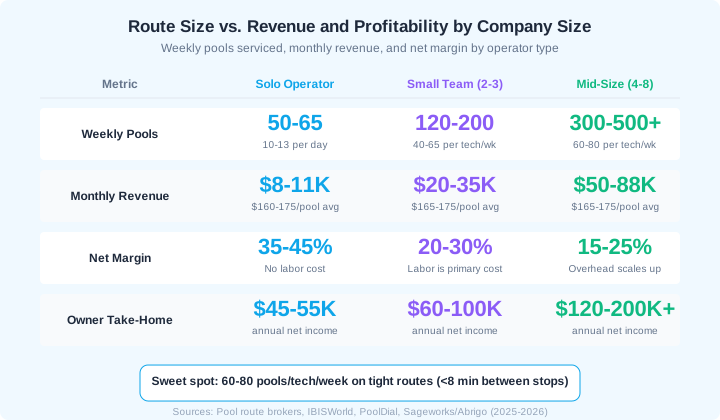
A solo operator running a full-time residential route typically services <b>50 to 65 pools per week</b> across five working days. That works out to 10-13 pools per day. The range depends on pool size, service complexity, drive time between stops, and whether you are handling chemical-only visits or full clean and check service.
At an average monthly rate of $160-175 per pool, a 50-pool route generates approximately $8,000-8,750 per month in recurring service revenue, or $96,000-105,000 annually. A 65-pool route pushes that to $10,400-11,375 monthly, or $124,800-136,500 per year. Solo operators who keep overhead minimal (one truck, home office, minimal software costs) typically keep 35-45% of that as net income.
| Route Size | Monthly Revenue | Annual Revenue | Est. Net Income (40%) |
|---|---|---|---|
| 40 pools | $6,400-7,000 | $76,800-84,000 | $30,700-33,600 |
| 50 pools | $8,000-8,750 | $96,000-105,000 | $38,400-42,000 |
| 60 pools | $9,600-10,500 | $115,200-126,000 | $46,100-50,400 |
| 65 pools | $10,400-11,375 | $124,800-136,500 | $49,900-54,600 |
The "sweet spot" for a solo operator is around 50-55 pools per week. That leaves time for 3-4 hours of admin, quote follow-ups, and the occasional repair call. Pushing past 65 pools solo means either cutting corners on service quality or working 6-day weeks, both of which lead to burnout and churn.
Small Team Route Size: 120-200 Pools Per Week
A small team of 2-3 technicians (including the owner on a route) typically services <b>120 to 200 pools per week</b>. Each technician should handle 40-65 pools per week depending on experience and route density. The owner often runs the largest route while a newer tech builds up from 30-40 pools.
At this size, monthly service revenue ranges from $20,000 to $35,000. The jump from solo to small team is where most operators feel the margin compression. Adding one technician at $17-21 per hour plus payroll taxes, workers comp, and a second vehicle drops net margin from 35-45% to 20-30%. The math only works if the additional tech adds enough pools to more than cover their fully loaded cost.
The break-even point for a new technician is typically 35-40 pools. Below that, the tech costs more than they generate. Above 50 pools, the tech is contributing meaningful profit. This is why the first hire is the hardest transition in pool service. You need enough demand to justify the hire before you make it, which usually means the owner is overloaded at 70+ pools and starting to drop quality.
Corey's advice on the first hire: "I waited too long. I was running 75 pools solo, callbacks were climbing, and I was losing customers faster than I gained them. The right time to hire is at 55-60 pools, before you start losing accounts from quality slips. Hire at 55, give the new tech 25 pools to start, and keep growing both routes together."
Mid-Size Operation Route Size: 300-500+ Pools Per Week
Companies with 4-8 technicians service <b>300 to 500+ pools per week</b>. At this scale, the owner is typically off the truck and focused on sales, operations, and quality control. Each technician runs 60-80 pools per week on mature, optimized routes.
Monthly revenue at this level ranges from $50,000 to $88,000+ for service alone, with additional revenue from repairs, equipment replacements, and seasonal work. Net margins compress further to 15-25% as overhead scales: office staff, additional vehicles, insurance for a larger fleet, and management time. But the absolute dollar amount of profit increases significantly. A 20% net margin on $70,000/month is $14,000, compared to 40% on $9,000/month ($3,600) for a solo operator.
Revenue Per Pool: What You Should Be Charging
The national average for weekly residential pool service in 2026 is <b>$160-175 per month</b>, with significant regional variation. Sun Belt markets with year-round service typically charge $140-200, while seasonal markets charge higher monthly rates during the active season (often $175-225) with reduced or suspended billing during the off-season.
| Market Type | Monthly Rate Range | Annual Revenue Per Pool |
|---|---|---|
| Sun Belt (year-round) | $140-200 | $1,680-2,400 |
| Seasonal (8-9 month) | $175-225 | $1,400-2,025 |
| Premium/Custom pools | $200-350 | $2,400-4,200 |
| Commercial accounts | $250-600 | $3,000-7,200 |
If your average revenue per pool is below $150, you are almost certainly underpriced for 2026 cost structures. Chemical prices have stabilized after the 2021-2023 spikes, but labor costs continue to rise at 3-5% annually. Fuel costs remain elevated. A pool that was properly priced at $130 in 2022 needs to be $155-165 today to maintain the same margin.
Track your revenue per pool monthly. Pool Founder's profitability dashboard shows this metric by route and by customer, so you can identify which accounts are dragging your average down and which ones are funding the operation.
Route Density: The Hidden Profitability Lever
Route density, measured as average drive time between stops, has a bigger impact on profitability than almost any other factor. The target is <b>under 8 minutes between stops</b>. Every minute above 8 costs roughly $0.50 in fuel plus 1-2 minutes of unbillable time. Over a full route of 13 pools, the difference between 6-minute spacing and 12-minute spacing is 78 minutes of wasted time per day, or roughly 6.5 hours per week.
Dense routes allow more stops per day (14-16 on tight routes vs. 8-10 on spread-out routes), which directly increases revenue per tech per day. A tech running 15 stops at $40/visit generates $600/day compared to $360/day at 9 stops. Same hours, same truck, dramatically different output.
| Avg. Drive Time | Pools Per Day | Daily Revenue (at $40/stop) | Weekly Revenue |
|---|---|---|---|
| Under 6 min | 15-16 | $600-640 | $3,000-3,200 |
| 6-8 min | 13-14 | $520-560 | $2,600-2,800 |
| 8-12 min | 10-12 | $400-480 | $2,000-2,400 |
| 12+ min | 8-9 | $320-360 | $1,600-1,800 |
The best way to improve route density is to cluster your marketing and new customer acquisition by zip code. Rather than accepting any customer anywhere in your service area, focus on the neighborhoods where you already have stops. Offering a discount to customers in your densest zip codes can actually increase profitability even at a lower per-pool rate because the reduction in drive time more than offsets the price difference.
When to Add Another Route vs. Filling Existing Routes
The decision between filling existing routes and adding a new one comes down to simple math. If your current technicians are at 55-60 pools per week each, there is room to add 5-10 more stops per route before you need another truck. If a tech is at 70+ stops and quality metrics are slipping (callbacks above 5%, chemical readings inconsistent), you need to split the route.
- 1<b>Under 50 pools per tech:</b> Fill existing routes. Focus all marketing on zip codes adjacent to current stops.
- 2<b>50-65 pools per tech:</b> Optimal range. Start planning for the next hire but do not rush it.
- 3<b>65-75 pools per tech:</b> At capacity. You are probably seeing quality dip. Start interviewing and training.
- 4<b>75+ pools per tech:</b> Over capacity. You are losing customers from service quality issues. Split immediately.
Pool Founder's route management shows pools per tech, average time per stop, and drive time between stops. When a tech crosses 65 pools, the system flags it so you can plan the split before quality suffers.
Free starter kit
Start a pool service business with the numbers already run.
A short email series from an owner who started with $1,200 and a used truck. No software pitch, just the four things that decide whether year one works.
- Startup cost breakdownEvery line item from $2K bootstrap to fully equipped
- Pricing calculatorThe minimum you can charge per visit and still profit
- First-10-customers playbookDoor hangers, referrals, and the phone script that closes
- Licensing & insurance checklistWhat your state requires and which insurers pay claims
Already running routes? Try Pool Founder free
Frequently Asked Questions
How many pools can one person service per day?
A solo operator or technician on well-routed stops can service 13-16 pools per day. With tight route density (under 8 minutes between stops), the upper end is achievable. Spread-out routes with 12+ minute drive times limit a tech to 8-10 pools per day. The national average for a trained technician is approximately 12-14 pools per day.
What is the average revenue per pool for weekly service?
The national average for weekly residential pool service in 2026 is $160-175 per month. Sun Belt markets with year-round service typically range from $140-200 per month. Seasonal markets charge $175-225 during the active season. Premium and custom pools command $200-350 monthly. If your average is below $150, you are likely underpriced for current cost structures.
How many pools do you need to make a living in pool service?
At $160-175 per pool per month with a 35-45% net margin (solo operator), you need approximately 40-50 pools to earn $30,000-42,000 annually. A 60-pool route generates roughly $48,000-54,000 in net income. Most solo operators target 50-65 pools as the sweet spot that provides solid income without burning out.
When should a pool service company hire its first technician?
The optimal time to hire your first technician is when you reach 55-60 pools on your personal route. Waiting until you are at 70+ pools means you are already losing customers from service quality issues. The new hire should start with 25-30 pools while you continue running 55-60, growing both routes simultaneously.
What is a good route density for pool service?
Target under 8 minutes average drive time between stops. Routes with 6-minute spacing allow 15-16 pools per day and generate $600+ in daily revenue per tech. Routes with 12+ minute spacing are limited to 8-9 pools per day and generate $320-360. Dense routes are 50-70% more productive than spread-out routes.