Why Does Route Density Matter More Than How Many Pools You Service?
Route density is the number of service stops concentrated within a given geographic area, and it is the single biggest factor that separates profitable pool companies from ones that just stay busy. A 60-pool route where every stop is within two miles of the next generates more profit than a 90-pool route scattered across three zip codes, because the scattered route burns 45-85 extra miles per day in drive time, fuel, and vehicle wear that produces zero revenue. The IRS values those wasted miles at $0.725 each in 2026, meaning poor density can quietly drain $8,000-$16,000 per year from your bottom line.
Corey spent years building and buying pool routes before co-founding Pool Founder, and the pattern was always the same: the routes that looked great on paper (high pool count, decent monthly revenue) often underperformed routes half their size because they were spread too thin. This guide covers exactly how to measure your route density, what good density looks like, and five concrete tactics to tighten your routes so every mile you drive earns more money.
What Is Route Density and How Do You Measure It?
Route density measures how tightly your service stops are clustered within your service area. Higher density means shorter drive times between stops, lower fuel costs, and more billable hours per day. There are three practical ways to measure it, and every pool service owner should track at least one.
What Are the Best Metrics for Measuring Route Density?
The most actionable density metric is revenue per mile driven, calculated by dividing total route revenue by total miles driven in a month. This single number captures the financial impact of your route layout better than pool count or gross revenue alone. A route generating $12,000/month over 1,200 miles ($10/mile) is meaningfully more profitable than one generating $15,000/month over 2,400 miles ($6.25/mile).
| Metric | How to Calculate | What It Tells You |
|---|---|---|
| Revenue per mile | Monthly route revenue / total miles driven | Dollar return on every mile of driving, the clearest profitability signal |
| Average drive time between stops | Total daily drive time / number of stops | Whether your stops are clustered or scattered, target under 7 minutes |
| Drive time percentage | (Drive time / total work hours) x 100 | How much of your day is spent driving vs. servicing, target under 30% |
| Stops per route mile | Daily stop count / total daily miles | Raw geographic concentration of your customers |
Track your drive time percentage for one week. If your techs are spending more than 30% of their day driving, your routes have a density problem that is costing you thousands annually.
What Does Good Route Density Look Like?
Good route density means a technician averages 3-7 minutes of drive time between stops and spends less than 30% of their total work day behind the wheel. In practical terms, that looks like 12-15 full-service pools per day within a 40-55 mile total radius, with most stops clustered in 2-3 adjacent neighborhoods. Poor density looks like 10-12 pools per day covering 80+ miles with 10-15 minute gaps between stops.
How Many Pools Can a Technician Service Per Day With High Density?
With tight route density, an experienced technician can service 14-18 full-service residential pools per day. Each stop takes roughly 30-45 minutes of on-site service time. With 3-5 minutes of drive time between clustered stops, that works out to 35-50 minutes per stop total, fitting 14-16 stops comfortably into a 9-hour day. Scattered routes with 10-15 minute drive gaps cap out at 10-12 pools because 2-2.5 hours are lost to windshield time.
| Metric | High Density | Medium Density | Low Density |
|---|---|---|---|
| Drive time between stops | 3-5 min | 7-10 min | 12-20 min |
| Total daily miles | 35-55 | 55-75 | 80-120 |
| Full-service stops/day | 14-18 | 11-13 | 8-10 |
| Drive time % of day | 15-22% | 28-35% | 38-50% |
| Revenue per mile | $8-12+ | $5-8 | $3-5 |
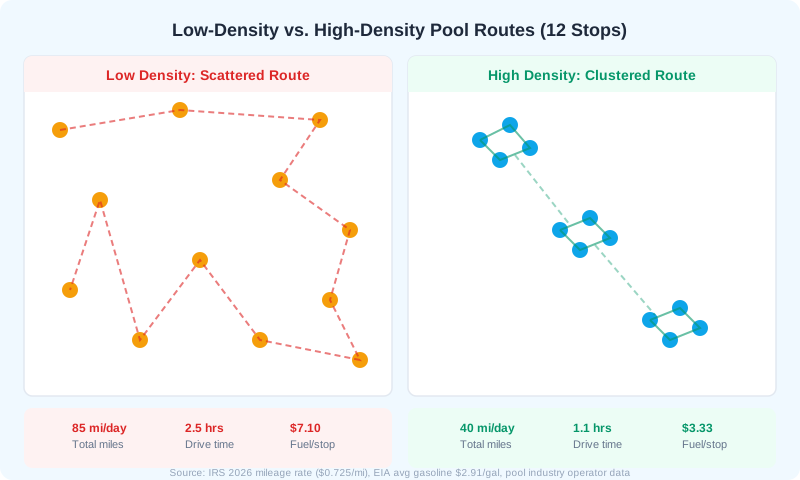
A route with 15-20 accounts within a 5-mile radius is the sweet spot for residential pool service. Below that threshold, you need premium pricing to offset the extra drive time.
What Is the Financial Impact of Poor Route Density?
Poor route density silently erodes profit because the costs are spread across fuel, vehicle wear, lost capacity, and opportunity cost rather than showing up on a single line item. A pool tech driving 85 miles per day instead of 45 miles burns an extra $11,700 per year at the IRS rate of $0.725/mile. But the bigger cost is lost capacity: those extra 80-90 minutes of daily drive time represent 2-3 stops you cannot fit into the day, or $28,000-$47,000 in revenue you never bill.
How Much Does Each Extra Mile Between Stops Actually Cost?
Every extra mile driven costs $0.725 in direct vehicle expense according to the 2026 IRS standard mileage rate, which accounts for fuel, depreciation, insurance, and maintenance. With regular gasoline averaging $2.91/gallon nationally in 2026 and a typical service truck getting 15-18 MPG, fuel alone runs $0.16-$0.19 per mile. The remaining $0.53-$0.56 covers maintenance ($0.09/mile for light-duty vehicles according to fleet maintenance benchmarks), depreciation, tires, and insurance.
| Cost Category | Per Extra Mile | Per 40 Extra Miles/Day | Annual (260 Days) |
|---|---|---|---|
| Fuel ($2.91/gal, 16 MPG) | $0.18 | $7.28 | $1,891 |
| Vehicle maintenance | $0.09 | $3.60 | $936 |
| Depreciation and wear | $0.34 | $13.60 | $3,536 |
| Insurance allocation | $0.12 | $4.60 | $1,196 |
| Total (IRS rate) | $0.725 | $29.00 | $7,540 |
$7,540-$15,950
Annual cost of driving 40 extra miles per day due to poor route density, including lost revenue from 2 missed stops/day
Source: IRS 2026 standard mileage rate, EIA gasoline price data
What Revenue Do You Lose From Low-Density Routes?
The real damage from poor density is not the fuel bill. It is the revenue you cannot earn. With average residential pool service rates of $120-$160/month (roughly $30-$40 per weekly visit), every stop you cannot fit into the day costs $7,800-$10,400 in annual revenue. A tech stuck in traffic between scattered stops who misses just 2 pools per day compared to a tight-route tech loses your company $15,600-$20,800 per year in unbilled capacity.
Run this math on your own routes: take your daily mileage, subtract 45 miles (a tight-route baseline for 12-15 stops), and multiply the excess miles by $0.725. Then count how many stops per day you are missing versus a tech running a tight route. The combined number is what low density costs you annually.
How Do You Improve Route Density?
Improving route density comes down to five tactics: targeted neighborhood marketing, dropping or repricing outlier accounts, swapping accounts with other operators, restructuring route days by geography, and using software to identify clustering opportunities. Most operators can improve density 20-30% within 90 days by combining just two or three of these approaches.
1. How Does Targeted Neighborhood Marketing Build Density?
Instead of marketing to your entire service area and accepting every lead regardless of location, target the specific neighborhoods and zip codes where you already have customers. Every new customer you add within an existing cluster costs you almost zero incremental drive time, meaning the full service fee drops straight to your bottom line. Door hangers, yard signs at current customer properties, and zip-code-targeted digital ads are the three highest-ROI tactics for neighborhood-level acquisition.
- Place yard signs or door hangers within a 3-block radius of every current customer
- Run Google Ads targeted to the specific zip codes where you already have 5+ accounts
- Ask current customers for neighbor referrals with a small incentive ($25-$50 service credit)
- Post in neighborhood Facebook groups and Nextdoor communities where you are already active
- When quoting new customers, prioritize leads in high-density zones over distant prospects
2. When Should You Drop or Reprice Outlier Accounts?
An outlier account is any customer more than 15 minutes of drive time from your nearest cluster. That single stop adds 30+ minutes of round-trip drive time to your day, which means the actual cost to service that account is $10-$15 higher than a clustered account after fuel, vehicle wear, and lost capacity. You have two options: raise the price to cover the true cost of service, or drop the account and replace it with a customer closer to your existing routes.
Before dropping an outlier, calculate the "density-adjusted profit" for that stop: monthly service fee minus the true cost of the extra drive time (extra miles x $0.725 x 4.3 weeks). If the adjusted profit is under $40/month, the account is dragging down your route.
3. How Do Route Swaps With Other Operators Work?
Route swaps are when two pool service companies trade accounts that are geographically closer to each other, and they are one of the fastest ways to improve density without losing revenue. If you have 5 accounts on the east side that are 20 minutes from your core territory, and another operator has 5 accounts on the west side near your clusters, trading those accounts improves density for both companies at zero cost.
- Network with other pool service operators in your metro area through IPSSA chapters or local trade groups
- Identify your 5-10 most geographically isolated accounts and map them
- Propose even swaps (matching monthly revenue) or negotiate a small buyout differential
- Handle the customer transition professionally with joint communication to minimize churn
- A well-executed swap can eliminate 30-60 minutes of daily drive time overnight
4. How Do You Restructure Route Days by Geography?
Many operators assign customers to route days based on when they signed up rather than where they live. Monday might include stops from three different zip codes because those customers all happened to start service on a Monday. Restructuring route days so that each day covers a tight geographic zone is the single highest-impact change you can make. It typically reduces total weekly mileage by 20-35%.
- 1Map all your current customers and color-code them by service day
- 2Identify geographic clusters and assign each cluster to a single route day
- 3Rebalance so each day has roughly equal stop counts (within 2-3 stops)
- 4Notify affected customers 7-10 days before the change with a brief, positive explanation
- 5Optimize the stop sequence within each day using routing software
5. How Does Route Software Help Identify Density Opportunities?
Route software with geographic clustering automatically groups stops by location, highlights outlier accounts, and calculates drive time savings from restructuring, turning a manual 3-4 hour project into a 10-minute exercise. Pool Founder shows you a visual route map with color-coded stops and drive-time estimates, so you can see exactly where your density gaps are and what it would look like to rebalance. The system also auto-assigns new customers to the closest geographic route day, preventing density from degrading as you grow.
What Does the Math Look Like: Low Density vs. High Density?
The difference between a low-density and high-density route is not marginal. It is the difference between a pool tech earning you $55,000/year in gross profit and earning you $85,000+/year doing the same hours of work. Here is the side-by-side comparison for a single technician running a 5-day route.
| Low Density (Scattered) | High Density (Clustered) | Difference | |
|---|---|---|---|
| Stops per day | 10 | 15 | +5 stops/day |
| Monthly revenue per stop | $140 avg | $140 avg | -- |
| Monthly gross revenue | $6,067 | $9,100 | +$3,033/month |
| Daily miles driven | 90 | 45 | -45 miles/day |
| Annual fuel cost | $4,354 | $2,177 | -$2,177/year |
| Annual vehicle cost (IRS rate) | $16,965 | $8,483 | -$8,483/year |
| Revenue per mile driven | $4.32 | $12.95 | +$8.63/mile |
At $140/month average service rate and 4.33 weeks per month, each stop generates roughly $32 per visit. The high-density tech fits 5 more stops per day by spending 1.4 fewer hours driving. Over 260 work days, that is 1,300 additional stops and $41,600 in added annual revenue from the same work hours. The fuel and vehicle savings add another $8,483. Total annual difference: roughly $50,000 per tech.
$50,000+
Annual profit difference per technician between a low-density and high-density route
Source: Calculated from IRS 2026 mileage rate, EIA fuel data, and industry service rate averages
This is not theoretical. These numbers come from real-world route comparisons. If you run a 3-tech operation, fixing density across all routes is worth $100,000-$150,000 per year in combined revenue gains and cost savings.
How Do You Maintain Route Density as You Grow?
Route density naturally degrades over time as you add customers from different areas, lose customers in your core zones, and hire new techs without rebalancing. The operators who maintain high density treat it as an ongoing discipline, not a one-time project. Three habits prevent density drift: geographic-first customer acceptance, monthly route audits, and zone-based capacity limits.
What Is Geographic-First Customer Acceptance?
Geographic-first acceptance means evaluating every new lead based on where it falls relative to your existing routes before considering whether to quote it. A $200/month pool 25 minutes from your nearest cluster is less profitable than a $120/month pool 3 minutes from an existing stop. Train your intake process to check the address against your route map before scheduling a quote visit.
How Often Should You Audit Route Density?
Review your routes monthly if you are adding more than 3-4 new customers per month, or quarterly if your customer base is stable. The audit is simple: pull up your route map, look for any stop that is more than 10 minutes from its nearest neighbor, and either flag it for repricing, relocation to a different day, or replacement. Pool Founder tracks revenue per mile and drive time percentage automatically, so the audit takes minutes instead of hours.
What Are Zone-Based Capacity Limits?
Once a geographic zone reaches 45-50 weekly service pools, split it into two sub-zones rather than letting a single tech cover an expanding area. This prevents the gradual sprawl that kills density. Each sub-zone stays tight, and new customers get assigned to the sub-zone closest to their address. When a sub-zone fills up, you know it is time to add a tech for that area specifically.
- Define 3-5 geographic zones based on neighborhoods, major roads, or zip codes
- Set a capacity limit per zone (45-50 weekly pools for full service)
- When a zone fills, stop accepting new customers outside existing clusters
- Split zones geographically when they exceed capacity rather than stretching boundaries
- Use route software to track zone utilization and alert you before capacity is reached
Ready to streamline your pool service business?
Pool Founder gives you route optimization, automated invoicing, chemical tracking, and everything else you need to run a more profitable pool business.
Frequently Asked Questions
What is a good route density for pool service?
Good pool service route density means averaging 3-7 minutes of drive time between stops, with drive time accounting for less than 30% of the work day. In practical terms, that translates to 12-15 full-service stops per day within a 40-55 mile total driving radius, with most stops clustered in 2-3 adjacent neighborhoods. Revenue per mile driven should be $8 or higher.
How many pools should a pool tech service per day?
With high route density, an experienced pool technician can service 14-18 full-service residential pools per day. Each stop takes roughly 30-45 minutes of on-site time, plus 3-5 minutes of drive time between clustered stops. Scattered routes with poor density reduce this to 8-10 pools per day because 2-2.5 hours are lost to drive time. Chemical-only stops are faster and allow higher daily counts.
How do I calculate revenue per mile for my pool route?
Divide your total monthly route revenue by the total miles driven that month. For example, if your route generates $12,000/month and you drive 1,200 miles, your revenue per mile is $10. Target $8-12+ per mile for a healthy route. Below $5/mile indicates a serious density problem that is costing you thousands in unnecessary vehicle expense and lost capacity annually.
Should I drop customers that are far from my route?
If an outlier account is more than 15 minutes of drive time from your nearest cluster, calculate the density-adjusted profit first: monthly service fee minus extra drive cost (extra round-trip miles x $0.725 x 4.3 weeks/month). If adjusted profit drops below $40/month, either raise the price to cover true service cost or replace the account with a closer customer. Trading outlier accounts with other operators is another option.
How much does poor route density cost a pool service company?
Poor route density costs $8,000-$16,000+ per year per technician in direct vehicle costs (calculated at the 2026 IRS standard mileage rate of $0.725/mile). The bigger cost is lost revenue from reduced daily capacity. A scattered route tech who completes 10 stops/day instead of 15 misses roughly 1,300 stops per year, representing $40,000+ in unbilled revenue at average service rates.
What is the IRS mileage rate for 2026?
The IRS standard mileage rate for business use in 2026 is $0.725 per mile (72.5 cents), up from $0.70 per mile in 2025. This rate covers fuel, depreciation, insurance, maintenance, and other vehicle operating costs. Pool service companies can use this rate to calculate the true cost of every mile driven and to evaluate whether outlier accounts are worth keeping on their routes.
Sources & References
- IRS — 2026 Standard Mileage Rate (72.5 cents per mile)
- U.S. Energy Information Administration — Motor Fuel Prices February 2026 ($2.91/gal avg)
- Sealey Business Brokers — Route Density Matters: Why 10 Pools in One Zip Code Beats 20 Across the County
- OxMaint — Fleet Maintenance Costs: How Much Should You Budget Per Vehicle 2025 ($0.09/mile light-duty)
- HomeGuide — 2026 Pool Maintenance Costs ($80-$350/month avg)
- The Globe and Mail — QuoteIQ Route Density for Field Service Businesses
- ResponsibleFleet — How Route Optimization & Fleet Efficiency Save Thousands in 2026