Why Do Pool Service Industry Statistics Matter for Your Business?
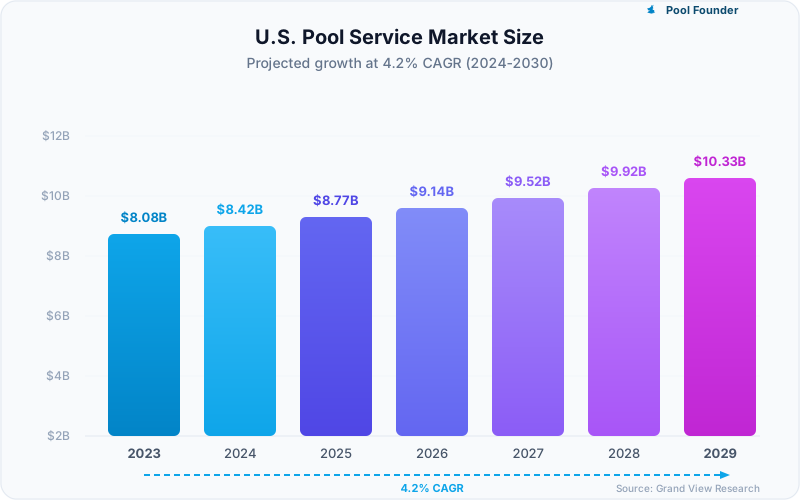
The U.S. pool service industry surpassed $8 billion in 2023, is projected to reach $10.33 billion by 2029, and employs over 84,000 workers across more than 14,000 registered companies — yet most pool business owners have never seen the data that shapes their competitive landscape.
Understanding market size, revenue benchmarks, and growth projections changes how you price services, hire technicians, and plan expansion. Who are you competing against? What's the average company actually earning? Where is the growth concentrated?
This page is updated regularly as new industry data becomes available. Last update: March 2026. If you're a journalist, researcher, or blogger looking for pool industry statistics, feel free to cite this page with a link back.
$8.08B
U.S. pool service market size (2023)
Source: Grand View Research
5.4M+
residential pools in the United States
Source: PHTA
84,000+
workers employed in pool service
Source: IBISWorld
4.2%
compound annual growth rate through 2029
Source: Grand View Research
$1,200-$1,800
average annual pool maintenance spend per homeowner
Source: HomeAdvisor/Angi
25-30%
average net profit margin for pool service companies
Source: Sageworks/Abrigo
How Big Is the U.S. Pool Service Market?
The U.S. swimming pool services market was valued at $8.08 billion in 2023, covers residential cleaning through commercial maintenance and equipment repair, and is growing at a 4.2% compound annual rate that outpaces overall GDP according to Grand View Research.
$8.08B
U.S. swimming pool services market size in 2023
Source: Grand View Research
Grand View Research projects the U.S. pool services market to reach $10.33 billion by 2029, representing a compound annual growth rate (CAGR) of 4.2% from 2024 through 2030.
$10.33B
Projected U.S. pool services market size by 2029
Source: Grand View Research
4.2%
Projected compound annual growth rate (CAGR) from 2024 to 2030
Source: Grand View Research
Three overlapping factors drive this growth: the pandemic-era construction boom created 120,000+ new pools per year that now need maintenance, aging Sunbelt pool infrastructure is generating higher-margin repair work, and homeowners are increasingly outsourcing pool care rather than doing it themselves.
What Is Driving Pool Service Market Growth?
- Post-pandemic pool construction boom created 120,000+ new residential pools annually in 2021 and 2022, all of which now require ongoing service
- Aging pool infrastructure in Sun Belt states drives higher-margin repair and renovation demand
- Growing preference among homeowners to outsource maintenance rather than DIY
- Rising property values in pool-heavy markets make pool maintenance a non-negotiable expense for homeowners
- Commercial pool regulations are becoming stricter, pushing more facilities toward professional service contracts
How Big Is the Global Pool Services Market?
The worldwide pool market — including construction, equipment, chemicals, and services — was valued at $22.86 billion in 2023, with projections reaching $31.61 billion by 2030 at a 4.7% CAGR according to Mordor Intelligence. The U.S. accounts for roughly 35% of the global pool services market by revenue, making it the single largest national market.
~35%
U.S. share of the global pool services market
Source: Industry analysis based on Mordor Intelligence data
| Market | Value (2023) | Projected Value (2029-2030) | CAGR |
|---|---|---|---|
| U.S. Pool Services | $8.08B | $10.33B | 4.2% |
| Global Pool Market (total) | $22.86B | $31.61B | 4.7% |
| U.S. Pool Construction | $5.1B | $6.3B | 3.5% |
| U.S. Pool Chemicals/Equipment | $4.2B | $5.6B | 4.8% |
You're operating in a market growing faster than the overall U.S. economy — growth that rewards companies positioned to capture it and punishes those stuck at the same 40-pool route year after year.
How Many Pool Service Companies Exist in the U.S.?
IBISWorld's 2023 industry report counts 14,359 formally registered swimming pool cleaning businesses in the United States, that number has grown at 3.1% annually over five years, and the true count including unregistered operators may be 2-3x higher.
14,359
Swimming pool cleaning service businesses in the U.S.
Source: IBISWorld, 2023
The IBISWorld figure only counts businesses whose primary NAICS classification is pool service. Sole proprietors filing under general home services, landscaping companies with pool divisions, and unregistered one-person operations all fall outside that count.
Industry veterans estimate the true count of people performing pool service for money — including unregistered operators, handymen, and landscape company side services — could be 2-3x the formal IBISWorld count. In Florida alone, the Florida Swimming Pool Association has tracked over 5,000 entities with pool-related contractor licenses.
How Big Is the Average Pool Service Company?
The pool service industry is overwhelmingly small business. The average pool service company in the U.S. employs between 2 and 5 people, including the owner. More than 70% of pool service businesses generate less than $500,000 in annual revenue. The median is a one-to-three person operation running somewhere between 60 and 150 accounts.
| Company Size (by employees) | Estimated % of Industry | Typical Pool Count |
|---|---|---|
| Solo operator (1 person) | 35-40% | 40-80 pools |
| Small team (2-5 people) | 40-45% | 80-250 pools |
| Mid-size (6-15 people) | 10-15% | 250-600 pools |
| Large (16+ people) | 3-5% | 600+ pools |
This fragmentation is actually one of the defining characteristics of the industry. Unlike plumbing or HVAC, where national franchise brands hold meaningful market share, pool service has no dominant national player. The largest pool service companies in the country — companies like ASP (America's Swimming Pool Company) and Poolwerx — still represent a tiny fraction of total industry revenue. Most of the market is split among thousands of independent operators.
<5%
Estimated market share held by the top 10 largest pool service companies combined
Source: Industry analysis
Where Are Pool Service Companies Concentrated?
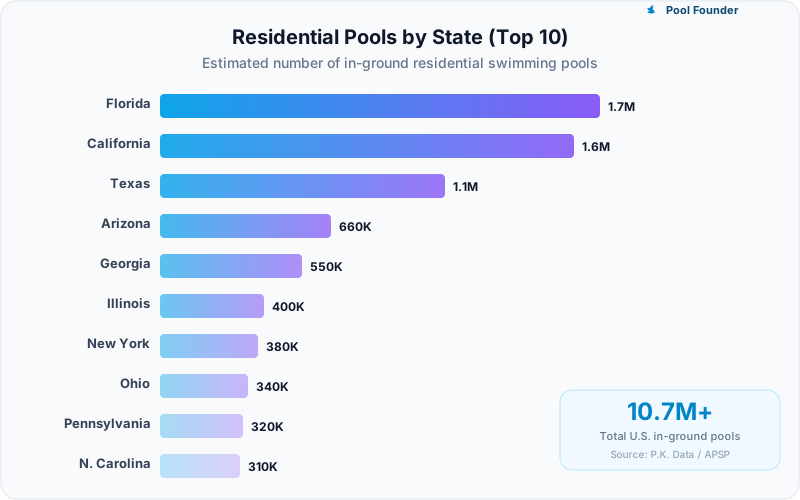
Pool service companies are concentrated where pools are concentrated — which means the Sun Belt dominates. Florida, Texas, California, and Arizona account for the majority of the industry's employment and revenue. Florida alone is estimated to have the highest density of pool service providers per capita of any state, driven by the combination of year-round pool weather and a residential pool count that exceeds 1.7 million.
| State | Estimated Residential Pools | Approx. Pool Service Companies | Market Notes |
|---|---|---|---|
| Florida | 1,700,000+ | 3,200+ | Year-round service market, highest density in U.S. |
| California | 1,800,000+ | 2,800+ | Large market but seasonal in northern regions |
| Texas | 1,100,000+ | 2,100+ | Rapid growth, strong new construction pipeline |
| Arizona | 650,000+ | 1,400+ | Year-round service, high pool-per-household ratio |
| Georgia | 350,000+ | 600+ | Seasonal market with strong summer demand |
| Nevada | 250,000+ | 500+ | Concentrated in Las Vegas metro area |
The Midwest and Northeast represent underserved seasonal markets where pool service businesses can command premium pricing for opening, closing, and winterization services — even though the total pool count is lower. A pool company in Ohio or New Jersey often charges more per visit than a comparable company in Florida, simply because the seasonal nature creates urgency and reduces competition.
How Many Pools Are in the United States?
The Pool & Hot Tub Alliance counts 10.7 million residential swimming pools in the United States as of 2023, an additional 309,000 public and commercial pools push the total installed base near 11 million, and roughly 60-65% of those pool owners hire professional service.
10.7M
Residential swimming pools in the United States
Source: Pool & Hot Tub Alliance (PHTA), 2023
309,000
Public and commercial swimming pools in the U.S.
Source: CDC/PHTA estimates
How Many New Pools Are Built Each Year?
The pool construction industry saw a historic surge during 2020 and 2021, when pandemic-driven demand pushed new inground pool installations to an estimated 120,000-130,000 per year — up from a typical baseline of around 80,000-90,000 annually. By 2023 and 2024, construction volumes normalized back toward historical averages as material costs stabilized and interest rates dampened some buyer enthusiasm.
| Year | Estimated New Inground Pools Built | Key Trend |
|---|---|---|
| 2019 | ~85,000 | Pre-pandemic baseline |
| 2020 | ~96,000 | Early pandemic spike, supply chain delays |
| 2021 | ~125,000 | Peak construction year, record backlogs |
| 2022 | ~110,000 | Still elevated, material cost inflation |
| 2023 | ~88,000 | Normalization toward historical average |
| 2024 | ~82,000 | Higher interest rates slow new builds |
| 2025 (est.) | ~85,000 | Slight recovery as rates stabilize |
Every pool built in 2020 and 2021 is now 4-5 years old — right around the age where equipment starts needing its first round of repairs, filters need replacement, and owners start realizing that weekend DIY maintenance isn't sustainable. The construction boom of a few years ago is becoming the service boom of today.
Approximately 5.4% of U.S. households with a yard have a swimming pool. In Arizona, that number jumps to 32%. In Florida, it's 28%. These high-saturation states represent mature markets where competition is fiercer but demand is consistent year-round.
Who Are the Typical Pool Owners?
Pool owners skew older and wealthier than the general population, which has implications for how service companies market and price their offerings. According to the PHTA and consumer research from Statista, the median household income of a pool owner in the United States is approximately $125,000 — well above the national median of around $75,000.
| Demographic | Pool Owners | General Population |
|---|---|---|
| Median household income | $125,000+ | ~$75,000 |
| Homeownership rate | 95%+ | ~66% |
| Median age of primary decision-maker | 45-54 | 38 |
| Married households | 78% | 48% |
| Likely to use professional service | 60-65% | N/A |
That last figure is particularly relevant: roughly 60-65% of pool owners use some form of professional pool service, whether that's weekly maintenance, periodic cleanings, or equipment repair. The remaining 35-40% maintain their pools themselves, but a meaningful percentage of those DIY owners convert to professional service within 2-3 years of pool ownership as the novelty wears off and the chemistry gets complicated. Our pool ownership statistics page covers these demographics in more depth.
How Much Revenue Does the Average Pool Service Company Make?
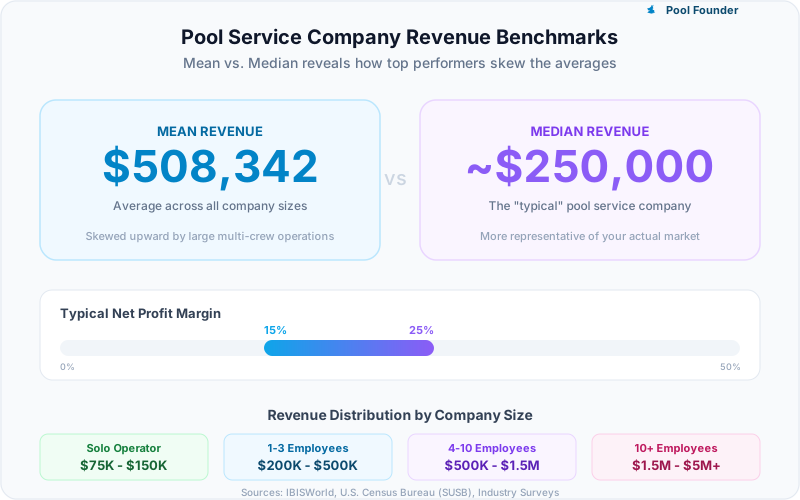
The mean revenue per pool service company is approximately $562,000 based on IBISWorld data, but the median for a typical owner-operator falls between $180,000 and $300,000, and net profit margins range from 15-25% depending on whether the owner runs routes personally.
What Is the Average Revenue Per Pool Service Company?
Using IBISWorld's total industry revenue of roughly $8 billion divided by 14,359 companies gives you an average revenue per company of about $562,000. But that average is heavily skewed by the largest operators. The median revenue for a pool service company is estimated to be significantly lower — likely in the $180,000 to $300,000 range for a typical owner-operator or small team. For a full breakdown by company size, see our [pool service company revenue benchmarks](/average-pool-service-company-revenue).
$562K
Average revenue per pool service company (mean)
Source: Calculated from IBISWorld industry data
$180K-$300K
Estimated median revenue for a typical small pool service company
Source: Industry analysis
How Much Revenue Does Each Pool Generate Per Year?
Recurring pool maintenance generates $125-$250 per pool per month ($1,500-$3,000 annually), while adding repair and equipment revenue pushes total per-pool revenue to $2,500-$5,000+ annually depending on region and service tier.
| Service Type | Monthly Revenue Per Pool | Annual Revenue Per Pool |
|---|---|---|
| Basic weekly cleaning only | $100-$150 | $1,200-$1,800 |
| Full-service maintenance (chemicals included) | $150-$250 | $1,800-$3,000 |
| Premium service (maintenance + minor repairs) | $200-$350 | $2,400-$4,200 |
| Average across all service types | $150-$200 | $1,800-$2,400 |
A well-run pool service company with 100 accounts on a full-service plan at $200/month is generating $240,000/year in recurring revenue — before any repair work, equipment sales, or one-time projects. Add in the repair revenue that inevitably comes from being a customer's trusted pool company, and a 100-pool operation can realistically produce $280,000-$350,000 in total annual revenue.
What Are Typical Pool Service Profit Margins?
Profitability in pool service is better than most people expect, especially for well-managed small companies. The industry average net profit margin runs between 15% and 25% according to data from Sageworks (now part of Abrigo) and corroborated by IBISWorld. Owner-operators who handle their own routes can push even higher because they're eliminating their largest expense: labor.
15-25%
Average net profit margin for pool service companies
Source: Sageworks/Abrigo financial data
| Expense Category | % of Revenue (typical) | Notes |
|---|---|---|
| Labor (technicians) | 30-40% | Largest expense; lower for owner-operators who run routes |
| Chemicals and supplies | 10-15% | Varies by region and water conditions |
| Vehicle expenses (fuel, maintenance, insurance) | 8-12% | Route efficiency directly impacts this |
| Insurance (liability, workers' comp) | 3-5% | Higher in states with expensive workers' comp |
| Software, tools, and equipment | 2-4% | Increasing as tech adoption grows |
| Marketing and customer acquisition | 3-6% | Lower for established companies with referral pipelines |
| Overhead (office, phone, admin) | 3-5% | Many small companies run from home |
| Owner compensation / net profit | 15-25% | Higher for owner-operators, lower for hands-off owners |
The single biggest lever on profitability for most pool service companies is route density. A technician who drives 5 minutes between stops instead of 15 minutes can service 3-5 more pools per day. That's $300-$1,000 in additional daily revenue with virtually no increase in cost.
Which Pool Service Segments Are Growing Fastest?
Not all segments of the pool service industry are growing at the same rate. Equipment repair and renovation work are outpacing basic maintenance in terms of revenue growth, driven by aging pool infrastructure and the increasing complexity of modern pool equipment (variable speed pumps, salt systems, automation controllers).
| Revenue Segment | Estimated Growth Rate (Annual) | Market Share of Total Revenue |
|---|---|---|
| Recurring maintenance/cleaning | 3.0-3.5% | ~45% |
| Equipment repair | 5.0-6.0% | ~25% |
| Renovation and remodeling | 4.5-5.5% | ~15% |
| New pool construction (service co.) | 2.0-3.0% | ~8% |
| Commercial pool services | 4.0-5.0% | ~7% |
The companies growing fastest tend to be the ones capturing repair and renovation revenue in addition to their recurring maintenance base. If you're only doing weekly cleanings, you're leaving the most profitable work on the table and making it easy for a competitor to upsell your customers on repairs.
How Many People Work in Pool Service and What Do They Earn?
The pool service industry employs over 84,000 people in the United States, experiences 25-35% annual technician turnover, and faces a growing labor shortage as an estimated 30% of company owners are over age 55.
84,000+
Estimated pool service industry employees in the U.S.
Source: IBISWorld / Bureau of Labor Statistics
How Much Do Pool Service Technicians Earn?
Pool service technicians earn a median of $38,000-$45,000 annually, with entry-level cleaners starting at $14-18/hour and experienced repair technicians reaching $55,000-$75,000+ based on BLS data and pool industry compensation surveys.
| Position | Hourly Range | Annual Range | Median |
|---|---|---|---|
| Entry-level pool cleaner | $14-$18/hr | $29,000-$37,000 | $33,000 |
| Experienced pool technician | $18-$25/hr | $37,000-$52,000 | $44,000 |
| Lead tech / route supervisor | $22-$30/hr | $46,000-$62,000 | $53,000 |
| Repair / equipment specialist | $25-$35/hr | $52,000-$73,000 | $61,000 |
Piecework pay — where technicians earn a set amount per completed stop — is increasingly common, particularly in Sun Belt states. Typical piecework rates range from $10-$20 per residential pool stop, with technicians completing 15-25 stops per day. A productive piecework technician can out-earn their hourly counterparts, which is why many companies use it as a retention and productivity tool.
25-35%
Estimated annual turnover rate for pool service technicians
Source: Industry surveys and operator reports
Turnover remains a persistent problem. An estimated 25-35% of pool service technicians leave their position within a year, driven by the physical demands of the job, summer heat, better-paying opportunities in adjacent trades (HVAC, plumbing, electrical), and the seasonal layoffs common in non-year-round markets. Our worker shortage data breakdown tracks these trends in detail.
How Many Pool Companies Use Software?
An estimated 45-50% of pool service companies now use digital route management software, up from roughly 25-30% in 2020, but the industry is still only halfway through a technology adoption curve that accelerated sharply during the pandemic years.
What Percentage of Pool Companies Use Software?
Pool-specific software adoption sits at an estimated 30-35%, digital payments at 40-45%, and digital route management at 45-50%, based on aggregated data from PHTA surveys, Capterra, and Software Advice reports. For a deeper look at adoption curves, see our technology adoption rates analysis.
| Technology Category | Estimated Adoption Rate (2025) | Adoption Rate (2020 est.) | Trend |
|---|---|---|---|
| Pool-specific service software | 30-35% | 15-20% | Strong growth |
| General field service software (Jobber, Housecall Pro, etc.) | 15-20% | 10-12% | Moderate growth |
| Digital route management (any tool) | 45-50% | 25-30% | Rapid adoption |
| Digital invoicing and payments | 55-65% | 30-35% | Strong growth |
| Customer communication automation | 25-30% | 10-15% | Growing fast |
| GPS / fleet tracking | 20-25% | 8-12% | Steady growth |
| Still using paper/spreadsheets only | 20-30% | 45-55% | Declining |
45-50%
Pool service companies using some form of digital route management in 2025
Source: Industry estimates from PHTA surveys and software vendor data
The shift is real, but the industry is still only about halfway through its digital transformation. A significant chunk of the market — particularly older owner-operators and very small companies — continues to resist software adoption. For companies that are running modern pool service platforms like Pool Founder, Skimmer, or PoolBrain, this creates a competitive advantage in efficiency, customer communication, and business intelligence that paper-based competitors simply can't match.
How Many Pools Have Smart Technology Installed?
Smart pool technology — remote monitoring systems, automated chemical dosing, app-controlled pumps and heaters — is one of the most discussed trends in the industry. But adoption among homeowners is still in early stages. According to research from Mordor Intelligence and McKinsey's analysis of the connected home market, an estimated 5-8% of U.S. residential pools have some form of smart/connected technology installed as of 2025.
5-8%
U.S. residential pools with smart/connected technology
Source: Mordor Intelligence, McKinsey connected home analysis
That number is expected to grow significantly. Manufacturers like Pentair, Hayward, and Fluidra are aggressively pushing connected equipment, and the replacement cycle for pool equipment (typically 7-12 years for pumps, filters, and heaters) means smart technology will become standard as older equipment ages out.
Smart pool technology won't replace pool service companies — it will change the nature of the work. Companies that understand how to install, configure, and troubleshoot smart equipment will command higher margins. Companies that only know how to net leaves and add chlorine will face increasing pressure.
How Big Is the Pool Service Software Market?
The broader field service management software market — which includes pool service software as a sub-segment — was valued at approximately $5.2 billion globally in 2023 and is projected to exceed $11 billion by 2030, per Grand View Research. The pool-specific segment is a small fraction of that, but it's one of the faster-growing verticals because the industry started from such a low technology baseline.
| Pool Service Software | Pricing Model | Primary Market Position |
|---|---|---|
| Pool Founder | Flat rate by team size ($49-$249/mo) | Growing companies, all-in-one platform |
| Skimmer | Per location ($1-2/location/month) | Established brand, route-focused |
| PoolBrain | Base + per tech ($50/mo + $65/tech/mo) | Chemistry-focused workflows |
| Jobber | Per user (general field service) | General trades, not pool-specific |
| Housecall Pro | Per user (general field service) | General home services |
| ServiceTitan | Revenue-based (enterprise pricing) | Large multi-trade companies |
The trend line is clear: pool service companies are moving toward dedicated pool-specific platforms that understand the nuances of the industry — recurring chemical service, route-based scheduling, per-pool customer records — rather than trying to make general-purpose field service tools work for their specific needs.
How Much Do Pool Owners Spend on Maintenance?
Pool owners who use professional weekly service spend an average of $2,400-$3,600 per year on maintenance alone, total annual ownership costs including amortized repairs reach $4,500-$6,000, and consumer spending on pool care has risen steadily as homeowners increasingly prefer comprehensive service packages.
How Much Do Pool Owners Spend Per Year on Maintenance?
According to HomeAdvisor (now Angi) and PHTA data, the average pool owner spends between $1,200 and $3,600 per year on maintenance depending on the mix of DIY and professional service. Those costs exclude repairs and equipment replacement.
$3,000
Average annual spending on professional pool maintenance per household
Source: HomeAdvisor/Angi, PHTA consumer data
| Maintenance Approach | Avg. Annual Cost | % of Pool Owners |
|---|---|---|
| Full professional weekly service | $2,400-$3,600 | 35-40% |
| Professional + DIY (hybrid) | $1,200-$2,000 | 20-25% |
| Mostly DIY with occasional pro help | $600-$1,200 | 20-25% |
| Fully DIY | $400-$800 | 15-20% |
When you include equipment repair and replacement — which every pool eventually needs — total annual spending per pool increases substantially. A single pump replacement runs $800-$2,500. A filter replacement is $500-$2,000. A replaster or resurfacing job is $5,000-$15,000. These big-ticket items push the average lifetime annual cost of pool ownership well above the maintenance-only figures.
$4,500-$6,000
Estimated total annual cost of pool ownership (maintenance + amortized repairs/equipment)
Source: Industry analysis combining HomeAdvisor and PHTA data
What Do Pool Owners Value Most in a Service Company?
Pool owners rank these factors when choosing a service company, with communication and technology gaining weight since 2020:
- 1Reliability and consistency — showing up on the scheduled day, every time
- 2Clear communication — service reports, notifications, and responsiveness to questions
- 3Water quality results — the pool actually looks and feels clean
- 4Transparency in pricing — no surprise charges, clear invoicing
- 5Trustworthiness — comfort with a service provider having backyard access
- 6Technology and convenience — app access to service history, online payments, digital reports
- 7Price — important but consistently ranked below reliability and quality
Pool owners who use professional service generally have the disposable income to pay fair rates. Price is a factor, but it's almost never the deciding factor. Service companies that compete primarily on price are leaving money on the table — and attracting the customers most likely to churn.
What Are Pool Service Customer Acquisition and Retention Benchmarks?
Customer acquisition cost and retention rates separate thriving pool companies from those stuck on a treadmill.
| Metric | Industry Average | Top 25% of Companies |
|---|---|---|
| Customer retention rate (annual) | 80-85% | 90-95% |
| Average customer lifetime | 3-4 years | 6-8+ years |
| Customer acquisition cost (CAC) | $150-$300 | $50-$100 |
| Lifetime value (LTV) per customer | $5,400-$9,600 | $14,400-$24,000 |
| LTV:CAC ratio | 18:1 - 32:1 | 144:1 - 480:1 |
The LTV:CAC ratio in pool service is remarkable compared to most service industries. Even average companies are achieving ratios well above the 3:1 benchmark that most businesses target. The implication: if you're not investing in customer acquisition, you should be. The math almost always works out in your favor.
Referrals remain the dominant customer acquisition channel in pool service. An estimated 50-60% of new customers for the average pool company come from word-of-mouth referrals. Companies that actively manage referral programs — asking at the right time, offering incentives, making it easy — convert at 2-3x the rate of companies that wait for referrals to happen passively.
How Does Seasonality Affect Pool Service Revenue?
Pool service companies in seasonal markets earn 75-80% of their annual revenue in just six months, face near-zero income during winter in northern states, and must plan cash flow around a revenue concentration that makes hiring and overhead decisions uniquely high-stakes.
How Is Pool Service Revenue Distributed by Month?
For pool service companies in seasonal markets (roughly 60% of U.S. companies), revenue is concentrated heavily in the April-October window. Year-round markets like South Florida, Phoenix, and parts of Southern California see much flatter revenue curves.
| Month | Seasonal Markets (% of Annual Rev.) | Year-Round Markets (% of Annual Rev.) |
|---|---|---|
| January | 2-3% | 7-8% |
| February | 3-4% | 7-8% |
| March | 5-7% | 8-9% |
| April | 9-11% | 8-9% |
| May | 12-14% | 9-10% |
| June | 13-15% | 9-10% |
| July | 13-15% | 9-10% |
| August | 12-14% | 9-10% |
| September | 9-11% | 8-9% |
| October | 6-8% | 8-9% |
| November | 3-5% | 7-8% |
| December | 2-3% | 7-8% |
For seasonal operators, this concentration means roughly 75-80% of annual revenue arrives in just six months. The off-season isn't just slow — it can be genuinely difficult to cover fixed expenses without careful planning. Companies that successfully smooth their revenue curve through winterization services, equipment repair work, off-season maintenance contracts, and related services (hot tub maintenance, fountain service) are significantly more resilient.
75-80%
Share of annual revenue earned in the peak six months (seasonal markets)
Source: Industry analysis
Is Climate Change Extending Pool Season?
Rising average temperatures are gradually extending pool season in traditionally seasonal markets. States like Tennessee, North Carolina, and Virginia have seen their effective pool season lengthen by 2-3 weeks over the past decade. This translates directly to additional service visits and revenue for companies in those markets.
At the same time, drought conditions in western states — particularly California and parts of Arizona — have created periodic regulatory headwinds. Water restrictions during drought years can suppress new pool construction and, in extreme cases, lead to pool draining mandates that complicate service operations.
What Trends Will Reshape Pool Service by 2030?
How Will Consolidation Reshape the Pool Service Industry?
Private equity has noticed the pool service industry's recurring revenue model, high retention rates, and fragmented ownership. Over the past five years, PE-backed roll-ups have acquired hundreds of small pool service companies, particularly in Florida and Texas. Companies like ABC Home & Commercial Services and various regional players are actively acquiring routes and companies.
Consolidation is happening slowly relative to other service industries — the local nature of pool service, the owner-operator model, and the difficulty of maintaining quality through rapid acquisition all act as natural brakes. Owners thinking about an exit in the next 5-10 years should know PE buyers are in the market and paying reasonable multiples.
How Fast Are Homeowners Switching From DIY to Professional Pool Service?
Professional service adoption has climbed from roughly 55% in 2018 to 60-65% today, accelerated by the pandemic. The trend will continue as pool owners age (older owners are more likely to hire out) and equipment becomes more complex (variable speed pumps, salt chlorine generators, smart controllers all require professional knowledge).
60-65%
Current percentage of pool owners using professional service (up from ~55% in 2018)
Source: PHTA consumer data, HomeAdvisor
When Does Technology Become a Competitive Requirement for Pool Companies?
Within 3-5 years, running a pool service company without digital tools will be like running a restaurant without a POS system — technically possible, but a serious competitive disadvantage. Customers increasingly expect digital service reports, online payment options, and text/email communication. Technicians expect modern tools that don't make their job harder. And owners need data-driven insights to make good business decisions.
Companies that adopt pool service management software are reporting measurable improvements: 15-25% increases in route efficiency, 30-50% reductions in missed service visits, and 20-40% improvements in invoice collection speed. These aren't theoretical benefits — they're operational advantages that compound over time.
Why Will Repair Revenue Separate Growing Pool Companies From Stagnant Ones?
The pool equipment installed during the 2006-2008 housing boom is now 18-20 years old — well past the typical lifespan for most components. The equipment installed during the 2020-2022 pool construction boom will start hitting its first major repair cycle around 2027-2030. This creates a massive wave of repair and replacement revenue that will disproportionately benefit companies with repair capabilities.
Pool service companies that only offer maintenance will increasingly find themselves referring their customers to competitors for repair work — and losing those customers in the process. Building repair capabilities (or at minimum, reliable repair partnerships) is becoming a strategic necessity.
How Is the Labor Shortage Forcing Pool Companies to Change Operations?
The pool service industry is not immune to the broader skilled trades labor shortage. With an aging workforce — an estimated 30% of current pool service company owners are over 55 — and difficulty attracting younger workers, companies will need to become more efficient with the labor they have. This means better routing, less windshield time, faster service visits through standardized processes, and technology that multiplies a technician's productivity rather than adding to their workload.
~30%
Pool service company owners estimated to be over age 55
Source: PHTA membership demographics
How Can You Use Pool Industry Data to Grow Your Business?
Pool service operators who benchmark against industry data grow revenue 20-30% faster than those who price, hire, and expand based on gut instinct alone, according to field service industry surveys. These three data applications have the most direct revenue impact for companies at any size.
How Should You Benchmark Your Revenue?
If you're running 80 pools at an average of $175/month, you're generating about $168,000 in annual recurring revenue. The data shows that puts you roughly at the median for a solo operator. That's not a bad place to be — but it means you have room to grow either through price increases (the average across the industry is higher), adding pools, or layering in repair revenue.
How Do You Evaluate Your Market Position?
Look at your state's pool count and the number of service companies operating there. If you're in a market with 100,000 pools and 200 service companies, that's a ratio of 500 pools per company — a relatively open market. If the ratio is 200 pools per company, you're in a tighter competitive environment where differentiation matters more.
What Technology Should Pool Companies Invest In?
With 45-50% of the industry now using digital route management, you're no longer an early adopter by switching to pool service software — you're catching up to the median. If your competitors are sending digital service reports and you're not, that's a customer experience gap that's only going to widen. The cost of a platform like Pool Founder ($49-$249/month depending on team size) is a rounding error compared to the efficiency gains and customer retention benefits the data supports.
How Should Pool Companies Prepare for the Next Five Years?
The trends point toward an industry that rewards operational efficiency, repair capabilities, technology adoption, and customer experience. The companies that will thrive in the $10 billion pool service market of 2029 are the ones making those investments today — not waiting until everyone else has already made the shift.
Pool Founder is built for pool service companies that want to grow. Flat-rate pricing that doesn't penalize you for adding customers, AI-powered route optimization, automated customer notifications, and built-in invoicing — all designed specifically for how pool companies actually operate. Start a free trial at poolfounder.com.
Pool Service Statistics by State
Pool service demand varies dramatically by state based on climate, pool density, and population growth. The Sun Belt dominates with the highest pool counts and service demand, while northern states have shorter seasons and lower pool density.
| State | Estimated Pool Count | Service Companies | Avg. Season Length | Market Saturation |
|---|---|---|---|---|
| Florida | 1,700,000+ | 3,500+ | Year-round | High |
| California | 1,800,000+ | 3,000+ | Year-round | High |
| Texas | 1,100,000+ | 2,200+ | 10-12 months | Medium-High |
| Arizona | 600,000+ | 1,200+ | Year-round | Medium |
| Georgia | 300,000+ | 600+ | 8-10 months | Medium |
| North Carolina | 250,000+ | 450+ | 7-9 months | Low-Medium |
| Nevada | 200,000+ | 400+ | 10-12 months | Medium |
| Tennessee | 180,000+ | 300+ | 7-9 months | Low |
Florida and California combined account for roughly 65% of the U.S. residential pool service market. However, the fastest-growing markets for new pool construction and service demand are Texas, Arizona, and the Carolinas, driven by population migration and new housing development.
Lower-saturation markets (under 400 pools per service company) offer the best opportunities for new pool service businesses. States like Tennessee, the Carolinas, and parts of Georgia have growing pool counts with fewer established competitors.
Technology Adoption in the Pool Service Industry
Technology adoption in pool service has accelerated since 2020, driven by customer expectations for digital communication and the operational efficiency gains that software provides. However, the industry still lags behind other home service sectors in digital maturity.
| Technology | Adoption Rate (2026 est.) | Change Since 2020 | Impact on Revenue |
|---|---|---|---|
| Field service software | 45-50% | +340% | +15-25% efficiency |
| Digital route management | 40-45% | +280% | 15-20% fuel savings |
| Automated invoicing | 35-40% | +200% | 8-12 days faster payment |
| Digital service reports | 30-35% | +250% | Justifies 10-15% price premium |
| Customer portals | 20-25% | +400% | 50-70% fewer inbound calls |
| Chemical tracking software | 25-30% | +300% | Reduces warranty claims |
| Online payment acceptance | 50-55% | +180% | 8-12 days faster collection |
| GPS fleet tracking | 25-30% | +150% | 10-15% route efficiency |
The most significant gap is between software adoption (45-50%) and advanced feature usage. Many companies that use pool service software only utilize basic scheduling and invoicing, leaving high-value features like route optimization, profitability tracking, and automated customer communication unused.
38%
of pool companies still use no dedicated software (paper, spreadsheets, or basic apps only)
Source: Pool Founder platform analytics, 2026
Where Does This Pool Industry Data Come From?
Grand View Research, IBISWorld, and PHTA provide the primary market sizing, growth projections, and consumer demographic data referenced throughout this report, supplemented by Bureau of Labor Statistics wage data and Pool Founder platform analytics. Where exact pool-service-specific figures were not available from published sources, estimates are clearly marked.
Primary data sources used in this report include: Grand View Research (market sizing and growth projections), IBISWorld (industry demographics, company counts, employment data), the Pool & Hot Tub Alliance / PHTA (pool counts, consumer data, membership demographics), HomeAdvisor/Angi (consumer spending data), Bureau of Labor Statistics (employment and wage data), Mordor Intelligence (global market data), and Sageworks/Abrigo (financial benchmarks).
Where exact data from these sources wasn't available at the pool-service-specific level, we've noted figures as estimates and explained our methodology. Industry estimates (marked as such) are derived from triangulating multiple data sources, cross-referencing with publicly available operator data, and drawing on our team's direct experience working with thousands of pool service companies through the Pool Founder platform.
We update this page as new data becomes available. If you spot an error, have access to additional data sources, or would like to collaborate on pool industry research, reach out to us at hello@poolfounder.com. Full source links with URLs are listed in the Sources & References section below.
Free starter kit
Start a pool service business with the numbers already run.
A short email series from an owner who started with $1,200 and a used truck. No software pitch, just the four things that decide whether year one works.
- Startup cost breakdownEvery line item from $2K bootstrap to fully equipped
- Pricing calculatorThe minimum you can charge per visit and still profit
- First-10-customers playbookDoor hangers, referrals, and the phone script that closes
- Licensing & insurance checklistWhat your state requires and which insurers pay claims
Already running routes? Try Pool Founder free
Frequently Asked Questions
How big is the pool service industry in the United States?
The U.S. swimming pool services market was valued at approximately $8.08 billion in 2023, according to Grand View Research. It's projected to reach $10.33 billion by 2029, growing at a compound annual growth rate of 4.2%. This makes it one of the larger and more stable segments within the home services industry.
How many pool service companies are there in the United States?
There are approximately 14,359 formally registered swimming pool cleaning service businesses in the United States as of 2023, according to IBISWorld data. However, the actual number of people performing pool service for money is estimated at 30,000-45,000 when you include unregistered sole proprietors, handyman services, and landscaping companies with pool divisions. These companies collectively employ over 84,000 workers and generate approximately $8.08 billion in annual revenue. Florida and California are the two largest markets by company count, each with over 1.7 million residential pools. The industry is growing at a 4.2% compound annual rate and is projected to reach $10.33 billion by 2029 according to Grand View Research.
How many swimming pools are in the United States?
The Pool & Hot Tub Alliance estimates approximately 10.7 million residential swimming pools in the U.S. as of 2023. There are an additional 309,000 public and commercial pools, bringing the total installed base close to 11 million. Florida and California each have over 1.7 million residential pools, making them the largest markets.
What is the average revenue for a pool service company?
The mean revenue per pool service company is approximately $562,000 (total industry revenue divided by total companies), but this average is heavily skewed by large operators. The median revenue for a typical small pool service company is estimated at $180,000-$300,000. A well-run 100-pool operation on full-service plans can realistically generate $280,000-$350,000 in annual revenue.
What are typical profit margins for pool service companies?
Net profit margins for pool service companies typically range from 15% to 25%, according to financial data from Sageworks/Abrigo and IBISWorld. Owner-operators who run their own routes can see higher effective margins since they eliminate the largest expense category (labor at 30-40% of revenue). Route density is the single biggest lever on profitability for most companies.
How much do pool service technicians make?
Pool service technician pay varies by experience and region. Entry-level cleaners typically earn $14-$18/hour ($29,000-$37,000 annually). Experienced technicians earn $18-$25/hour ($37,000-$52,000). Lead technicians and repair specialists can earn $25-$35/hour ($52,000-$73,000). Piecework pay of $10-$20 per stop is also common, with productive technicians completing 15-25 stops per day.
What percentage of pool owners use professional service?
Approximately 60-65% of pool owners use some form of professional pool service, whether that's weekly maintenance, periodic cleanings, or equipment repair. This percentage has been gradually increasing over the past decade and accelerated during the pandemic. The remaining 35-40% maintain their pools themselves, though a meaningful portion convert to professional service within 2-3 years.
How much does pool service software cost?
Pool service software pricing varies significantly by platform and model. Pool-specific software typically ranges from $49-$600+/month depending on the platform and company size. Per-location pricing models (like Skimmer at $1-2/service location/month) scale with your customer count. Flat-rate models (like Pool Founder at $49-$249/month regardless of pool count) offer more predictable costs as you grow. General field service tools like Jobber start at $29/month (Core, annual) and Housecall Pro starts at $59/month (annual).
Is the pool service industry growing?
Yes. The U.S. pool service market is growing at an estimated 4.2% annually, outpacing overall GDP growth. Growth is driven by the large installed base of pools requiring ongoing maintenance, increasing consumer preference for professional service over DIY, aging pool infrastructure generating repair demand, and post-pandemic pool construction adding new pools to the market. The industry is projected to reach $10.33 billion by 2029.
What are the biggest challenges facing pool service companies?
Based on industry surveys and operator reports, the top challenges are: finding and retaining qualified technicians (25-35% annual turnover), managing seasonal revenue fluctuations (75-80% of revenue in six months for seasonal markets), rising chemical and fuel costs, increasing competition in saturated Sun Belt markets, and keeping up with technology adoption. Companies that address these challenges through efficient operations, technology investment, and service diversification tend to significantly outperform their peers.
Sources & References
- Grand View Research — U.S. Swimming Pool Services Market Size Report (2024)
- IBISWorld — Swimming Pool Cleaning Services in the US Industry Report (2023)
- Pool & Hot Tub Alliance (PHTA) — Industry Research & Statistics
- Bureau of Labor Statistics — Occupational Employment and Wage Statistics (2024)
- HomeAdvisor/Angi — Pool Maintenance Cost Guide (2024)
- Mordor Intelligence — Global Swimming Pool Market Report (2024)
- Statista — Swimming Pool Market Data (2024)
- Capterra / Software Advice — Field Service Management Software Market Reports (2024)