Why Pool Construction Data Matters for Service Companies
~72,000
estimated new inground pool installations in the U.S. in 2025, down from a peak of 120,000 in 2021
Source: PHTA, NAHB Eye on Housing
33%
of all new pool construction permits in 2025 were issued in Florida alone
Source: HBWeekly, NAHB
12-18 months
average time from pool completion to first professional service contract
Source: Pool route broker estimates
Every new pool built today is a service customer within the next one to two years. Pool construction starts are the leading indicator for the service pipeline, and understanding where pools are being built tells you where the next wave of recurring revenue is forming. The pandemic boom created a surge of 120,000+ new pools per year in 2020-2022. That wave has now corrected back toward pre-pandemic levels, but the installed base keeps growing.
This article tracks annual construction starts from 2019 through 2025, breaks down the data by region and state, and explains what the numbers mean for service companies planning routes, hiring, and market expansion. Every data point comes from HBWeekly permit tracking, the Pool and Hot Tub Alliance (PHTA), NAHB Eye on Housing reports, and AQUA Magazine industry analysis.
Construction starts in this article refer to residential inground pool building permits. Above-ground pools, commercial pools, and renovations are excluded unless noted. Regional data is based on HBWeekly permit tracking for Florida, Texas, and Metro Atlanta. National estimates are compiled from PHTA, NAHB, and industry analyst reports.
How Many New Pools Are Built in the U.S. Each Year?
Before the pandemic, the U.S. built roughly 80,000 to 90,000 new inground residential pools per year. That number exploded during 2020-2022 as stay-at-home demand, low interest rates, and a shift toward outdoor living drove construction to an estimated 120,000 to 130,000 pools annually. By 2023, the market started correcting as interest rates climbed and material costs normalized. Through 2025, construction has settled at approximately 72,000 permits nationally, the lowest level since 2020.
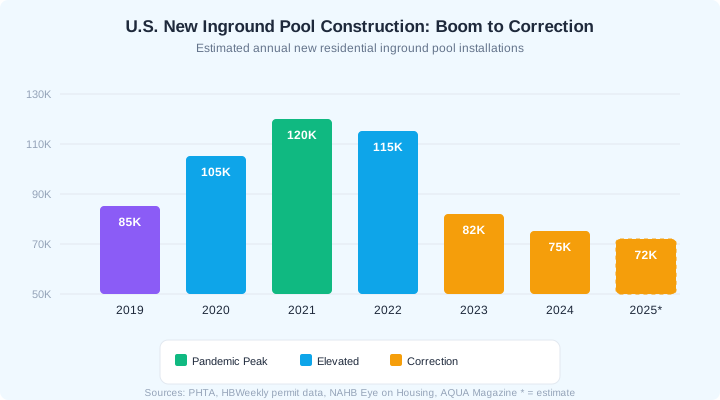
The December 2025 permit index from NAHB shows pool construction permits running 34.3% below the January 2020 baseline. That sounds alarming in isolation, but context matters. The 2020-2021 period was historically abnormal. The current level is closer to the long-term average that the industry sustained for a decade before COVID. What changed is the installed base. Those 400,000+ extra pools built during the boom are now aging into service contracts.
Corey ran routes through the entire pandemic cycle. His observation: "We started seeing the boom pools show up as service leads 12-18 months after completion. The homeowner tries to maintain it themselves, realizes it is more work than they expected, and calls a service company. That wave hit hard in 2022-2023 and it is still feeding the service pipeline today."
Pool Construction by State: Where the Permits Are
Pool construction in the U.S. is concentrated in a handful of Sun Belt states. Florida alone accounts for roughly 33% of all new pool permits nationally, followed by California at 14%, Texas at 12%, and Arizona at 8%. Together, these four states represent about 67% of all new pool construction, a ratio that has held relatively steady for years.
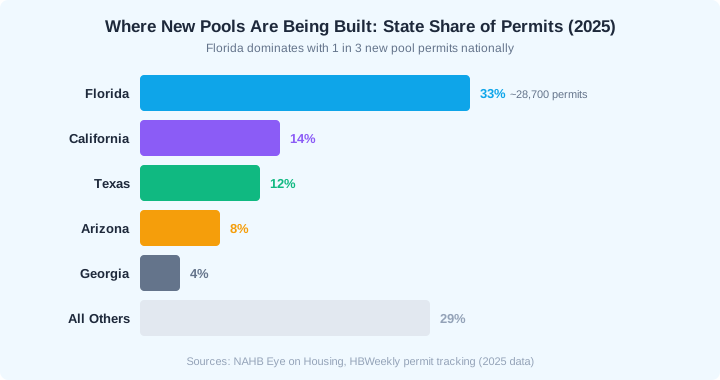
This concentration has direct implications for service companies. If you operate in Florida, your organic lead pipeline from new construction is three times larger than any other state. If you are in a non-Sun Belt market, your growth comes almost entirely from winning existing pools away from competitors or from the smaller number of new builds in your area.
| State | 2025 Permits (est.) | Share | YoY Trend |
|---|---|---|---|
| Florida | 28,700 | 33% | +6% (first positive year since 2021) |
| California | ~12,000 | 14% | Declining (Title 24 headwinds) |
| Texas | ~7,000 | 12% | -10% (decelerating decline) |
| Arizona | ~5,500 | 8% | Flat to slight positive |
| Georgia (Metro ATL) | ~2,500 | 4% | Flat (stabilizing) |
Florida: The Recovery Story
Florida posted approximately 28,700 new pool construction permits in 2025, a 6% year-over-year increase and the first positive reading after three consecutive years of decline: -6% in 2022, -22% in 2023, and -10% in 2024. The recovery was led by Southeast Florida (+15%) and West Florida (+20%), while Central Florida and the Southwest held flat.
| Florida Region | 2025 Permits | YoY Change |
|---|---|---|
| Southwest | 8,355 | 0% |
| Southeast | 5,795 | +15% |
| West | 5,053 | +20% |
| Central | 3,862 | 0% |
| Northeast | 2,872 | -3% |
| Northwest | 2,750 | +2% |
The top five counties for pool construction were Lee (2,568 permits), Palm Beach (1,966), Sarasota (1,770), Miami-Dade (1,616, up 36%), and Manatee (1,425). For service companies in these counties, each year of construction at this volume adds thousands of pools to the local installed base. At a 60-70% eventual professional service adoption rate, that translates to 1,500+ new recurring service customers per county per year.
Texas: The Slow Stabilization
Texas has had the roughest correction of the major pool markets. After a 31% year-over-year drop in 2023 and an 18% decline in 2024, new pool permits fell an additional 10% in 2025 to approximately 7,000 statewide. The rate of decline is decelerating, which suggests the market is approaching equilibrium, but Texas has not yet turned positive.
The Texas story is partly about interest rates. New pool construction in Texas skews toward financing more than Florida, where a higher percentage of buyers pay cash. Rising rates from 2022 to 2024 hit Texas harder. For service companies, the installed base in Texas is still growing because even at 7,000 new pools per year, the total number of pools increases. The growth rate just slowed dramatically from the 2021 peak.
Even in a "down" construction market, Texas adds 7,000 new pools per year to the installed base. Over three years, that is 21,000 pools that did not exist in 2022. Service companies that position themselves in the right zip codes now are building route density for the next decade.
What the Construction Cycle Means for Service Revenue
The relationship between construction starts and service revenue follows a predictable lag. New pool owners typically attempt DIY maintenance for the first 6-12 months, then start searching for professional service after their first algae bloom, cloudy water event, or equipment failure. The conversion from new pool to service contract takes 12-18 months on average, based on route broker data and service company lead tracking.
This means the construction boom of 2020-2022 is still feeding the service pipeline today. An estimated 350,000-400,000 "extra" pools were built above the historical baseline during the boom years. Even if only 60% of those eventually hire professional service, that is 210,000-240,000 incremental service accounts created in a three-year window. Many of those accounts are now 2-4 years old, past the DIY phase, and actively seeking service.
| Construction Year | Pools Built (est.) | Service Conversion Window | Status |
|---|---|---|---|
| 2020 | 105,000 | 2021-2022 | Fully converted |
| 2021 | 120,000 | 2022-2023 | Fully converted |
| 2022 | 115,000 | 2023-2024 | Mostly converted |
| 2023 | 82,000 | 2024-2025 | Converting now |
| 2024 | 75,000 | 2025-2026 | Entering pipeline |
| 2025 | 72,000 | 2026-2027 | Future pipeline |
For service companies, this data supports an important conclusion: the best time to acquire new service accounts is not during the construction boom itself. It is 12-24 months after. The 2023-2024 construction pools are entering the service pipeline right now in 2026, and they are the freshest opportunity for route growth.
How New Construction Affects Equipment Repair Revenue
New pools come with equipment warranties that typically last 1-3 years for pumps, heaters, and automation systems. During the warranty period, homeowners call the builder or manufacturer for repairs rather than their service company. Once warranties expire, the service company becomes the first call for equipment issues.
Pools built during the 2020-2022 boom are now 3-6 years old. Pump warranties have expired. Heater warranties are expiring. Salt cells on boom-era pools are approaching end of life at 3-5 years. This creates a secondary wave of revenue from equipment repairs and replacements that follows the initial service contract conversion. Service companies that track equipment age per customer can proactively recommend replacements before failures occur, improving customer satisfaction and adding repair revenue to the recurring base.
Pool Founder tracks equipment age and type per customer. When a salt cell or pump approaches its expected end of life, you can flag it for your technician to inspect and recommend replacement before the customer calls about a green pool.
Market Size Projections Through 2030
The U.S. swimming pool construction market was valued at approximately $2.0 billion in 2025 and is projected to grow at a 3.3% compound annual growth rate through 2035 according to Expert Market Research and IMARC Group. The overall pool service market (maintenance, repair, renovation) is significantly larger at $8.8 billion and growing at 4.2% CAGR according to IBISWorld and Grand View Research.
The service market grows faster than the construction market because every pool built adds a permanent customer to the service TAM. Construction is cyclical. Service is cumulative. A pool built in 2021 generates construction revenue once, but it generates service revenue for 20-30 years. That compounding effect is why the service side of the industry is the better long-term bet for operators looking to build wealth.
| Metric | Value | Growth Rate | Source |
|---|---|---|---|
| Pool Construction Market (2025) | $2.0B | 3.3% CAGR to 2035 | IMARC Group |
| Pool Service Market (2025) | $8.8B | 4.2% CAGR to 2029 | IBISWorld, Grand View Research |
| Total U.S. Pools | 10.7M | Growing ~1% per year | PHTA |
| New Pools Per Year (normalized) | 75,000-85,000 | Returning to pre-COVID baseline | NAHB |
Free starter kit
Start a pool service business with the numbers already run.
A short email series from an owner who started with $1,200 and a used truck. No software pitch, just the four things that decide whether year one works.
- Startup cost breakdownEvery line item from $2K bootstrap to fully equipped
- Pricing calculatorThe minimum you can charge per visit and still profit
- First-10-customers playbookDoor hangers, referrals, and the phone script that closes
- Licensing & insurance checklistWhat your state requires and which insurers pay claims
Already running routes? Try Pool Founder free
Frequently Asked Questions
How many new pools are built in the United States each year?
Before the pandemic, the U.S. built approximately 80,000-90,000 new inground residential pools per year. The 2020-2022 boom pushed that number to 120,000-130,000 annually. By 2025, construction has corrected to approximately 72,000 permits, slightly below the pre-pandemic baseline. The long-term normalized range is expected to settle at 75,000-85,000 per year.
Which state builds the most new swimming pools?
Florida leads the nation with approximately 33% of all new pool construction permits, followed by California at 14%, Texas at 12%, and Arizona at 8%. Together these four states account for roughly 67% of all new pool construction in the U.S. Florida posted approximately 28,700 new pool permits in 2025.
How long after a pool is built does the owner hire a service company?
Most new pool owners attempt DIY maintenance for the first 6-12 months before hiring professional service. The average time from pool completion to first service contract is 12-18 months, based on route broker data. The conversion typically happens after the first algae bloom, cloudy water event, or equipment issue that the homeowner cannot resolve.
Is the pool construction market growing or shrinking in 2026?
Pool construction is stabilizing after a three-year correction from pandemic highs. Florida turned positive in 2025 with a 6% increase. Texas is still declining but at a decelerating rate (-10% vs. -31% in 2023). The market is expected to return to pre-pandemic baseline levels of 75,000-85,000 pools per year by 2027-2028.
How does new pool construction affect the pool service market?
Every new pool built adds a permanent customer to the service market within 12-18 months. The pandemic boom created an estimated 350,000-400,000 extra pools above baseline. Even at a 60% professional service adoption rate, that adds 210,000-240,000 new recurring accounts. This is why the service market ($8.8B) grows faster than construction ($2.0B), because service revenue is cumulative while construction is cyclical.
Are pool construction permits a good leading indicator for service demand?
Yes. Pool construction permits are the best leading indicator for future service demand, with a 12-24 month lag. Tracking permit data by county helps service companies identify where new route density is forming and where to focus marketing for new customer acquisition.
Sources & References
- NAHB Eye on Housing - Pool Permitting Falls Lower in 2025
- HBWeekly - Florida Swimming Pool Construction Activity: 2025 Market Review
- HBWeekly - Texas Swimming Pool Construction Activity Report: 2025 Annual Review
- AQUA Magazine - Ripple Effects: Pandemic-Era Pool Construction
- IMARC Group - Swimming Pool Construction Market Size and Forecast 2034
- IBISWorld - Swimming Pool Cleaning Services in the US 2025