How Many Swimming Pools Are in the United States?
The United States has approximately 10.7 million swimming pools, including 10.4 million residential pools and just over 300,000 public or commercial pools, according to the Pool & Hot Tub Alliance (PHTA). That translates to roughly one pool for every 31 people in the country. About 8% of U.S. homes have a pool, making pool ownership a significant segment of the residential property market.
For pool service companies, these numbers define your addressable market. Understanding where pools are concentrated, who owns them, and whether new construction is growing or shrinking directly affects where to start a business, how to plan expansion, and what customer demographics to target. Four states alone account for 54% of all pool industry sales.
10.7M
total swimming pools in the United States
Source: PHTA (Pool & Hot Tub Alliance)
10.4M
residential swimming pools
Source: PHTA
8%
of U.S. homes that have a swimming pool
Source: Pool Research, PHTA estimates
1:31
ratio of pools to people in the United States
Source: PHTA, Census Bureau population data
Which States Have the Most Swimming Pools?
Florida leads the nation with approximately 1.59 million residential pools, averaging one pool for every 14 residents. California follows with 1.34 million pools (one per 29 residents). Texas, New York, and Arizona round out the top five. Arizona stands out with the highest per-capita pool ownership in the country at one pool for every 13 residents, driven by extreme summer heat and a suburban development pattern built around outdoor living.
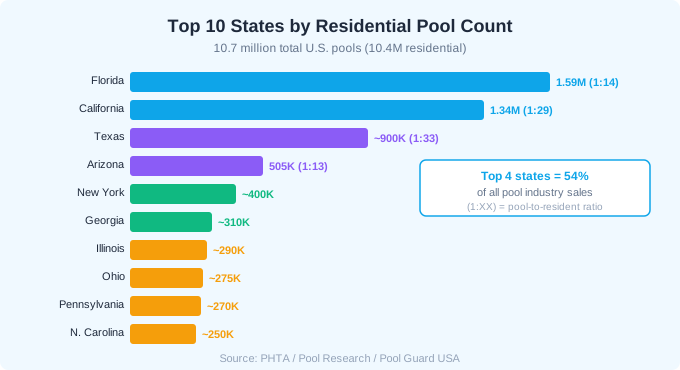
| State | Est. Residential Pools | Pool-to-Resident Ratio | % of U.S. Total |
|---|---|---|---|
| Florida | 1,590,000 | 1:14 | 15.3% |
| California | 1,340,000 | 1:29 | 12.9% |
| Texas | ~900,000 | ~1:33 | ~8.7% |
| Arizona | 505,000 | 1:13 | 4.9% |
| New York | ~400,000 | ~1:49 | ~3.8% |
| Georgia | ~310,000 | ~1:35 | ~3.0% |
| Illinois | ~290,000 | ~1:43 | ~2.8% |
| Ohio | ~275,000 | ~1:42 | ~2.6% |
| Pennsylvania | ~270,000 | ~1:48 | ~2.6% |
| North Carolina | ~250,000 | ~1:42 | ~2.4% |
The top four states (Florida, California, Texas, and Arizona) account for 54% of all pool industry sales according to PHTA data. This concentration means the majority of pool service companies, and the majority of industry revenue, operate in sunbelt markets with year-round or near-year-round pool seasons.
Who Owns Swimming Pools in America?
Pool ownership skews toward suburban homeowners with household incomes above $75,000. The typical pool owner is a homeowner (not a renter) between 35 and 65 years old living in a single-family home in a suburban or exurban area. The pool ownership rate increases significantly with income, with households earning over $100,000 being 3-4x more likely to own a pool than those earning under $50,000.
| Demographic Factor | Pool Ownership Rate | Notes |
|---|---|---|
| Household income over $100K | 12-15% | Highest ownership rate by income bracket |
| Household income $75K-$100K | 8-10% | Above national average |
| Household income under $50K | 3-4% | Below national average |
| Homeowners (vs. renters) | 10-12% | Renters rarely have pools (1-2%) |
| Suburban/exurban homes | 10-14% | Lot size and zoning favor pools |
| Urban homes | 2-4% | Space constraints limit ownership |
| Households with children | 10-12% | Families more likely to invest in pools |
| Age 35-54 | Highest ownership rate | Peak earning years, family formation |
For pool service companies, these demographics define your ideal customer profile: suburban homeowners aged 35-65 with household incomes above $75,000. This is the segment most likely to own a pool, most likely to hire professional service rather than DIY, and most likely to maintain a recurring service contract.
What Are the Trends in New Pool Construction?
New pool construction boomed during 2020-2021 as pandemic-era homeowners invested in backyard living. Construction then pulled back significantly: Texas saw a 31% decline in permits in 2023, followed by an 18% decrease in 2024 and an 11% contraction in 2025. The declining rate of decline suggests the market is approaching stabilization after the pandemic-era spike and subsequent correction.
| Year | Market Trend | Key Drivers |
|---|---|---|
| 2019 | Stable baseline | Pre-pandemic normal construction pace |
| 2020 | Surge begins | Work-from-home, backyard investment, low interest rates |
| 2021 | Peak construction | 400,000+ new residential pools built nationally |
| 2022 | Pullback begins | Rising interest rates, material costs, builder backlogs clearing |
| 2023 | Significant decline | Texas permits down 31%, Florida slowing |
| 2024 | Continued decline | Texas permits down 18%, market correction continues |
| 2025 | Stabilizing | Texas permits down 11%, decline rate moderating |
Florida remains the strongest construction market, adding nearly 2,450 new pool permits in June 2025 alone (an 18% month-over-month increase). The Southwest Florida region led the state with 830 new permits. Dallas leads Texas with 687 permits in Q1 2025 alone, more than Houston, Austin, and San Antonio combined.
For pool service companies, every new pool built becomes a future recurring service customer. Even with construction slowing from pandemic peaks, tens of thousands of new pools are being built annually, steadily expanding the total addressable market.
How Does Pool Ownership Affect the Pool Service Market?
The U.S. pool service industry was valued at $8.08 billion in 2023 and is growing at a 4.2% compound annual rate. With 10.7 million pools and roughly 14,000 registered pool service companies, the average company has access to approximately 764 pools in its market. Of course, most pools are concentrated in specific metropolitan areas, creating both opportunity and competition.
| Market Metric | National Data | What It Means for Service Companies |
|---|---|---|
| Total pools | 10.7 million | Massive addressable market |
| Professional service rate | ~40-50% | 4-5 million pools use professional service |
| DIY maintenance rate | ~50-60% | Large conversion opportunity for service companies |
| Pool service companies | 14,000+ | Fragmented market, room for consolidation |
| Industry revenue | $8.08 billion | Growing at 4.2% CAGR through 2029 |
| Avg revenue per company | $450,000-$575,000 | Wide range from solo ops to large companies |
Roughly 40-50% of pool owners use professional service, meaning 4-5 million pools have recurring service contracts. The other 50-60% are DIY. This represents both the existing market and a massive growth opportunity. Converting even 5% of DIY pool owners to professional service would add 300,000+ new recurring customers to the industry.
What Are the Regional Differences in Pool Ownership?
Pool ownership patterns vary dramatically by region, driven by climate, housing density, lot sizes, and local culture. The sunbelt states dominate total pool counts, but per-capita ownership reveals some surprises. Arizona leads with one pool per 13 residents, while Florida (one per 14) and Nevada (approximately one per 18) round out the top three. Northern states like Connecticut and New Jersey have higher ownership rates than their climate might suggest, driven by wealthy suburban communities.
| Region | Characteristics | Pool Season | Service Model |
|---|---|---|---|
| Southwest (AZ, NV, NM) | Highest per-capita ownership, extreme heat | Year-round | Weekly service, heavy chemical management |
| Southeast (FL, GA, SC) | Highest total pools, warm humid climate | Year-round in FL, 9-10 months elsewhere | Weekly service, algae prevention focus |
| Texas | Large and growing market, extreme summer heat | 8-10 months | Weekly seasonal, winterization in north TX |
| California | Second most pools, diverse climate zones | 8-12 months depending on region | Weekly service, water conservation focus |
| Northeast (NY, NJ, CT) | Seasonal market, affluent suburban ownership | 4-5 months | Opening/closing, chemical-only service popular |
| Midwest (OH, IL, MI) | Shorter season, lower ownership rates | 3-4 months | Heavily seasonal, equipment winterization |
These regional differences directly affect business models. A pool company in Phoenix runs year-round with consistent weekly service. A pool company in Chicago operates 4-5 months of weekly service, 2 months of openings/closings, and needs 5 months of alternative revenue or seasonal cash reserves. The business model that works in Florida does not translate directly to Ohio.
What Is the Future of Pool Ownership in the U.S.?
The U.S. swimming pool market is projected to reach $2 billion in construction value in 2025, growing at an 8.4% compound annual rate over the past five years. While new construction has pulled back from pandemic peaks, the total pool count continues to grow because pools last 20-30+ years and the installation rate exceeds the removal rate. The total addressable market for pool service is expanding even when new construction slows.
- Aging pool stock: Millions of pools built in the 1990s-2000s are reaching the age where major renovations (resurfacing, re-plumbing, equipment replacement) are needed, driving repair and renovation revenue.
- Sunbelt migration: Population growth in Florida, Texas, Arizona, and the Carolinas continues to drive new pool demand in those markets.
- Smart pool technology: IoT-connected pool equipment is creating new service categories around automation, remote monitoring, and smart chemical management.
- Energy efficiency upgrades: Variable-speed pump mandates and solar heating adoption are driving equipment upgrade revenue.
- Climate patterns: Longer, hotter summers in northern states are extending pool seasons and increasing ownership rates in non-traditional markets.
Corey Adams, Pool Founder co-founder and 15-year pool veteran: "There are 10.7 million pools and that number goes up every year. The question for pool service companies is not whether there is enough demand. There is. The question is whether you are set up to capture your share of it efficiently."
Free starter kit
Start a pool service business with the numbers already run.
A short email series from an owner who started with $1,200 and a used truck. No software pitch, just the four things that decide whether year one works.
- Startup cost breakdownEvery line item from $2K bootstrap to fully equipped
- Pricing calculatorThe minimum you can charge per visit and still profit
- First-10-customers playbookDoor hangers, referrals, and the phone script that closes
- Licensing & insurance checklistWhat your state requires and which insurers pay claims
Already running routes? Try Pool Founder free
Frequently Asked Questions
How many swimming pools are in the United States?
The United States has approximately 10.7 million swimming pools, including 10.4 million residential pools and just over 300,000 public or commercial pools, according to the Pool & Hot Tub Alliance. About 8% of U.S. homes have a pool.
Which state has the most swimming pools?
Florida leads with approximately 1.59 million residential pools, followed by California with 1.34 million. Arizona has the highest per-capita pool ownership at one pool for every 13 residents. Florida, California, Texas, and Arizona account for 54% of all pool industry sales.
What percentage of US homes have a pool?
Approximately 8% of U.S. homes have a swimming pool. The ownership rate varies significantly by income, region, and housing type. Households earning over $100,000 have 12-15% pool ownership, while suburban homes have 10-14% ownership rates.
Are new pools still being built?
Yes, though construction has slowed from the 2020-2021 pandemic peak. Texas pool permits declined 31% in 2023, 18% in 2024, and 11% in 2025, suggesting the market is stabilizing. Florida added nearly 2,450 permits in June 2025 alone, showing continued strong demand in sunbelt markets.
What is the typical pool owner demographic?
The typical pool owner is a suburban homeowner aged 35-65 with a household income above $75,000. Pool ownership increases significantly with income, with households earning over $100,000 being 3-4x more likely to own a pool. Families with children have higher ownership rates than those without.
How many pools use professional service vs. DIY maintenance?
Approximately 40-50% of pool owners (4-5 million pools) use professional service, while 50-60% maintain their pools themselves. This large DIY segment represents a significant growth opportunity for pool service companies, as converting even 5% of DIY owners would add 300,000+ recurring customers.
Sources & References
- PHTA (Pool & Hot Tub Alliance): Industry Statistics and Data
- Pool Research: How Many Swimming Pools Are in the U.S.?
- Pool Guard USA: Pool Ownership by State (2026 Rankings)
- HBWeekly: Texas Swimming Pool Construction Trends Q3 2025
- HBWeekly: Florida Pool Construction Report June 2025
- RenoSys: Swimming Pool Statistics & Industry Insights 2025
- Grand View Research: U.S. Swimming Pool Services Market Size