Every Piece of Equipment on the Pad Has a Clock. Know When It Runs Out.
Your customers rarely ask about equipment until something breaks. Then it is an emergency, they want answers fast, and they want to know whether to fix it or replace it. The difference between a $150 seal job and a $2,500 pump swap comes down to knowing where each piece of equipment sits in its lifecycle. Get it right and you build trust. Get it wrong and you either leave money on the table or lose a customer who thinks you oversold them.
Corey Adams, Pool Founder co-founder and 15-year pool service veteran, has replaced hundreds of pumps, heaters, and salt cells across every brand. "Early in my career I would just quote repairs because the number was smaller and easier for the customer to swallow. But I learned the hard way that fixing a 12-year-old heater only to have the heat exchanger crack three months later costs you more than the repair. It costs you credibility. Now I walk customers through exactly where their equipment stands and what makes sense financially. They appreciate the honesty, and they stick around."
This guide covers every major piece of pool equipment: pumps, filters (sand, DE, cartridge), heaters (gas and heat pump), salt chlorinators, automation systems, lights, cleaners, and valves. For each one you will find expected lifespan, signs of failure, repair vs replace decision criteria, replacement cost ranges, and manufacturer warranty baselines.
How Long Does Each Piece of Pool Equipment Last?
Pool equipment lifespans range from 2 years for cartridge filter elements to 20 years for LED lights. Most major equipment falls in the 5-15 year range depending on the component, brand quality, water chemistry, and how well it is maintained. The chart below shows expected lifespan ranges for every major equipment category based on manufacturer data and industry sources.
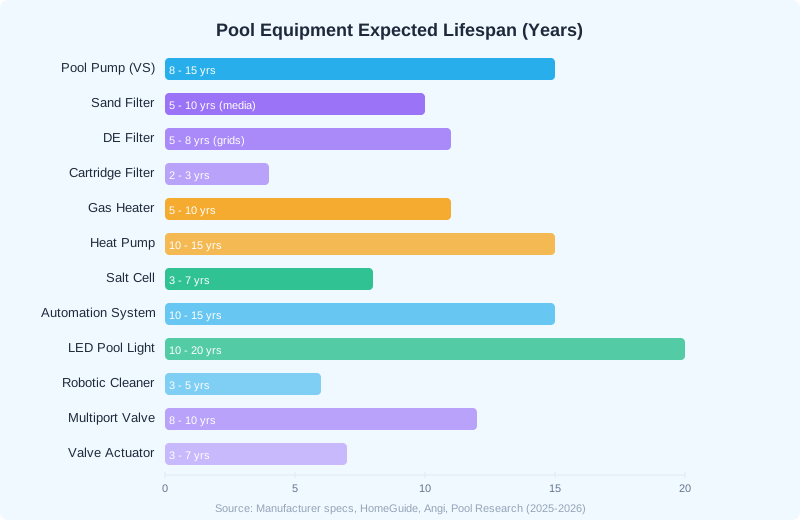
The single biggest factor shortening equipment life is poor water chemistry. Low pH eats copper heat exchangers. High calcium scales salt cells. Unbalanced LSI corrodes everything metal on the pad. Fix the water first, and equipment lasts longer.
| Equipment | Lifespan | Replacement Cost (Installed) | Warranty (Typical) |
|---|---|---|---|
| Variable-speed pump | 8-15 years | $800-$2,500 | 1-3 years |
| Sand filter (media) | 5-10 years | $250-$1,000 | 1-2 years |
| DE filter (grids) | 5-8 years | $550-$1,300 | 1-2 years |
| Cartridge filter | 2-3 years | $250-$1,200 | 1 year |
| Gas heater | 5-10 years | $1,500-$4,500 | 1-2 years |
| Heat pump | 10-15 years | $2,000-$6,000 | 2-5 years |
| Salt cell | 3-7 years | $200-$900 (cell only) | 2-3 years |
| Automation system | 10-15 years | $1,500-$3,500+ | 2-3 years |
| LED pool light | 10-20 years | $700-$1,500 | 1-3 years |
| Robotic cleaner | 3-5 years | $1,000-$2,000 | 1-2 years |
| Multiport valve | 8-10 years | $150-$500 | 1 year |
| Valve actuator | 3-7 years | $200-$400 | 1-2 years |
How Long Do Pool Pumps Last and When Should You Replace?
A well-maintained pool pump lasts 8 to 15 years depending on the type. Single-speed pumps typically last 7 to 10 years, while variable-speed pumps last 10 to 15 years because they run at lower RPMs and generate less heat and vibration. According to Angi, the average pool pump replacement costs between $900 and $2,500 installed in 2026, with variable-speed models toward the higher end of that range.
What Are the Signs a Pool Pump Is Failing?
- Loud screeching or grinding noises from worn bearings. Bearing replacement costs $150-$300 and buys 2-3 more years if the motor is otherwise healthy.
- Visible leaks from the seal plate. Shaft seal replacement costs $75-$150 in parts and is worth doing on pumps under 8 years old.
- Motor runs hot and trips the breaker. Usually means the motor windings are failing. Motor replacement costs $300-$600, which often pushes the math toward a full pump swap.
- Loss of prime that persists after cleaning the basket and checking suction lines. Worn impeller or cracked volute. If the pump is over 10 years old, replace it.
- Rust on the motor housing or wet feet (base corrosion). The motor is compromised. Replace.
Should You Repair or Replace a Pool Pump?
Replace the pump if it is over 10 years old and needs a repair costing more than $300. Replace it if it is a single-speed pump in a state that requires variable-speed (the DOE energy efficiency rule took effect in 2021, and most replacements now require VS by law). Repair if the pump is under 8 years old and the issue is a seal, gasket, or capacitor. A $75 shaft seal on a 5-year-old Pentair IntelliFlo is a no-brainer repair. Our pump motor replacement guide covers the full process.
If you are quoting a pump replacement for a customer, always mention the energy savings. Variable-speed pumps use up to 80% less electricity than single-speed models, saving $300-$500 per year. That recoups the cost difference in 1-2 years. Customers who understand the math are far more likely to approve the upgrade.
How Long Do Pool Filters Last? Sand vs DE vs Cartridge
Pool filter lifespan depends entirely on the filter type. Sand filter tanks can last 20+ years, but the media needs replacement every 5-10 years. DE filter grids last 5-8 years. Cartridge filter elements last only 2-3 years. Replacement costs range from $250 for a sand filter to $1,300 for a full DE system installed. The filter tank itself rarely fails unless it cracks from freeze damage or UV degradation.
When Should You Replace Sand Filter Media?
Replace sand filter media every 5-7 years, or sooner if the filter cannot maintain proper pressure differential after backwashing. If the pressure returns to the "dirty" reading within 24-48 hours of backwashing, the sand is channeled or saturated. Sand replacement costs $50-$350 depending on filter size. The tank, laterals, and standpipe typically last much longer than the media itself.
When Should You Replace DE Filter Grids?
DE filter grids last 5-8 years with proper maintenance. Replace grids when you see DE powder returning to the pool through the returns (torn fabric), when the filter cannot hold pressure even after a full teardown and cleaning, or when the grid frames are bent or corroded. A full grid set costs $150-$400 in parts. If the filter manifold or tank is cracked, replace the entire unit ($550-$1,300 installed). See our filter troubleshooting guide for detailed diagnostics.
How Often Do Cartridge Filters Need Replacing?
Cartridge filter elements last 2-3 years with regular cleaning. Clean cartridges every 4-6 weeks during season and deep clean with a chemical soak quarterly. Replace when the pleats are flattened, torn, or the filter cannot hold a clean baseline pressure. Replacement cartridges cost $50-$200 each depending on the model. If you are doing a full system replacement, expect $250-$1,200 installed.
| Filter Type | Media/Element Life | Tank Life | Annual Maintenance Cost |
|---|---|---|---|
| Sand | 5-10 years | 15-20+ years | $50-$100 (backwash water) |
| DE | 5-8 years (grids) | 15-20 years | $50-$120 (DE powder) |
| Cartridge | 2-3 years | 10-15 years | $50-$200 (replacement cartridges) |
How Long Do Pool Heaters Last? Gas vs Heat Pump
Gas pool heaters last 5-10 years on average. Heat pumps last 10-15 years with proper maintenance. The difference comes down to how they work: gas heaters use combustion and have more components that corrode and fail, while heat pumps use a compressor and refrigerant cycle similar to an air conditioner. According to HomeGuide, gas heater replacement costs $1,500-$4,500 installed in 2026, while heat pump replacement runs $2,000-$6,000 installed.
What Are the Signs a Pool Heater Is Failing?
- Heater fires but does not reach set temperature. Could be a dirty or clogged heat exchanger (cleanable) or a failing heat exchanger with internal scale buildup (expensive repair or replace).
- Error codes on the display. Ignition failures, high limit faults, or flow switch errors. A single ignition failure is often a dirty igniter ($50-$150 fix). Repeated failures suggest deeper issues.
- Visible rust or water dripping from the cabinet. The heat exchanger is leaking. On gas heaters, copper heat exchanger replacement costs $500-$1,200, which on a heater over 7 years old usually means full replacement makes more sense.
- Soot buildup around the burner tray. Indicates incomplete combustion. Could be a simple cleaning or could mean the burners are corroded beyond repair.
- The heat pump compressor is noisy or cycles on and off rapidly. Refrigerant leak or compressor failure. Compressor replacement costs $800-$1,500, which often exceeds 50% of a new unit.
Should You Repair or Replace a Pool Heater?
The 50% rule applies here: if the repair costs more than half the price of a new unit, replace it. For gas heaters, that threshold is roughly $750-$2,000. For heat pumps, it is $1,000-$3,000. Always factor in age. A $600 heat exchanger repair on a 3-year-old Pentair MasterTemp is smart. The same repair on an 8-year-old unit with corroded burners is throwing money at a problem that is going to recur.
Operating cost matters as much as replacement cost when advising customers. Gas heaters cost $200-$500+ per month to run, while heat pumps cost $50-$150 per month. For a customer who heats their pool 6+ months a year, a heat pump pays for the price difference in 2-3 seasons through lower operating costs.
How Long Does a Salt Chlorinator Cell Last?
Salt chlorinator cells last 3-7 years depending on water chemistry, run time, and maintenance. Most cells are rated for 8,000-15,000 hours of operation. Running the cell 8-12 hours per day puts typical lifespan at 3-5 years. Replacement cells cost $200-$900 depending on the model. Full salt system replacement (cell, control board, and installation) runs $1,200-$2,500.
What Kills Salt Cells Prematurely?
- Calcium scale buildup. The number one killer. High calcium hardness (above 400 ppm) and high pH cause calcium to plate onto the cell plates, reducing chlorine output and generating excess heat. Inspect and acid-wash cells every 3-6 months.
- Running the cell at 100% output. Cells that run at maximum output 24/7 degrade much faster. Size the cell to the pool and keep output at 50-70% when possible.
- Low salt levels. Running below the manufacturer minimum (typically 2,700 ppm) forces the cell to work harder and wears the plates faster.
- Improper pH management. Salt systems naturally drive pH up. If you are not managing pH, the resulting high-pH water accelerates scaling on the cell.
When Should You Replace a Salt Cell vs the Whole System?
If the cell is dead but the control board displays and communicates properly, replace the cell only ($200-$900). If the control board is also showing errors, losing communication, or the system is over 8 years old, replace the entire unit. Pentair IntelliChlor complete systems run $1,200-$2,500 installed. Hayward AquaRite systems are in a similar range. Budget roughly $100-$200 per year for eventual cell replacement as a maintenance cost. Our salt chlorinator troubleshooting guide walks through every common error code.
How Long Do Pool Automation Systems Last?
Pool automation systems last 10-15 years with proper installation and care. The control panel itself is the longest-lived component. Wireless modules, actuators, and sensors are the weak links that fail first. Automation system replacement costs $1,500-$3,500+ for the control panel and basic installation, with complex setups running significantly higher when adding actuators, sensors, and new wiring.
What Fails First on Pool Automation Systems?
- Wireless/WiFi modules. The most common complaint across Pentair IntelliCenter, Jandy iAquaLink, and Hayward OmniLogic is app connectivity failures. The module itself fails and needs replacement ($100-$300) every 3-5 years, especially in humid or coastal environments.
- Valve actuators. Actuators control diverter valves for pool/spa switching, solar, and water features. They last 3-7 years and cost $200-$400 each to replace. Salt air and humidity corrode the internal electronics.
- Temperature and flow sensors. Sensors drift or fail after 5-8 years. Replacement is inexpensive ($30-$80) but diagnosing the failure takes time.
- Relay boards. Internal relays that switch equipment on and off can burn out after years of cycling. Board replacement costs $200-$500.
Should You Upgrade or Patch an Old Automation System?
If the main board still works and the issue is a failed actuator or sensor, repair it. These are $100-$400 fixes. If the system is a legacy model with discontinued parts (older Compool, early Jandy AquaLink RS), upgrade the entire system. Pentair offers upgrade kits that convert older EasyTouch and IntelliTouch panels to IntelliCenter without full rewiring, which saves significant labor cost.
How Long Do LED Pool Lights, Cleaners, and Valves Last?
LED pool lights last 10-20 years (20,000-30,000 hours), making them the longest-lived equipment on the pad. Robotic pool cleaners average 3-5 years. Multiport valves last 8-10 years, and valve actuators last 3-7 years. These are the components that often get overlooked during equipment assessments but still represent real cost when they fail.
When Should You Replace Pool Lights?
Replace pool lights when they flicker, lose color modes, or stop working entirely. LED fixture replacement costs $700-$1,500 per light installed. If the fixture housing and niche are in good shape, you may only need the LED module ($50-$600). Older incandescent fixtures should be upgraded to LED at the first failure. LEDs use 87% less electricity and last 10-15 times longer, so the upgrade pays for itself.
When Should You Replace a Robotic Pool Cleaner?
Robotic pool cleaners last 3-5 years on average, with quality models occasionally reaching 7-8 years. Replace when the drive motors fail (the cleaner spins in circles or barely moves), the power supply dies, or the brushes and tracks are worn beyond replacement parts availability. Motors and power supplies cost $200-$400 each to repair, so on a cleaner over 4 years old the math often favors replacement at $1,000-$2,000 for a new unit.
How Long Do Pool Valves and Actuators Last?
Multiport valves last 8-10 years. The spider gasket is the most common failure point. It is a star-shaped rubber gasket inside the valve that seals between port positions. When it wears out, water bypasses to the wrong port during backwash or rinse. Spider gasket replacement costs $15-$40 in parts and is worth doing on any valve under 8 years old. Full multiport valve replacement runs $150-$500.
Valve actuators last 3-7 years, with coastal and high-humidity environments at the shorter end. Humidity gets into the motor housing, corrodes circuit boards and relay contacts, and shorts out microswitches. Rinse actuators with fresh water monthly if you are near the coast. Replacement cost is $200-$400 per actuator.
The Repair vs Replace Decision Framework
Every repair vs replace decision comes down to three factors: the age of the equipment relative to its expected lifespan, the cost of the repair relative to a new unit, and whether the failure is isolated or a sign of broader deterioration. Use this framework to advise customers confidently and consistently.
What Is the 50% Rule for Pool Equipment?
If the repair costs more than 50% of the replacement cost, replace the equipment. This is the most widely used threshold in the pool service industry and it holds up well in practice. A $600 heat exchanger repair on a $3,000 heater that is 3 years old is a good repair. The same $600 repair on an 8-year-old unit is a bad bet because another component will likely fail within 1-2 years.
What Is the 75% Lifespan Rule?
If the equipment is past 75% of its expected lifespan and needs a major repair, replace it. A 12-year-old pump (past 75% of a 15-year lifespan) with a failed motor should be replaced, not repaired. A 5-year-old pump with the same failure should get a new motor. This rule prevents the cascading repair trap where you fix one thing and something else breaks three months later.
| Decision Factor | Repair | Replace |
|---|---|---|
| Age vs lifespan | Under 60% of expected life | Over 75% of expected life |
| Repair cost | Under 50% of new unit cost | Over 50% of new unit cost |
| Failure type | Single component (seal, gasket, capacitor) | Core component (motor, heat exchanger, compressor) |
| Repair history | First major repair | Second or third repair in 12 months |
| Parts availability | Parts readily available | Discontinued or hard to source |
When you present repair vs replace options to customers, always give them both quotes with the reasoning behind each. "Your pump is 11 years old. I can replace the motor for $450, which buys you maybe 2-3 more years. Or we can replace the whole pump with a variable-speed model for $1,800, which will last 12-15 years and save you $300-$500 a year in electricity." Let them choose. They will respect the transparency.
Manufacturer Warranty Periods: What the Big Three Cover
Pentair, Hayward, and Jandy (Zodiac) are the three dominant equipment manufacturers, and their warranty terms vary significantly based on whether the equipment is professionally installed. As a pool service company, you should always register equipment on behalf of your customers to maximize coverage. Warranty claims handled smoothly build long-term loyalty.
What Are Pentair, Hayward, and Jandy Warranty Periods?
Pentair limits warranties to 60 days on pumps, filters, and heaters unless a certified professional installs the equipment, which extends coverage to 1-5 years depending on the product. Hayward offers a standard 1-year warranty that extends to 2-3 years on select products when installed by a certified professional. Jandy/Zodiac dealers report 3-year parts and labor warranties on professionally installed equipment. Always check the specific product warranty at time of purchase, as terms can change.
Professional installation warranties are a selling point for your business. When a homeowner buys a pump online and installs it themselves, they get 60-90 days of coverage. When you install it, they get 1-5 years. Make sure your customers know this.
How Should You Track Equipment Age and Warranty Status?
Record the make, model, serial number, and install date for every piece of equipment on every customer account. When a component fails, you can immediately tell the customer whether it is under warranty and handle the claim for them. This is the kind of detail that separates a professional service company from a guy with a truck. Pool Founder lets you log equipment details on each customer profile so the information is always at your fingertips in the field.
Run a pool route?
The business side of what you just read.
Pricing, chemical costs, and the tools owners use to keep the numbers straight.
- Commercial pool service pricing2026 rate tables and the cost-plus formula
- Chemical cost per poolWhat chemicals actually cost per stop
- Chemical tracking softwareLog readings and dosing from the pool deck
- Pool service softwareRoutes, invoicing, and service reports in one app
- Free profit & rate calculatorsProfit per pool, minimum rate, break-even
Frequently Asked Questions
What pool equipment lasts the longest?
LED pool lights last the longest at 10-20 years (20,000-30,000 hours of operation). After that, heat pumps and automation system control panels last 10-15 years. Sand filter tanks can last 15-20+ years, though the sand media inside needs replacement every 5-10 years.
What pool equipment needs replacing most often?
Cartridge filter elements need replacing most often at every 2-3 years. Salt chlorinator cells come next at 3-7 years, followed by valve actuators (3-7 years in coastal areas) and robotic cleaners (3-5 years). These are the components to budget for as ongoing maintenance costs.
How do you know when a pool pump needs replacing?
The clearest signs are a motor that trips the breaker repeatedly, visible rust or corrosion on the motor housing, persistent loss of prime after checking all suction-side components, and grinding noises from worn bearings. If the pump is over 10 years old and needs a repair costing more than $300, replacement is usually the better investment.
Is it worth repairing a 10-year-old pool heater?
It depends on the repair. Minor fixes like igniter replacement ($50-$150) or thermostat replacement are worth it. Major repairs like heat exchanger replacement ($500-$1,200) on a 10-year-old gas heater are not, because the heater is past 75% of its expected lifespan and other components will likely fail soon. Use the 50% rule: if the repair exceeds half the cost of a new unit, replace.
How much does it cost to replace all pool equipment?
Replacing a complete pool equipment pad (pump, filter, heater, salt system, and automation) costs $8,000-$18,000+ depending on brands, sizes, and local labor rates. Most pool owners do not replace everything at once. Instead, equipment is replaced as it reaches end-of-life, typically staggered over several years.
Does a salt system shorten the life of other pool equipment?
Salt systems can accelerate corrosion on metal components if the salt level is too high or if equipment is not rated for saltwater use. The salt concentration in a pool (3,200 ppm) is about one-tenth of ocean water, so the effect is mild with proper chemistry management. Use equipment rated for salt pools, maintain proper salt levels (2,700-3,400 ppm), and monitor for galvanic corrosion at dissimilar metal connections.
Sources & References
- Angi - Pool Pump Replacement Cost (2026)
- HomeGuide - Pool Heater Cost (2026)
- HomeGuide - Pool Filter Replacement and Installation Cost (2026)
- Angi - Pool Light Replacement Cost Guide (2026)
- Pool Research - Pool Cleaner Longevity
- Pool Research - Multiport Valve Replacement Cost (2025)
- River Pools - How Long Should Salt Chlorine Generators Last?
- Pentair - Product Warranty Information
- Hayward - Product Warranty
- Benchmark Pool Supply - Average Lifespan of Pool Filters Explained
- Precision Swimming Pools - Pool Automation System Cost (2026)