Where invoicing lives
The Invoices page is where you view, create, and send invoices. Two companion pages cover recurring and one-time billing: Maintenance Billing is the worklist for recurring maintenance billing, and Work Order Billing handles one-time job billing, including deposits (see work order billing and deposits). Company-wide invoice settings live on the Invoice Settings page.
Invoicing works without Stripe — you can create and send invoices before connecting payments, and record offline payments when the money arrives. See accept online payments.
Emailing an invoice to a customer, and charging a saved card, both require a verified phone number or email on the account. If a send is refused, see verify your phone or email.
The Invoices page at a glance: stats and receivables aging
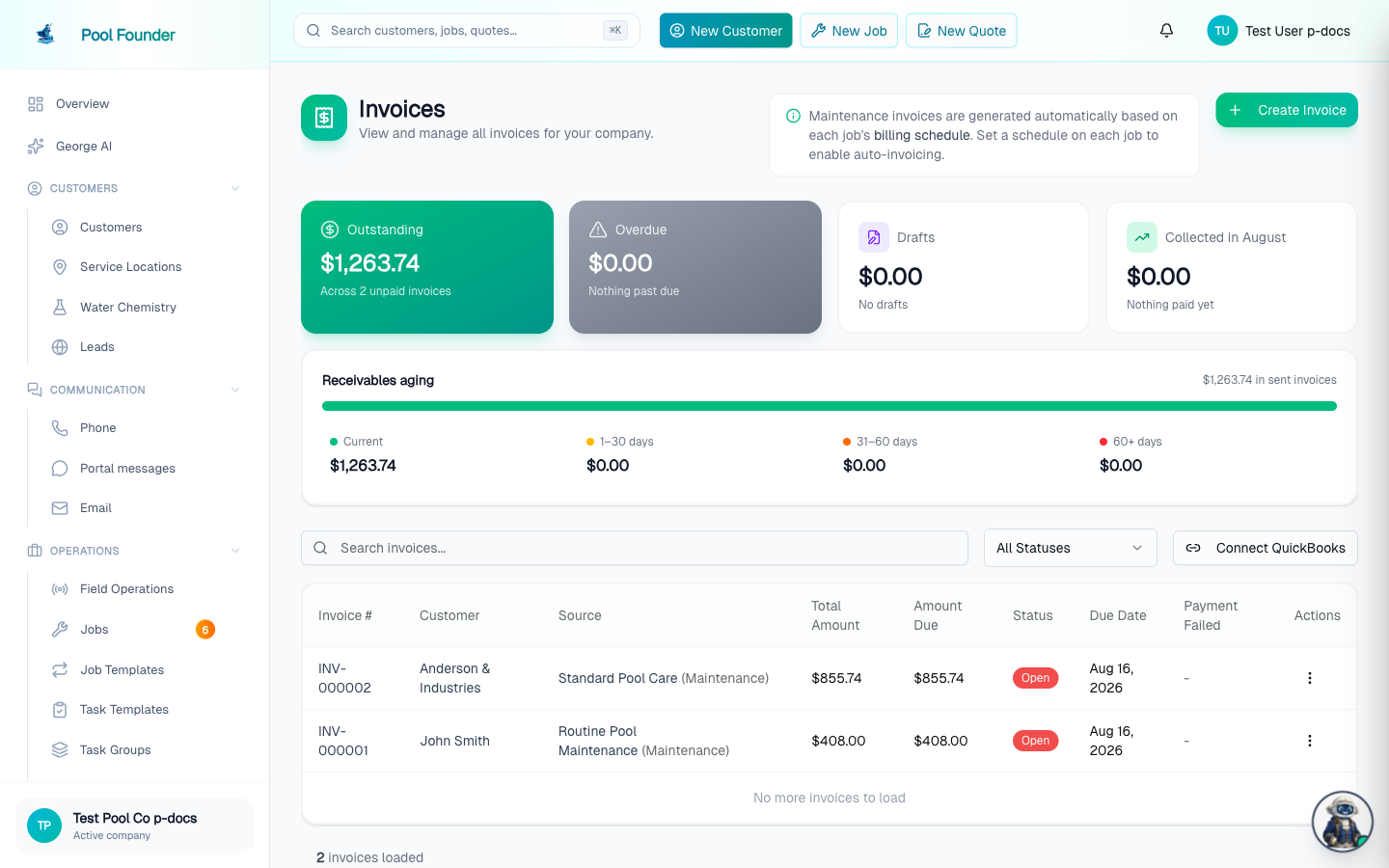
Above the invoice table, four clickable stat tiles give a live read on your billing — clicking any of them filters the table below:
- Outstanding — everything currently owed to you, "Across N unpaid invoices". Clicks through to open invoices.
- Overdue — the slice of outstanding that's past due ("N invoices past due"). Clicks through to the overdue filter.
- Drafts — invoices created but not yet sent: money you haven't asked for yet.
- Collected in [month] — what's been paid this month, with the invoice count.
Below the tiles, the Receivables aging bar breaks the outstanding balance into Current, 1–30 days, 31–60 days, and 60+ days buckets — a stacked bar plus a legend with dollar amounts, each linking into the matching table filter. When nothing is owed it reads "No outstanding receivables — everything's been collected."
Above the table you can search invoices (by customer name, invoice number, and other details), filter by status (All Statuses, Overdue, Paid, Open, Draft, Void), and pick a sort order. The sort dropdown offers Last sent (default — most recently emailed invoices first; invoices that have never been sent slot in by creation date), Last paid (most recently paid first, with unpaid invoices below all paid ones), Newest (most recently created first), and Due date (soonest due first; invoices without a due date last).
Create and send an invoice
- 1Open Invoices and click Create Invoice.
- 2Pick a mode at the top: From Work Order (invoice a completed work order — line items pre-fill from the job) or Custom Invoice (a freeform invoice for any customer and any charge).
- 3Add or adjust line items and discounts — both modes support discounts on any invoice.
- 4Choosing send invoice emails it to the customer with a secure payment link; choosing one of the customer's saved cards charges it immediately.
- Your work in progress is saved automatically. If you leave or reload mid-invoice, the form is restored next time with the banner "We restored your unsaved invoice from where you left off." and a Discard draft button. Drafts are cleared once the invoice is created.
- When invoicing a work order that still has incomplete tasks, a "N Tasks Remaining" warning appears — you can still create the invoice, but it suggests scheduling additional visits to finish the tasks first.
- The "Pass Processing Fees to Customer" toggle (per invoice, credit cards only, auto-disabled in surcharge-restricted states) is covered in accept online payments.
A completed work order does not have to get an invoice of its own. Add to Next Maintenance Invoice, on the work order page and on its Work Order Billing row, queues its charges onto the customer's next monthly or weekly maintenance invoice instead, so they arrive as extra line items on one bill — see work order billing and deposits.
Invoices can also be created and managed from the technician mobile app — see mobile invoices.
Everything you can do on an invoice
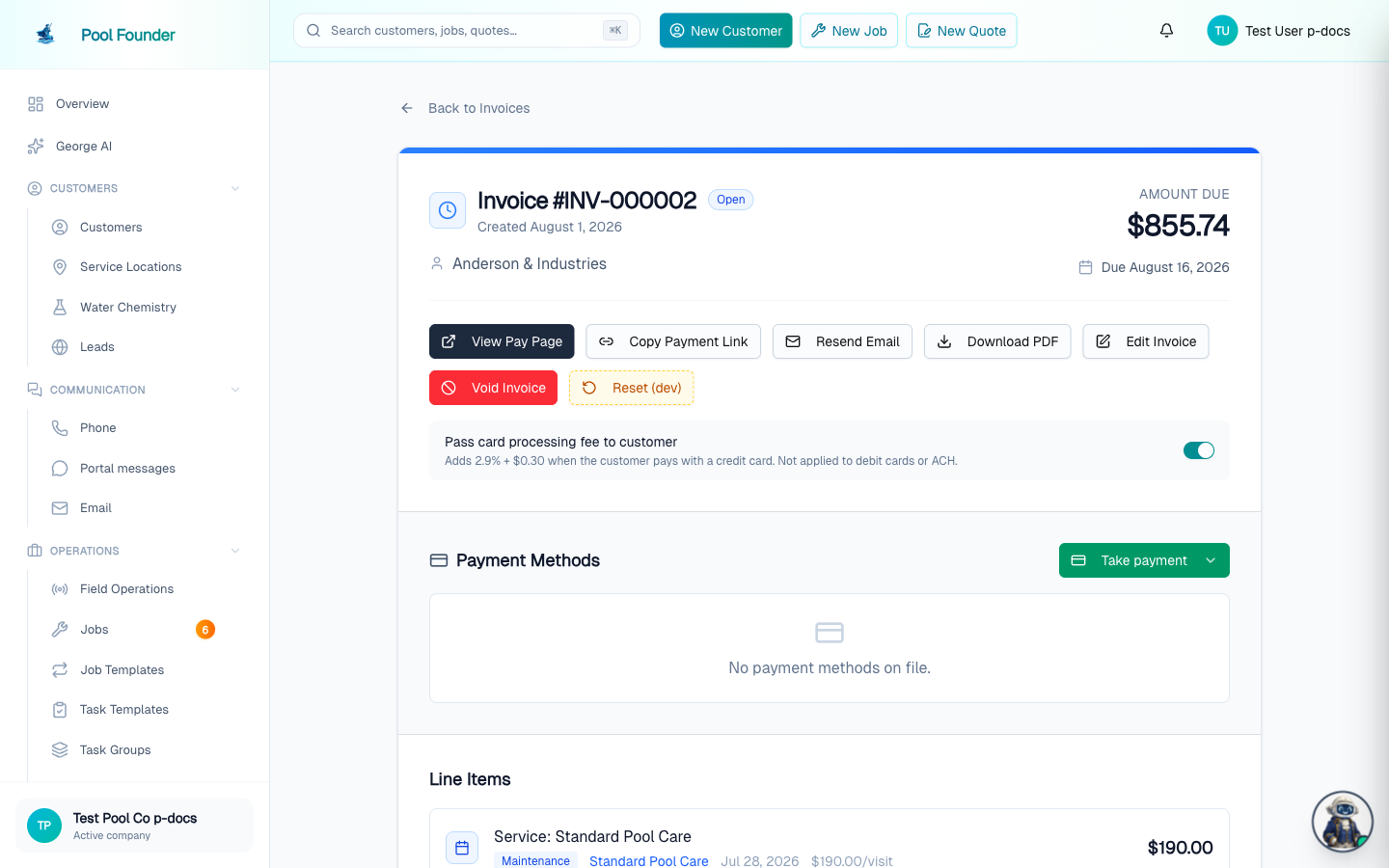
Open any invoice from the Invoices page to reach its detail page. Depending on the invoice's status, you can:
- Take payment — "Pay with a new card" or "Record a manual payment" (cash/check, with a description like "Check #1234" and optional proof-of-payment photos).
- Charge / Charge Now — next to any of the customer's saved payment methods.
- Resend Email — re-sends the invoice email (open invoices).
- Void Invoice — cancels a draft or open invoice, with an optional email to the customer (see below).
- Issue Refund — for paid invoices; card and ACH payments only (see below).
- Void — next to any recorded manual payment, to reverse a mis-keyed check or cash payment. See record and void manual payments.
- Edit Invoice, Download PDF, View Pay Page, and Copy Payment Link (copies the invoice's pay-page URL to the clipboard, ready to text or email to the customer).
The page also links out to everything the invoice relates to: the customer's name opens their page, a linked quote appears as a chip that opens the quote, and each line item links to its job. While an ACH payment is in flight, Edit, Void, and Take payment are hidden until it settles.
Edit an invoice
Edit Invoice works on draft and open invoices (paid invoices can't be edited — they need a refund or credit adjustments instead). Edits save in place: "Saving will update this invoice in place. The customer will see the new total next time they open the pay link."
- Line items and discounts are fully editable — add, change, or remove them.
- Recorded payments are locked. They appear as read-only rows so the running total stays honest, but a payment is a fact, not a discount — reversing one is a deliberate Void from the invoice page.
- You can't cut the total below what's already been paid. Saving is blocked with "Total is below the [amount] already paid. Refund or void a payment first."
- Editing down to $0 resolves the invoice. With a recorded payment, the button becomes Close & mark paid — the invoice closes as paid and the customer gets a receipt. With no payment, it becomes Void invoice, with a confirm dialog ("There are no charges left to bill, so saving will cancel this invoice.") and an "Email the customer" checkbox.
- The due date is editable too — changing it updates the PDF and pay page and shifts when overdue reminders send (an invoice is "overdue" the day after its due date). It never charges the customer or changes when autopay runs.
- On a normal edit, a Save changes confirm asks whether to "Email the updated invoice" to the customer — or save quietly.
Refunds
Issue Refund on a paid invoice opens the refund dialog. Enter any amount up to the maximum refundable (it defaults to the full amount), add an optional reason, and choose whether to "Email the customer a refund confirmation" (on by default).
- If the customer paid a card processing surcharge, a checkbox — "Refund the [amount] card processing surcharge to the customer" — decides whether the surcharge comes back too. Refunding it makes the customer whole but your company absorbs the fee; keeping it offsets the processing cost, and the customer is refunded the invoice amount only.
- Stripe never returns its own processing fee on refunds — the dialog shows the exact fee your company absorbs, no matter how much you refund.
- Refunds only work for card and ACH payments. Recorded manual payments (check, cash, Zelle) are reversed by voiding the payment instead — see record and void manual payments.
Voiding an invoice
Void Invoice cancels a draft or open invoice — with an optional reason for your records and an "Email the customer" checkbox that sends a short notice that the invoice was canceled and nothing is owed. Voiding cannot be undone, and the customer's pay link switches to an "Invoice voided" notice.
If the invoice has a partial payment on it, the dialog warns you: voiding does not automatically refund that payment. Settle the money first — use Issue Refund for a card or ACH payment, or void the recorded manual payment — so the books reflect reality.
Payment links are per invoice
- 1Open the customer's page, find the Invoices card, and click the link icon on the invoice's row ("Copy payment link") — no need to open the invoice.
- 2Or open the invoice itself and use the Copy Payment Link button next to "View Pay Page".
Payment links are per invoice — each invoice has its own secure pay-page URL. There is no single all-invoices payment link for a customer. To give a customer one place to see and pay everything, share the customer portal link instead.
Emails, Activity, and Edit history
The bottom of every invoice page keeps the full paper trail in three panels:
- Emails — every email tied to the invoice (invoice sent, updated invoice, payment receipt, payment reminder, payment failed notice, cancellation notice, refund notice) with live delivery tracking chips: Sent, Delivered, Opened, Clicked, Bounced, or Marked spam. A banner also counts pay-page visits: "Customer viewed the pay page N times", with the most recent time — so you know whether "I never got it" holds up.
- Activity — the invoice's lifecycle timeline: created, sent, viewed, edited, payment attempted, paid in full, payment failed, reminder sent, voided, refunded — each with who did it (you, the customer, or the system) and when.
- Edit history — one entry per edit showing who edited, when, and the total before → after, with an expandable snapshot of the exact version the edit replaced.
Invoice Settings: company-wide invoice configuration
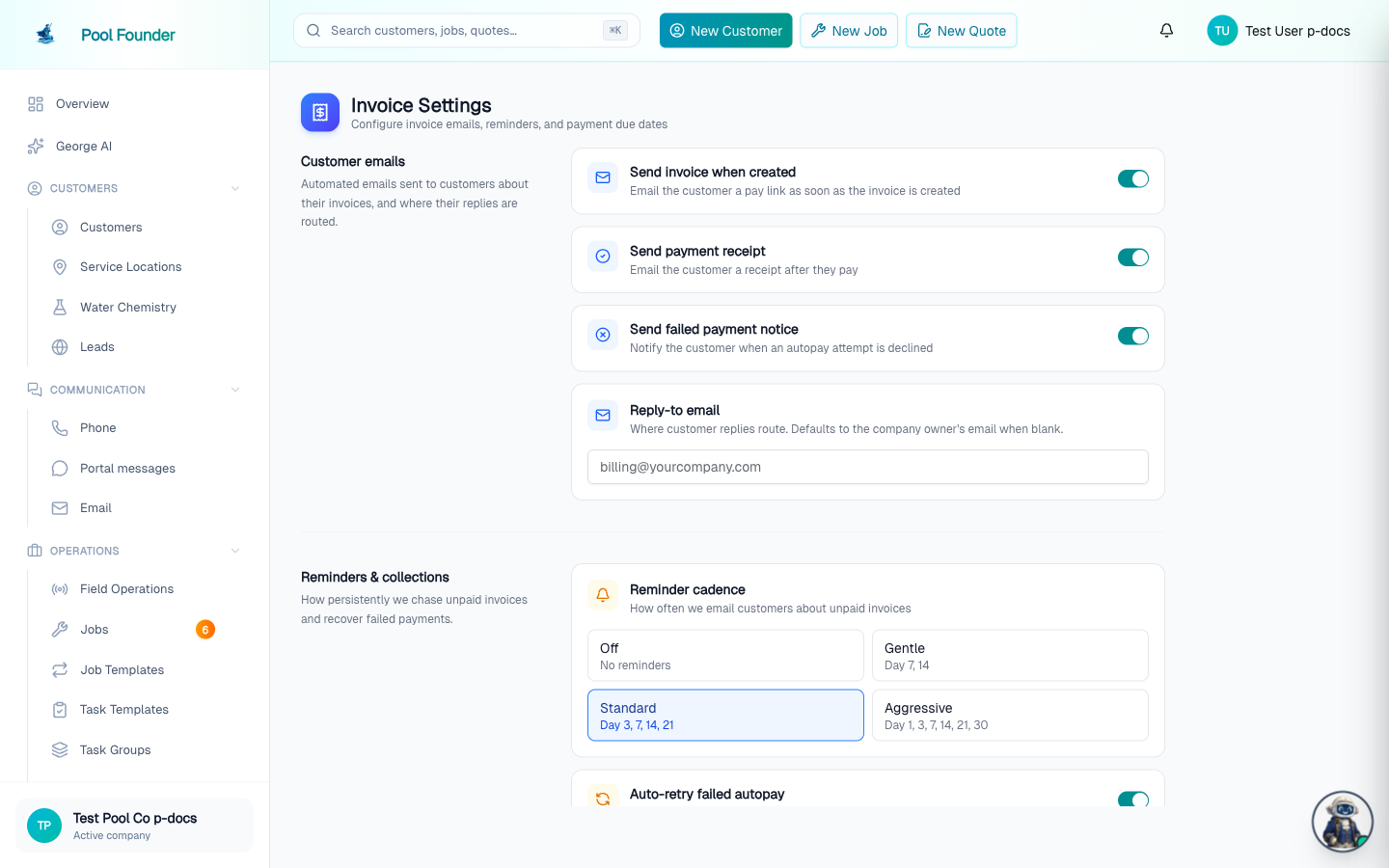
The Invoice Settings page holds every company-wide invoice setting:
- Customer email settings — send on create, receipts, failed-payment notices, and the reply-to address.
- Reminders & collections — reminder cadence, autopay retries, and write-off (detailed below).
- Pay by Zelle — show a Zelle QR code and link on invoices, service reports, and the customer portal. See accept online payments for the full setup.
- Payment terms — default due dates for invoices and deposits.
- Invoice footer — text shown at the bottom of your invoices.
- Business address — your company address as it appears in the header of invoice PDFs, on the payment page, and on card receipts. You can type a PO Box into the address field if you don't want your street address on customer documents.
- Sales tax — the default tax rate for new chemicals and parts and for line items you mark Taxable, and the label the tax row uses on invoices (detailed below).
- Maintenance line item display options — how maintenance charges are presented on invoices.
Reminders & collections
The Reminders & collections section controls how persistently unpaid invoices are chased and failed payments recovered:
- Reminder cadence — pick a preset for how often customers are emailed about unpaid invoices: Off (no reminders), Gentle (day 7 and 14 after the invoice date), Standard (day 3, 7, 14, and 21), or Aggressive (day 1, 3, 7, 14, 21, and 30).
- Auto-retry failed autopay — when an autopay charge fails, retry automatically at +24 hours, +72 hours, and +7 days (max 3 retries).
- Retry on card update — immediately re-charge open invoices when a customer adds a new card, so a replaced card settles the balance without waiting for the next retry.
Whenever an autopay charge fails, owners and administrators also get a Payment Failed notification with the reason, whether or not auto-retry is on. A decline while the customer is paying on the invoice page does not alert you, since the customer sees it right away. If several autopay charges fail within a couple of minutes, they arrive as one notification with the count.
There is no "uncollectible" or automatic write-off status. Once the reminder cadence is exhausted, an unpaid invoice simply stays open and counts toward the balance the customer owes. If you have decided not to collect an invoice, void it — that cancels it and removes it from the outstanding balance.
Sales tax: where to set the tax rate and how it's charged
Pool Founder charges sales tax on any line marked taxable: chemicals and parts from your catalog, and any work order, quote, or invoice line item whose Taxable switch is on, labor included. The rate is set per line and per catalog item, never on the customer, so a taxable line and an untaxed one can sit on the same invoice. Maintenance service rates are not taxed.
Where you set the rate
- On each chemical and part — open the item and set its Tax Rate (%) field. That rate is charged when the item is billed from a visit and is where a catalog line starts when you add it with Add from catalog. The Chemicals and Parts tables show a Tax column so you can see at a glance which items are taxed (untaxed items read —).
- On each line item — work orders, work order quotes, and invoices have a Taxable switch with a rate box on every line. See catalog parts and taxable line items.
- Invoice Settings → Sales tax → Default tax rate — the rate a newly created chemical or part starts with, and the rate a line's Taxable switch fills in when you turn it on. Changing this default never re-rates items you already have or lines already saved.
- Invoice Settings → Sales tax → Apply to all chemicals and parts — a one-time Apply to all items button (with a confirmation) that stamps the default rate onto every chemical and part you already have, including ones that are currently untaxed. Invoices that have already been issued are not changed.
- Invoice Settings → Sales tax → Tax label on invoices — what the tax row is called on the invoice PDF, pay page, and customer portal. Defaults to "Sales tax".
How it appears on an invoice
- A taxed invoice shows Subtotal, the tax row, and Invoice Total. Invoices with no tax on them keep the single total row, with no "$0.00 tax" line.
- Tax is calculated per line, on that line's own amount, at that line's own rate — never as one rate across the whole invoice. A single line that aggregates several chemicals whose rates do not match is taxed item by item and shows the combined amount.
- When you edit an invoice, each line has its own Tax percentage box with a live "+$X.XX tax" preview, and the total updates as you type. Chemical and part lines arrive pre-filled from the item; a line you add by hand starts untaxed. Add from catalog is on Edit Invoice too.
- On Create Invoice (From Work Order and Custom Invoice), every line has the Taxable switch, and Add from catalog adds a part or chemical at quantity × unit price with its own rate. A work order's taxable lines arrive already taxed.
- A line with a quantity other than 1 reads with the count, e.g. "Pool Pump ×2", and lines added from the catalog are badged Part or Chemical on the invoice page.
- If you pass the credit-card processing fee to the customer, that fee is calculated on the taxed total.
Deposits and discounts
- Deposit invoices are not taxed. A deposit is a payment toward the job, not a sale of goods, so no tax is added to it and the deposit credit still comes off the pre-tax subtotal on the final invoice.
- A discount reduces the tax too. The discount is spread across the invoice's own line items in proportion to their amounts, so taxed lines carry less tax, and each discount row shows "Reduces tax by $X.XX". That includes discounts you add while editing an invoice, on the web and in the mobile app. It does not reduce the tax on chemical and part rows that came from visit completions, and it is never spread over a deposit.
Changing an item's tax rate never changes an invoice that has already been issued — every invoice keeps the tax it was created with. Re-rating an item affects invoices created from that point on.
Sales tax needs your account to be on Pool Founder's own invoicing (which is where new accounts start). A handful of older accounts still bill through the legacy Stripe invoice flow, where tax cannot be applied — on those, the Sales tax section and the Taxable switches are not shown, no tax is ever charged, and saving a rate is refused with a message pointing to support@poolfounder.com.
Not available: tax-exempt customers, tax rates based on the customer's address or jurisdiction, Stripe Tax or any automatic tax calculation, and tax on maintenance service rates, maintenance quotes, project milestones, or change orders. On the mobile app, the Create Invoice screen has no Taxable switch; mobile Edit Invoice keeps and edits each line's tax.
Invoice numbering
There is no invoice numbering customization — invoice numbers are generated for you and the format is not editable. If that matters to your business, contact support at support@poolfounder.com to request it.
Frequently asked questions
How do I resend an invoice?
Open the invoice from the Invoices page and use Resend Email.
A customer paid by check or cash — what do I do?
Open the invoice, click "Take payment", and choose "Record a manual payment". Add a description like "Check #1234" — and optionally attach a photo of the check — so the record is clear.
Does changing an invoice's due date charge the customer?
No — changing the due date only updates the PDF and pay page and shifts when overdue reminders send. It never charges the customer or changes when autopay runs, and the customer is only emailed if you choose to send the updated invoice when saving.
Does the customer get the card fee back when I refund?
That's your choice — the refund dialog has a checkbox to refund the card processing surcharge or keep it to offset the fee. Either way, Stripe never returns its own processing fee on refunds, so your company absorbs that amount.
Can I change the address shown on my invoices — for example to a PO Box?
Yes — go to Invoice Settings and edit the Business address section. The address you save there is printed in the header of every invoice PDF and on the payment page, and it also updates the address on card receipts. A PO Box works: type it into the address field and fill in the city, state, and ZIP by hand (the address suggestions only cover street addresses). The change applies to invoices going forward — already-sent PDFs are not regenerated.
Where do I set my sales tax rate?
Start with Invoice Settings → Sales tax → Default tax rate: new chemicals and parts inherit it, and it fills in whenever you turn on the Taxable switch on a work order, quote, or invoice line. The rate actually charged is set per chemical and part (its Tax Rate (%) field) and per line item (the Taxable switch and its rate box). Use the "Apply to all items" button in that same section to stamp the default onto the catalog you already have. Maintenance service rates are not taxed.
Can each chemical have its own tax rate?
Yes. The tax rate lives on each chemical and each part individually, so you can charge 7.5% on one, 4% on another, and leave a third untaxed. The company-wide Default tax rate in Invoice Settings is only the rate a newly created item starts with — changing it never re-rates items you already have.
Does a discount reduce the sales tax on an invoice?
Yes. A discount is spread across the invoice's own line items in proportion to their amounts, so taxed lines carry less tax, and each discount row shows "Reduces tax by $X.XX". It does not reduce the tax on chemical and part rows that came from visit completions, and deposits are never taxed.
Can I charge sales tax on labor or a service call line?
Yes, on work orders, work order quotes, and invoices. Turn on the Taxable switch on that line and the rate fills in from your Default tax rate (or type one). Maintenance service rates are not taxed.
Can I mark a customer as tax exempt?
No. There is no tax-exempt setting on a customer, and tax is never calculated from the customer's address. Taxability is chosen per line item (the Taxable switch) and per chemical or part (its Tax Rate), so for an exempt customer leave the Taxable switch off on their line items. Chemicals and parts billed from visits still carry their catalog rate, so clear the Tax % on those rows with Edit Invoice.
Is sales tax charged on a deposit invoice?
No. Deposit invoices are not taxed — a deposit is a payment toward the job rather than a sale of goods. The deposit credit still comes off the pre-tax subtotal when the final invoice is created.
Is there one payment link I can give a customer for all their invoices?
No — payment links are per invoice. For one place a customer can see and pay everything, share your customer portal link instead.