Why Every Pool Service Company Must Understand the VGB Act
The Virginia Graeme Baker Pool and Spa Safety Act (VGB Act or VGBA) is a federal law that went into effect December 19, 2008. It requires every public pool and spa drain cover in the United States to meet specific anti-entrapment standards. The law was enacted after Virginia Graeme Baker, the 7-year-old granddaughter of former Secretary of State James Baker, died from suction entrapment in a spa in 2002. Her body was held against a drain by the suction force of the circulation pump, and she could not be freed in time.
Corey Adams, Pool Founder co-founder and 15-year pool service veteran, considers VGB compliance non-negotiable. "This is not a guideline or a best practice. It is federal law enforced by the Consumer Product Safety Commission. If you service a commercial pool with a non-compliant drain cover, you are exposing a child to an entrapment hazard. And if something happens, the pool operator, the management company, and the service company are all exposed. Check every drain cover on every commercial pool you service. No exceptions."
$1.825M
Maximum CPSC civil penalty for a series of related VGB Act violations
Source: Consumer Product Safety Commission
What Pools Does the VGB Act Cover?
The VGB Act applies to all public pools and spas. "Public" in this context does not just mean municipal pools. It includes any pool or spa that is not a single-family residential pool. If the pool serves more than one household, it is likely covered.
| Pool Type | Covered by VGB Act? | Examples |
|---|---|---|
| Municipal pools | Yes | City pools, county aquatic centers, public water parks |
| Hotel and resort pools | Yes | Hotel pools, resort pools, vacation rental pools |
| HOA and community pools | Yes | Subdivision pools, apartment complex pools, condo pools |
| Water parks | Yes | Wave pools, lazy rivers, splash pads with recirculated water |
| Health club and gym pools | Yes | YMCA pools, gym pools, therapy pools |
| Single-family residential | No | Private homeowner pools and spas |
| Multi-family residential | Yes | Apartment and condo shared pools |
Many states have adopted VGB-equivalent requirements that extend to all pools, including single-family residential. Check your state and local codes. Even where the federal VGB Act does not apply, state or local codes may impose identical drain cover and anti-entrapment requirements on residential pools.
Drain Cover Requirements: ASME/ANSI A112.19.8
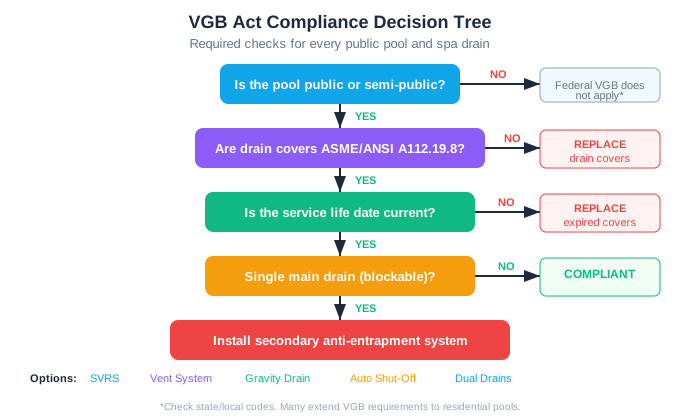
Every drain cover on a covered pool or spa must comply with the ASME/ANSI A112.19.8 standard (or its successor, which the CPSC updated in 2019 to incorporate APSP-16 2017). This standard defines the physical design, testing, and marking requirements for drain covers that resist body and limb entrapment.
What Makes a Drain Cover VGB-Compliant?
- Marked with the standard: The cover must be permanently marked with the ASME/ANSI A112.19.8 designation, the manufacturer name, the flow rating in GPM, and the service life date.
- Rated flow capacity: The cover must be rated for the maximum flow rate of the circulation system. Installing a cover rated for 80 GPM on a system pulling 120 GPM creates an entrapment hazard even if the cover is otherwise compliant.
- Anti-entrapment design: The cover must be designed to prevent body entrapment (a person being held against the cover by suction), limb entrapment (an arm or leg trapped in an opening), hair entrapment (hair pulled into the drain), and evisceration/disembowelment (internal injuries from suction).
- Service life date: Drain covers have a finite service life stamped on the cover. Once the service life expires, the cover must be replaced even if it appears physically intact. This is one of the most commonly overlooked compliance requirements.
Check the service life date on every drain cover you encounter during service. Many covers installed in 2009 and 2010 in response to the original VGB Act have reached or exceeded their 10-year service life. A cover past its service life date is non-compliant regardless of its physical condition.
Secondary Anti-Entrapment Systems for Single Main Drains
A compliant drain cover alone is not sufficient if the pool has a single main drain that is not an unblockable drain. The VGB Act requires a secondary layer of protection for these configurations. An "unblockable drain" is one where the cover dimensions are large enough that no human body part can fully block the suction area, typically 18 inches by 23 inches or larger.
Approved Secondary Systems
| System Type | How It Works | Typical Cost |
|---|---|---|
| Safety Vacuum Release System (SVRS) | Detects a blockage by sensing a rapid increase in suction and automatically shuts off the pump or reverses flow | $500-$2,000 installed |
| Suction-Limiting Vent System | A vent pipe opens to atmosphere when a blockage occurs, breaking the vacuum that holds a person against the drain | $200-$800 installed |
| Gravity Drainage System | The drain operates by gravity flow only, with no mechanical suction. No entrapment hazard exists because there is no vacuum. | $1,000-$3,000 retrofit |
| Automatic Pump Shut-Off System | Sensors detect a blockage and shut the pump off within seconds | $800-$2,500 installed |
| Dual Main Drains | Two drains spaced at least 3 feet apart. If one is blocked, the other provides flow, preventing dangerous suction on either. | $2,000-$5,000 retrofit |
The most common retrofit solution for existing pools with single main drains is an SVRS. It can be added to the existing plumbing without major construction. However, the device must be tested and listed to the ASME/ANSI A112.19.17 or ASTM F2387 standard to be VGB-compliant.
CPSC Enforcement and Penalties
The Consumer Product Safety Commission (CPSC) enforces the VGB Act. Both the CPSC and state Attorneys General have the authority to take enforcement action, including shutting down non-compliant pools. The CPSC prioritizes enforcement at facilities that pose the greatest entrapment risk: wading pools, in-ground spas, and pools designed for young children, especially those with flat drain grates and single main drain configurations.
Penalty Structure
| Violation Type | Maximum Penalty | Additional Consequences |
|---|---|---|
| Single civil violation | $8,000 per occurrence | Each non-compliant drain is a separate violation |
| Series of related violations | $1,825,000 total | Applies when multiple drains or multiple pools are non-compliant |
| Willful violation (criminal) | Fines + up to 5 years imprisonment | For knowingly operating non-compliant pools |
| Pool closure | Immediate shutdown order | CPSC or state AG can close the pool until compliance is achieved |
Beyond CPSC enforcement, non-compliant pools expose operators to catastrophic civil liability in the event of an entrapment injury or death. Plaintiffs in entrapment lawsuits will point to VGB non-compliance as evidence of negligence. Settlements and jury verdicts in pool entrapment cases routinely exceed $1 million.
What Pool Service Companies Should Do on Every Commercial Visit
Pool service technicians are often the most frequent set of trained eyes on a commercial pool. You may visit weekly or even daily. That makes you the first line of defense against entrapment hazards. Incorporating a VGB check into your routine service takes less than 2 minutes and could prevent a tragedy.
VGB Service Checklist
- 1Visual drain cover inspection: Are all drain covers present, intact, and securely fastened? A missing, cracked, or loose drain cover is an immediate safety hazard. If you find one, do not leave the pool open. Notify the operator immediately and document the finding in writing with photos.
- 2Check the service life date: Read the date stamped on the drain cover. If the cover is past its service life, notify the operator in writing that replacement is required for VGB compliance.
- 3Verify flow rating: The drain cover flow rating (in GPM) should match or exceed the circulation system flow rate. If the pool was recently repumped to a higher-flow unit, the existing covers may no longer be rated for the actual flow.
- 4Test SVRS or other secondary system (if installed): Many SVRS units have a test function. If the pool has an SVRS, test it according to the manufacturer instructions at least quarterly.
- 5Document everything: Record your findings in your service notes. If the pool is non-compliant, send written notice to the operator. This documentation protects you if an incident occurs and someone questions whether the service company knew about the hazard.
If you discover a non-compliant drain on a commercial pool, document it in writing and notify the pool operator the same day. Do not wait for the next service visit. If the operator does not address the issue, follow up in writing. Your documentation trail demonstrates that you identified the hazard and reported it. This is critical for liability protection.
Drain Cover Replacement: What You Need to Know
Replacing non-compliant or expired drain covers is one of the most common VGB-related tasks pool service companies encounter. Getting it right requires matching the right cover to the specific drain configuration and flow rate.
Steps for Proper Drain Cover Replacement
- 1Measure the drain sump: Measure the interior dimensions of the sump (the drain housing in the pool floor or wall). Cover dimensions must match the sump exactly.
- 2Determine the system flow rate: Calculate or measure the actual GPM of the circulation system. The replacement cover must be rated for at least that flow rate.
- 3Select a compliant cover: Choose a cover marked with ASME/ANSI A112.19.8 compliance, the correct flow rating, and a service life date that provides reasonable longevity (typically 7-10 years).
- 4Install with proper hardware: Use the fasteners specified by the manufacturer. Do not substitute hardware. Drain covers that can be removed without tools are not compliant.
- 5Record the installation: Document the cover model, manufacturer, flow rating, service life date, and installation date. Provide this information to the pool operator for their records.
Drain cover replacement on commercial pools may require a contractor license in some states. Check your state licensing requirements before performing this work. In many jurisdictions, this falls under pool repair work that requires a licensed contractor.
Ready to streamline your pool service business?
Pool Founder gives you route optimization, automated invoicing, chemical tracking, and everything else you need to run a more profitable pool business.
Frequently Asked Questions
Does the VGB Act apply to residential pools?
The federal VGB Act applies to public pools and spas, which includes any pool serving more than one household (HOA pools, apartment pools, hotel pools). Single-family residential pools are not covered by the federal law. However, many states have adopted equivalent requirements that do apply to residential pools. Check your state and local codes.
What is an unblockable drain?
An unblockable drain has a cover so large that no human body can fully block the suction area. The standard threshold is approximately 18 inches by 23 inches or larger. Pools with unblockable drains still need VGB-compliant covers but do not require a secondary anti-entrapment system.
How often do VGB-compliant drain covers need to be replaced?
Drain covers must be replaced before their stamped service life date expires. Most covers have a 7 to 10-year service life. A cover past its service life date is considered non-compliant even if it is physically intact. Check the date stamped on every cover during routine service.
What is a Safety Vacuum Release System (SVRS)?
An SVRS is a device that detects when a drain is blocked by sensing a rapid increase in suction pressure. When a blockage is detected, the SVRS automatically shuts off the pump or reverses the water flow to release the trapped person. It is the most common secondary anti-entrapment device used in retrofit applications.
What are the penalties for VGB non-compliance?
Civil penalties reach $8,000 per violation, with a maximum of $1,825,000 for a series of related violations. Willful violations carry criminal penalties including fines and up to 5 years imprisonment. The CPSC and state Attorneys General can also order immediate pool closure until compliance is achieved.
Am I liable as a pool service company if a pool I service has a non-compliant drain?
Potentially, especially if you knew or should have known about the non-compliance and did not report it. Your best protection is to check drain covers during routine service, document non-compliance in writing, and notify the pool operator immediately. Keep records of all notifications. This demonstrates you identified the hazard and reported it, which significantly reduces your liability exposure.