Why Is Liability Insurance Non-Negotiable for Pool Service Businesses?
Pool service is one of the highest-liability home service trades. Every week you work with corrosive chemicals on someone else's property, operate around water where drowning risk exists, drive between 15 to 30 stops with a truck loaded with hazardous materials, and access backyards where slip-and-fall injuries can happen at any time. A single uninsured incident, a chemical spill that damages an $80,000 pool deck, a customer who trips over your equipment hose, a traffic accident on the way to a stop, can generate claims that exceed $100,000 and end your business overnight.
The good news is that pool service liability insurance is affordable relative to the risk it covers. The median general liability policy for pool cleaners costs roughly $67 per month according to Insureon data, and a comprehensive insurance package covering general liability, commercial auto, and workers compensation typically runs 1.5% to 4% of annual revenue. That is a manageable cost for protection that keeps a single bad day from becoming a business-ending event.
This guide covers every type of insurance a pool service business needs, with real cost data from Insureon, The Hartford, and industry sources. All figures reflect 2025-2026 median premiums for pool and spa cleaning businesses unless otherwise noted.
What Insurance Does a Pool Service Business Need?
Pool service businesses need a minimum of three insurance policies to operate legally and responsibly: general liability insurance, commercial auto insurance, and workers compensation insurance if you have any employees. Beyond those essentials, several additional coverages address risks specific to the pool industry that standard policies exclude or limit. Understanding what each policy covers, and what it does not cover, prevents dangerous gaps that surface only when you file a claim.
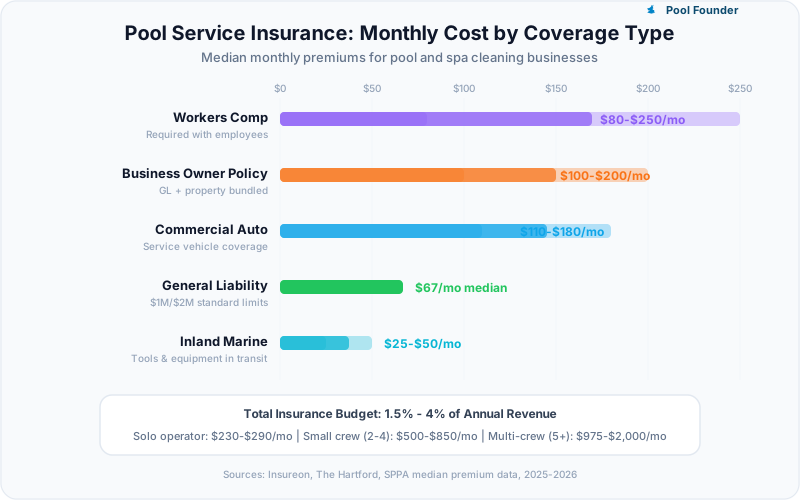
Required Insurance for Pool Service Companies
- General liability insurance: Covers third-party bodily injury and property damage claims. This is the foundation of your coverage and is required by most commercial customers and many residential HOAs before they will sign a contract with you.
- Commercial auto insurance: Legally required in all 50 states if you use a vehicle for business purposes. Your personal auto policy will deny claims that occur while you are driving for work, leaving you fully exposed.
- Workers compensation insurance: Required in most states as soon as you hire your first employee. Covers medical expenses and lost wages for on-the-job injuries. Four monopolistic states, North Dakota, Ohio, Washington, and Wyoming, require you to purchase workers comp through the state fund rather than private insurers.
Recommended Additional Coverage
- Business Owner's Policy (BOP): Bundles general liability with commercial property insurance at a discount, typically 15-20% less than buying each policy separately. Ideal if you have an office, storage facility, or significant equipment inventory.
- Commercial umbrella insurance: Extends the limits of your underlying policies, usually adding $1 million or more in coverage above your general liability, commercial auto, and workers comp limits. Critical once you are servicing high-value properties or commercial accounts.
- Pollution liability insurance: Standard general liability policies typically exclude pollution-related claims. Since pool service involves daily handling of chlorine, muriatic acid, and other chemicals, a pollution endorsement or standalone policy fills a gap that could otherwise leave you uninsured for your most common risk.
- Inland marine insurance: Covers your tools and equipment while they are in transit or stored on your truck. Standard commercial property policies only cover equipment at a fixed location, not the $3,000 to $6,000 worth of tools riding in your truck every day.
- Professional liability (Errors and Omissions): Covers claims arising from professional mistakes or negligence, such as recommending the wrong chemical treatment that damages a pool surface or providing incorrect repair advice.
Many pool service owners assume their general liability policy covers chemical spills. It usually does not. Standard GL policies contain pollution exclusions that apply to chemical releases. If you handle pool chemicals, which every pool service company does, you need a pollution liability endorsement or a separate pollution policy.
How Much Does Pool Service Liability Insurance Cost?
Insurance costs for pool service businesses vary based on revenue, number of employees, location, claims history, and coverage limits. The following cost data comes from Insureon's median premiums for pool and spa cleaning businesses, which represent the midpoint of actual policies sold to pool service companies across the United States. Your actual premiums may be higher or lower depending on your specific risk profile.
| Coverage Type | Monthly Cost | Annual Cost | Why You Need It |
|---|---|---|---|
| General Liability | ~$67 | ~$800 | Covers property damage and bodily injury claims from third parties |
| Workers Compensation | ~$136 | ~$1,627 | Covers employee injuries on the job; required once you have employees |
| Commercial Auto | ~$173 | ~$2,075 | Covers accidents in business vehicles; legally required for business use |
| Business Owner's Policy (BOP) | ~$76 | ~$907 | Bundles GL and property coverage at a discount |
| Commercial Umbrella | ~$67 | ~$801 | Extends limits above your underlying policies |
$67/month
Median general liability premium for pool and spa cleaning businesses
Source: Insureon, 2025
How Revenue Affects Your Insurance Costs
Insurance premiums as a percentage of revenue decrease as your business grows. A solo operator generating $50,000 in annual revenue can expect to spend 2.5% to 4.1% of revenue on a comprehensive insurance package. At $150,000 in revenue with one or two employees, that percentage drops to 1.6% to 4.2%. By $500,000 in revenue, insurance costs typically represent just 0.9% to 3.6% of revenue. The absolute dollar amount increases as you add employees and vehicles, but the cost per dollar of revenue goes down because the fixed components of each policy get spread across a larger revenue base.
| Annual Revenue | Typical Insurance Cost | Percentage of Revenue |
|---|---|---|
| $50,000 (solo operator) | $1,250-$2,050 | 2.5%-4.1% |
| $150,000 (1-2 employees) | $2,400-$6,300 | 1.6%-4.2% |
| $500,000 (3-5 employees) | $4,500-$18,000 | 0.9%-3.6% |
What Factors Drive Premium Costs Up or Down?
Insurers calculate your premium based on several factors that you can partially control. Understanding these factors helps you manage costs proactively rather than simply accepting whatever rate you are quoted.
- Claims history: The single biggest factor. A clean claims record over three to five years earns lower premiums, while even one paid claim can increase rates by 20-40% at renewal.
- Number of employees: Each additional employee increases your workers comp and general liability premiums because more workers mean more exposure.
- Annual revenue: Higher revenue generally means more customer interactions and higher property values being serviced, which increases exposure.
- Location: States with higher litigation costs, more severe weather, or more pools per capita tend to have higher premiums. Florida and California pool service companies typically pay more than those in the Midwest.
- Coverage limits: Increasing from $1 million to $2 million per occurrence might only add 10-15% to your premium, making higher limits surprisingly affordable.
- Deductible amount: Choosing a $1,000 or $2,500 deductible instead of $500 can reduce premiums by 5-15%, but you take on more out-of-pocket risk per claim.
- Years in business: New businesses pay higher rates because they lack a track record. Premiums typically decrease after three to five years of clean operation.
What Does General Liability Insurance Cover for Pool Companies?
General liability insurance is the most important policy for any pool service business. It covers claims of bodily injury and property damage caused by your business operations, your products, or your completed work. The standard policy structure provides $1 million per occurrence and $2 million aggregate coverage, meaning the insurer will pay up to $1 million for any single claim and up to $2 million total for all claims during the policy period. For most small to mid-size pool service businesses, these standard limits provide adequate protection. Our general liability deep dive covers policy structure and exclusions in detail.
Common Pool Service Claims Covered by General Liability
The claims that pool service companies file most frequently fall into a handful of predictable categories. Knowing what is covered helps you understand both the value of your policy and the operational risks you should focus on reducing.
- Property damage from chemical spills: You accidentally knock over a container of muriatic acid that etches a customer's natural stone pool deck. Repair or replacement costs for premium decking materials can easily reach $10,000 to $50,000. General liability covers the property damage, though chemical-related claims may require a pollution endorsement depending on your policy wording.
- Slip-and-fall injuries: A customer or their family member slips on water you tracked across the pool deck during service. Medical bills, potential surgery costs, and pain and suffering claims from a serious fall can reach $50,000 to $200,000. See our slip-and-fall liability guide for prevention strategies.
- Equipment damage to customer property: Your vacuum head cracks a tile, your pole scratches a window, or your chemical pump leaks onto patio furniture. These smaller claims, typically $500 to $5,000, are the most common GL claims for pool service businesses.
- Completed operations claims: After you leave a job, the customer discovers that your work caused damage. For example, an incorrect chemical balance you set causes staining to the pool surface over the following week. Completed operations coverage handles claims that arise after you have finished the work and left the property.
- Personal and advertising injury: A competitor claims you made false statements about their business, or a customer alleges you invaded their privacy. This coverage component handles these non-physical injury claims.
General liability typically costs $760 to $1,300 per year for pool service businesses, depending on your state, staff size, and coverage limits. At the median cost of $800 per year, you are paying roughly $67 per month for $1 million in per-occurrence protection. That works out to about $2.20 per day for coverage that could save your business from a six-figure lawsuit.
What General Liability Does Not Cover
Understanding the exclusions in your general liability policy is just as important as knowing what it covers. The most critical exclusions for pool service businesses include the following.
- Pollution and chemical releases: Most standard GL policies exclude pollution-related claims. Since every pool service visit involves transporting and applying chemicals, this exclusion creates a significant gap that you must address with a pollution endorsement or separate policy.
- Employee injuries: General liability covers injuries to third parties, not your own employees. Workers compensation insurance is required to cover employee injuries.
- Vehicle accidents: Any claim arising from the use of a motor vehicle is excluded from GL and must be covered by commercial auto insurance.
- Professional errors: If a customer claims your professional advice or service recommendation caused them financial loss, you need professional liability (E&O) coverage.
- Your own property and tools: Damage to your own equipment, tools, or vehicles is not covered by GL. You need inland marine or commercial property insurance for your business assets.
- Intentional acts and criminal behavior: No insurance policy covers damage you cause deliberately.
When Do You Need Workers Compensation Insurance?
In most states you need workers compensation insurance as soon as you hire your first employee, whether that employee is full-time, part-time, or seasonal. Some states have higher thresholds, with a handful allowing up to three or five employees before requiring coverage, but the safest approach is to secure workers comp before your first employee starts work. The penalties for operating without required workers comp coverage are severe in every state, including personal liability for all medical costs, substantial fines, potential criminal charges, and loss of your ability to operate.
$2-$4
Workers compensation cost per $100 of payroll for pool service businesses
Source: Insureon, ContractorNerd
How Workers Comp Premiums Are Calculated
Workers compensation premiums are based on a simple formula: your total payroll multiplied by a rate per $100 of payroll for your industry classification code. Pool service falls into classifications that carry rates of $2 to $4 per $100 of payroll, reflecting the moderate physical risk of the work. That means a single employee earning $35,000 per year would cost roughly $700 to $1,400 per year in workers comp premiums. The exact rate depends on your state, your claims history, and your experience modification number.
| Employee Annual Payroll | Workers Comp Rate | Annual Premium |
|---|---|---|
| $35,000 (1 technician) | $2-$4 per $100 | $700-$1,400 |
| $70,000 (2 technicians) | $2-$4 per $100 | $1,400-$2,800 |
| $140,000 (4 technicians) | $2-$4 per $100 | $2,800-$5,600 |
| $210,000 (6 technicians) | $2-$4 per $100 | $4,200-$8,400 |
What Is an Experience Modification Number?
Your experience modification number, often called your experience mod or EMR, is a multiplier that adjusts your workers comp premium based on your actual claims history compared to the average for your industry. A new business starts with an EMR of 1.0. If your claims experience is better than average, your EMR drops below 1.0 and you pay less than the base rate. If your claims are worse than average, your EMR rises above 1.0 and you pay more. An EMR of 0.85 means you pay 15% less than the base rate, while an EMR of 1.25 means you pay 25% more. It typically takes three years of claims data before your EMR begins to reflect your actual experience.
Monopolistic State Fund States
Four states require employers to purchase workers compensation through a state-operated fund rather than from private insurance companies: North Dakota, Ohio, Washington, and Wyoming. If you operate in one of these states, you cannot shop for workers comp on the private market and must apply through the state workers compensation board. The coverage is functionally similar, but the application process and premium structure differ from private market policies. If you operate across state lines and one of your service areas is in a monopolistic state, you will need a state fund policy for employees working in that state alongside your private policy for employees in other states.
Even if your state does not require workers compensation for sole proprietors or single-member LLCs, carrying a policy protects you personally. If you are injured on a job and have no workers comp, your health insurance may deny the claim because the injury occurred during commercial work. Workers comp also covers lost wages during recovery, which health insurance never does.
What Additional Coverage Should Pool Companies Consider?
Beyond the three essential policies, several additional coverage types address risks that are especially relevant to pool service operations. Whether you need these depends on your business size, the types of customers you serve, and how much risk you are comfortable retaining personally.
Commercial Auto Insurance
Commercial auto insurance is legally required in every state if you use a vehicle for business purposes, and it is arguably the most important coverage for a pool service company after general liability. You spend more time driving between stops than performing any other single activity, and a serious at-fault accident without commercial auto coverage could result in an uninsured liability of $500,000 or more. The median cost is approximately $173 per month or $2,075 per year per vehicle according to Insureon data. Your personal auto policy contains a business use exclusion that will deny any claim occurring while you are using the vehicle for work, even if you are just driving to your first stop of the day.
Business Owner's Policy (BOP)
A Business Owner's Policy bundles general liability insurance with commercial property insurance into a single policy at a discounted rate, typically saving 15-20% compared to purchasing each coverage separately. At a median cost of $76 per month or $907 per year, a BOP is particularly cost-effective for pool service companies that own or rent an office, maintain a storage yard, or keep significant chemical and equipment inventory at a fixed location. The commercial property component covers your business personal property, including tools, chemicals, computers, and office furniture, against fire, theft, vandalism, and certain natural disasters.
Commercial Umbrella Insurance
Commercial umbrella insurance provides additional liability limits above your underlying general liability, commercial auto, and workers comp policies. At a median cost of $67 per month or $801 per year, an umbrella policy typically adds $1 million to $5 million in additional coverage. This policy activates when a claim exceeds the limits of your underlying policy. For example, if you have $1 million in GL coverage and a claim results in a $1.5 million judgment, the umbrella pays the $500,000 difference. Umbrella coverage is essential once you begin servicing high-value properties, commercial pools, or HOA accounts where a single claim could exceed your base policy limits.
Pollution Liability Insurance
Pool service companies handle chlorine, muriatic acid, algaecides, and other chemicals every single day. Standard general liability policies exclude pollution-related claims, which means a chemical spill that damages a customer's property, contaminates soil, or injures someone through fume exposure would not be covered under your base GL policy. A pollution liability endorsement typically adds $200 to $500 per year to your premium, and standalone pollution policies start around $500 to $1,500 per year depending on your chemical volume and risk profile. Given that chemical handling is a core activity of every pool service visit, this coverage fills what is arguably the most dangerous gap in a standard insurance package for pool companies.
Inland Marine Insurance
Inland marine insurance covers your tools, equipment, and supplies while they are being transported in your vehicle or stored temporarily at a job site. Most pool service companies carry $3,000 to $6,000 worth of equipment on their trucks at all times, and replacing everything after a theft or vehicle accident would be a significant financial hit. Standard commercial property insurance only covers equipment at a fixed business location, not in transit. Inland marine premiums are typically $300 to $600 per year for $10,000 to $20,000 in equipment coverage.
The Swimming Pool & Spa Professionals Alliance (SPPA) offers industry-specific insurance programs designed for pool and spa professionals. These programs often provide better coverage terms and more competitive rates than generic small business policies because the underwriting is tailored to pool industry risks. Check thesppa.com for current program offerings if you want coverage designed specifically for your trade.
How to Reduce Your Insurance Premiums
Insurance is a necessary business expense, but you do not have to overpay for it. Several proven strategies can reduce your premiums by 10% to 30% without sacrificing the coverage you need. The key is to understand what insurers look for when calculating risk, and then systematically reduce your risk profile.
Maintain a Clean Claims History
Your claims history is the single most influential factor in your premium calculation. Every paid claim stays on your record for three to five years and increases your rates at renewal, often by 20-40% per claim. Before filing a small claim, calculate whether the payout is worth the long-term premium increase. A $2,000 property damage claim that raises your premium by $400 per year for five years actually costs you $2,000 in higher premiums, making the claim effectively free for the insurer and very expensive for you. Many experienced pool service owners carry a higher deductible and self-insure small losses to keep their claims record clean.
Implement a Documented Safety Program
Insurers offer premium discounts of 5-15% for businesses that maintain documented safety programs. A pool service safety program should include written chemical handling procedures, vehicle safety protocols, personal protective equipment requirements, regular safety training records, and incident reporting processes. Our OSHA compliance guide covers the specific requirements. The documentation matters as much as the practice itself because insurers need to see proof that your safety program is real and consistently followed, not just a document that sits in a filing cabinet.
Bundle Your Policies
Purchasing multiple policies from the same insurer typically earns a multi-policy discount of 10-20%. A Business Owner's Policy is the most common bundle, combining general liability with commercial property coverage at a 15-20% discount. Some insurers extend additional discounts when you add commercial auto, umbrella, or workers comp to the same account. The convenience of managing all policies through a single insurer and the combined discount make bundling the easiest way to reduce your total insurance spend.
Choose Higher Deductibles Strategically
Increasing your deductible from $500 to $1,000 or $2,500 can reduce your premium by 5-15%. This makes financial sense if you have enough cash reserves to cover the higher deductible in the event of a claim. A $1,000 deductible that saves you $150 per year in premiums pays for itself after seven years without a claim, and in the meantime, the higher deductible discourages filing small claims that would damage your long-term claims record. As a rule of thumb, set your deductible at a level you can comfortably pay out of your operating account without disrupting your business.
Review Your Coverage Annually
Insurance needs change as your business grows. Reviewing your coverage annually, ideally 60 to 90 days before your renewal date, ensures that you are not paying for coverage you no longer need and not underinsured for risks you have outgrown. Common adjustments include updating your revenue and payroll estimates, which directly affect GL and workers comp premiums, adding or removing vehicles from your commercial auto policy, adjusting coverage limits as your customer base changes, and shopping competitive quotes from at least three insurers every two to three years to ensure your current carrier is still offering competitive rates.
Reduce Your Experience Modification Number
Your experience modification number directly multiplies your workers comp premium, so reducing it from 1.0 to 0.85 saves you 15% on workers comp every year. The most effective strategies for improving your EMR include implementing a return-to-work program that gets injured employees back on light duty quickly, investigating every workplace incident to identify and fix root causes, maintaining detailed safety training records, and working with your insurer's loss control department to identify risks before they become claims. Since your EMR is calculated based on a rolling three-year window, the benefits of improved safety compound over time.
The most expensive insurance mistake pool service owners make is not shopping their rates every two to three years. Insurance markets change, new carriers enter the pool service niche, and your risk profile improves with each clean year. Get quotes from at least three carriers at renewal, including one industry-specific program like the SPPA insurance offering, to ensure you are getting the best rate available for your risk profile.
Free starter kit
Start a pool service business with the numbers already run.
A short email series from an owner who started with $1,200 and a used truck. No software pitch, just the four things that decide whether year one works.
- Startup cost breakdownEvery line item from $2K bootstrap to fully equipped
- Pricing calculatorThe minimum you can charge per visit and still profit
- First-10-customers playbookDoor hangers, referrals, and the phone script that closes
- Licensing & insurance checklistWhat your state requires and which insurers pay claims
Already running routes? Try Pool Founder free
Frequently Asked Questions
What are the best pool liability insurance companies in 2026?
The best pool liability insurance companies in 2026 for rates and coverage are: Insureon, the largest online insurance marketplace for small businesses where you can compare quotes from multiple carriers in a single application; The Hartford, which offers specific pool and spa contractor insurance programs with competitive rates for general liability, workers comp, and BOP policies; SPPA (Swimming Pool and Spa Professionals Alliance), which provides industry-specific group insurance programs designed for pool professionals with negotiated rates; and local independent insurance agents who represent multiple carriers and can shop your coverage across 10-20 companies simultaneously. For the best rates, get quotes from at least three of these sources, maintain a clean claims history for three to five years, bundle policies with a single carrier for 10-20% discounts, and implement a documented safety program that can earn an additional 5-15% premium reduction. The median general liability premium for pool service businesses is $67 per month through these providers.
What is the minimum insurance coverage I need to start a pool service business?
At minimum, you need general liability insurance ($1 million per occurrence / $2 million aggregate) and commercial auto insurance if you use a vehicle for business. General liability costs approximately $67 per month or $800 per year at the median. If you hire any employees, most states require workers compensation insurance from day one. Many commercial customers and HOAs will not sign a contract with you without proof of general liability coverage, so even if your state does not legally mandate it for sole proprietors, the market effectively requires it.
Does my personal auto insurance cover me while driving for my pool business?
No. Personal auto insurance policies contain a business use exclusion that denies claims occurring while you are using the vehicle for commercial purposes. This includes driving to and from customer stops, transporting chemicals and equipment, and any other business-related driving. If you are in an accident while working and only have personal auto insurance, your claim will be denied and you will be personally liable for all damages, injuries, and legal costs. Commercial auto insurance costs approximately $173 per month or $2,075 per year at the median, and it is legally required in all 50 states for business vehicle use.
Do I need to carry insurance for subcontractors who work for me?
You should require all subcontractors to carry their own general liability and workers compensation insurance and provide you with certificates of insurance before they begin work. If a subcontractor causes damage or is injured on a job and does not have their own coverage, the claim may come back to your insurance policy, increasing your premiums and potentially exceeding your coverage limits. Additionally, some states classify uninsured subcontractors as employees for workers compensation purposes, which means you could be held liable for their injuries and face penalties for not having workers comp coverage for them. Always get certificates of insurance from subcontractors and verify they are current before each project.
What is a certificate of insurance and do my customers need one?
A certificate of insurance (COI) is a standardized document issued by your insurance company that proves you carry active coverage and lists your policy types, limits, and effective dates. Many commercial customers, property managers, HOAs, and municipal pool operators require a COI before they will allow you to work on their property. Your insurer can issue COIs at no additional cost, usually within 24 to 48 hours. Some customers may also require that they be listed as an "additional insured" on your policy, which extends your coverage to include claims made against them arising from your work. Adding an additional insured typically costs $25 to $50 per endorsement or may be included in your policy at no charge.
How often should I review and update my pool service insurance?
Review your insurance annually, starting 60 to 90 days before your renewal date. This gives you enough time to get competitive quotes, make coverage adjustments, and negotiate with your current carrier before your policy renews. Key triggers for a mid-year review include hiring your first employee, adding a vehicle, expanding into commercial or municipal pool service, exceeding revenue thresholds that change your risk profile, or any claim that could affect your renewal terms. Shopping your insurance to at least three carriers every two to three years ensures you are not overpaying, since insurance markets shift and new carriers frequently enter the pool service niche with competitive introductory rates.