Does OSHA Apply to Pool Service Companies?
Yes. If you have one or more employees, OSHA applies to your pool service business. Many pool service owners assume OSHA only targets construction sites, factories, and warehouses. That assumption is wrong. OSHA covers all private-sector employers, and pool service companies handle multiple OSHA-regulated hazards every day: corrosive chemicals, electrical equipment, confined spaces (pump rooms), vehicle-mounted materials, and heat exposure during summer months.
Corey Adams, Pool Founder co-founder and 15-year pool service veteran, takes OSHA compliance seriously. "A lot of pool guys think OSHA will never show up at a pool service company. That is true right up until an employee gets a chemical burn, goes to the ER, and the hospital reports it. Then OSHA shows up. If you do not have SDSs, do not have documented training, and your guys are not wearing gloves and goggles, you are looking at $16,550 per violation. Three violations and you are out over $49,000."
$16,550
Maximum OSHA fine per serious violation (2025)
Source: OSHA, January 2025
Which OSHA Standards Apply to Pool Service Companies?
Pool service operations trigger several OSHA standards. The three most relevant are the Hazard Communication Standard (HazCom), Personal Protective Equipment (PPE) requirements, and the General Duty Clause. Understanding which standards apply lets you build a compliance program that covers your actual risks without over-engineering a safety program designed for a factory.
| OSHA Standard | Reference | Why It Applies to Pool Service |
|---|---|---|
| Hazard Communication (HazCom) | 29 CFR 1910.1200 | You handle chlorine, muriatic acid, and other hazardous chemicals daily |
| Personal Protective Equipment | 29 CFR 1910.132-138 | Chemical splash, eye injury, and skin contact hazards require PPE |
| General Duty Clause | Section 5(a)(1) OSH Act | Covers recognized hazards not addressed by specific standards |
| Recordkeeping | 29 CFR 1904 | Required if you have 11+ employees (some exemptions) |
| Emergency Action Plan | 29 CFR 1910.38 | Chemical spill response procedures |
| Electrical Safety | 29 CFR 1910 Subpart S | Working near pool equipment with 240V circuits |
Solo operators with no employees are generally exempt from OSHA enforcement. However, if you hire your first employee, even a part-time helper, all applicable OSHA standards apply immediately. Compliance is not something you phase in. It is required from day one.
What Does OSHA Hazard Communication Require?
The Hazard Communication Standard (HazCom), codified at 29 CFR 1910.1200, is the most relevant OSHA standard for pool service companies. It governs how you communicate chemical hazards to your employees. OSHA updated HazCom in 2024 to align with the seventh revision of the Globally Harmonized System (GHS) for chemical classification and labeling.
HazCom Requirements for Pool Service
- Written Hazard Communication Program: You must have a written program that describes how you handle chemical hazards, how employees access safety information, and what procedures to follow in a spill or exposure event. This can be a simple 2-3 page document.
- Safety Data Sheets (SDSs): You must maintain a current SDS for every hazardous chemical your employees work with. For pool service, this includes chlorine (liquid, tablet, and granular), muriatic acid, sodium bicarbonate, cyanuric acid, algaecides, calcium chloride, and any other chemical on the truck. SDSs must be readily accessible to employees during their shift.
- Container labels: Every chemical container must have the manufacturer label intact with GHS-compliant hazard information. Do not transfer chemicals to unmarked containers.
- Employee training: Employees must be trained on how to read SDSs, understand GHS labels, use PPE correctly, and respond to chemical exposures and spills. Training must happen before the employee handles any chemicals and be refreshed when new chemicals are introduced.
The easiest way to maintain SDSs: download the PDF for every chemical you use from the manufacturer website, store them in a shared digital folder (Google Drive, Dropbox, or similar), and keep a printed binder in each truck. Digital access satisfies the "readily accessible" requirement as long as employees can access the files on a phone or tablet at the job site.
What PPE Is Required for Pool Service Technicians?
OSHA requires employers to conduct a hazard assessment (29 CFR 1910.132) and provide appropriate PPE at no cost to employees. For pool service, the primary hazards are chemical splash, skin contact with corrosive substances, and eye injury. The PPE requirements are straightforward and inexpensive.
Required PPE for Chemical Handling
| Hazard | Required PPE | Cost | Notes |
|---|---|---|---|
| Chemical splash (eyes) | Chemical splash goggles or safety glasses with side shields | $5-$20 | Required when pouring, mixing, or testing chemicals |
| Chemical contact (hands) | Chemical-resistant gloves (nitrile) | $10-$20/box | Required when handling any pool chemicals |
| Chemical contact (skin) | Long-sleeve shirt or chemical apron | $15-$30 | Recommended for muriatic acid handling |
| Inhalation (acid fumes) | N95 or chemical cartridge respirator | $3-$30 | Required when pouring muriatic acid in enclosed spaces |
| Foot protection | Closed-toe shoes (non-slip) | $50-$100 | Required on all job sites |
Hazard Assessment Documentation
OSHA requires you to certify in writing that a workplace hazard assessment has been performed. For pool service, this is a one-page document that identifies the chemical, physical, and environmental hazards your technicians face and specifies the PPE required for each. Create it once, update it when you add new services or chemicals, and keep it on file.
PPE must be provided at no cost to employees. You cannot require technicians to buy their own safety glasses, gloves, or respirators. You must also train employees on proper PPE use, maintenance, and limitations. "Wear these gloves" is not sufficient training. Demonstrate how to don and doff them, when to replace them, and what chemicals they protect against.
What Does an OSHA Inspection of a Pool Service Company Look Like?
OSHA inspections of pool service companies are rare but not unheard of. They typically happen after a reported incident (employee injury, chemical exposure, hospitalization) or an employee complaint. Understanding the inspection process helps you prepare and respond appropriately.
OSHA Inspection Process
- 1Opening conference: The compliance officer presents credentials and explains the reason for the inspection. You have the right to ask why they are there and to have a representative present.
- 2Document review: The officer asks to see your written HazCom program, SDSs, PPE hazard assessment, training records, and OSHA 300 log (if applicable). Missing documents are immediate violations.
- 3Walkaround: The officer inspects your workplace, which for pool service may include your office, truck fleet, and potentially a job site. They look at chemical storage, container labeling, PPE availability, and working conditions.
- 4Employee interviews: The officer may interview employees privately about training, chemical handling procedures, PPE usage, and any safety concerns. You cannot be present during these interviews.
- 5Closing conference: The officer discusses initial findings and outlines next steps. Formal citations arrive by mail within six months.
You have the right to accompany the officer during the walkaround. Exercise this right. You can explain your safety procedures, provide context, and sometimes resolve potential violations on the spot.
What Are the Most Common OSHA Violations for Pool Service?
Based on OSHA enforcement data and industry reports, pool service companies are most commonly cited for Hazard Communication violations and PPE failures. These are also the easiest to fix proactively.
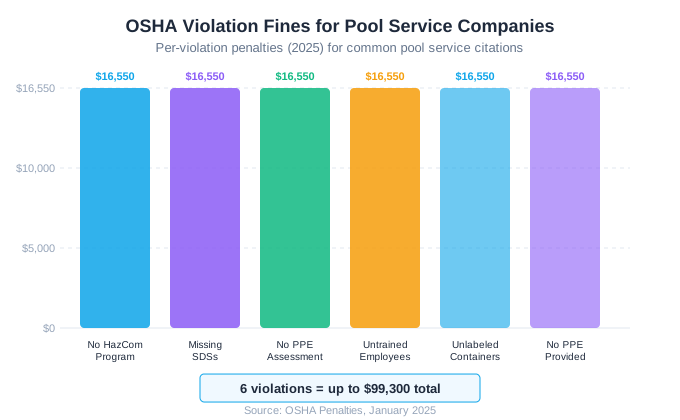
| Violation | Typical Fine | How to Fix It |
|---|---|---|
| No written HazCom program | $5,000-$16,550 | Write a 2-3 page HazCom program document |
| Missing or inaccessible SDSs | $5,000-$16,550 | Download SDSs for all chemicals, store digitally and in truck binder |
| No PPE hazard assessment | $5,000-$16,550 | Complete a written hazard assessment, keep on file |
| Employees not trained on chemical hazards | $5,000-$16,550 | Conduct documented training before employees handle chemicals |
| Unlabeled chemical containers | $5,000-$16,550 | Never transfer chemicals to unmarked containers |
| PPE not provided or not used | $5,000-$16,550 | Provide goggles and gloves, enforce use, document training |
Each violation is fined separately. Six common violations at the minimum serious penalty of $5,000 each total $30,000. At the maximum of $16,550 each, the total exceeds $99,000. Willful violations, where OSHA determines you intentionally disregarded the standard, carry penalties up to $165,514 per violation.
Small businesses with 25 or fewer employees can receive penalty reductions of up to 60%. But even with maximum reductions, multiple violations add up quickly. Prevention is dramatically cheaper than penalties.
How Do You Build an OSHA Compliance Program for Pool Service?
Building a complete OSHA compliance program for a pool service company is not complex. It requires a few documents, basic training, appropriate PPE, and consistent follow-through. You can set up everything in one afternoon.
OSHA Compliance Checklist
- 1Written HazCom program (1 hour): Document your chemical inventory, where SDSs are stored, container labeling procedures, and employee training requirements. Keep it simple and specific to pool service chemicals.
- 2SDS binder and digital folder (1-2 hours): Download SDSs for every chemical you use. Print copies for a truck binder. Store digital copies in a shared cloud folder. Update when you add new products.
- 3PPE hazard assessment (30 minutes): Write a one-page document identifying chemical, physical, and environmental hazards and the PPE required for each. Sign and date it.
- 4Purchase PPE (15 minutes): Stock chemical splash goggles, nitrile gloves, and closed-toe shoes for all employees. Budget $50-$100 per employee.
- 5Employee training (1-2 hours per employee): Cover SDS reading, GHS label interpretation, PPE use, chemical spill procedures, and emergency contacts. Document the training with date, topics, and employee signature.
- 6OSHA 300 log (if 11+ employees): Set up an OSHA 300 log to record work-related injuries and illnesses. Post the 300A summary annually from February 1 through April 30.
Total time to set up: 4-6 hours. Total cost: $50-$200 for PPE and supplies. Compared to $16,550+ per violation, this is the most cost-effective compliance investment you will ever make.
Ready to streamline your pool service business?
Pool Founder gives you route optimization, automated invoicing, chemical tracking, and everything else you need to run a more profitable pool business.
Frequently Asked Questions
Does OSHA apply to solo pool service operators?
Generally no. OSHA covers employers, meaning businesses with employees. If you are a sole proprietor with no employees, OSHA does not enforce standards against you. However, the moment you hire your first employee, even part-time, all applicable OSHA standards apply immediately.
What are the most common OSHA fines for pool service companies?
The most common violations are missing written HazCom programs, inaccessible Safety Data Sheets, no PPE hazard assessment, and untrained employees handling chemicals. Each serious violation carries a fine of up to $16,550 as of 2025. Multiple violations are fined separately, so a single inspection can generate $30,000-$99,000 in penalties.
Do I need Safety Data Sheets for pool chemicals?
Yes. OSHA requires employers to maintain and make readily accessible a Safety Data Sheet for every hazardous chemical in the workplace. For pool service, this includes chlorine (all forms), muriatic acid, sodium bicarbonate, cyanuric acid, algaecides, and any other chemical your employees handle. SDSs must be accessible at the job site, either as printed copies in a truck binder or digital files on a phone or tablet.
What PPE is required for pool service technicians?
At minimum, chemical splash goggles (or safety glasses with side shields) and chemical-resistant nitrile gloves when handling pool chemicals. An N95 or chemical cartridge respirator is required when pouring muriatic acid in enclosed spaces. Closed-toe, non-slip shoes are required on all job sites. Employers must provide PPE at no cost to employees.
How do I create a written HazCom program for my pool service company?
A written HazCom program is a 2-3 page document that lists all hazardous chemicals your employees work with, explains where SDSs are stored and how employees access them, describes container labeling procedures, and outlines employee training requirements. There are free OSHA-provided templates available. Customize the template for pool service chemicals and keep it on file at your office.
Sources & References
- OSHA: Hazard Communication Standard (29 CFR 1910.1200)
- OSHA: Penalties and Adjusted Amounts (2025)
- OSHA: 2025 Annual Adjustments to Civil Penalties
- OSHA: Hazard Communication Safety Data Sheets Quick Card
- OSHA: Personal Protective Equipment Overview
- Pool Service Owners: OSHA and Safety Standards for Pool Service