Health Code Compliance Is Your Responsibility
When a health inspector fails a commercial pool, the citation goes on the operator record. But when the operator hired your company to maintain water quality, the liability conversation shifts fast. Health code compliance for commercial pools is governed by a patchwork of state, county, and municipal codes that vary significantly across jurisdictions. The CDC Model Aquatic Health Code (MAHC) provides a national framework, but only jurisdictions that voluntarily adopt it are bound by its standards. Every pool service company needs to know the specific codes that apply in their service area.
Corey Adams, Pool Founder co-founder and 15-year pool service veteran, treats health code compliance as the baseline. "Your job as a pool service company is to keep that pool within code at all times. Not most of the time. All of the time. One failed inspection and the property manager is calling another company. Two failed inspections and you are getting sued. Know your local code numbers cold."
1 in 8
Public pools shut down on first inspection due to health code violations (CDC)
Source: CDC Healthy Swimming Program
The Regulatory Framework: Federal, State, and Local
Pool health codes operate on three levels. Understanding which authority governs each pool you service is step one. Federal guidelines set the baseline, but state and local codes determine what you are actually held to during an inspection.
| Level | Authority | Role | Binding? |
|---|---|---|---|
| Federal | CDC Model Aquatic Health Code (MAHC) | Voluntary national guidance for states and localities | Only if adopted by your jurisdiction |
| State | State health department or environmental agency | Sets minimum water quality standards, testing frequency, operator certification requirements | Yes, enforceable by state inspectors |
| County/Municipal | Local health department | May impose additional requirements beyond state code | Yes, enforceable by local inspectors |
The CDC released the MAHC as a voluntary model code because pool regulations varied so widely between states that there was no consistent national standard. As of 2025, more than 20 states and hundreds of local jurisdictions have adopted portions of the MAHC or aligned their existing codes with MAHC recommendations. However, adoption is partial in many cases, so you must verify the specific standards in your service area.
The quickest way to find your applicable code: call your local health department and ask for the current pool code citation and a copy of the inspection checklist. Most departments provide the checklist free. That checklist tells you exactly what the inspector will measure, test, and document.
Water Quality Standards: The Numbers You Must Hit
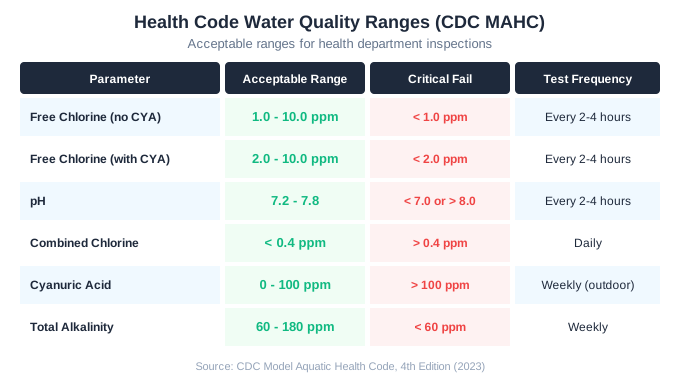
Water quality standards define the acceptable ranges for chemical parameters that health inspectors test. These ranges are non-negotiable. A reading outside the acceptable range is a violation, period. Knowing the exact numbers for your jurisdiction prevents borderline readings from becoming citations.
| Parameter | MAHC Recommended Range | Common State Variations | What Inspectors Test |
|---|---|---|---|
| Free chlorine (without CYA) | 1.0-10.0 ppm | Some states set minimum at 1.5 or 2.0 ppm | DPD colorimetric or digital photometer |
| Free chlorine (with CYA) | 2.0-10.0 ppm | Some jurisdictions ban CYA in commercial pools entirely | DPD test with CYA level verification |
| pH | 7.2-7.8 | Some states narrow to 7.4-7.6 | Phenol red indicator or digital meter |
| Combined chlorine | Below 0.4 ppm | Some codes set 0.2 ppm maximum | Total chlorine minus free chlorine |
| Cyanuric acid | 0-100 ppm (MAHC max) | Florida: 100 ppm max. Some states: 40-50 ppm max | Turbidity-based CYA test |
| Total alkalinity | 60-180 ppm | Generally consistent across states | Acid demand titration |
| Water temperature | Varies by pool type | Spas: typically 104 F max | Calibrated thermometer |
| Water clarity | Main drain visible from deck | Some codes specify NTU turbidity limits | Visual or turbidimeter |
The minimum free chlorine level changes when cyanuric acid is present. Without CYA, the MAHC minimum is 1.0 ppm. With CYA, it jumps to 2.0 ppm because CYA reduces chlorine efficacy. This distinction trips up many pool service companies during inspections. Always know the CYA level before assessing whether your chlorine is adequate.
Testing Frequency and Documentation Requirements
Health codes do not just specify what to test. They specify how often. Testing frequency requirements vary by jurisdiction, but the MAHC provides a framework that most codes follow or exceed.
| Parameter | MAHC Recommended Frequency | Documentation Required |
|---|---|---|
| Free chlorine and pH | Every 2-4 hours while pool is open | Logged in written or digital record with time, reading, and initials |
| Combined chlorine | Daily | Logged alongside free chlorine reading |
| Total alkalinity | Weekly | Logged in chemical record |
| Cyanuric acid | Weekly (outdoor pools) | Logged in chemical record |
| Calcium hardness | Monthly | Logged in chemical record |
| Water temperature | Hourly for spas, daily for pools | Logged with chemical readings |
Documentation is where most pool service companies fall short during inspections. The inspector does not just test the water right now. They ask to see your records for the past 30 to 90 days. Missing records, gaps in testing dates, or handwritten logs that are illegible can result in citations even if the current water quality is perfect.
Pool Founder generates digital chemical logs with timestamped readings, GPS-verified service locations, and technician identification. When a health inspector asks for records, you hand them a clean digital report instead of a water-stained paper log. This is not a convenience feature. It is a compliance tool.
What Happens During a Health Department Inspection
Health department pool inspections are typically unannounced. The inspector arrives, identifies themselves, and begins the inspection. Understanding the process helps you prepare your clients and reduces the chance of a surprise violation.
Typical Inspection Process
- 1Water testing: The inspector takes independent water samples and tests free chlorine, pH, combined chlorine, and water temperature using their own calibrated equipment. Your test kit readings are not accepted.
- 2Record review: The inspector asks to see chemical logs, maintenance records, and operator certification. Missing or incomplete records are an automatic citation in most jurisdictions.
- 3Physical inspection: The inspector checks drain covers (VGB compliance), depth markings, safety equipment (ring buoys, shepherd hooks), signage (no diving, depth markers, CPR instructions), fencing and gate latches, and the equipment room.
- 4Equipment room check: Chemical storage, ventilation, pump operation, and filter pressure are evaluated. Improperly stored chemicals (acid next to chlorine) are a serious violation.
- 5Report and citation: The inspector issues a written report. Violations are categorized as critical (immediate closure or correction required) or non-critical (must be corrected within a specified period, typically 10-30 days).
Critical violations that trigger immediate pool closure typically include free chlorine below the minimum, pH outside the acceptable range, no disinfectant residual at all, a missing or broken drain cover, fecal contamination (AFR: Accidental Fecal Release), or visible algae growth.
How to Handle a Failed Inspection
Failed inspections happen. How you respond determines whether the client fires you or trusts you to fix the problem and prevent it from recurring. A systematic response protects both the client relationship and your reputation.
- 1Get the written inspection report immediately. Do not rely on a verbal summary. Read every citation and understand exactly what was out of compliance.
- 2Correct critical violations the same day. If chlorine is low, shock the pool. If pH is out of range, adjust it. If a drain cover is damaged, replace it or close the pool until you can. Document every corrective action with photos, timestamped readings, and chemical addition records.
- 3Submit a corrective action plan to the health department. Most departments require written documentation of what caused the violation and what steps you are taking to prevent recurrence. Be specific: "Adjusted service schedule from weekly to twice-weekly to maintain chlorine above 2.0 ppm during peak summer bather loads."
- 4Communicate proactively with the pool operator. Do not wait for them to call you. Send them the inspection report, your corrective actions, and your plan to prevent future violations. This demonstrates ownership and professionalism.
- 5Adjust your service protocol. A failed inspection means your current service frequency, chemical dosing, or testing schedule is insufficient. Change something. If you keep doing the same thing, you will fail the re-inspection.
Never argue with a health inspector on site. If you disagree with a finding, note it in writing and follow the formal appeal process after the inspection. Arguing during the inspection does not change the outcome and damages your professional reputation.
State-by-State Variations That Catch Pool Companies Off Guard
Pool service companies that operate across state lines or near state borders face the added challenge of different codes in adjacent jurisdictions. Here are common variations that surprise pool service pros.
- Cyanuric acid limits: Some states allow up to 100 ppm (Florida), while others cap it at 40-50 ppm or ban it entirely in commercial pools. If you service pools in multiple jurisdictions, you may need different chemical programs for each.
- Operator certification requirements: Some states require a CPO or AFO certified operator on site during operating hours. Others require only that a certified operator is "responsible" for the pool, even if they are not physically present.
- Testing frequency: The MAHC recommends testing every 2-4 hours, but some states require hourly testing during high-use periods. Others allow twice-daily testing for low-bather-load facilities.
- Automatic chemical feeder requirements: Some jurisdictions require automated chemical controllers on commercial pools above a certain size. Manual chemical dosing is not permitted.
- Fecal accident response protocols: The MAHC provides detailed AFR protocols (different for formed stool vs. diarrheal incident). Some states have adopted these protocols verbatim, while others have their own. Know which protocol applies in your jurisdiction.
Ready to streamline your pool service business?
Pool Founder gives you route optimization, automated invoicing, chemical tracking, and everything else you need to run a more profitable pool business.
Frequently Asked Questions
What is the minimum free chlorine level for a commercial pool?
The CDC MAHC recommends a minimum of 1.0 ppm without cyanuric acid and 2.0 ppm with cyanuric acid. However, state and local codes may set higher minimums. Check your specific jurisdiction. A reading below the local minimum is an automatic violation during a health inspection.
How often do health inspectors inspect commercial pools?
Inspection frequency varies by jurisdiction. Most health departments inspect commercial pools 1-2 times per year on an unannounced basis. High-risk facilities (water parks, heavily used public pools) may be inspected more frequently. Pools with previous violations typically face increased inspection frequency.
What triggers an immediate pool closure by a health inspector?
Critical violations including zero disinfectant residual, free chlorine below the minimum, pH outside acceptable range, missing or broken drain covers, visible algae growth, fecal contamination (AFR), and water clarity so poor that the main drain is not visible from the deck. The pool must remain closed until the violation is corrected and verified.
Am I required to keep chemical testing records for commercial pools?
Yes. Most jurisdictions require documented chemical logs showing test results, dates, times, and the person who performed the test. The MAHC recommends retaining records for at least 1 year. Some states require up to 3 years. Digital logs with timestamps are easier to maintain and present during inspections than paper logs.
What is the Model Aquatic Health Code (MAHC)?
The MAHC is a voluntary, science-based model code published by the CDC. It provides comprehensive guidance for public pool design, construction, operation, and maintenance. States and local jurisdictions can adopt the MAHC in whole or in part. It is not federal law, but it becomes enforceable when adopted by a jurisdiction.