Variable Speed Pumps Are Now Standard. Here Is How to Master Them.
Since July 2021, the Department of Energy requires all new replacement pool pumps over 1.0 HP to meet energy efficiency standards that effectively mandate variable speed technology. That means every pool tech is now encountering variable speed pumps on their route, whether they installed them or not. ENERGY STAR estimates that variable speed pumps save up to 70% on energy bills compared to single-speed pumps, roughly $350 and 2,800 kWh per year for the average pool owner.
"The first time I saw a variable speed pump on a service call, I had no idea how to set it up," says Corey Adams, Pool Founder co-founder and 15-year pool service veteran. "The customer had it running at 3,450 RPM 24 hours a day, which defeats the entire purpose. Once I learned the programming and the physics behind it, I started saving my customers real money and picking up upsell work programming pumps on every route." This guide covers how VSPs work, how to program them for different equipment scenarios, common problems, and how to talk about savings with customers.
How Do Variable Speed Pool Pumps Save Energy?
Variable speed pumps use a permanent magnet motor (similar to an electric vehicle motor) that can run at any speed from about 600 RPM to 3,450 RPM. The energy savings come from a physics principle called the Pump Affinity Law: when you cut pump speed in half, energy consumption drops by a factor of eight. That is not a typo. Running a pump at 1,725 RPM uses one-eighth the energy of running at 3,450 RPM.
Up to 70%
Energy savings of variable speed pumps vs. single-speed, per ENERGY STAR
Source: ENERGY STAR
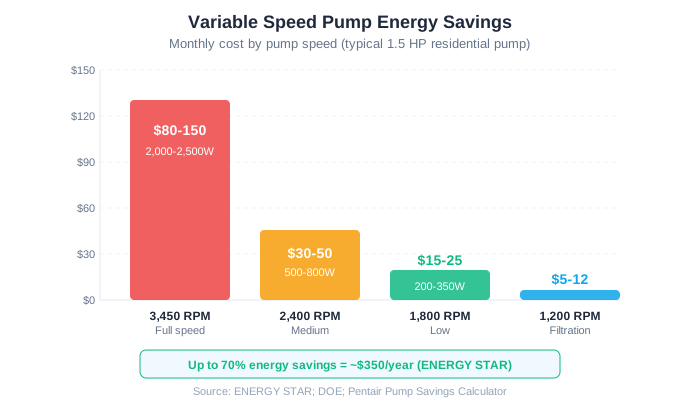
The trade-off is that lower speed means lower flow rate, which means it takes longer to turn over the pool volume. But because energy savings are so dramatic, you can run the pump for much longer at low speed and still use far less electricity than a high-speed run. A single-speed pump running 8 hours at 3,450 RPM might cost $80-150 per month. A variable speed pump running 12-16 hours at 1,200-1,800 RPM achieves the same turnover for $20-50 per month.
| Speed (RPM) | Flow (GPM est.) | Power Draw | Monthly Cost Est. |
|---|---|---|---|
| 3,450 | 70-80 | 2,000-2,500W | $80-150 |
| 2,400 | 50-60 | 500-800W | $30-50 |
| 1,800 | 35-45 | 200-350W | $15-25 |
| 1,200 | 20-30 | 75-150W | $5-12 |
Actual flow rates and power draw depend on pump model, plumbing diameter, and total dynamic head. These estimates represent a typical 1.5 HP VSP on a standard residential pool with 2-inch plumbing.
How Do You Program a Variable Speed Pump for Different Equipment?
Most variable speed pumps allow you to program 4-8 speed schedules that run at different times and RPMs. The key is matching pump speed to what each piece of equipment requires to function properly. A pool cleaner needs higher flow than basic filtration. A heater needs minimum flow to avoid tripping its flow switch. A water feature needs specific pressure to reach the right height.
Recommended Speed Settings by Equipment
| Equipment/Mode | Recommended RPM Range | Notes |
|---|---|---|
| Basic filtration | 1,200-1,800 RPM | Lowest cost. Run 12-16 hours. |
| Suction-side cleaner | 2,200-2,600 RPM | Needs enough suction to drive cleaner. |
| Pressure-side cleaner | 2,400-2,800 RPM | Booster pump may handle this instead. |
| In-floor cleaning system | 2,400-3,000 RPM | Pop-ups need pressure to function. |
| Pool heater (gas) | 2,000-2,400 RPM | Must exceed heater flow switch minimum. |
| Heat pump | 2,000-2,600 RPM | Check manufacturer minimum GPM. |
| Salt chlorinator | 1,800-2,400 RPM | Cell needs flow to generate chlorine. |
| Water features/spillovers | 2,400-3,450 RPM | Depends on head height and desired effect. |
| Solar heating panels | 2,000-2,400 RPM | Enough flow to fill panels without air locks. |
"I set the base filtration speed as low as possible, usually 1,400-1,600 RPM, and then schedule higher speeds only when specific equipment needs to run. A typical schedule is low speed from 8 AM to 8 PM, bump to 2,400 RPM for 2 hours for the cleaner, then back to low speed." - Corey Adams
What Are the Most Common Variable Speed Pump Problems?
Variable speed pumps are more reliable than single-speed pumps because the permanent magnet motor runs cooler and has fewer mechanical stresses at lower speeds. But they do have failure modes that single-speed pumps do not, primarily related to the drive electronics and programming.
Drive Board or Control Board Failure
The drive board converts incoming power to the variable frequency that controls motor speed. Power surges, lightning strikes, and moisture are the primary killers. Symptoms include the pump not powering on, the display showing error codes but the motor not spinning, or the motor running at full speed regardless of the set speed. Drive board replacement typically costs $300-600 for the part.
Other Common VSP Issues
- Pump not priming at low speed. If the pump was recently drained or has a suction leak, it may not generate enough vacuum at low RPM to prime. Temporarily run at 3,450 RPM to prime, then reduce speed.
- Overheating and thermal shutdown. The drive electronics generate heat. If the ventilation slots on the motor housing are blocked by debris, mulch, or ant nests, the pump overheats and shuts down. Clean the vents.
- Communication errors with automation. Pentair IntelliFlo pumps communicate via RS-485 with IntelliCenter. Wiring issues, incorrect addresses, or firmware mismatches cause the automation to lose contact with the pump.
- Flow switch errors on connected equipment. Running the pump too slow for a heater or chlorinator triggers flow switch faults on that equipment. Increase the scheduled speed during the equipment run time.
- Salt cell not producing chlorine. The salt cell requires minimum flow (typically 20-30 GPM) to generate chlorine. If filtration speed is too low, the cell shows a "no flow" error. Schedule a higher speed during chlorination hours.
How Do You Diagnose a Variable Speed Pump That Will Not Start?
A VSP that shows no signs of life, no display, no motor movement, is almost always a power issue or a dead drive board. Here is the diagnostic sequence.
- 1Check the breaker. VSPs require dedicated circuits. Verify voltage at the pump junction box with a multimeter. You should see 230V (or 115V on some models) between the line leads.
- 2Inspect the wiring connections inside the pump drive housing for corrosion, loose terminals, or burned wires. Ants and moisture cause more wiring failures than mechanical wear.
- 3Look at the display. If the display lights up but the motor does not spin, the drive board is receiving power but may not be sending it to the motor. This usually means a drive board fault.
- 4If the display shows an error code, look up the code in the manufacturer manual. Common codes: E01/E02 (overcurrent), E04 (undervoltage), E06 (overtemperature).
- 5If there is no display and voltage is confirmed at the junction box, the drive board is likely dead. On Pentair IntelliFlo, the drive board is a separate replaceable module. On Hayward TriStar VS, the entire motor assembly may need replacement.
Ants are the number one enemy of variable speed pump electronics in the southern United States. Fire ants nest inside the drive housing, causing shorts across circuit board traces. If you open a pump drive and see ants, clean thoroughly and apply an ant bait around the equipment pad.
How Do You Explain VSP Savings to Customers?
Selling a variable speed pump upgrade is one of the most profitable upsells in pool service. The average pump replacement costs $1,200-2,500 installed, and the customer saves $40-100 per month on their electric bill. That means the pump often pays for itself in 18-24 months. But most homeowners do not understand the physics. Here is how to explain it simply.
The Conversation Framework
- 1"Your current pump runs at one speed, full blast, like driving your car at 100 mph everywhere. A variable speed pump is like cruise control. It runs just fast enough to keep the water clean."
- 2"When we cut the speed in half, the pump uses about one-eighth the electricity. Not half. One-eighth. That is the physics."
- 3"Most of my customers save $40-100 a month on their electric bill. That means the pump pays for itself in about two years, and then it is pure savings after that."
- 4"It is also quieter. At low speed, you cannot hear it from 10 feet away. Your neighbors will appreciate that."
- 5"And since July 2021, any new pump over 1 HP is required by federal law to be variable speed anyway. So when this pump eventually dies, you will be getting one regardless."
$350/year
Average annual energy savings switching from single-speed to variable speed pump
Source: ENERGY STAR
Some utility companies offer rebates of $100-400 for variable speed pump installations. Check your local utility rebate programs and mention them to the customer. A rebate shortens the payback period and makes the upgrade an easier decision.
What Speed Should You Set for Overnight Filtration?
Many service techs debate whether to run the pump overnight or during the day. The answer depends on the customer situation, but the most energy-efficient approach is to run the pump during off-peak electricity hours (often 9 PM to 6 AM) at the lowest speed that achieves one full turnover during those hours.
To calculate the minimum speed, you need to know the pool volume and the flow rate at various RPMs for the installed pump model. As a starting point, most 15,000-20,000 gallon pools can achieve a full turnover in 10-12 hours at 1,200-1,500 RPM. If the customer has a salt chlorinator or heater that needs to run during the day, schedule a higher speed block during daytime hours and drop to the low filtration speed at night.
Check with your local utility for time-of-use rate plans. In areas like California, Arizona, and Texas, running the pump overnight at off-peak rates can save an additional 20-40% on top of the VSP efficiency gains.
Run a pool route?
The business side of what you just read.
Pricing, chemical costs, and the tools owners use to keep the numbers straight.
- Commercial pool service pricing2026 rate tables and the cost-plus formula
- Chemical cost per poolWhat chemicals actually cost per stop
- Chemical tracking softwareLog readings and dosing from the pool deck
- Pool service softwareRoutes, invoicing, and service reports in one app
- Free profit & rate calculatorsProfit per pool, minimum rate, break-even
Frequently Asked Questions
Are variable speed pool pumps required by law?
Yes. Since July 19, 2021, the Department of Energy requires all new pool pumps manufactured over 1.0 total horsepower to meet efficiency standards that effectively mandate variable speed technology. This applies to replacement pumps, not existing installations.
How much does a variable speed pump save per month?
Most pool owners save $40-100 per month on electricity compared to a single-speed pump. ENERGY STAR estimates average annual savings of $350 and 2,800 kWh. Actual savings depend on your electricity rate, pool size, and how many hours the old pump ran.
Can you run a variable speed pump too slow?
Yes. Running too slow can prevent proper skimming (debris floats past the skimmer), cause equipment like heaters and salt cells to fault on low flow, and fail to achieve adequate turnover. The minimum useful speed for most residential pools is around 1,000-1,200 RPM.
How long do variable speed pump motors last?
Variable speed pump motors typically last 8-12 years, longer than single-speed motors which average 5-8 years. The permanent magnet motor runs cooler at low speeds, reducing bearing and winding stress. The drive board electronics are usually the first component to fail.
Do you need a special electrician to install a variable speed pump?
Variable speed pumps wire into the same circuit as single-speed pumps. However, they require a dedicated circuit (no shared loads) and proper grounding. If the existing wiring meets these requirements, most licensed pool professionals can handle the installation. Complex wiring situations should involve a licensed electrician.