Every Pool Pump Problem Has a Pattern. Here Is How to Find It Fast.
A pool pump that stops working is the fastest way to turn a routine service day into an emergency. Water turns green within 48-72 hours without circulation, and customers start calling the moment they notice. According to Angi, the average pool pump repair costs $150-500, while a full replacement runs $900-2,500 installed. Knowing how to diagnose the problem on site saves you a return trip, earns customer trust, and lets you quote the repair accurately before parts are even ordered.
"Pump calls used to slow my whole route down," says Corey Adams, Pool Founder co-founder and 15-year pool service veteran. "I would spend 30 minutes staring at a pump trying to figure out what was wrong. Once I built a mental checklist for each symptom, I could diagnose 90% of problems in under five minutes. That is what this guide gives you." This article covers the 10 most common pool pump problems, organized by symptom, with exact diagnostic steps and fixes for each one.
Safety first. Always turn off the pump at the breaker before inspecting electrical components, opening the pump housing, or touching the motor. Pool pumps run on 115V or 230V, and working on live equipment can cause serious injury or death. If you are not comfortable with electrical diagnosis, call a licensed electrician.
What Should You Check Before Diagnosing Any Pool Pump Problem?
Before diving into specific symptoms, run through a quick baseline check that rules out the simplest causes. This 60-second inspection eliminates roughly half of all pump service calls. Check that the breaker is on, the timer or automation system is set correctly, the water level is at mid-skimmer, and both the skimmer and pump baskets are clean. These four items account for more callbacks than any mechanical failure.
- 1Confirm the circuit breaker is in the ON position. Check the sub-panel at the equipment pad, not just the main panel.
- 2Verify the timer or pool automation controller is sending power. Use a multimeter at the motor leads if needed.
- 3Check the pool water level. It should be at the middle of the skimmer opening. Low water causes air ingestion.
- 4Empty the skimmer basket and pump strainer basket. Packed baskets restrict flow and can prevent priming.
- 5Visually inspect the pump for obvious leaks, cracks, or burn marks on the motor.
Keep a multimeter and a tube of silicone-based O-ring lubricant on your truck at all times. These two items solve more pump problems on the first visit than any other tool.
Problem 1: Pool Pump Won't Prime
A pool pump that won't prime means the pump is running but the strainer basket never fills with water and the pump never "catches" suction. This is the single most common pump complaint in residential pool service. The root cause is almost always air entering the suction side of the plumbing, preventing the pump from creating enough vacuum to pull water from the pool.
What Causes a Pool Pump to Fail to Prime?
The most common causes are a low pool water level (water below the skimmer opening lets air in), a cracked or dry pump lid O-ring, loose suction-side fittings or unions, a clogged impeller, or a stuck skimmer weir door. According to INYOPools, the first two items, water level and skimmer weir, resolve about 90% of priming failures without any parts or repairs.
How Do You Fix a Pool Pump That Won't Prime?
- 1Check the water level. Fill the pool until water is at mid-skimmer. This alone fixes many priming issues.
- 2Inspect and free the skimmer weir door. A stuck weir blocks water flow to the pump.
- 3Remove the pump lid and inspect the O-ring. Clean it, lubricate with silicone lube, and replace if cracked or flat. Never use petroleum jelly.
- 4Check for air leaks at unions and fittings on the suction side. Tighten unions by hand (do not use tools on plastic unions).
- 5Fill the pump housing with water using a garden hose, replace the lid, and turn on the pump. It should prime within 30-60 seconds.
- 6If it still will not prime, check the impeller for debris. Turn off the pump, reach into the volute through the basket area, and spin the impeller by hand to confirm it moves freely.
"If a pump will not prime and you have already checked the water level and O-ring, grab a garden hose and slowly run water over every suction-side fitting and union while the pump is running. When you hit the leak, you will see the air bubbles in the pump basket disappear. Mark that fitting and fix it." - Corey Adams
Problem 2: Pool Pump Loses Prime After Running
A pump that primes initially but then loses prime after a few minutes or hours has a suction-side air leak that is intermittent or a gradually worsening obstruction. Unlike a pump that never primes, this pattern points to a smaller, harder-to-find leak, a partially clogged line, or an issue that develops as the system heats up or vibration loosens fittings.
What Are the Most Common Causes of Losing Prime?
- Small suction-side air leaks at pipe joints, valve stems, or the pump lid that only open up under sustained vacuum.
- Cracked suction pipe underground that draws air when the water table drops or soil shifts.
- Failing check valve that allows water to drain back to the pool when the pump cycles off, forcing a re-prime each start.
- Partially clogged skimmer line that restricts flow enough to starve the pump over time.
- Worn valve stem O-rings on three-way or diverter valves on the suction side.
How Do You Find a Suction-Side Air Leak?
The shaving cream test is the fastest field method. With the pump running, apply shaving cream (foam, not gel) around every joint, union, valve, and fitting between the pool and the pump. Where there is an air leak, the shaving cream will be visibly sucked inward. Alternatively, use a garden hose to slowly pour water over each fitting. When you cover the leak, the air bubbles in the pump basket will temporarily stop. Both methods are endorsed by the California Pool Association for field diagnostics.
Three-way valve stems are one of the most overlooked air leak sources. The internal O-rings dry out and crack over time, letting air past the seal. If your shaving cream test shows air being drawn at a valve handle, rebuild the valve with a new O-ring kit ($8-15).
Problem 3: Pool Pump Makes Loud Noise (Cavitation)
A pool pump making a loud grinding or gravel-like rattling noise is most likely experiencing cavitation. Cavitation occurs when the pump does not get enough water on the suction side, causing air pockets or vapor bubbles to form and then collapse violently inside the impeller housing. This is damaging to the pump over time, eroding the impeller and reducing efficiency. It is not just a noise problem; left unaddressed, cavitation will destroy the impeller.
What Causes Pool Pump Cavitation?
- Restricted suction from a dirty filter, clogged baskets, or partially closed suction valves.
- Undersized plumbing that cannot deliver enough water volume to the pump, especially after a pump upgrade.
- Air leaks on the suction side that reduce the pump's ability to maintain full prime.
- Pump too large for the plumbing, pulling more water than the pipes can deliver.
- Long suction runs with too many elbows or small-diameter pipe creating excessive friction loss.
How Do You Fix Pool Pump Cavitation?
Start by ruling out the easy causes. Clean the filter, empty all baskets, and open all suction valves fully. If the noise stops, you found it. If the noise persists, check for air leaks using the shaving cream method described above. For pumps that were recently replaced or upgraded, verify the new pump is not oversized for the existing plumbing. A 2-inch suction line can only deliver so much water regardless of pump horsepower. If the pump is oversized, a variable-speed pump running at lower RPM is often the best long-term fix.
Problem 4: Pool Pump Motor Bearings Are Failing (Screaming or Squealing Noise)
A high-pitched screeching, squealing, or metallic grinding noise from the motor (not the wet end) indicates worn motor bearings. Bearings are the most common wear item in pool pump motors and typically fail after 5-8 years of normal use. According to INYOPools, bearing replacement costs $65-300 depending on the motor. If the bearings are not replaced promptly, the motor can overheat and burn out the windings, turning a $150 repair into a $350-700 motor replacement.
How Do You Confirm Bearing Failure?
- 1Turn the pump off at the breaker.
- 2Remove the pump basket and reach into the volute to access the impeller.
- 3Try to spin the motor shaft by turning the impeller. It should spin freely with minimal resistance.
- 4If the shaft feels rough, grinds, or is hard to turn, the bearings are failing.
- 5Listen for the noise location. Bearings are at the front and rear of the motor body, not in the wet end.
"When I hear bearings going, I always give the customer two quotes: one for bearing replacement and one for a new motor," Corey says. "On a motor older than 7-8 years, I recommend the new motor. Bearing replacement on an old motor buys you maybe another 2-3 years. A new motor gets you 8-10. And always replace the shaft seal at the same time you do bearings, because a leaking seal is usually what killed the bearings in the first place."
Bearing noise combined with water dripping from between the motor and the wet end means the shaft seal has been leaking onto the bearings. Replace both the shaft seal and the bearings together, or you will be back in 6 months.
Problem 5: Pool Pump Motor Overheats and Shuts Off
A pool pump that runs for a while and then shuts off on its own is tripping its internal thermal overload switch. This is a safety device built into the motor that kills power when the motor temperature exceeds safe limits. The motor will restart on its own once it cools down, then overheat and shut off again, creating a frustrating cycle. According to AQUA Magazine, electrical issues are the most common cause of pump motor overheating, followed by airflow restriction and mechanical friction.
What Causes a Pool Pump Motor to Overheat?
| Cause | Symptoms | Fix |
|---|---|---|
| Restricted airflow | Motor housing hot to the touch, pump in enclosed space or surrounded by debris | Clear 12 inches of clearance around motor, remove vegetation and debris from vents |
| Low or incorrect voltage | Motor struggles to start, draws excessive amps, breaker may trip | Check voltage at motor leads with multimeter. Should be within 10% of nameplate rating. |
| Clogged impeller | Pump strains audibly, lower-than-normal flow rate | Clear debris from impeller. Access through pump basket or disassemble wet end. |
| Failing bearings | Squealing or grinding noise before shutdown, motor hot near bearings | Replace bearings ($65-300) or replace motor ($350-700) |
| Running dry or low flow | Pump cycles between priming and losing prime, basket not staying full | Fix suction-side air leaks, raise water level, clean filter |
Hayward recommends checking that the motor vents are clear and that there is adequate ventilation before assuming an internal motor problem. A pump motor installed against a wall in an enclosed equipment room with no airflow will overheat on a 95-degree Florida afternoon even if the motor is mechanically perfect. Direct sunlight on the motor body also contributes significantly.
If the motor is getting correct voltage, has clean vents, adequate airflow, and still overheats, the internal windings are likely degraded. At that point, motor replacement is the only real fix. A motor running at elevated temperature will eventually burn out completely.
Problem 6: Pool Pump Trips the Circuit Breaker
A pool pump that trips the circuit breaker is drawing more current than the circuit can handle, or there is a short circuit or ground fault in the motor or wiring. This is one of the more serious pump problems because it involves the electrical system. According to the Association of Aquatic Professionals, common causes include moisture in the motor, a failing capacitor, corroded wiring, an oversized pump on an undersized circuit, or internal motor winding failure.
How Do You Troubleshoot a Pool Pump That Trips the Breaker?
- 1Reset the breaker once. If it trips immediately when the pump tries to start, suspect a short circuit or ground fault in the motor.
- 2Check for moisture. Open the rear motor cover and look for water, condensation, or corrosion on the wiring and capacitor. Use a blower to dry if damp.
- 3Inspect the capacitor for bulging, cracking, or leaking fluid. A failed capacitor can cause excessive amp draw at startup.
- 4Check all wiring connections for tightness and corrosion. Loose connections create resistance, heat, and can trip breakers.
- 5Measure amp draw with a clamp meter while the pump runs. Compare to the nameplate FLA (full load amps). If actual amps exceed the nameplate by more than 10%, the motor is likely failing.
- 6If the pump only trips the breaker after rain, moisture intrusion is the most likely cause. A weatherproof motor cover can prevent recurrence.
A GFCI breaker that trips is different from a standard breaker trip. GFCI trips indicate current leaking to ground, which often means moisture in the motor or damaged wire insulation. GFCI protection is required on pool pump circuits per NEC 680.21(C). Never bypass a GFCI breaker. Fix the underlying cause.
Problem 7: Pool Pump Leaks at the Shaft Seal
Water dripping from the bottom of the pump where the motor meets the wet end (volute) is a leaking shaft seal. The shaft seal is a two-piece mechanical seal that prevents water from traveling along the motor shaft into the motor body. Shaft seal failure is a normal wear item, typically lasting 3-5 years depending on water chemistry and how often the pump runs dry. According to In The Swim, replacement costs $100-250 installed by a professional.
What Causes a Shaft Seal to Fail?
- Running the pump dry. Without water to lubricate and cool the seal faces, heat builds rapidly and warps the seal. Even a few minutes of dry running can damage a new seal.
- Aggressive water chemistry. Sustained low pH (below 7.0) or very high chlorine levels degrade the rubber components of the seal.
- Age and normal wear. Seals degrade over 3-5 years of continuous use.
- Improper installation. A seal that is not seated evenly or has debris on the seal face will leak from day one.
How Do You Replace a Pool Pump Shaft Seal?
Shaft seal replacement requires disassembling the wet end of the pump. Remove the motor from the pump housing, pull the impeller off the shaft (this often requires an impeller wrench or holding the shaft from the back), remove the old seal in two pieces (the ceramic ring from the seal plate and the spring assembly from the impeller), clean both mounting surfaces thoroughly, and install the new seal dry and clean. Do not lubricate the seal faces. Ensure both halves are perfectly aligned and free of debris or fingerprints on the polished surfaces.
Always replace the shaft seal and the pump housing O-rings together when doing this repair. The labor to access the seal is the expensive part. The O-rings cost $5-10 and prevent a return trip for a secondary leak.
Problem 8: Low Flow Rate or Weak Circulation
Low flow rate means the pump is running but water circulation through the pool is noticeably weak, returns have low pressure, and the filter pressure gauge reads lower than normal. This is different from a pump that won't prime. The pump is moving water, just not enough of it. According to INYOPools, the most common cause is a dirty filter, followed by clogged baskets, a clogged impeller, and suction-side air leaks.
How Do You Diagnose Low Flow Rate?
- 1Check filter pressure. If the gauge reads 8-10 PSI above the clean starting pressure, the filter needs cleaning or backwashing.
- 2Clean the skimmer basket and pump strainer basket.
- 3Inspect the impeller for debris. Hair, pine needles, and plastic fragments commonly clog the impeller vanes.
- 4Open all suction and return valves fully. A partially closed valve is an easy miss.
- 5Check for air leaks. Even a small suction-side leak reduces vacuum and flow rate.
- 6For variable-speed pumps, verify the RPM setting. A speed reduction of 500 RPM can cut flow noticeably on some systems.
| Symptom | Most Likely Cause | Action |
|---|---|---|
| Filter pressure high, flow low | Dirty or clogged filter | Backwash, clean cartridge, or recharge DE |
| Filter pressure low, flow low | Suction restriction or air leak | Clean baskets, check for air leaks, inspect impeller |
| Pressure normal, returns weak | Partially closed return valve or blocked return line | Open all return valves, check for obstructions |
| Flow decreases over hours | Debris accumulation in baskets or filter | Clean baskets, note cleaning frequency and recommend a leaf trap if frequent |
Problem 9: Air Bubbles Coming from Return Jets
Persistent air bubbles blowing out of the return jets into the pool mean air is entering the suction side of the plumbing system and passing through the pump and filter before exiting at the returns. A small, steady stream of micro-bubbles is the most common presentation. This is not just cosmetic. Air in the system reduces circulation efficiency, can cause the pump to lose prime, and accelerates corrosion of internal metal components.
What Causes Air Bubbles in Pool Return Jets?
- Low water level. Water below mid-skimmer allows the skimmer to gulp air.
- Pump lid O-ring leak. This is the most common cause of persistent return jet bubbles, according to Leslie's Pool.
- Loose unions or fittings on the suction side of the pump.
- Cracked pump lid. Hairline cracks can be invisible but draw air under vacuum.
- Drain plug leaks. Pump drain plugs with worn O-rings or missing thread sealant.
- Valve stem O-rings. Worn O-rings inside diverter or three-way valves on the suction side.
How Do You Eliminate Air Bubbles?
Start with the pump lid O-ring. Remove the lid, clean the O-ring and the groove it sits in, lubricate with silicone-based lube, and replace the lid. If the bubbles persist, work your way through every suction-side connection using the shaving cream or garden hose test. Also check that pump drain plugs are tight and sealed with Teflon tape. After any repair, open the air relief valve on top of the filter to bleed trapped air before closing it once a steady stream of water appears.
A big rush of bubbles every time the pump starts, followed by clearing after 1-2 minutes, means water is draining back from the filter to the pool through the suction line when the pump is off. Install a check valve on the suction line, or replace the existing check valve if it is stuck open.
Problem 10: Pool Pump Hums but Won't Start (Motor Won't Spin)
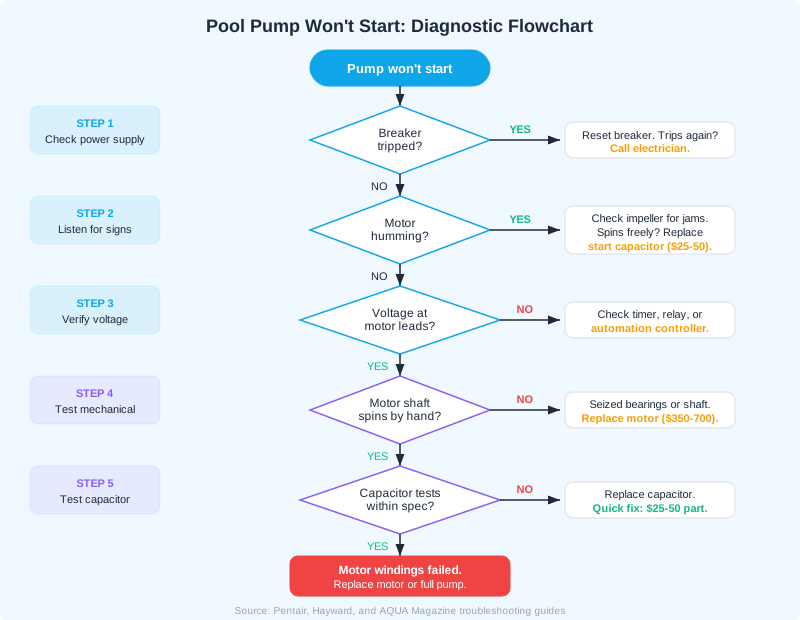
A pool pump that hums audibly but the motor shaft does not spin is one of the easiest problems to diagnose. The humming sound is the motor receiving power and trying to start, but something is physically preventing rotation or the start capacitor has failed. According to INYOPools, approximately 60% of humming pump issues are resolved by freeing a jammed impeller or replacing the start capacitor, a $25-50 part.
How Do You Diagnose a Humming Pool Pump Motor?
- 1Turn off the pump at the breaker immediately. A motor that hums without spinning is drawing locked-rotor amps, which generates extreme heat and can burn out the windings in minutes.
- 2Remove the pump basket and reach into the volute to check if the impeller is jammed with debris. Spin it by hand to test.
- 3If the impeller spins freely, the start capacitor is the most likely culprit. Locate the capacitor in the hump on top of the motor.
- 4Visually inspect the capacitor for bulging, cracking, or leaking fluid. Any of these signs mean replacement is needed.
- 5For a definitive test, use a multimeter set to capacitance mode. The reading should be within 10% of the microfarad rating printed on the capacitor.
- 6If the capacitor tests good and the impeller is clear, the motor windings or centrifugal start switch have likely failed. Motor replacement is the next step.
| Diagnosis | Part Cost | Labor Time | Total Repair Cost |
|---|---|---|---|
| Jammed impeller (debris removal) | $0 | 15-20 min | $75-150 service call |
| Failed start capacitor | $25-50 | 20-30 min | $100-200 |
| Seized bearings | $65-150 | 1-2 hours | $200-400 |
| Motor replacement | $350-700 | 1-2 hours | $500-900 |
Problem Bonus: Excessive Vibration and Shaking
A pool pump that vibrates excessively, walks across the pad, or shakes the connected plumbing is more than a nuisance. Sustained vibration accelerates bearing wear, loosens pipe fittings (creating future leaks), and can crack PVC connections at the pump. The causes range from simple mounting issues to internal mechanical problems.
What Causes Excessive Pool Pump Vibration?
- Loose mounting bolts. The pump is not secured to the equipment pad. Tighten all base bolts.
- Uneven mounting surface. A cracked or settled pad creates uneven contact. Shim the base or pour a new pad.
- Worn motor bearings. Bearings that are failing create imbalance in the rotor, causing vibration.
- Damaged or unbalanced impeller. A chipped impeller or one with debris wedged in the vanes spins unevenly.
- Rigid plumbing connections. PVC pipes connected directly to the pump without unions or flexible connectors transmit all vibration into the plumbing system.
The fix depends on the cause. For mounting issues, secure the pump to the pad with stainless steel bolts and consider placing a rubber anti-vibration pad underneath, which reduces transmitted noise by 20-30% and extends bearing life. For internal causes like bearings or impeller damage, address the root cause directly. Flexible hose connectors (also called flex hoses or pump connectors) between the pump and the hard plumbing absorb vibration and reduce stress on PVC joints.
When Should You Repair a Pool Pump vs. Replace It?
The repair-versus-replace decision comes up on almost every pump service call. According to Angi's 2026 data, pool pump repairs average $150-500 while full replacements average $900-2,500 installed. The general rule among pool professionals is simple: if the repair costs more than 50% of a new pump, replace it. But age matters too. A 3-year-old pump with a failed capacitor is worth a $50 repair. A 10-year-old pump with bad bearings and a leaking seal is not worth $300 in parts and labor.
| Pump Age | Repair Type | Recommendation |
|---|---|---|
| Under 5 years | Capacitor, O-rings, seal | Repair. Pump has years of life left. |
| 5-8 years | Bearings, seal, impeller | Repair if cost is under 50% of replacement. Get two quotes. |
| 8-10 years | Motor or major component | Lean toward replacement, especially if switching to variable-speed. |
| Over 10 years | Any repair | Replace. Parts availability decreases and efficiency drops with age. |
"I always present the customer with both options and my honest recommendation," Corey says. "If their 12-year-old single-speed pump needs a $400 motor, I tell them to put that $400 toward a variable-speed replacement. They will save $50-100 per month on electricity and the new pump pays for itself in under two years. That is a much better conversation than replacing a motor that might give them two more years."
The federal Department of Energy rule that took effect July 2021 requires most new replacement pool pumps to be variable-speed. When recommending a replacement, make sure you are quoting a compliant VS pump. Single-speed pumps over 1 HP can no longer be sold for most residential applications.
How Do Pool Pump Problems Affect Your Service Business?
Pump problems are some of the most profitable service calls if you handle them well. A tech who can diagnose a pump issue on site, explain the cause clearly to the customer, and provide an accurate repair quote builds trust and closes the work order. A tech who shrugs and says "you need a new pump" for a $25 capacitor loses credibility and revenue. Building diagnostic skills across your team directly improves close rates on repair work.
Tracking pump repair work orders, parts used, and time spent helps you understand your margins and improve quoting accuracy. Pool Founder lets you create work orders from the field, attach photos of the problem, and send the customer a quote before you leave the property. When the customer approves, the job is already scheduled and parts are noted. That kind of speed turns a 3-day repair turnaround into same-day approval.
Train your techs to run through the baseline checklist on every maintenance visit, not just when a customer complains. Catching a noisy bearing or a slow drip at the shaft seal before the pump fails completely lets you schedule the repair proactively. The customer sees you as someone who is looking out for their equipment, not just dumping chemicals and moving on.
Run a pool route?
The business side of what you just read.
Pricing, chemical costs, and the tools owners use to keep the numbers straight.
- Commercial pool service pricing2026 rate tables and the cost-plus formula
- Chemical cost per poolWhat chemicals actually cost per stop
- Chemical tracking softwareLog readings and dosing from the pool deck
- Pool service softwareRoutes, invoicing, and service reports in one app
- Free profit & rate calculatorsProfit per pool, minimum rate, break-even
Frequently Asked Questions
How long do pool pumps typically last?
Most pool pumps last 8-12 years with proper maintenance, according to Angi. Variable-speed pumps may last longer because they run at lower RPMs, which reduces wear on bearings and seals. Factors that shorten pump life include running dry, poor water chemistry, inadequate ventilation, and voltage issues.
Can I replace just the pool pump motor instead of the whole pump?
Yes. If the wet end (housing, impeller, seal plate) is in good condition, you can replace just the motor. Motor-only replacements cost $350-700 versus $900-2,500 for a complete pump. However, since July 2021, the DOE requires most replacement pumps over 1 HP to be variable-speed, so check compliance before ordering a single-speed motor.
Why does my pool pump work fine in the morning but lose prime in the afternoon?
Heat-related prime loss usually means a suction-side air leak that worsens as PVC expands in afternoon heat. Pipes expand and contract with temperature, and a marginal joint or fitting that holds vacuum in the cool morning may open up as temperatures rise. Perform the shaving cream air leak test during the afternoon when the problem is active.
How much does it cost to repair a pool pump?
Pool pump repairs average $150-500 according to Angi 2026 data. A capacitor replacement runs $100-200 total, a shaft seal replacement costs $100-250, bearing replacement costs $150-400, and a motor replacement runs $500-900 including labor. The repair cost depends on the specific problem and your local labor rates.
Is it safe to run a pool pump with a small leak at the shaft seal?
No. Even a small shaft seal leak means water is reaching the motor bearings, which will accelerate bearing failure and can eventually cause electrical shorts in the motor. A $100-250 seal replacement now prevents a $500-900 motor replacement later. Fix shaft seal leaks as soon as you spot them.
What is the difference between a start capacitor and a run capacitor on a pool pump?
The start capacitor provides a burst of energy to get the motor spinning and disengages once the motor reaches speed. The run capacitor stays in the circuit and helps the motor maintain consistent power while running. A failed start capacitor causes a humming motor that will not spin. A failed run capacitor causes the motor to run hot, vibrate, or shut off under load. Both are inexpensive parts ($25-50) and straightforward to replace.
Sources & References
- Angi - How Much Does It Cost to Repair a Pool Pump? (2026)
- Angi - How Much Does Pool Pump Replacement Cost? (2026)
- AQUA Magazine - Why Pool Pumps Overheat and What You Can Do to Stop It
- Association of Aquatic Professionals - Common Pool Pump Electrical Issues
- Hayward - Why Is My Pump Running Hot and Powering Off?
- INYOPools - How To Determine Why a Pool Pump Won't Prime
- INYOPools - How To Troubleshoot a Pool Pump Motor (Noisy)
- INYOPools - How To Troubleshoot a Pool Pump Motor (Overheated)
- In The Swim - Pool Pump Shaft Seal Replacement
- California Pool Association - Find and Fix Air Bubbles in Pools
- Trouble Free Pool - Suction Side Air Leaks