Is It the Motor, the Wet End, or Time for a New Pump? Here Is How to Tell.
A dead pool pump does not always need a full replacement. Sometimes it is just the motor. Sometimes it is just a capacitor, a seal, or a bearing. According to Angi, the average pool pump repair costs $150-700, while a full pump replacement runs $700-4,000 installed depending on pump type and brand. Knowing how to diagnose the actual failure point saves your customer money and earns you their trust.
"I used to recommend full pump replacements on every dead pump because I did not know how to diagnose the motor separately," says Corey Adams, Pool Founder co-founder and 15-year pool service veteran. "Once I learned the difference between motor failures and wet end failures, I started saving customers hundreds of dollars on straightforward motor swaps. They remember that." This guide walks through diagnosing the failure, matching a replacement motor, and making the repair vs. replace recommendation.
How Do You Tell If the Motor or the Wet End Has Failed?
The pool pump has two main sections: the motor (electric motor, capacitor, bearings, shaft) and the wet end (impeller, diffuser, volute, seal plate, mechanical seal). Each fails differently, and the symptoms are distinct if you know what to look for.
Signs of Motor Failure
- Motor hums but does not spin. Usually a bad start capacitor or seized bearings. Test the capacitor with a multimeter. Try spinning the shaft by hand through the back vent cover.
- Motor trips the breaker immediately. Shorted motor windings. Use a multimeter to check winding resistance and insulation to ground. Any continuity to ground means the motor is shorted.
- Motor runs but is extremely hot and smells like burned insulation. Failing windings. The motor will die soon even if it still runs.
- Loud grinding or screeching noise from the motor end. Failed front or rear bearing. Bearings can be replaced, but labor cost often makes a full motor replacement more practical.
- Motor does not respond at all, no hum, no click. Check for voltage at the motor terminals first. If voltage is present but the motor is dead, the windings or thermal overload are failed.
Signs of Wet End Failure
- Motor runs fine but pump has no flow. Broken or worn impeller. The impeller vanes can break off or erode, especially in high-CYA or low-pH water.
- Leak from between the motor and wet end. Failed mechanical shaft seal. This is the most common wet end repair and typically costs $15-30 for the seal kit.
- Cracked pump housing or volute. Visible crack with water spraying. Most volutes are replaceable without replacing the motor.
- Clogged impeller. Debris stuck in the impeller reduces flow. Remove the motor from the wet end and clean the impeller.
How Do You Match a Replacement Pool Pump Motor?
Replacing a pool pump motor requires matching several specifications exactly. Getting any one of these wrong means the motor will not fit, will not perform correctly, or will fail prematurely. Here are the specifications you need to record from the old motor nameplate.
Motor Specifications to Match
| Specification | Where to Find It | Why It Matters |
|---|---|---|
| Horsepower (HP) | Motor nameplate | Must match for proper flow and pressure |
| Service Factor (SF) | Motor nameplate | 1.0 SF or 1.65 SF, determines actual HP output |
| Frame Size | Motor nameplate (48Y or 56Y) | Determines bolt pattern and shaft dimensions |
| Voltage | Motor nameplate (115/230V or 230V only) | Must match the circuit |
| Speed (RPM) | Motor nameplate (3,450 or 1,725) | High speed vs. low speed, must match pump design |
| Shaft Diameter | Measure or check nameplate | Must match impeller and seal |
| Rotation | Looking at shaft end | CCW is standard for pool pumps |
Understanding Service Factor
Service factor is a multiplier that tells you how much continuous overload the motor can handle. A 1.0 HP motor with a 1.65 service factor (called "up-rated") actually delivers 1.65 HP continuously. An older 1.5 HP motor with 1.0 SF (called "full-rated") delivers exactly 1.5 HP. When replacing, match the total horsepower output (HP x SF), not just the nameplate HP. A 1.0 HP up-rated motor (1.65 total HP) is not the same as a 1.0 HP full-rated motor (1.0 total HP).
The most common frame sizes for residential pool pumps are 48Y and 56Y. The "Y" indicates the shaft extends from the front of the motor (face mount). A 56Y frame is physically larger than a 48Y and the shaft is a different length. They are not interchangeable without an adapter plate.
When Should You Repair vs. Replace the Entire Pump?
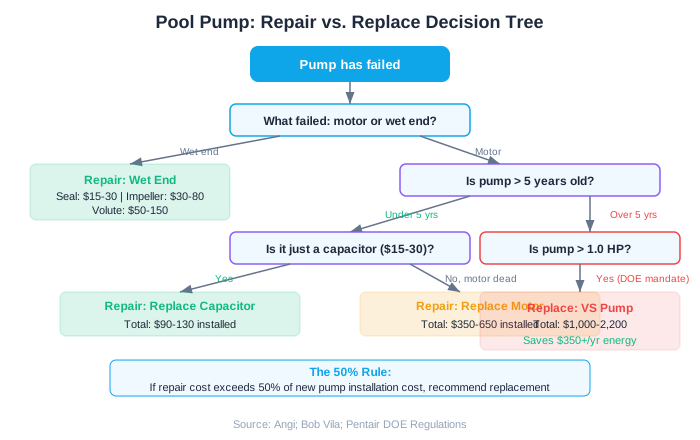
The repair vs. replace decision comes down to age, cost, and the DOE regulation. Here is a framework that works for most situations.
The 50% Rule
If the repair cost exceeds 50% of the cost of a new pump installation, recommend replacement. According to Bob Vila, motor-only replacements range from $200-800 for the part. A full variable speed pump installation runs $1,200-2,500. If a motor replacement costs $500+ in parts and labor on an 8-year-old pump, the customer is better served by a new variable speed pump that comes with a warranty and will save them $350+ per year in energy costs.
Decision Matrix
| Scenario | Recommendation | Reasoning |
|---|---|---|
| Single-speed pump under 5 years, bad capacitor | Repair ($15-30 part) | Quick, cheap fix. Pump has years of life left. |
| Single-speed pump under 5 years, bad motor | Replace motor ($200-400) | Motor swap is cost-effective on a newer pump. |
| Single-speed pump over 5 years, dead motor | Replace pump (VS upgrade) | DOE requires VS for pumps over 1 HP. Upgrade now. |
| VS pump under 3 years, drive board failure | Repair (warranty or $300-600) | Check warranty first. Drive board swap is viable. |
| Any pump, cracked volute + bad motor | Replace pump | Multiple failures signal end of life. |
| Any pump, shaft seal leak only | Repair ($15-30 part) | Seal replacement is routine maintenance. |
Since July 2021, any new pump manufactured over 1.0 total HP must meet DOE efficiency standards (effectively variable speed). When a customer has a dead single-speed pump over 1 HP, they cannot legally replace it with another single-speed. This makes the replacement decision easier to explain.
How Do You Physically Replace a Pool Pump Motor?
A motor swap on a standard residential pool pump takes 45-90 minutes. The process is the same across most brands: separate the motor from the wet end, transfer the impeller and seal to the new motor, and reassemble. Here is the step-by-step process.
- 1Turn off the breaker. Verify zero voltage at the pump with a multimeter.
- 2Disconnect the electrical wiring at the motor. Note or photograph the wire connections for the new motor.
- 3Remove the 4-6 bolts connecting the motor to the seal plate. Separate the motor from the wet end.
- 4Remove the impeller from the old motor shaft. Hold the shaft with pliers or a shaft holder tool from the back of the motor and turn the impeller counterclockwise.
- 5Remove the old mechanical seal. The seal has two halves: one in the seal plate and one on the impeller. Replace both halves with a new seal kit.
- 6Install the new seal halves. Press the stationary half into the seal plate. Slide the rotating half onto the new motor shaft.
- 7Thread the impeller onto the new motor shaft. Hand-tighten clockwise (it will self-tighten during operation).
- 8Bolt the new motor to the seal plate. Torque evenly in a cross pattern.
- 9Reconnect electrical wiring to the new motor per the wiring diagram on the motor nameplate.
- 10Prime the pump, turn on the breaker, and test. Check for leaks at the seal plate and confirm proper rotation.
Always replace the mechanical shaft seal when replacing the motor. The old seal is disturbed during removal and will not re-seat properly. A new seal costs $15-30 and prevents a callback for a seal leak two weeks later.
What Are the Most Common Pool Pump Motor Failure Causes?
Understanding why motors fail helps you advise customers on prevention and set proper expectations for motor lifespan. Most motor failures fall into four categories.
- Water damage from seal leaks. A leaking shaft seal drips water onto the motor bearings and windings. Over months, this corrodes bearings and shorts windings. Replacing seals proactively every 2-3 years prevents this.
- Overheating from restricted airflow. Motors have vent openings for cooling air. Debris, mulch, or ant nests blocking these vents cause the motor to overheat. The thermal overload trips repeatedly, weakening the windings each time.
- Voltage problems. Low voltage (brownouts) forces the motor to draw more amperage to maintain speed, overheating the windings. High voltage spikes damage capacitors and windings. A surge protector at the equipment pad helps.
- Running dry. A pump that loses prime and runs without water overheats the seal and motor rapidly. Even a few minutes of dry running can damage bearings and warp the seal faces.
5-8 years
Average lifespan of a single-speed pool pump motor in residential service
How Do You Price Motor Replacement vs. Full Pump Jobs?
Pricing pump work correctly protects your margin and gives the customer a fair deal. Here are typical pricing structures used by professional pool service companies.
Typical Pricing Ranges
| Service | Parts Cost | Labor | Total to Customer |
|---|---|---|---|
| Capacitor replacement | $15-30 | $75-100 | $90-130 |
| Shaft seal replacement | $15-30 | $100-150 | $115-180 |
| Motor replacement (single-speed) | $200-400 | $150-250 | $350-650 |
| Full pump replacement (VS) | $800-1,800 | $200-400 | $1,000-2,200 |
| Full pump + plumbing modification | $900-2,000 | $300-600 | $1,200-2,600 |
When quoting a full pump replacement, always present the variable speed upgrade option alongside the base quote. Explain the energy savings, the DOE requirement, and the utility rebate if available. Most customers choose the upgrade when they understand the payback period.
Run a pool route?
The business side of what you just read.
Pricing, chemical costs, and the tools owners use to keep the numbers straight.
- Commercial pool service pricing2026 rate tables and the cost-plus formula
- Chemical cost per poolWhat chemicals actually cost per stop
- Chemical tracking softwareLog readings and dosing from the pool deck
- Pool service softwareRoutes, invoicing, and service reports in one app
- Free profit & rate calculatorsProfit per pool, minimum rate, break-even
Frequently Asked Questions
How do you know if a pool pump motor is bad?
A bad pool pump motor typically hums without spinning (bad capacitor or seized bearings), trips the breaker immediately (shorted windings), makes grinding noises (failed bearings), or does not respond at all (dead windings or thermal overload). Test with a multimeter for winding resistance and insulation to ground.
Can you replace just the motor on a pool pump?
Yes. On most residential pool pumps, the motor bolts to the wet end and can be replaced independently. You need to match the horsepower, service factor, frame size, voltage, and shaft dimensions. Always replace the mechanical shaft seal at the same time.
How much does a pool pump motor replacement cost?
A motor-only replacement typically costs $350-650 total, including $200-400 for the motor and $150-250 for labor. A full variable speed pump replacement runs $1,000-2,500 installed. If the motor replacement cost exceeds 50% of a new pump, replacement is usually the better value.
What is the difference between 48Y and 56Y frame motors?
The 48Y and 56Y designate the NEMA frame size. A 56Y frame is physically larger with a different shaft length and bolt pattern than a 48Y. They are not interchangeable without an adapter plate. Always match the existing frame size when ordering a replacement motor.
Should you replace a single-speed motor or upgrade to variable speed?
If the pump is over 5 years old and the motor is over 1.0 HP, upgrading to a variable speed pump is usually the better investment. DOE regulations require variable speed for new pumps over 1.0 HP, and the energy savings of $350+ per year means the upgrade pays for itself within 2-3 years.