"Just Match What Was There" Is the Most Expensive Advice in Pool Service.
Pool pump sizing is one of the most misunderstood aspects of pool service. The common approach, "just put in the same size that was there," assumes the original pump was correctly sized. It usually was not. Builders routinely oversize pumps to ensure the pool "works" without doing any hydraulic calculations. The result is a pump that wastes electricity, creates excessive pressure on the filter and plumbing, and generates unnecessary noise. Proper pump sizing starts with the pool volume, target turnover rate, pipe size, and total dynamic head.
"I used to just match horsepower for horsepower on every replacement," says Corey Adams, Pool Founder co-founder and 15-year pool service veteran. "Then I learned how to read a pump curve and calculate TDH. Turns out half the pumps I was replacing were oversized by a full horsepower. When I started right-sizing pumps, customers saved money on energy, their equipment lasted longer, and I stopped seeing cracked filter tanks." This guide teaches the hydraulic calculation for proper pump sizing, how to read a pump performance curve, and why "match what was there" fails.
What Is the Right Flow Rate for a Pool?
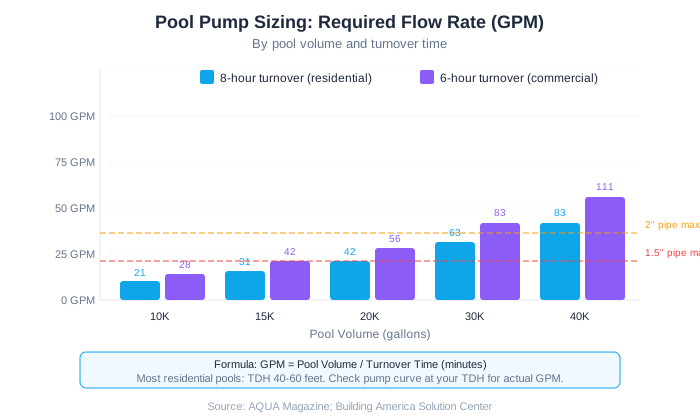
The starting point for pump sizing is the required flow rate in gallons per minute (GPM). The industry standard for residential pools is one complete turnover every 8 hours, though many jurisdictions require commercial pools to turn over every 6 hours. The formula is simple: pool volume in gallons divided by turnover time in minutes equals the required GPM.
Flow Rate Calculation
Required GPM = Pool Volume (gallons) / Turnover Time (minutes). For an 8-hour turnover: GPM = Pool Volume / 480. For a 20,000-gallon pool with an 8-hour turnover: 20,000 / 480 = 41.7 GPM. That is the minimum flow rate the pump must deliver at the system operating point.
| Pool Volume | 8-Hour Turnover (GPM) | 6-Hour Turnover (GPM) |
|---|---|---|
| 10,000 gal | 21 GPM | 28 GPM |
| 15,000 gal | 31 GPM | 42 GPM |
| 20,000 gal | 42 GPM | 56 GPM |
| 30,000 gal | 63 GPM | 83 GPM |
| 40,000 gal | 83 GPM | 111 GPM |
For variable speed pumps, the required GPM is the flow rate you need at the filtration speed. You can achieve the same turnover by running longer at a lower GPM. A 20,000-gallon pool can turn over in 12 hours at just 28 GPM, which requires far less pump power.
What Is Total Dynamic Head and How Do You Calculate It?
Total Dynamic Head (TDH) is the total resistance the pump must overcome to move water through the entire plumbing system, measured in feet of head. It includes friction losses from pipes, fittings, valves, the filter, the heater, and the elevation difference between the pool surface and the equipment pad. Most residential inground pools have a TDH of 40-60 feet. Above-ground pools typically run 25-35 feet.
Components of Total Dynamic Head
| Component | Typical Head Loss | How to Estimate |
|---|---|---|
| Pipe friction (suction) | 5-15 ft | 1-3 ft per 10 ft of pipe at target GPM |
| Pipe friction (return) | 5-15 ft | 1-3 ft per 10 ft of pipe at target GPM |
| 90-degree elbows | 1-2 ft each | Count all elbows on suction and return |
| Filter (clean) | 3-8 ft | Check manufacturer spec, varies by type |
| Heater | 3-5 ft | Varies by model, check spec sheet |
| Salt cell | 1-2 ft | Minimal resistance when clean |
| Elevation difference | 1 ft per foot | Vertical distance pool to equipment |
| Check valves | 3-5 ft each | Count all check valves in system |
Add up all the components to get your total TDH. For a rough estimate, most standard residential pools with the equipment pad at pool level, a clean filter, and 2-inch plumbing come in at 40-55 feet of head. If the equipment pad is elevated above the pool (like on a hillside), add the vertical distance.
Pipe diameter has a massive impact on TDH. Friction loss in 1.5-inch pipe at 60 GPM is roughly 4x higher than in 2-inch pipe at the same flow. The maximum recommended flow for 1.5-inch PVC is about 42 GPM. For 2-inch PVC, it is about 73 GPM. Exceeding these limits creates excessive friction, noise, and risk of pipe failure.
How Do You Read a Pump Performance Curve?
A pump performance curve is a graph that shows the relationship between flow rate (GPM, on the horizontal axis) and head (feet, on the vertical axis) for a specific pump. Every pump manufacturer publishes these curves for each model. The curve tells you exactly how much flow a pump delivers at any given system resistance.
How to Use the Curve
- 1Find the pump curve for the model you are considering. It is in the spec sheet or on the manufacturer website.
- 2Locate your calculated TDH on the vertical (Y) axis.
- 3Draw a horizontal line from your TDH across to the pump curve.
- 4Where the horizontal line intersects the pump curve, drop a vertical line down to the horizontal (X) axis.
- 5The value on the X axis is the flow rate (GPM) the pump will deliver at your system TDH.
- 6If the GPM at your TDH meets or exceeds your required flow rate, the pump is properly sized.
The intersection of your system TDH line and the pump curve is called the operating point. This is where the pump will actually run in your specific plumbing system. A pump that delivers 80 GPM at 30 feet of head might only deliver 45 GPM at 55 feet of head. The curve shows you the real-world performance.
For variable speed pumps, the manufacturer publishes curves at multiple speeds (e.g., 1,200 RPM, 1,800 RPM, 2,400 RPM, 3,450 RPM). You want the pump to deliver your required GPM at your TDH on one of the lower speed curves. If you need full speed to hit the target flow, the pump may be undersized.
Why Does "Match What Was There" Fail?
There are three reasons this approach fails consistently. Each one costs your customer money and can damage their equipment.
Reason 1: Builders Oversize Pumps
Pool builders select pumps for the worst-case scenario and then add a safety margin on top of that. A pool that needs 45 GPM gets a pump that delivers 80 GPM. This oversizing wastes 40-60% of the energy consumed. Replacing an oversized pump with the same size continues the waste. An oversized pump does not clean the pool faster. It just pushes water through the filter faster than the filter can effectively capture particles.
Reason 2: The Plumbing May Have Changed
Over the life of a pool, equipment is added (heaters, salt cells, water features) and plumbing is modified. Each addition changes the TDH of the system. The original pump sizing, if it was ever correct, no longer matches the current system. A pump that was correctly sized for a bare pool with a filter is now undersized for a pool with a filter, heater, salt cell, and solar panels.
Reason 3: Variable Speed Changes the Math
If the original pump was a 1.5 HP single-speed, replacing it with a "1.5 HP variable speed" is not equivalent. A variable speed pump at low speed delivers far less flow than the single-speed pump did at full speed. The HP rating on a VS pump refers to the maximum, not the operating point. You need to check the pump curve at the speed you plan to run to confirm it delivers adequate flow for your system TDH.
How Do You Size a Pump for a Pool with Multiple Features?
Pools with heaters, water features, in-floor cleaning systems, and solar panels have different flow requirements for each feature. The pump must deliver enough flow for the most demanding feature, not just basic filtration.
Minimum Flow Requirements by Feature
| Feature | Minimum GPM | Notes |
|---|---|---|
| Basic filtration (8-hr turnover) | 21-83 | Based on pool volume |
| Gas heater | 30-40 | Check manufacturer spec, varies by model |
| Heat pump | 25-45 | Must exceed flow switch threshold |
| Salt chlorinator | 20-30 | Below minimum causes no-flow error |
| Suction-side cleaner | 30-40 | Needs sustained suction at the cleaner port |
| In-floor cleaning system | 50-70 | Pop-ups require significant pressure |
| Waterfall or spillover | 40-80+ | Depends on width and height |
| Solar heating panels | 30-50 | Must fill panels without air locks |
With a variable speed pump, you program different speeds for different features. Filtration runs at 1,200-1,800 RPM. When the heater calls for heat, the pump ramps to 2,400 RPM to meet the flow requirement. When the waterfall runs, the pump goes to 3,000+ RPM. The pump must be able to deliver the highest required GPM at the system TDH on its performance curve.
Size the pump for the highest single-feature flow demand, not the sum of all features. Features do not all run simultaneously. But make sure the pump curve shows adequate flow at your TDH for each feature at its scheduled speed.
What Happens When a Pump Is Oversized or Undersized?
Both conditions cause problems, but they manifest differently. Understanding the symptoms helps you identify sizing issues on existing installations.
Symptoms of an Oversized Pump
- Excessively high filter pressure. The pump pushes more water than the filter can handle at reasonable pressure.
- Noisy plumbing. Water velocity in the pipes is too high, causing a rushing or hammering sound.
- Short filter cleaning cycles. The filter gets dirty faster because it is being force-fed debris at high flow.
- Cracked filter tank or blown clamp bands. Excessive pressure over time fatigues the filter housing.
- High electric bills. The pump consumes more energy than needed. According to the Building America Solution Center, an oversized pump can waste 40-60% of its energy.
Symptoms of an Undersized Pump
- Poor water clarity. The pump cannot turn the water over fast enough for the filter to keep up.
- Weak return jets. Low flow rate means low pressure at the return fittings.
- Equipment faults. Heaters, salt cells, and cleaners trip on low-flow errors because the pump does not meet their minimum GPM requirements.
- Algae problems despite good chemistry. Insufficient circulation creates dead zones where algae can establish.
- Skimmer not pulling debris. Low suction means floating debris stays on the surface.
What Is the Pump Sizing Process Step by Step?
Here is the complete process for sizing a pool pump correctly. Use this every time you quote a pump replacement or new installation.
- 1Calculate pool volume in gallons using the appropriate shape formula.
- 2Determine the required flow rate (GPM) based on an 8-hour turnover (or 6-hour for commercial).
- 3Identify the maximum flow requirement for any connected equipment (heater, salt cell, cleaner, water features).
- 4Use the higher of the two values (turnover GPM or equipment GPM) as your target flow.
- 5Estimate total dynamic head (TDH) by adding friction losses from pipe, fittings, filter, heater, and elevation.
- 6Look up the pump performance curve for the model you are considering.
- 7Find your TDH on the vertical axis and read across to the curve. Drop down to find the actual GPM at that head.
- 8Confirm the GPM at your TDH meets or exceeds your target flow. For variable speed, confirm this at the speed you plan to schedule that feature.
- 9If the GPM is too low at your TDH, consider a larger pump model. If the GPM far exceeds your target (50%+), consider a smaller model.
- 10For variable speed pumps, verify that your filtration speed (low RPM) can achieve basic turnover in 10-14 hours, and that your feature speed delivers adequate GPM for each piece of connected equipment.
The best pump size is the smallest pump that delivers your required GPM at your calculated TDH. Bigger is not better. An oversized pump wastes energy, beats up equipment, and gives you callbacks. Right-sizing protects the whole system.
Run a pool route?
The business side of what you just read.
Pricing, chemical costs, and the tools owners use to keep the numbers straight.
- Commercial pool service pricing2026 rate tables and the cost-plus formula
- Chemical cost per poolWhat chemicals actually cost per stop
- Chemical tracking softwareLog readings and dosing from the pool deck
- Pool service softwareRoutes, invoicing, and service reports in one app
- Free profit & rate calculatorsProfit per pool, minimum rate, break-even
Frequently Asked Questions
How do you determine what size pool pump you need?
Calculate the required flow rate (pool volume divided by turnover time in minutes), estimate total dynamic head from pipe friction, fittings, filter, and elevation, then find a pump whose performance curve delivers your required GPM at your TDH. The right size is the smallest pump that meets these requirements.
What is total dynamic head in pool plumbing?
Total dynamic head (TDH) is the total resistance, measured in feet of water, that the pump must overcome to circulate water through the plumbing system. It includes friction from pipes, fittings, filter, heater, and elevation change. Most residential pools have a TDH of 40-60 feet.
What happens if a pool pump is too big?
An oversized pump creates excessive filter pressure, noisy plumbing, shortened filter cleaning cycles, potential filter housing damage, and wastes 40-60% of its energy. It does not clean the pool faster. It just pushes water through the filter faster than the media can effectively capture particles.
How many GPM does a 20,000-gallon pool need for an 8-hour turnover?
20,000 gallons divided by 480 minutes (8 hours) equals approximately 42 GPM. This is the minimum flow rate the pump must deliver at the system operating point (your TDH) to achieve one complete turnover every 8 hours.
What is the maximum flow rate for 1.5-inch pool plumbing?
The maximum recommended flow for 1.5-inch PVC pipe is approximately 42 GPM. Exceeding this creates excessive friction loss, noisy pipes, and risk of pipe failure. For flow rates above 42 GPM, 2-inch plumbing (max approximately 73 GPM) or larger is required.