Salt Pools Are Not Low-Maintenance Pools. They Are Different-Maintenance Pools.
Salt chlorine generators produce chlorine through electrolysis of dissolved salt (sodium chloride) in the pool water. The process creates the same hypochlorous acid that liquid and granular chlorine provide. But the electrolysis reaction also produces sodium hydroxide as a byproduct, which has a pH above 13. This is why salt pools have a persistent pH rise problem that traditional chlorine pools do not. Managing that pH rise, protecting the salt cell from calcium scaling, and keeping CYA in the right range are the three chemistry challenges that make salt pools different from every other pool on your route.
Corey Adams, Pool Founder co-founder and 15-year pool service veteran, services dozens of salt pools. "The biggest misconception from homeowners is that salt pools take care of themselves. They do not. They need acid almost every week, the cell needs inspection every three months, and if CYA gets too high, the cell runs at 100% but the pool still does not hold chlorine. Salt pools are great, but they need a tech who understands the chemistry."
This guide covers salt pool water chemistry, the electrolysis process, pH management, calcium hardness targets, CYA considerations, and how to price salt pool service.
How Does a Salt Chlorine Generator Produce Chlorine?
A salt chlorine generator (SCG) passes pool water containing dissolved sodium chloride (NaCl) over electrolytic plates coated in ruthenium or iridium. The electrical current splits the salt molecule. At the anode, chloride ions are oxidized into chlorine gas, which immediately dissolves into hypochlorous acid (HOCl) in the water. At the cathode, hydrogen gas and sodium hydroxide (NaOH) are produced. The hypochlorous acid sanitizes the pool. The sodium hydroxide raises the pH.
What Salt Level Does a Salt Pool Need?
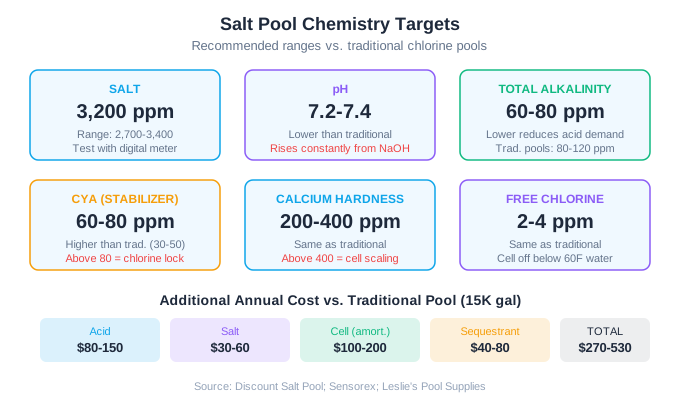
Most salt chlorine generators require a salt concentration between 2,700 and 3,400 ppm, with 3,200 ppm as the ideal target for peak efficiency. Below 2,700 ppm, most units reduce output or shut off with a low-salt warning. Above 3,400 ppm, the water tastes noticeably salty and some units display a high-salt alert. A 10,000-gallon pool at the target level contains approximately 267 pounds of dissolved salt.
| Parameter | Target Range | Notes |
|---|---|---|
| Salt | 2,700-3,400 ppm (ideal 3,200) | Test with digital salt meter, not strips |
| Free chlorine | 2-4 ppm | Same as traditional pools |
| pH | 7.2-7.4 | Lower than traditional pools due to constant pH rise |
| Total alkalinity | 60-80 ppm | Lower range reduces acid demand |
| Calcium hardness | 200-400 ppm | Higher CH accelerates cell scaling |
| CYA | 60-80 ppm | Higher than traditional pools to protect SCG-generated chlorine |
| Water temperature | 60°F+ for cell operation | Most cells shut off below 60°F |
Salt does not evaporate. You only lose salt through splash-out, backwashing, leaks, or partial drains. If salt drops consistently between visits, look for a leak or excessive backwashing.
Why Does pH Rise Constantly in Salt Pools?
The number one chemistry difference between salt pools and traditional chlorine pools is the relentless upward pH drift. The electrolysis process generates sodium hydroxide (NaOH) as a byproduct at the cathode. Sodium hydroxide has a pH above 13. Every time the cell runs, it pushes pH higher. In a pool with the cell running 8 to 12 hours per day, pH can rise 0.1 to 0.3 units per week.
How Do You Manage pH Rise on a Salt Pool Route?
The key is to manage total alkalinity at the lower end of the range. Keeping TA at 60-80 ppm instead of 80-120 ppm reduces the water's buffering capacity, which means pH rises more slowly and requires less acid to correct. Add muriatic acid weekly, targeting pH 7.2. Do not let pH climb above 7.6 between visits. High pH causes two problems: it reduces chlorine effectiveness (at pH 8.0, only 22% of FC is active HOCl) and it accelerates calcium scaling on the cell plates.
| Pool Volume | Typical Weekly Acid Dose | Notes |
|---|---|---|
| 10,000 gallons | 8-16 oz muriatic acid | Varies by TA, cell runtime, and aeration |
| 15,000 gallons | 12-24 oz muriatic acid | Pools with water features need more acid |
| 20,000 gallons | 16-32 oz muriatic acid | Adjust based on weekly pH reading |
| 25,000+ gallons | 20-40 oz muriatic acid | Consider an automatic acid feeder |
Pools with water features, fountains, or spillover spas need significantly more acid. These features aerate the water, which drives off CO2 and raises pH independently of the salt cell. A pool with an active water feature can see pH rise twice as fast as the same pool without one.
How Does a Salt System Affect Calcium Hardness and Cell Scaling?
Calcium scaling on the cell plates is the primary threat to salt cell longevity. When pH rises at the cathode during electrolysis, calcium carbonate precipitates directly onto the plates. This scale insulates the plates, reducing chlorine production and forcing the cell to work harder. The higher the calcium hardness and pH, the faster scale forms.
What Calcium Hardness Level Is Safe for Salt Cells?
Keep calcium hardness between 200 and 400 ppm. Below 200 ppm, the water becomes aggressive and can corrode the cell and other metal components. Above 400 ppm, scaling accelerates significantly, especially when pH drifts above 7.6. In hard-water markets where fill water comes in at 300-400+ ppm CH, you may need to drain and dilute periodically to keep CH below 400.
- Test calcium hardness monthly on salt pools
- If CH exceeds 400 ppm, partial drain and refill is the only reliable correction
- Watch for white scale buildup at the waterline, tile, and returns, all signs of high calcium plus high pH
- Use a sequestrant (metal and scale control product) monthly in high-CH areas to slow scale formation
- Do not use calcium hypochlorite shock on salt pools. It adds calcium. Use liquid chlorine or dichlor instead.
The Langelier Saturation Index (LSI) is the best tool for predicting scaling on salt cells. An LSI above +0.3 means the water is scale-forming. Check LSI monthly on every salt pool using pH, temperature, calcium hardness, alkalinity, and TDS (salt level is your primary TDS factor in salt pools).
How Should You Manage CYA on Salt Pools?
Cyanuric acid management on salt pools requires a different approach than traditional chlorine pools. Salt cells generate unstabilized chlorine, which means all the CYA in a salt pool comes from either initial dosing or from dichlor/trichlor that was added as supplemental chlorine. The recommended CYA range for salt pools is 60-80 ppm, higher than the 30-50 ppm target for traditional pools.
Why Do Salt Pools Need Higher CYA?
Salt cells produce chlorine continuously during the day when the pump runs. Without CYA protection, UV light destroys that chlorine within 2 to 3 hours. At CYA 60-80 ppm, enough free chlorine is buffered to last between pump cycles and maintain a residual overnight. However, CYA above 80 ppm significantly reduces the sanitizing power of the chlorine produced. At CYA 100+, the cell may run at maximum output but still fail to maintain adequate FC.
| CYA Level | FC Needed for Same Kill Rate | Impact on Salt Cell |
|---|---|---|
| 30 ppm | 2 ppm FC | Chlorine burns off too fast in direct sun |
| 60 ppm | 4 ppm FC | Ideal range. Good UV protection, reasonable FC target. |
| 80 ppm | 5 ppm FC | Upper limit. Cell may need to run at higher output. |
| 100+ ppm | 7+ ppm FC | Cell cannot keep up. Drain and dilute to lower CYA. |
The single biggest mistake on salt pools is adding trichlor tabs as "supplemental chlorine." Every tab adds CYA. Within a season, CYA can reach 100-150 ppm, and the salt cell cannot produce enough active chlorine to overcome the CYA lock. If the cell cannot keep up, increase runtime or cell output before reaching for tabs.
How Should You Price Salt Pool Service?
Salt pools cost more to service than traditional chlorine pools. The weekly acid addition, quarterly cell inspections, higher product costs for salt-compatible chemicals, and the eventual cell replacement all add up. Many service companies price salt pools $20-40 per month higher than equivalent traditional pools, and this is justified by the real cost difference.
What Are the Additional Costs of Salt Pool Service?
| Cost Item | Annual Cost (15,000 gal pool) | Notes |
|---|---|---|
| Muriatic acid (weekly) | $80-150/year | pH management is the biggest ongoing cost |
| Salt replenishment | $30-60/year | Only needed for splash-out and backwash losses |
| Cell replacement (amortized) | $100-200/year | Cells last 3-7 years, cost $400-800 to replace |
| CYA management | $20-40/year | Occasional stabilizer addition |
| Sequestrant/scale control | $40-80/year | Monthly treatment in hard water areas |
Total additional cost over a traditional chlorine pool is roughly $270 to $530 per year. A $30/month premium covers the low end. A $45/month premium covers the high end and includes cell replacement reserve. Be transparent with customers about why salt pool service costs more. Most homeowners understand when you explain the acid, cell, and scaling costs.
Track salt pool acid usage and cell cleaning frequency in your service software. These metrics tell you which pools are costing more than your pricing covers. If a pool needs acid every 5 days instead of every 7, or the cell scales every 6 weeks instead of every 12, your pricing needs to reflect that reality.
What Are the Most Common Salt Pool Mistakes?
Salt pools have their own set of common mistakes that differ from traditional pool errors. Most of these come from treating a salt pool like a regular chlorine pool and not accounting for the unique chemistry of electrolysis.
- Letting pH run above 7.6 for weeks. This accelerates cell scaling, reduces chlorine effectiveness, and causes calcium precipitation (cloudy water).
- Using trichlor tabs in a salt pool. Tabs add CYA that accumulates over the season and cannot be removed without draining.
- Skipping cell inspections. Scale that builds for 6 months is harder to remove and shortens cell life.
- Using cal-hypo shock on a salt pool. It adds calcium that accelerates cell scaling. Use liquid chlorine instead.
- Running the cell at 100% all the time instead of adjusting output to match demand. High output produces more sodium hydroxide, which means more pH rise and more acid needed.
- Not testing salt level with a reliable meter. Salt test strips are inaccurate. A digital salt meter or taking a sample to a pool store gives a reliable reading.
- Ignoring the flow sensor and water temperature. Most cells will not produce chlorine below 60 degrees F or without adequate flow.
"I see it every spring," Corey says. "A homeowner ran their salt pool all winter without checking chemistry. pH is 8.2, the cell is caked in scale, CYA is 120 because they added tabs. It takes a full day to get that pool right, including a cell cleaning, a partial drain for CYA, and enough acid to drop pH from 8.2 to 7.2. That is why spring openings on salt pools should be priced higher."
Run a pool route?
The business side of what you just read.
Pricing, chemical costs, and the tools owners use to keep the numbers straight.
- Commercial pool service pricing2026 rate tables and the cost-plus formula
- Chemical cost per poolWhat chemicals actually cost per stop
- Chemical tracking softwareLog readings and dosing from the pool deck
- Pool service softwareRoutes, invoicing, and service reports in one app
- Free profit & rate calculatorsProfit per pool, minimum rate, break-even
Frequently Asked Questions
What salt level should a salt pool be?
Most salt chlorine generators require 2,700 to 3,400 ppm of dissolved salt, with 3,200 ppm as the ideal target. Below 2,700, most units reduce output or shut off. Above 3,400, the water tastes noticeably salty. Test with a digital salt meter rather than test strips for accurate readings.
Why does pH keep going up in my salt pool?
The electrolysis process that generates chlorine also produces sodium hydroxide (NaOH) as a byproduct at the cathode. Sodium hydroxide has a pH above 13. Every time the salt cell runs, it pushes pool pH higher. This is a normal part of salt pool chemistry and requires weekly acid addition to counteract.
Can I use calcium hypochlorite shock in a salt pool?
It is not recommended. Calcium hypochlorite adds calcium to the water, which accelerates scaling on the salt cell plates. Use liquid sodium hypochlorite (12.5%) for shocking salt pools. It adds no calcium and dissolves instantly. Dichlor is also acceptable for occasional use but adds CYA.
How much more should I charge for salt pool service?
Salt pools cost $270 to $530 more per year in chemicals and amortized cell replacement compared to traditional chlorine pools of the same size. A $30 to $45 per month premium over your standard rate covers these additional costs. Be transparent with customers about the acid, cell, and scaling costs that drive the difference.
What CYA level should a salt pool be?
The recommended CYA range for salt pools is 60 to 80 ppm, higher than the 30 to 50 ppm target for traditional chlorine pools. Salt cells generate unstabilized chlorine that needs CYA protection from UV degradation. However, CYA above 80 ppm reduces chlorine effectiveness faster than the cell can compensate. Above 100 ppm, drain and dilute.