A Clean Salt Cell Produces Chlorine. A Scaled Cell Produces Callbacks.
The salt cell is the most expensive consumable component on a salt pool. A replacement cell costs $400 to $800 depending on the brand and model, and the cell lifespan ranges from 3 to 7 years depending on water chemistry and maintenance. Proper inspection and cleaning directly extends cell life. Neglect shortens it dramatically. A cell that should last 5 years can fail in 18 months if calcium scale is allowed to build unchecked.
Corey Adams, Pool Founder co-founder and 15-year pool service veteran, inspects every salt cell quarterly. "I have seen cells last 7 years with proper maintenance and fail in less than a year without it. The difference is consistent pH control, regular inspections, and knowing when to clean versus when to replace. Cleaning a cell that is actually failing just delays the inevitable and frustrates the customer."
This guide covers visual inspection, the acid wash procedure, how to tell a dirty cell from a failing cell, and replacement planning.
How Often Should You Inspect a Salt Cell?
Inspect the salt cell every 3 months or every 500 operating hours, whichever comes first. Hayward, Pentair, and other major manufacturers all recommend this interval. Many modern units have a built-in inspection indicator that lights up after 500 hours of runtime. Do not wait for the indicator. Build quarterly inspections into your service schedule for every salt pool on your route.
What Does a Visual Inspection Look Like?
- 1Turn off the pump and salt system.
- 2Remove the cell from the plumbing housing. Most cells unscrew or have a union fitting.
- 3Hold the cell up and look through the end. You should be able to see light through the plates.
- 4Look for white or off-white deposits on the plates. This is calcium carbonate scale.
- 5Check for flaking or discoloration of the plate coating. Titanium plates with intact coating appear dark gray or black. Exposed (worn) areas appear lighter.
- 6Inspect the terminal connections for corrosion. Green or white buildup on the terminals indicates moisture intrusion.
| What You See | What It Means | Action |
|---|---|---|
| Clear plates, visible light through cell | Cell is clean and operational | Reinstall. No cleaning needed. |
| Light white film on plates | Early scale buildup | Flush with a garden hose. If film persists, acid wash. |
| Heavy white deposits blocking plate gaps | Significant calcium scaling | Acid wash required. |
| Flaking or peeling plate coating | Coating degradation from age or excessive cleaning | Cell is nearing end of life. Plan replacement. |
| Plates appear white or silver instead of dark | Coating is stripped. Cell is failing. | Replace the cell. Cleaning will not restore it. |
Do not clean a cell that does not need cleaning. Every acid wash removes a microscopic amount of the protective coating. Only clean when scale is visible and cannot be removed with a simple water rinse.
How Do You Acid Wash a Salt Cell?
Acid washing dissolves calcium carbonate scale from the cell plates. The procedure is straightforward but must be done carefully to avoid damaging the coating or creating a safety hazard. Use a 4:1 ratio of water to muriatic acid (one gallon of water to one quart of acid). Never use a stronger concentration.
Step-by-Step Acid Wash Procedure
- 1Remove the cell from the plumbing. Rinse with a garden hose to remove loose debris.
- 2In a clean plastic bucket or purpose-built cell stand, mix the acid solution: add 1 quart of muriatic acid to 1 gallon of water. Always add acid to water, never water to acid.
- 3Place the cell upright in the bucket or attach the cell stand cap. Fill the cell with the acid solution to cover the plates.
- 4Let it soak for 15 minutes maximum. You will see bubbling as the acid dissolves the calcium deposits.
- 5After 15 minutes, pour out the acid solution safely (into a waste bucket, not on grass or concrete).
- 6Rinse the cell thoroughly with a garden hose until all acid residue is gone.
- 7Inspect the plates. If heavy scale remains, repeat the soak one more time. Do not exceed two soaks per cleaning session.
- 8Reinstall the cell and restart the system. Check for leaks at the union connections.
Wear chemical-resistant gloves and safety glasses during the entire procedure. Muriatic acid produces hydrochloric acid fumes that irritate eyes and lungs. Work outdoors or in a well-ventilated area. Keep a bucket of clean water nearby to rinse any splashes immediately.
How Often Can You Safely Acid Wash a Cell?
Limit acid washing to no more than once per quarter. If the cell needs cleaning more frequently than every 3 months, the water chemistry is the problem, not the cell. Check pH (should be 7.2-7.4), calcium hardness (should be under 400 ppm), and total alkalinity (should be 60-80 ppm for salt pools). Fix the water chemistry to slow scale formation rather than cleaning more aggressively.
How Do You Tell a Dirty Cell from a Failing Cell?
This is one of the most important diagnostic skills for salt pool service. A dirty cell and a failing cell both produce low or zero chlorine, but the fix is completely different. Cleaning a dirty cell restores production. Cleaning a failing cell is a waste of time and acid. Here is how to tell the difference.
| Symptom | Dirty Cell | Failing Cell |
|---|---|---|
| Chlorine production | Low or zero | Low or zero |
| Visual inspection | White scale on plates | Plates appear silver/white (coating stripped) or plates are cracked |
| After acid wash | Production restores to normal | Production stays low or zero |
| Cell voltage reading | Normal or slightly elevated | Significantly elevated (consult manufacturer specs) |
| Salt reading on unit | May show low salt falsely | May show low salt even after adding salt |
| Cell age | Any age | Typically 3+ years old |
| Cleaning frequency | Normal (every 3-6 months) | Needed monthly or more to maintain production |
The Acid Wash Diagnostic Test
If you are unsure whether the cell is dirty or failing, perform an acid wash and measure results. After cleaning, reinstall the cell, run it for 24 hours, and test free chlorine. If FC rises to 2-4 ppm within 24 hours at the cell output setting that previously worked, the cell was just dirty. If FC stays at 0-1 ppm after 24 hours despite proper salt level and water flow, the cell is failing and needs replacement.
"I always do the diagnostic test before telling a customer they need a new cell," Corey says. "A $10 acid wash is a lot cheaper than a $600 cell. But if the cell is actually failing, I do not want to string the customer along with monthly cleanings that do not solve the problem. One clean, one test, and you know."
What Is the Expected Lifespan of a Salt Cell?
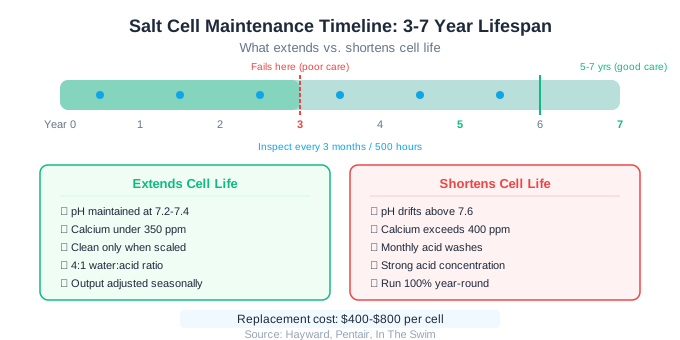
Salt cells typically last 3 to 7 years. The wide range reflects the dramatic impact of water chemistry and maintenance on cell life. A cell in a pool with proper pH control (7.2-7.4), moderate calcium hardness (200-350 ppm), and quarterly inspections will reach the upper end. A cell in a pool where pH runs 7.8+ and calcium exceeds 400 ppm may fail in 2 years or less.
| Factor | Extends Cell Life | Shortens Cell Life |
|---|---|---|
| pH management | Maintained at 7.2-7.4 weekly | Allowed to drift above 7.6 regularly |
| Calcium hardness | Kept at 200-350 ppm | Exceeds 400 ppm |
| Cleaning frequency | Only when scale is visible | Over-cleaned (monthly acid washes strip coating) |
| Acid concentration | 4:1 water to acid ratio | Stronger acid solutions or undiluted acid |
| Cell output setting | Adjusted seasonally (lower in winter) | Run at 100% year-round |
| Salt level | Maintained at 3,200 ppm | Consistently low (cell works harder) |
How Should You Plan for Cell Replacement?
Do not wait for a cell to fail completely. Track the cell installation date and start planning replacement at the 4-year mark. By year 5, have the replacement cell sourced and priced. Some service companies amortize cell replacement into their monthly salt pool fee, adding $10-15 per month to cover the eventual $400-800 replacement. This prevents sticker shock for the customer and guarantees revenue for you.
3-7 Years
Salt cell lifespan range depending on water chemistry and maintenance
What Are the Signs a Salt System Needs Attention?
Between quarterly inspections, watch for warning signs that indicate the salt system is not functioning properly. Catching problems early prevents emergency callbacks and protects the cell from premature failure.
Common Warning Signs and What They Mean
| Warning Sign | Likely Cause | Action |
|---|---|---|
| Low chlorine despite cell running | Scale buildup, low salt, or failing cell | Inspect cell, test salt level, run diagnostic test |
| Check Salt light on | Salt below 2,700 ppm or sensor issue | Test salt with a digital meter. Add salt if low. If salt is correct, clean the sensor. |
| Check Cell light on | Scale detected or cell fault | Remove and inspect cell. Clean if scaled. If clean, may be a cell or board fault. |
| High voltage reading on control board | Scale insulating plates (cell works harder) | Acid wash the cell. If voltage stays high after cleaning, cell is failing. |
| Flow error light | Low water flow through cell | Check pump basket, filter pressure, and cell housing for debris |
| No lights on control panel | Power issue, tripped breaker, or bad board | Check breaker, GFCI, and wiring connections |
Log every warning light, cell cleaning, and salt addition in your service software. When a customer asks why they need a new cell, the service history shows exactly what happened: how many cleanings it needed, when warning lights started appearing, and the declining performance over time. Data builds trust.
How Do You Winterize a Salt Cell?
In regions with freezing winters, the salt cell must be removed or protected during the off-season. Water left inside the cell housing can freeze and crack the housing or damage the plates. Even in mild-winter climates, the cell should not run when water temperature drops below 60 degrees F because most cells are not designed to produce chlorine at low temperatures.
Winterization Procedure
- 1Turn off the salt system at the control panel.
- 2Remove the cell from the plumbing. Inspect and acid wash if scale is present.
- 3Drain all water from the cell housing and the cell itself.
- 4Store the cell indoors in a clean, dry location. Do not leave it outside exposed to freezing temperatures.
- 5Cap or plug the plumbing housing openings to prevent debris from entering.
- 6In spring, reinstall the cell, prime the housing, and do not turn the system on until water temperature reaches 60 degrees F consistently.
In mild climates where pools run year-round, reduce cell output to the minimum setting during cooler months. Chlorine demand drops significantly when the pool is not being used and water temperature is low. Running the cell at 20-30% output in winter instead of 50-70% saves cell life without sacrificing water quality.
Run a pool route?
The business side of what you just read.
Pricing, chemical costs, and the tools owners use to keep the numbers straight.
- Commercial pool service pricing2026 rate tables and the cost-plus formula
- Chemical cost per poolWhat chemicals actually cost per stop
- Chemical tracking softwareLog readings and dosing from the pool deck
- Pool service softwareRoutes, invoicing, and service reports in one app
- Free profit & rate calculatorsProfit per pool, minimum rate, break-even
Frequently Asked Questions
How often should you clean a salt cell?
Inspect the cell every 3 months or 500 operating hours. Only clean (acid wash) when visible scale is present on the plates. Over-cleaning strips the protective coating and shortens cell life. If the cell needs cleaning more often than every 3 months, fix the water chemistry (lower pH, lower calcium hardness, lower TA) to reduce scale formation.
What acid ratio should you use to clean a salt cell?
Use a 4:1 ratio of water to muriatic acid: one gallon of water to one quart of acid. Never use a stronger concentration. Soak the cell for 15 minutes maximum. Rinse thoroughly with a garden hose after cleaning. Do not exceed two soaks per cleaning session.
How do you know when a salt cell needs to be replaced?
A cell needs replacement when it no longer produces adequate chlorine after a thorough acid wash, when the plate coating is visibly stripped (plates appear silver or white instead of dark gray/black), when voltage readings remain high after cleaning, or when the cell requires monthly cleanings to maintain production. Most cells last 3 to 7 years.
How much does a replacement salt cell cost?
Replacement salt cells cost $400 to $800 depending on brand, model, and pool size rating. Hayward TurboCell T-15 (40,000 gallons) runs approximately $550-650. Pentair IntelliChlor IC40 runs approximately $600-750. Generic replacement cells are available for $300-450 but may have shorter lifespans.
Can you clean a salt cell with vinegar instead of muriatic acid?
White vinegar can dissolve light calcium deposits but is much less effective than muriatic acid on heavy scale. A vinegar soak needs 12-24 hours versus 15 minutes for acid. Vinegar is safer to handle but may not fully clean a heavily scaled cell. For professional service, muriatic acid at a 4:1 dilution is the standard.
Does over-cleaning damage a salt cell?
Yes. Every acid wash removes a small amount of the ruthenium or iridium coating on the titanium plates. This coating is what enables electrolysis. Excessive cleaning (more than once per quarter) or using too-strong acid solutions accelerates coating loss and shortens cell life. Only clean when visible scale is present.