Water Features Look Great. They Also Change Everything About Your Chemistry.
Waterfalls, deck jets, bubblers, sheer descents, laminar jets, and spillover fountains add visual appeal and property value to residential pools. They also add persistent pH rise, accelerated chemical consumption, increased equipment wear, algae growth on wet surfaces, and calcium scaling in hard water areas. Every active water feature on a pool introduces aeration that disrupts the carbon dioxide equilibrium in the water, pushing pH upward and requiring more acid to manage.
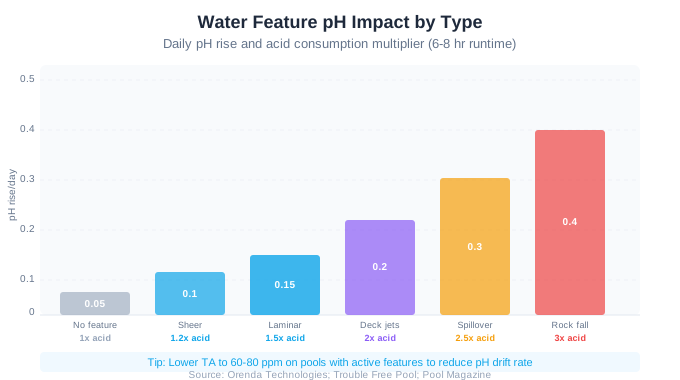
According to Orenda Technologies and Trouble Free Pool, the aeration from water features drives off dissolved CO2, which shifts the carbonate equilibrium and raises pH independently of any other chemistry factor. A pool running a waterfall six to eight hours per day can see pH rise 0.2 to 0.4 units per day, compared to 0.05 to 0.1 for the same pool without the feature running. This is not a small difference. It fundamentally changes your acid budget and service protocol.
This guide covers how water features affect chemistry, the maintenance they require, how to price pools with active features, and how to prevent the most common feature-related problems.
How Do Water Features Affect Pool Chemistry?
The core chemistry issue with every water feature is aeration. When water is exposed to air through splashing, cascading, or jet action, it accelerates the release of dissolved carbon dioxide (CO2) from the water into the atmosphere. CO2 in water forms carbonic acid, which acts as a natural pH suppressor. When that CO2 is driven off, the carbonic acid disappears, and pH rises. This is the same mechanism that causes pH rise in spas with jet action and in salt pools, but water features compound it because they run for extended periods.
pH Rise by Feature Type
| Feature Type | Aeration Level | pH Rise/Day | Acid Impact |
|---|---|---|---|
| Sheer descent | Low | 0.05-0.1 | Minimal increase |
| Laminar jets | Low-moderate | 0.05-0.15 | Minor increase |
| Deck jets | Moderate | 0.1-0.2 | 25-50% more acid |
| Spillover waterfall | High | 0.2-0.3 | 50-100% more acid |
| Rock waterfall | Very high | 0.2-0.4 | 75-150% more acid |
| Multiple features running | Very high | 0.3-0.5+ | 100-200% more acid |
The practical impact is straightforward: pools with active water features need significantly more muriatic acid. A standard 15,000-gallon pool without features might need 8 to 16 ounces of acid per week. The same pool with a rock waterfall running six hours daily could need 20 to 40 ounces per week. That is a 2x to 3x increase in acid consumption that must be reflected in your pricing.
Lowering total alkalinity to 60 to 80 ppm on pools with active water features reduces the rate of pH rise. Lower TA means less buffering capacity, which means pH climbs more slowly and requires less acid to correct. This is the same strategy used for salt pools.
What Maintenance Do Water Features Require?
Beyond chemistry management, water features require physical maintenance that does not apply to a standard pool. Moving water creates conditions for algae growth on wet surfaces, calcium deposits on feature faces, debris accumulation in jets and nozzles, and pump wear from extended run times.
Feature Maintenance Checklist
| Task | Frequency | Time | Notes |
|---|---|---|---|
| Inspect nozzles/jets for clogs | Weekly | 2-3 min | Debris and calcium block flow |
| Brush waterfall face | Bi-weekly | 5-10 min | Algae grows on wet rock/tile |
| Clean deck jet covers | Monthly | 3-5 min | Remove calcium and debris |
| Inspect feature plumbing valves | Monthly | 2-3 min | Check for leaks at joints |
| Acid wash calcium from feature face | Quarterly | 15-30 min | Especially in hard water areas |
| Check feature pump operation | Weekly | 1-2 min | Listen for bearing noise, check flow |
| Clean auto-fill float/valve | Monthly | 2-3 min | Features increase evaporation |
Rock waterfalls are the most maintenance-intensive feature. The natural stone surface is porous, traps moisture, and provides an ideal substrate for algae growth. In warm climates, a rock waterfall that is not brushed regularly will develop visible green algae within two to three weeks. The homeowner sees the green waterfall before they notice anything else about the pool, so this is a customer satisfaction issue as much as a chemistry issue.
How Should You Price Pools with Water Features?
Water features add service time (inspection, brushing, cleaning) and chemical cost (additional acid). Both need to be reflected in your pricing. The premium varies by feature type, complexity, and how many hours per day the features run.
| Feature Scenario | Monthly Premium | Justification |
|---|---|---|
| Single sheer descent or laminar jets | +$10-15/mo | Minor additional acid, minimal maintenance |
| Deck jets (4-8 jets) | +$15-25/mo | Moderate acid increase, monthly jet cleaning |
| Spillover waterfall | +$20-35/mo | Significant acid increase, bi-weekly brushing |
| Rock waterfall | +$30-50/mo | High acid demand, regular algae brushing, calcium removal |
| Multiple features combined | +$40-65/mo | Compound pH effect, extended maintenance time |
For a pool with a rock waterfall and deck jets, you are looking at $45 to $75 per month in additional service premium. On a base rate of $150, that brings the total to $195 to $225 per month. The customer is paying for the aesthetic they wanted when they built the features, and you are covering the real cost of maintaining them properly.
When quoting a new customer with water features, ask how many hours per day the features run. A waterfall that runs two hours per day has one-third the chemistry impact of one that runs six hours. Adjust your quote accordingly and document the assumed run time in the service agreement.
What Are the Common Water Feature Problems?
Water features introduce failure modes that do not exist on standard pools. Knowing these problems and their symptoms helps you diagnose issues quickly and propose solutions before the customer calls with a complaint.
Feature Problem Diagnosis Guide
| Symptom | Likely Cause | Fix |
|---|---|---|
| Reduced flow from waterfall | Clogged valve, debris in line, pump impeller wear | Inspect valve, flush line, check pump |
| White deposits on feature face | Calcium carbonate from high CH and high pH | Acid wash feature, lower CH target to 250 ppm |
| Green algae on rock waterfall | Insufficient brushing, low FC on feature surface | Brush bi-weekly, apply algaecide directly to rock |
| Deck jets spraying unevenly | Debris in jet nozzle, calcium buildup | Remove and clean nozzle assembly |
| Constant pH rise despite acid | Feature running too many hours, TA too high | Reduce run time, lower TA to 60-80 ppm |
| Excessive water loss | Wind carrying spray outside pool, splash-out | Adjust jet angle, reduce feature pressure |
Excessive water loss from water features is a common customer complaint. Wind catches spray from deck jets, waterfalls, and bubblers and carries water outside the pool shell. A pool with active features can lose 50% more water to evaporation and splash-out than the same pool without features. This increases the auto-fill running time, dilutes chemicals faster, and raises the water bill. Adjusting feature pressure and run times is the first step, but some installations simply lose water by design.
How Do Water Features Affect Equipment Life?
Water features add run time to pumps, increase load on heaters (heated features lose heat rapidly through aeration), and accelerate wear on valves and actuators that control feature operation. The equipment implications are not dramatic on a per-visit basis, but over three to five years, they add up to earlier replacement cycles and more repair calls.
- Feature pumps run 6 to 12 hours daily, accumulating 2,000 to 4,000 operating hours per year versus 1,500 to 2,500 for circulation-only pumps
- Actuator valves that switch between pool and feature modes cycle hundreds of times per year, wearing gears and seals faster
- Heaters work harder when features aerate the water, losing heat through evaporative cooling at the waterfall or fountain surface
- Auto-fill systems run more frequently due to increased evaporation, wearing float valves and solenoids faster
- Check valves on feature lines handle higher pressure differentials and fail more frequently than standard return line check valves
Track feature pump hours and actuator cycles in your service notes. Proactively recommending pump bearing replacement, actuator service, or check valve replacement before failure positions you as a preventive maintenance expert rather than a reactive repair technician. This is particularly valuable on high-end homes where the homeowner expects problems to be anticipated, not discovered after something breaks.
Run a pool route?
The business side of what you just read.
Pricing, chemical costs, and the tools owners use to keep the numbers straight.
- Commercial pool service pricing2026 rate tables and the cost-plus formula
- Chemical cost per poolWhat chemicals actually cost per stop
- Chemical tracking softwareLog readings and dosing from the pool deck
- Pool service softwareRoutes, invoicing, and service reports in one app
- Free profit & rate calculatorsProfit per pool, minimum rate, break-even
Frequently Asked Questions
Do water features raise pool pH?
Yes. All water features raise pH through aeration, which drives dissolved CO2 out of the pool water. Without CO2, the carbonic acid that naturally suppresses pH disappears, and pH climbs. The degree of pH rise depends on the feature type and run time. A rock waterfall running six hours daily can raise pH 0.2 to 0.4 units per day, requiring 2x to 3x more muriatic acid than a pool without features.
How much more should I charge for pools with water features?
The premium depends on the feature type and complexity. Simple features like sheer descents add $10 to $15 per month. Rock waterfalls add $30 to $50 per month. Pools with multiple features can justify a $40 to $65 monthly premium. The premium covers increased acid consumption (50-200% more), additional service time for feature inspection and cleaning (5-15 minutes per visit), and quarterly calcium removal.
How do I prevent algae on a rock waterfall?
Brush the rock surface every two weeks with a stiff nylon brush to remove algae before it becomes visible. Apply a copper-based algaecide directly to the rock surface quarterly. Ensure the waterfall area receives adequate chlorine circulation when the feature is off. If the waterfall has its own pump on a separate circuit, consider running the main pool pump briefly after the waterfall shuts off to circulate chlorinated water through the feature plumbing.
Should I lower total alkalinity on pools with water features?
Yes. Lowering TA to 60 to 80 ppm (versus the standard 80 to 120 ppm) reduces the rate of pH rise from aeration. Lower TA means less buffering capacity, so pH climbs more slowly and requires less acid to correct. This is the same strategy used for salt pools, which also experience persistent pH rise from their electrolysis process.
Why is my pool losing so much water with the waterfall running?
Water features increase water loss through two mechanisms: evaporative cooling (aerated water evaporates faster than still water) and splash-out (wind catches spray and carries water outside the pool). A pool with active features can lose 50% or more water compared to the same pool without features. Reduce feature pressure, adjust spray angles to minimize wind catch, and limit run times during windy conditions.