Your Test Method Determines the Quality of Every Decision You Make
Every chemical adjustment you make on a pool service route starts with a test result. If the result is inaccurate, the adjustment is wrong, and you either waste product, create a new problem, or generate a callback. The testing method you use directly determines the quality of every chemical decision across your entire route. Cheap methods save time per stop but cost you in misdiagnosed problems. Professional methods take 60 seconds longer but catch issues that strips miss.
Corey Adams, Pool Founder co-founder and 15-year pool service veteran, standardized his company on FAS-DPD testing years ago. "When I switched from strips to the Taylor K-2006, my chemical spend went down because I stopped overcorrecting. The callbacks went down because I was catching combined chlorine and CYA problems that strips were not showing me. The 60 extra seconds per pool pays for itself ten times over."
This analysis compares OTO kits, test strips, DPD reagent kits, FAS-DPD titration, and digital colorimeters across accuracy, cost, speed, and suitability for professional pool service.
What Are the Five Main Pool Water Testing Methods?
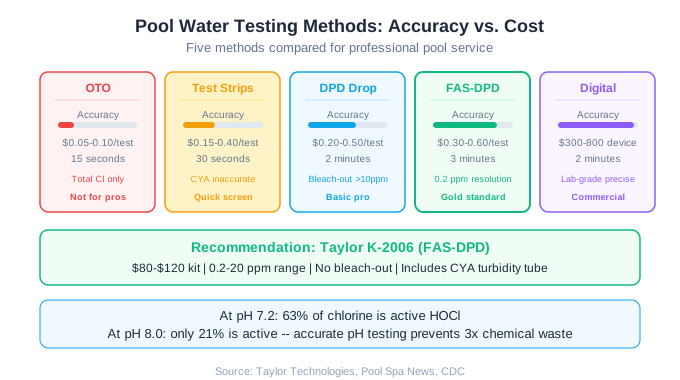
Pool water testing methods range from basic color-match indicators to laboratory-grade instruments. Each method trades off accuracy, speed, and cost differently. The right choice depends on your service model, pool count, and whether you service commercial accounts with health department compliance requirements.
| Method | Measures FC/CC? | Accuracy | Cost per Test | Time per Test | Best For |
|---|---|---|---|---|---|
| OTO (yellow reagent) | Total chlorine only | Low | $0.05-0.10 | 15 seconds | Not recommended for pros |
| Test strips | Some: FC + TC strips available | Low-moderate | $0.15-0.40 | 30 seconds | Quick homeowner screening |
| DPD drop test | Yes (FC + TC by subtraction) | Moderate | $0.20-0.50 | 2 minutes | Basic professional testing |
| FAS-DPD titration | Yes (FC + CC direct, 0.2 ppm resolution) | High | $0.30-0.60 | 3 minutes | Professional route service |
| Digital colorimeter | Yes (FC + TC digital readout) | Very high | $0.15-0.30 (reagent cost) | 2 minutes | Commercial compliance |
0.2 ppm
FAS-DPD resolution for combined chlorine, the minimum needed for professional chloramine management
Why Is OTO Testing Insufficient for Professional Service?
OTO (orthotolidine) is the yellow-reagent test that has been around for decades. You add drops to a water sample and match the yellow color to a chart. OTO measures total chlorine only. It cannot distinguish between free chlorine and combined chlorine. This means you cannot detect chloramine problems, calculate breakpoint doses, or verify that your sanitizer is actually active.
What Are the Specific Limitations of OTO?
- Measures total chlorine only, not free or combined chlorine separately
- Color matching is subjective and affected by lighting, sample turbidity, and human perception
- Cannot detect chloramine issues that cause customer complaints (smell, eye irritation)
- Resolution is poor: hard to distinguish between 1 ppm and 2 ppm by color alone
- Most health departments do not accept OTO results for commercial pool compliance
- OTO reagent itself is a known carcinogen (orthotolidine) and has been banned in some jurisdictions
If you are still using OTO kits on your route, upgrading to DPD or FAS-DPD is the single highest-impact change you can make for service quality. OTO cannot tell you the one thing that matters most: how much active, free chlorine is actually available to sanitize the pool.
Are Test Strips Accurate Enough for Pool Service Professionals?
Test strips have improved significantly over the past decade. Modern strips from brands like AquaChek and LaMotte can measure FC, TC, pH, alkalinity, and CYA on a single strip. Some manufacturers claim accuracy comparable to liquid reagent kits. However, the practical accuracy in the field is limited by several factors.
What Are the Pros and Cons of Test Strips?
| Pros | Cons |
|---|---|
| Fastest method: dip and read in 15-30 seconds | Wide color bands make precise readings difficult |
| Multi-parameter strips test 5-7 factors at once | CYA readings on strips are notoriously inaccurate (only useful for rough estimates) |
| No liquid reagents to spill on the truck | FC/TC differentiation is imprecise, making CC calculation unreliable |
| Cheapest per-test cost for multi-parameter | Accuracy degrades when strips are expired, stored in heat, or exposed to moisture |
| Good for quick screening on low-risk residential pools | Not accepted for health department compliance testing |
The biggest problem with strips for professionals is the CYA test. Strips typically show CYA ranges of 0, 30-50, 100-150, or 200+. That is far too imprecise for CYA management, where the difference between 40 ppm and 80 ppm changes your entire chlorine strategy. The turbidity tube method (included in the Taylor K-2006) is the only reliable field method for CYA.
How Does DPD Testing Work and When Should You Use It?
DPD (N,N-diethyl-p-phenylenediamine) testing uses a two-step color comparison to measure both free and total chlorine. DPD-1 reagent reacts with free chlorine to produce a pink color. The intensity of the pink is compared to a color chart to determine the FC level. DPD-3 reagent is then added to the same sample, reacting with combined chlorine to produce additional pink. The second reading gives total chlorine. Subtracting FC from TC gives combined chlorine.
What Is the Bleach-Out Problem with DPD?
DPD drop testing has a critical limitation at high chlorine levels. When FC exceeds approximately 10 ppm, the sample can "bleach out," turning clear instead of pink. This makes a highly chlorinated pool look like it has zero chlorine. Techs who do not know about bleach-out can add massive amounts of unnecessary chlorine to a pool that is already over-chlorinated. The FAS-DPD method eliminates this problem by measuring up to 20 ppm without bleaching.
If you use DPD drop tests and get a zero reading right after shocking, be suspicious. Dilute the sample 1:1 with distilled water and retest. If you get a reading on the diluted sample, you have bleach-out. Multiply the result by 2 for the actual level.
Why Is FAS-DPD the Gold Standard for Pool Service Routes?
FAS-DPD titration, found in the Taylor K-2006 kit, is the professional standard for pool water testing. Instead of matching colors to a chart, you add FAS (ferrous ammonium sulfate) solution drop by drop until the pink color disappears. Each drop equals 0.2 ppm. This eliminates the subjectivity of color matching and provides accurate results from 0.2 ppm to 20 ppm. It measures both free and combined chlorine directly.
What Makes FAS-DPD Better Than Standard DPD?
- Measures FC from 0.2 to 20 ppm vs DPD drop test limit of 5 ppm
- No bleach-out problem at high chlorine levels
- 0.2 ppm resolution for combined chlorine, critical for chloramine management
- No color matching required. The endpoint is clear: the pink disappears.
- Includes CYA turbidity tube test, the most accurate field method for cyanuric acid
- Tests pH, alkalinity, calcium hardness, and acid demand in the same kit
| Parameter | FAS-DPD (Taylor K-2006) | DPD Drop Test | Test Strips |
|---|---|---|---|
| Free chlorine range | 0.2-20 ppm | 0-5 ppm | 0-10 ppm (approximate) |
| Combined chlorine | Direct measurement, 0.2 ppm steps | By subtraction | Imprecise |
| CYA | Turbidity tube (accurate to 10 ppm) | Not included | Wide ranges only |
| Calcium hardness | Drop count titration | Some kits include | Not on most strips |
| Kit cost | $80-120 | $25-40 | $15-25 for 100 strips |
| Reagent refill cost | $40-60 annually | $15-25 annually | $15-25 per 100 strips |
At approximately $0.40 per test for reagent cost, the Taylor K-2006 pays for itself after catching a single problem that strips would have missed. One prevented algae callback saves $50-150 in chemicals and labor.
When Should You Use a Digital Colorimeter or Photometer?
Digital colorimeters and photometers use light absorption to measure chemical concentrations with laboratory-grade accuracy. A reagent is added to the water sample, and the device measures the color intensity electronically rather than relying on human eyes. Popular models for pool service include the LaMotte ColorQ Pro, Hach Pocket Colorimeter, and Taylor TTi Series.
What Are the Advantages of Digital Testing?
- Eliminates human error in color matching entirely
- Provides precise numerical readouts (e.g., 2.4 ppm, not "between 2 and 3")
- Accepted by health departments for commercial pool compliance reporting
- Some models store results digitally for record-keeping
- Faster than titration methods once calibrated
What Are the Drawbacks?
- High upfront cost: $300-800 for professional-grade photometers
- Requires regular calibration to maintain accuracy
- Still needs chemical reagent tablets or solutions for each test
- Battery dependent. A dead photometer in the field means no testing.
- Not as rugged as a drop-count kit for daily truck use
Digital photometers make the most sense for companies servicing commercial or public pools where health department compliance requires documented, defensible test results. For residential-only routes, the Taylor K-2006 FAS-DPD kit delivers comparable accuracy at a fraction of the cost.
Corey uses the Taylor K-2006 on residential routes and a LaMotte photometer for commercial accounts. "The photometer prints a time-stamped result I can file for the health department. On residential, the Taylor kit is faster and I do not have to worry about calibration or batteries."
Run a pool route?
The business side of what you just read.
Pricing, chemical costs, and the tools owners use to keep the numbers straight.
- Commercial pool service pricing2026 rate tables and the cost-plus formula
- Chemical cost per poolWhat chemicals actually cost per stop
- Chemical tracking softwareLog readings and dosing from the pool deck
- Pool service softwareRoutes, invoicing, and service reports in one app
- Free profit & rate calculatorsProfit per pool, minimum rate, break-even
Frequently Asked Questions
What is the most accurate pool water test method?
Digital photometers and colorimeters are the most accurate, eliminating human color perception error entirely. For field use without electronic equipment, FAS-DPD titration (Taylor K-2006) is the gold standard. It measures free chlorine from 0.2 to 20 ppm with no bleach-out risk and provides 0.2 ppm resolution for combined chlorine.
Are pool test strips accurate enough for professionals?
Test strips are acceptable for quick screening on low-risk residential pools, but they lack the precision needed for professional chemistry management. Strip CYA readings are particularly unreliable, showing broad ranges instead of specific values. For combined chlorine detection, breakpoint calculation, and health department compliance, reagent-based testing is required.
What is the DPD bleach-out problem?
When free chlorine exceeds approximately 10 ppm, DPD reagent can bleach out, causing the sample to turn clear instead of pink. This makes a heavily chlorinated pool appear to have zero chlorine, leading techs to add even more. FAS-DPD titration is immune to this problem and measures accurately up to 20 ppm.
How much does a professional pool test kit cost?
The Taylor K-2006 FAS-DPD kit costs $80 to $120 with annual reagent refills running $40 to $60. A digital colorimeter costs $300 to $800 upfront with ongoing reagent costs of $0.15 to $0.30 per test. Test strips cost $15 to $25 per 100. The Taylor K-2006 is the best value for most pool service routes.
Can I use an OTO test kit for commercial pools?
No. Most health departments do not accept OTO results for commercial pool compliance because OTO only measures total chlorine and cannot differentiate free from combined chlorine. Commercial pools require DPD or FAS-DPD testing at minimum, and many jurisdictions prefer digital photometer results for documentation purposes.
How often should I replace my test kit reagents?
Replace liquid reagents annually or when they change color, become cloudy, or produce inconsistent results. DPD reagents are particularly sensitive to heat and light. Store the kit in a cool, dark place on the truck, not in direct sunlight. Expired reagents give false readings that lead to incorrect chemical adjustments.
Sources & References
- Taylor Technologies: Testing Choices for Watershapers
- Taylor Technologies: How FAS-DPD Tests for Free and Combined Chlorine
- Pool Spa News: Methods and Limitations of Routine Pool Water Testing
- Test Your Own Pool: OTO, DPD, and FAS-DPD Chlorine Tests Explained
- CDC: Healthy Swimming Water Testing Guidelines