That "Chlorine Smell" at the Pool? It Is Not Chlorine. It Is Chloramines.
When a customer complains about the strong chlorine smell at their pool, the instinct is to think there is too much chlorine. The opposite is true. That smell is chloramines, a byproduct that forms when free chlorine reacts with nitrogen-based contaminants like sweat, urine, and body oils. Chloramines are the primary cause of red eyes, skin irritation, and respiratory complaints at pools. They provide almost no sanitizing power. It takes 25 parts of combined chlorine to do the disinfection work of 1 part of free chlorine.
Corey Adams, Pool Founder co-founder and 15-year pool service veteran, deals with chloramine callbacks regularly. "When I get a call about a pool that smells like chlorine, the first thing I do is test combined chlorine. Nine times out of ten, it is above 0.5 ppm and the free chlorine is low. The pool does not need less chlorine. It needs a breakpoint shock to destroy the chloramines and restore actual sanitizing power."
This guide covers the chemistry, math, and field procedures for managing combined chlorine on a professional pool service route. If you understand free chlorine and basic water balance, you are ready for this material.
What Is the Difference Between Free, Combined, and Total Chlorine?
Free chlorine (FC) is the active, unused chlorine available to sanitize pool water. Combined chlorine (CC) is chlorine that has already reacted with nitrogen compounds and is no longer effective. Total chlorine (TC) is the sum of both. The formula is simple: Total Chlorine - Free Chlorine = Combined Chlorine. When TC and FC are equal, combined chlorine is zero, and the water is properly sanitized.
What Is Free Chlorine and Why Does It Matter?
Free chlorine exists in two forms in pool water: hypochlorous acid (HOCl) and hypochlorite ion (OCl-). Hypochlorous acid is the active sanitizer that kills bacteria, viruses, and algae. The ratio between HOCl and OCl- depends on pH, which is why pH control matters so much. At pH 7.2, about 65% of free chlorine is in the HOCl form. At pH 8.0, only about 22% is active HOCl. The CDC recommends maintaining free chlorine at 1-3 ppm for residential pools.
What Is Combined Chlorine and How Does It Form?
Combined chlorine forms when hypochlorous acid reacts with ammonia and nitrogen compounds introduced by swimmers and the environment. These reactions produce three types of chloramines in sequence. Monochloramine (NH2Cl) forms first and has weak sanitizing ability. Dichloramine (NHCl2) forms next and causes the characteristic "pool smell." Trichloramine (NCl3), also called nitrogen trichloride, is the most volatile. It off-gasses into the air above the water and is responsible for the eye and respiratory irritation associated with poorly maintained pools.
| Chlorine Type | What It Is | Ideal Level | Test Method |
|---|---|---|---|
| Free Chlorine (FC) | Active, ready-to-sanitize chlorine | 2-4 ppm | DPD-1 reagent |
| Combined Chlorine (CC) | Spent chlorine bound to contaminants | 0 ppm (under 0.2 ppm) | TC minus FC |
| Total Chlorine (TC) | FC + CC combined | Same as FC when CC is 0 | DPD-3 reagent |
Most health departments set the maximum allowable combined chlorine at 0.2-0.4 ppm. The MAHC (Model Aquatic Health Code) recommends action when CC exceeds 0.4 ppm. New Jersey and Pennsylvania use the stricter 0.2 ppm limit. If you service commercial or public pools, know your jurisdiction.
What Causes Chloramines to Form in Pool Water?
Chloramines form whenever free chlorine encounters nitrogen-based contaminants. The biggest sources are sweat, urine, body oils, and cosmetics introduced by swimmers. A single swimmer introduces an average of 50 mL of urine and 200-1,000 mL of sweat per hour of swimming, according to research published in Environmental Science and Technology. Each of these fluids is loaded with ammonia and urea that react rapidly with HOCl to create chloramines.
Why Do Some Pools Have Worse Chloramine Problems Than Others?
Three factors drive chloramine severity: bather load, chlorine management, and water replacement rate. High-traffic pools, especially commercial and HOA community pools, produce more nitrogen compounds per day. Pools that run low free chlorine cannot oxidize contaminants fast enough, allowing chloramines to accumulate. And pools with minimal water replacement (no splash-out, no backwashing, no dilution) concentrate chloramines over time.
- High bather load relative to pool volume (party pools, swim lessons, lap pools)
- Inadequate free chlorine residual (running below 2 ppm in residential, below 3 ppm in commercial)
- Poor pH control (high pH reduces HOCl percentage, slowing oxidation of nitrogen compounds)
- Infrequent shocking or breakpoint chlorination
- Minimal water dilution from splash-out, backwash, or rain
- Indoor pools with poor air circulation (trichloramine cannot off-gas and accumulates)
Can Chloraminated Tap Water Cause Combined Chlorine in Pools?
Yes. Many municipal water systems use monochloramine as a disinfectant instead of free chlorine. When you fill or top off a pool with chloraminated tap water, you are adding combined chlorine directly. A pool filled with chloraminated city water can start with 1-4 ppm combined chlorine before any swimmers enter. This is a common and overlooked cause of persistent combined chlorine readings, especially after a drain and refill. The PHTA has published a fact sheet specifically addressing chloraminated fill water and recommends testing source water before filling.
Corey has seen this catch techs off guard. "We had a customer in a city that switched to chloramines in their tap water. Every time we refilled that pool, we got 2 ppm combined chlorine immediately. We had to do a breakpoint shock after every fill until we figured out it was the source water, not the pool."
How Does Breakpoint Chlorination Work? The Math You Need to Know
Breakpoint chlorination is the process of adding enough free chlorine to completely oxidize all chloramines in the water. The standard formula is: Chlorine Needed = (Combined Chlorine x 10) - Current Free Chlorine. You must raise the free chlorine to 10 times the current combined chlorine level and hold it there until the reaction completes. This is the only reliable chemical method for eliminating chloramines from pool water.
How Do You Calculate the Breakpoint Chlorination Dose?
Start by testing both free chlorine and total chlorine. Subtract FC from TC to get combined chlorine. Multiply combined chlorine by 10, then subtract your current free chlorine. The result is how many ppm of additional chlorine you need to add. For example: if FC is 2 ppm, TC is 3 ppm, then CC is 1 ppm. You need (1 x 10) - 2 = 8 ppm of additional chlorine to reach breakpoint.
| Combined Chlorine (CC) | Target FC (10x CC) | Current FC | Additional Chlorine Needed |
|---|---|---|---|
| 0.5 ppm | 5 ppm | 2 ppm | 3 ppm |
| 1.0 ppm | 10 ppm | 2 ppm | 8 ppm |
| 1.5 ppm | 15 ppm | 3 ppm | 12 ppm |
| 2.0 ppm | 20 ppm | 2 ppm | 18 ppm |
What Are the Four Zones of the Breakpoint Curve?
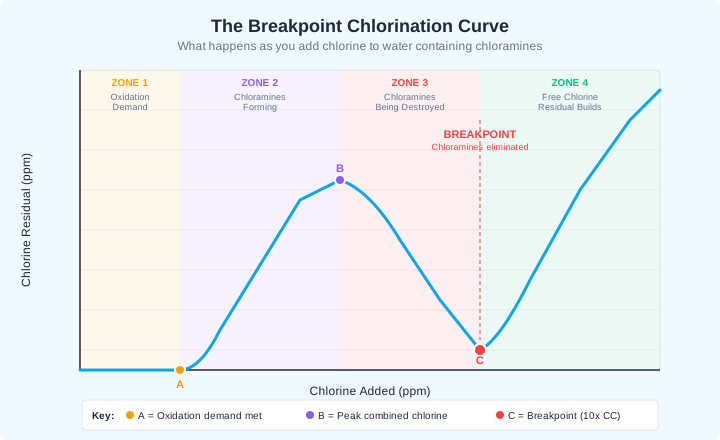
The breakpoint chlorination curve has four distinct zones. Zone 1 is the initial oxidation demand, where chlorine reacts with metals (iron, manganese) and organic matter before any residual appears. Zone 2 is the chloramine formation zone, where free chlorine reacts with ammonia to form monochloramine and dichloramine, and the measured residual rises. Zone 3 is the destruction zone, where continued chlorine addition begins oxidizing the very chloramines it created, and the residual drops. Zone 4 is the free chlorine zone, after the breakpoint, where all chloramines have been destroyed and additional chlorine builds a true free chlorine residual.
The most common mistake is not adding enough chlorine. If you undershoot the breakpoint, you end up in Zone 2 or 3, which can actually increase combined chlorine temporarily. This is why a partial shock often makes things worse. Either hit the full 10x target or do not shock at all.
When and How to Superchlorinate a Pool
Superchlorination (shocking to breakpoint) should be performed whenever combined chlorine exceeds 0.2 ppm on a residential pool or 0.4 ppm on a commercial pool, per MAHC guidelines. The process requires lowering pH to 7.2 or below first, adding enough chlorine to reach 10 times the combined chlorine level, and holding that level for at least 4 hours with the pump running. Swimmers cannot enter until free chlorine drops to 5 ppm or below.
What Is the Step-by-Step Process for Breakpoint Chlorination?
- 1Test free chlorine and total chlorine using a DPD or FAS-DPD test kit. Calculate combined chlorine (TC - FC).
- 2Lower pH to 7.2 or below using muriatic acid. Lower pH increases the percentage of active HOCl, making the shock more effective.
- 3Calculate the chlorine dose: (CC x 10) - current FC = additional chlorine needed in ppm.
- 4Convert ppm to ounces of product. For liquid chlorine (12.5% sodium hypochlorite): multiply ppm needed x pool gallons / 10,000 x 10 oz.
- 5Add the full calculated dose to the pool with the pump running. Distribute evenly around the pool.
- 6Keep the pump running for at least 4 hours to ensure complete circulation and reaction.
- 7Retest free and combined chlorine after 4-8 hours. If CC is still above 0.2 ppm, repeat the process.
- 8Do not allow swimmers until FC drops to 5 ppm or below.
Does Cyanuric Acid Affect Breakpoint Chlorination?
Yes. Cyanuric acid (CYA) reduces the effectiveness of chlorine by binding a portion of free chlorine into a less active form. In a stabilized pool, you may need to increase your shock dosage to compensate. A common rule of thumb is to increase the percentage by the CYA reading. If CYA is 50 ppm, increase your shock dose by 50%. This is another reason to keep CYA under 50 ppm in residential pools, because high CYA makes breakpoint chlorination significantly more expensive and less effective.
Always superchlorinate after the pool is closed to swimmers. For residential service routes, schedule breakpoint shocks for the end of the day so the pool has overnight to react and the chlorine level can drop before the next day. Corey schedules all shock treatments for the last stop of the day on that route.
How to Test for Combined Chlorine: DPD and FAS-DPD Methods
The gold standard for measuring combined chlorine in pool water is the FAS-DPD titration method, most commonly found in the Taylor K-2006 test kit. This method can measure free and combined chlorine as low as 0.2 ppm and as high as 20 ppm with professional-grade accuracy. Basic test strips and OTO (orthotolidine) test kits only measure total chlorine and cannot differentiate between free and combined chlorine, making them insufficient for chloramine diagnosis.
How Does the FAS-DPD Test Work?
The FAS-DPD method uses two separate reactions to measure free and total chlorine independently. First, DPD-1 indicator powder is added to a water sample and reacts with free chlorine to produce a pink color. FAS (ferrous ammonium sulfate) reagent is then added drop by drop until the pink disappears. Each drop represents 0.2 ppm of free chlorine. Then DPD-3 powder is added to the same sample, which reacts with combined chlorine to bring the pink color back. FAS drops are added again until the pink disappears. The second drop count gives you combined chlorine.
| Test Method | Measures CC? | Accuracy | Best For |
|---|---|---|---|
| FAS-DPD (Taylor K-2006) | Yes (0.2 ppm resolution) | Professional grade | Route service, commercial pools |
| DPD colorimetric | Yes (by subtraction) | Good (color matching) | Quick field checks |
| Digital photometer | Yes (FC + TC readouts) | High (no color matching) | Commercial compliance testing |
| Test strips | Some (FC + TC strips) | Low (wide range) | Homeowner screening only |
| OTO (yellow reagent) | No (total only) | Low | Not recommended |
How Often Should You Test for Combined Chlorine?
Test combined chlorine on every service visit for commercial and public pools. For residential pools, test at minimum every 2 weeks and always when a customer complains about smell, eye irritation, or cloudy water. Test after every breakpoint shock to confirm chloramines have been eliminated. On high-traffic residential pools (party houses, swim teams), test weekly.
"I test combined chlorine on every single stop," Corey says. "It takes 30 extra seconds with the Taylor kit, and it is the one reading that tells me more about the pool's real condition than anything else. If combined chlorine is zero, I know my chlorine program is working. If it is above 0.3, I know I need to either shock or figure out what changed."
Health Effects of Chloramines: What Your Customers Need to Hear
Chloramines cause the symptoms that swimmers commonly blame on "too much chlorine." The CDC confirms that chloramines, not free chlorine, are responsible for eye irritation, skin rash, and the strong chemical smell at pools. A study published in PubMed documented an outbreak at an indoor pool where 84% of exposed individuals reported coughing, 78% reported eye irritation, and 34% developed a rash, all traced to elevated chloramine levels.
What Are the Three Types of Chloramines and Their Health Effects?
Monochloramine stays dissolved in water and causes mild eye and skin irritation on direct contact. Dichloramine is more irritating and contributes to the "pool smell" that most people associate with chlorine. Trichloramine (nitrogen trichloride) is the most dangerous. It is highly volatile, meaning it leaves the water and enters the air. The World Health Organization recommends that trichloramine concentration in indoor pool air stay below 0.5 mg/m3. Trichloramine exposure is linked to respiratory distress, coughing, and exacerbation of asthma, particularly in lifeguards and swim instructors with chronic exposure.
| Chloramine Type | Where It Exists | Primary Symptom | Volatility |
|---|---|---|---|
| Monochloramine (NH2Cl) | Dissolved in water | Mild eye/skin irritation | Low |
| Dichloramine (NHCl2) | Water and air interface | "Pool smell," stronger irritation | Moderate |
| Trichloramine (NCl3) | Primarily in the air | Coughing, respiratory distress | High |
How Should You Explain Chloramines to Customers?
When a customer calls about the "chlorine smell" or eye irritation, do not just shock the pool without explaining why. Tell them the smell means the pool needs more chlorine, not less. Explain that chloramines are the chemical byproduct that forms when chlorine does its job against sweat and body oils, and that a breakpoint shock will destroy them. This is a chance to demonstrate expertise and build trust. Customers who understand the chemistry become better customers because they stop resisting when you recommend a shock treatment.
For indoor pool service accounts, chloramine management is critical for staff health. Lifeguards and swim instructors with daily exposure to trichloramine in the air above indoor pools have documented higher rates of respiratory symptoms. If you service indoor pools, test combined chlorine twice weekly and ensure the HVAC system provides adequate fresh air exchange.
Beyond Shocking: Other Methods to Reduce Chloramines
Breakpoint chlorination is the most common and cost-effective method for eliminating chloramines on residential pool routes. But it is not the only tool available, especially for commercial accounts with persistent chloramine problems. UV systems, ozone generators, and advanced oxidation process (AOP) systems can significantly reduce chloramine formation and provide ongoing control between shock treatments.
How Do UV and Ozone Systems Help with Chloramines?
Medium-pressure UV systems destroy monochloramine and dichloramine as water passes through the UV chamber. They are point-of-contact systems, meaning they treat water as it circulates through the plumbing, but they do not add a residual to the pool itself. Ozone systems oxidize ammonia and urea, the precursors to chloramines, before they can react with chlorine. Ozone can maintain combined chlorine at or below 0.2 ppm when properly sized for the pool volume and bather load.
What About Non-Chlorine Shock (MPS)?
Potassium monopersulfate (MPS), sold as "non-chlorine shock" or "oxidizer," can oxidize some organic contaminants but does not achieve true breakpoint chlorination. MPS does not destroy chloramines the way free chlorine does. It is useful as a supplemental oxidizer between breakpoint shocks, but it is not a replacement. One important note: MPS interferes with DPD test results, causing false high readings for combined chlorine for 24-48 hours after application. If you use MPS, wait at least 24 hours before testing combined chlorine.
- UV systems: Destroy mono- and dichloramine on contact. Best for commercial and indoor pools. Require proper sizing for flow rate.
- Ozone: Oxidizes chloramine precursors (ammonia, urea). Can hold CC below 0.2 ppm. More common in commercial installations.
- AOP (Advanced Oxidation Process): Combines UV and ozone or hydrogen peroxide for maximum chloramine control. Highest upfront cost.
- Non-chlorine shock (MPS): Supplemental oxidizer only. Does not achieve breakpoint. Interferes with DPD tests for 24-48 hours.
- Fresh water dilution: Partially draining and refilling dilutes chloramines along with everything else. Useful when shocking alone is insufficient.
For residential route service, breakpoint chlorination is still the most practical tool. UV and ozone systems make sense for commercial accounts, indoor pools, and high-traffic residential pools where chloramines are a recurring problem despite regular shocking.
Managing Combined Chlorine Across Your Pool Service Route
Chloramine management at scale requires a system. When you service 50-100+ pools per week, you cannot rely on reacting to complaints. You need to proactively track combined chlorine, identify problem pools before customers call, and schedule breakpoint shocks as part of your regular maintenance cycle rather than as emergency callbacks.
How Do You Build a Combined Chlorine Monitoring System?
- 1Test and log combined chlorine on every service visit using the FAS-DPD method.
- 2Flag any pool with CC above 0.2 ppm for a breakpoint shock within 7 days.
- 3Identify chronic offenders, pools that consistently show elevated CC. Investigate root cause (bather load, low FC, chloraminated fill water, inadequate circulation).
- 4Schedule proactive breakpoint shocks every 4-6 weeks on high-traffic pools and monthly on standard residential pools during swim season.
- 5After each shock, retest CC within 24 hours to confirm it dropped to 0 ppm.
What Should Combined Chlorine Thresholds Look Like?
| CC Reading | Status | Action Required |
|---|---|---|
| 0 ppm | Ideal | No action. Chlorine program is working. |
| 0.1-0.2 ppm | Acceptable | Monitor. May self-correct with normal chlorine dosing. |
| 0.3-0.4 ppm | Elevated | Schedule breakpoint shock within 7 days. |
| 0.5+ ppm | High | Breakpoint shock on this visit or next. Investigate cause. |
| 1.0+ ppm | Critical | Immediate breakpoint shock. Check for ongoing contamination source. |
Logging combined chlorine readings in your service software creates a history you can use to spot patterns. If the same five pools show elevated CC every month, those pools need a change in their chlorine program, not just more shocking. Maybe they need higher FC targets, a mid-week tablet to maintain residual, or a conversation with the homeowner about pre-swim showering.
Pool Founder logs combined chlorine alongside free chlorine on every service report. When CC trends upward across multiple visits, the system flags it so you can address the root cause instead of chasing callbacks. Tracking chemistry data across your whole route turns reactive service into proactive management.
Run a pool route?
The business side of what you just read.
Pricing, chemical costs, and the tools owners use to keep the numbers straight.
- Commercial pool service pricing2026 rate tables and the cost-plus formula
- Chemical cost per poolWhat chemicals actually cost per stop
- Chemical tracking softwareLog readings and dosing from the pool deck
- Pool service softwareRoutes, invoicing, and service reports in one app
- Free profit & rate calculatorsProfit per pool, minimum rate, break-even
Frequently Asked Questions
What is the difference between free chlorine and combined chlorine?
Free chlorine (FC) is the active, unused chlorine available to sanitize your pool. Combined chlorine (CC) is chlorine that has already reacted with nitrogen compounds like sweat, urine, and body oils, forming chloramines. Combined chlorine provides almost no sanitizing power. It takes 25 parts of combined chlorine to match the disinfection ability of 1 part of free chlorine. The formula is Total Chlorine minus Free Chlorine equals Combined Chlorine.
How do you get rid of chloramines in a pool?
The most reliable method is breakpoint chlorination (superchlorination). Add enough chlorine to raise the free chlorine level to 10 times the current combined chlorine reading. For example, if combined chlorine is 1.0 ppm, raise FC to 10 ppm. Lower pH to 7.2 first for maximum effectiveness, run the pump for at least 4 hours, and retest afterward to confirm combined chlorine dropped to 0 ppm.
What causes the strong chlorine smell at a pool?
The strong smell is caused by chloramines, specifically trichloramine (nitrogen trichloride), not by free chlorine. Trichloramine is a volatile gas that off-gasses from the water into the air. It forms when free chlorine reacts with nitrogen from sweat, urine, and body oils. A pool that "smells like chlorine" actually needs more chlorine, not less, to reach breakpoint and destroy the chloramines.
What is the maximum combined chlorine level allowed in a pool?
Standards vary by jurisdiction. The Model Aquatic Health Code (MAHC) recommends action when combined chlorine exceeds 0.4 ppm. Some states like New Jersey and Pennsylvania enforce a stricter 0.2 ppm maximum. For residential pools, best practice is to maintain combined chlorine at 0 ppm and schedule a breakpoint shock whenever it exceeds 0.2 ppm.
Can you test for combined chlorine with test strips?
Some test strips measure both free and total chlorine, allowing you to calculate combined chlorine by subtraction. However, test strips lack the accuracy needed for professional chloramine management. The FAS-DPD method (Taylor K-2006 kit) measures combined chlorine down to 0.2 ppm with professional-grade accuracy and is the preferred method for pool service professionals and health department compliance testing.
Does non-chlorine shock (MPS) remove chloramines?
No. Potassium monopersulfate (MPS) is an oxidizer that can break down some organic contaminants, but it does not achieve true breakpoint chlorination and does not destroy chloramines the way free chlorine does. MPS also interferes with DPD test results, causing false high readings for combined chlorine for 24-48 hours. Use chlorine-based shock for breakpoint chlorination.
Sources & References
- CDC: Chloramines and Pool Operation
- CDC: Preventing Eye Irritation from Pool Chemicals
- Taylor Technologies: How FAS-DPD Tests for Free and Combined Chlorine Values
- MAHC (Model Aquatic Health Code): Combined Chlorine Section 1830
- Orenda Technologies: Breakpoint Chlorination Explained
- Indiana Department of Health: How to Shock the Pool (Breakpoint Chlorination)
- PHTA Fact Sheet: Chloraminated Tap Water
- PubMed: Health Effects Associated with Indoor Swimming Pools — Suspected Toxic Chloramine Exposure
- WHO: Guidelines for Safe Recreational Water Environments (Trichloramine 0.5 mg/m3 Guideline)