Why Do Professional Pool Companies Use Standardized Checklists?
Pool service companies using standardized checklists report up to 20% fewer repeat service calls according to field service case studies, while companies delivering consistent service retain up to 89% of customers compared to 33% for inconsistent ones (JustCall). The financial impact is direct: fewer callbacks mean fewer unpaid truck rolls, higher retention means lower customer acquisition costs, and documented service creates an evidence trail that has saved pool companies from six-figure lawsuits. A 5% increase in customer retention can boost profits by 25-95% according to Bain & Company research.
A professional technician checklist differs from a homeowner maintenance guide in scope, sequencing, and accountability. Homeowner checklists focus on what to check. Professional checklists define the exact order of operations, target parameters with adjustment protocols, equipment baseline tracking across hundreds of unique pool configurations, and documentation standards that satisfy both commercial compliance requirements and civil liability defense. A homeowner tests pH and adds chemicals. A professional technician tests four to seven parameters in sequence, calculates dosage based on pool volume and current readings, adjusts in a specific chemical order to avoid counteracting previous additions, records every reading digitally with timestamps and GPS confirmation, and flags equipment anomalies against that pool's historical baseline.
This checklist is designed for professional pool service technicians, not homeowners. It covers the procedures used by companies servicing 50-500+ pools per week, with documentation and equipment tracking standards that meet commercial pool compliance requirements.
What Should a Professional Technician Check on Every Weekly Visit?
Every weekly residential pool service stop should follow a 15-20 minute standard operating procedure covering water testing, chemical adjustment, surface cleaning, equipment inspection, and customer documentation in a consistent sequence that prevents missed steps and reduces average service time by 12-18% compared to unstructured visits. The sequence matters because certain tasks must happen before others: you test water chemistry before adding chemicals, you empty baskets before checking pump performance, and you log readings before leaving the property while the information is still fresh. Companies that enforce a fixed service sequence report that new technicians reach full productivity 30% faster because they follow the same muscle memory pattern on every pool.
What Is the Correct Service Sequence for a Pool Stop?
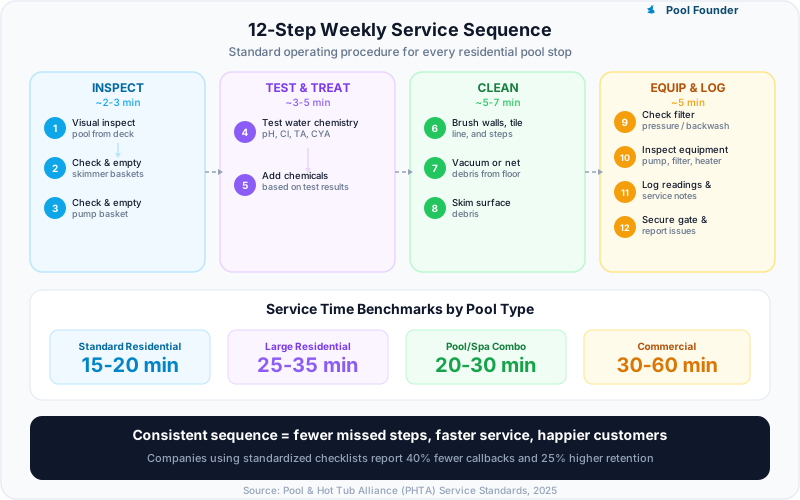
Top-performing pool companies follow a 12-step standard sequence progressing from visual inspection and basket clearing through water testing and chemical dosing to surface cleaning and ending with equipment checks and digital documentation, an order optimized to prevent backtracking, ensure accurate chemical testing before adjustment, and capture data while still on-site.
- 1Arrive and visually inspect pool condition from the deck. Look for water color changes, visible algae, floating debris, water level anomalies, and any damage to the pool surface or surrounding equipment. This 30-second scan sets expectations for the rest of the visit.
- 2Check and empty skimmer baskets. Remove all debris, inspect the basket for cracks, and note any unusual items (leaves indicating nearby tree issues, small animals indicating fence gaps, or excessive debris indicating the customer's landscaping schedule).
- 3Check and empty the pump basket (if accessible). Turn off the pump before opening the strainer lid, clear debris, inspect the basket and O-ring, and re-prime if necessary. Never run a pump with a clogged basket.
- 4Test water chemistry: pH, free chlorine, total alkalinity, and CYA (monthly). Use a reliable test kit or digital tester. Record all readings before making any adjustments. Testing before chemical addition gives you an accurate baseline.
- 5Add chemicals based on test results. Calculate dosage using the pool's known volume. Follow the correct adjustment order: alkalinity first, then pH, then sanitizer, then stabilizer. Never dump chemicals in the same spot.
- 6Brush walls, tile line, and steps. Brush from top to bottom, pushing debris toward the main drain. Pay extra attention to areas behind ladders, inside steps, and along the waterline where calcium and algae accumulate.
- 7Vacuum or net debris from the pool floor. If an automatic cleaner is present, verify it is functioning and clear its bag or canister. For manual service, vacuum visible debris that brushing pushed to the floor.
- 8Skim the surface. Remove all floating debris after brushing and vacuuming, since those activities dislodge material that floats up. This step comes last in the cleaning phase for that reason.
- 9Check filter pressure and backwash or clean if needed. Compare the current pressure gauge reading against the pool's documented clean-filter baseline. Backwash or clean when pressure is 8-10 PSI above baseline.
- 10Inspect all visible equipment: pump (noise, leaks, priming), filter (pressure, condition), heater (firing, error codes), salt cell (scale, flow indicator), automation controller (function, valve actuation), and timer schedule (correct run times).
- 11Log all readings and service notes in your app or service device. Record chemical readings (before and after), chemicals added (type and quantity), equipment observations, photos of any issues, and customer notifications if action is needed.
- 12Leave the gate and access points exactly as found. Do a final visual scan for anything to report to the customer: equipment concerns, deck hazards, landscaping encroachment on equipment, or upcoming maintenance needs.
How Long Should Each Service Stop Take?
Standard residential pools require 15-20 minutes per stop when following a consistent service sequence, with time variations driven by pool size, debris load, equipment complexity, and whether chemical adjustments require extended dosing calculations. Technicians who consistently exceed these benchmarks on standard pools are either encountering recurring issues that need a one-time fix (such as a persistent algae problem or a malfunctioning cleaner) or need additional training on efficient service patterns.
| Pool Type | Target Time | Key Variables | Stops Per Day |
|---|---|---|---|
| Standard residential | 15-20 min | Basic equipment, clear water | 18-24 |
| Large residential (>20K gal) | 25-35 min | Larger surface area, more chemicals | 12-16 |
| Pool/spa combo | 20-30 min | Dual water bodies, separate chemistry | 14-18 |
| Commercial | 30-60 min | Health dept requirements, high bather load | 6-10 |
15-20 min
Target service time for a standard residential pool using the 12-step sequence
18-24 pools
Daily stop target for a solo technician on a residential route
Track your average service time per pool type. If your team averages 25+ minutes on standard residential pools, audit the service sequence for inefficiencies or recurring site-specific problems that need a one-time resolution.
How Should You Test and Balance Pool Water Chemistry?
Water chemistry testing is the highest-skill task on every pool service visit, requiring accurate measurement of at least four parameters (free chlorine, pH, total alkalinity, and cyanuric acid) and the knowledge to adjust each without disrupting the others. Incorrect chemical adjustment is the leading cause of service callbacks, customer complaints, and equipment damage in the pool service industry. A technician who adds muriatic acid to lower pH without first checking alkalinity may crash the TA buffer, creating a pH bounce that requires multiple return visits. The difference between a competent technician and an expert is the ability to read all parameters as an interconnected system rather than isolated numbers.
What Are the Target Ranges for Each Chemical Parameter?
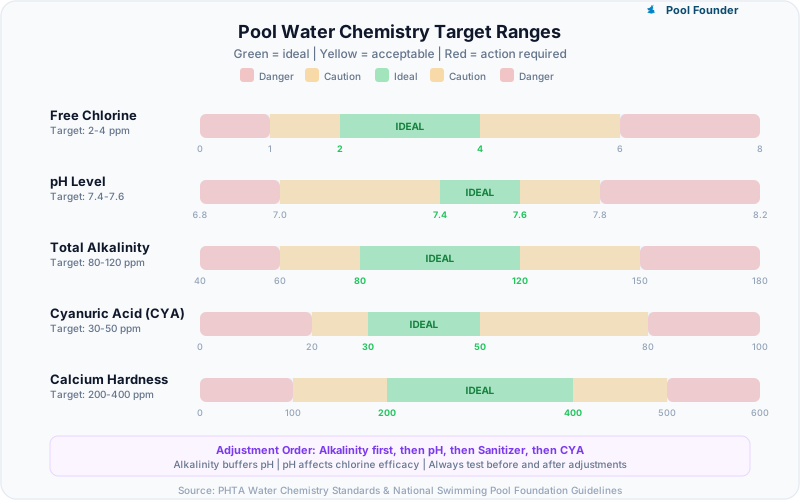
Free chlorine at 1.0-4.0 ppm per PHTA standards, pH at 7.4-7.6, and total alkalinity at 80-120 ppm are the three parameters tested on every weekly visit, with four additional parameters (CYA, calcium hardness, salt level, and TDS) checked monthly or quarterly to complete the seven-point water quality profile every professional technician must know.
| Parameter | Target Range | Test Frequency | To Increase | To Decrease |
|---|---|---|---|---|
| Free Chlorine | 1.0-4.0 ppm (PHTA standard) | Every visit | Liquid chlorine / trichlor tabs | Sodium thiosulfate / sunlight |
| pH | 7.4-7.6 | Every visit | Soda ash (sodium carbonate) | Muriatic acid / dry acid |
| Total Alkalinity | 80-120 ppm | Every visit | Sodium bicarbonate (baking soda) | Muriatic acid |
| Cyanuric Acid (CYA) | 30-50 ppm | Monthly | Stabilizer (cyanuric acid) | Partial drain (only method) |
| Calcium Hardness | 200-400 ppm | Monthly | Calcium chloride | Partial drain / dilution |
| Salt (saltwater pools) | 2,700-3,400 ppm | Monthly | Pool-grade salt | Partial drain / dilution |
| TDS (Total Dissolved Solids) | Below 2,000 ppm | Quarterly | N/A | Partial drain |
What Is the Correct Order for Chemical Adjustments?
The correct chemical adjustment order is total alkalinity first, pH second, sanitizer (chlorine) third, and cyanuric acid last, because each parameter affects the behavior of others and adjusting out of order creates a cascade of corrections that wastes chemicals, extends service time, and generates avoidable callbacks.
Alkalinity comes first because it acts as a pH buffer. If you adjust pH while alkalinity is too low, the pH will bounce back within hours because there is no buffer to hold it stable. Once alkalinity is in the 80-120 ppm range, pH adjustments will hold. pH comes second because it directly affects chlorine efficacy. At a pH of 7.2, about 63% of free chlorine is in its active sanitizing form (hypochlorous acid). At a pH of 8.0, only 21% is active. Adding chlorine to a pool with high pH is wasting chemical and money. Sanitizer comes third, after the pH is set to maximize its killing power. CYA is adjusted last and least frequently because it accumulates over time and the only way to reduce it is dilution through partial draining.
- 1Adjust total alkalinity to 80-120 ppm. Add sodium bicarbonate to raise TA (1.5 lbs per 10,000 gallons raises TA by approximately 10 ppm). Add muriatic acid to lower TA (target the acid at one spot with the pump off for 30 minutes to lower TA without significantly affecting pH).
- 2Adjust pH to 7.4-7.6. Add muriatic acid to lower pH or soda ash to raise pH. Wait 4-6 hours before retesting if you have made a large adjustment.
- 3Adjust free chlorine to 1.0-4.0 ppm per PHTA standards (with 2-4 ppm as the ideal operational target). Add liquid chlorine (sodium hypochlorite) for immediate sanitization. For ongoing chlorination, ensure tabs or salt cell are producing at the correct rate.
- 4Adjust CYA to 30-50 ppm (monthly check). Add stabilizer dissolved in a sock placed in the skimmer. If CYA is above 70 ppm, calculate and schedule a partial drain.
Never add chemicals to a pool with the pump off (except when intentionally lowering alkalinity with targeted acid addition). Chemicals need circulation to distribute evenly and avoid concentrated spots that can damage surfaces or bleach liners.
How Do You Handle Common Water Chemistry Problems?
Green pools (algae bloom), cloudy water, high cyanuric acid, and surface staining account for over 80% of all chemical-related service callbacks, and each requires a specific remediation protocol that goes beyond simply adjusting the out-of-range parameter.
Green pool (algae bloom): A green pool requires shock treatment, not just a chlorine adjustment. Triple- or quadruple-shock the pool (3-4 lbs of calcium hypochlorite per 10,000 gallons or equivalent liquid chlorine), brush all surfaces thoroughly to break up algae colonies and expose them to chlorine, run the filter system continuously for 24-48 hours, and backwash the filter once the pool begins to clear and dead algae loads the filter. Do not add algaecide during shock treatment because high chlorine levels will neutralize most algaecides. Retest and adjust chemistry once the water is clear. If the pool does not respond to double-shock, test CYA because levels above 70 ppm render even high chlorine doses ineffective.
Cloudy water: Cloudiness indicates a filtration problem, a chemistry imbalance, or both. Check filter pressure first because a dirty filter cannot clear particulate matter regardless of chemistry. If the filter is clean and pressure is normal, test all chemistry parameters with emphasis on pH (high pH causes calcium to precipitate and cloud water) and free chlorine (low chlorine allows particulate organic matter to accumulate). If chemistry is balanced and filtration is running, add a clarifier to coagulate microscopic particles the filter can capture. Persistent cloudiness after 48 hours of proper filtration and chemistry points to a filter media problem (channeling in sand, worn cartridge, depleted DE).
High CYA (cyanuric acid): CYA above 70 ppm reduces chlorine effectiveness regardless of how much chlorine is in the water. The only solution is partial draining and refilling with fresh water. Calculate the percentage of water that needs replacement: if CYA is 100 ppm and the target is 40 ppm, drain approximately 60% of the pool volume. There is no chemical that removes CYA. Technicians should track CYA trends because pools using stabilized chlorine (trichlor tabs) accumulate CYA continuously. A pool using only trichlor will typically hit problematic CYA levels within 12-18 months.
Staining: Pool stains require identification before treatment because metal stains and organic stains respond to different chemicals. Place a vitamin C tablet on a metal stain; if the stain lightens within 30 seconds, it is a metal stain (iron, copper, or manganese) that requires a metal sequestrant and potentially a source investigation (corroded heater, well water, copper-based algaecide). Place a trichlor tab on an organic stain; if it lightens, it is organic (leaves, berries, dirt) and responds to chlorine shock and brushing. Applying the wrong treatment wastes time, chemicals, and the customer's trust.
What Equipment Should Be Inspected on Every Service Stop?
Equipment-related issues, including pump failures, filter problems, and leaks, are among the leading causes of pool service callbacks, yet most technicians only inspect equipment when a customer complains, missing early warning signs that add 10-15 minutes of future emergency repair time per incident. A pump that develops a small drip at the union today becomes a flooded equipment pad and a $400 emergency call next week. A filter gauge that reads 5 PSI above normal today becomes a blown laterals repair next month. Proactive equipment inspection on every visit converts unpredictable emergency revenue into scheduled, profitable repair work and eliminates the customer frustration that drives churn.
What Are the Critical Equipment Check Points?
Pump operation, filter pressure, heater function, salt cell condition, automation controller status, and timer schedule are the six equipment categories requiring inspection on every service visit, with each check taking 15-30 seconds when the technician knows what to look and listen for.
Pump: Is the pump running? Listen for unusual noises: cavitation (gurgling/air sounds) indicates a suction leak or low water level, grinding indicates bearing failure, and screaming indicates a seized motor. Check for leaks at the discharge union, suction union, and pump lid. Verify the pump is priming properly by checking the strainer lid for a full pot of water with no visible air. A pump that takes more than 90 seconds to prime after basket cleaning has a suction-side air leak.
Filter: Read the pressure gauge and compare to the pool's documented clean-filter baseline. An increase of 8-10 PSI above baseline means the filter needs cleaning. A gauge that reads zero may be broken, not clean. Check for water leaking from the filter body, multiport valve, or backwash line. For DE filters, check the sight glass or backwash output for DE powder returning to the pool (indicates torn grid).
Heater: If the heater should be running, verify it fires on demand. Check the display for error codes and record any codes in service notes. Sniff the exhaust for unusual odors (gas smell near a gas heater indicates a potential gas leak requiring immediate shutdown and customer notification). Check for sooting around the exhaust or burner tray, which indicates incomplete combustion.
Salt cell (saltwater pools): Inspect the cell for visible calcium scale buildup through the inspection port or clear housing. Check the control unit for flow indicator status, salt level reading, and cell hours remaining. Most salt cells last 10,000-12,000 hours. When the cell approaches end-of-life, proactively inform the customer and quote replacement rather than waiting for a failure that leaves them without sanitization.
Automation controller: Verify the controller is powered on and displaying normally. Test that valves are actuating by triggering a mode change (pool to spa or vice versa) and confirming the actuator moves. Check scheduled programs for accuracy. Power surges and outages can reset controllers, leaving pools running on incorrect schedules.
Timer and schedule: Confirm the pump is running for the correct number of hours (minimum 8 hours per day for residential, often 10-12 hours in summer). Verify run times align with the customer's utility rate schedule if they have time-of-use billing. Check that the clock is set correctly because timers drift after power outages.
How Do You Track Filter Pressure Baselines?
Recording each pool's clean-filter baseline pressure is the single most valuable equipment data point a technician can track, because it transforms filter maintenance from guesswork into a precise, data-driven decision that prevents both premature cleaning (wasted labor) and delayed cleaning (poor filtration and equipment strain).
To establish a baseline, record the filter pressure immediately after a thorough cleaning or fresh media installation. This is the pool's clean-filter pressure. On every subsequent visit, compare the current reading to the baseline. The trigger for cleaning is 8-10 PSI above baseline, not an absolute number. A cartridge filter with a 10 PSI clean baseline needs cleaning at 18-20 PSI. A sand filter with a 14 PSI clean baseline needs backwashing at 22-24 PSI.
| Filter Type | Typical Clean Pressure | Clean/Backwash Trigger | Cleaning Method |
|---|---|---|---|
| Cartridge | 8-12 PSI | 18-22 PSI (+8-10 above baseline) | Remove and hose down; replace annually or when cleaning no longer restores baseline |
| Sand | 10-15 PSI | 20-25 PSI (+8-10 above baseline) | Backwash until sight glass runs clear (typically 2-3 minutes) |
| DE (Diatomaceous Earth) | 10-15 PSI | 20-25 PSI (+8-10 above baseline) | Backwash, then recharge with correct amount of DE powder per filter square footage |
Store filter baseline pressures in your pool service software so every technician on the route knows the trigger point for each pool. A new technician without baseline data will either clean filters too frequently (wasting time) or not frequently enough (degrading water quality).
What's the Difference Between Weekly, Monthly, and Quarterly Tasks?
Professional pool maintenance operates on three overlapping cycles, where weekly chemical service prevents immediate water quality issues, monthly inspections catch equipment degradation before failure, and quarterly deep maintenance extends the lifespan of every major system component by two to five years. Companies that only perform weekly service miss the monthly and quarterly tasks that prevent the most expensive failures. A $2 O-ring replaced during monthly lubrication prevents a $150 pump seal replacement. A $50 quarterly filter teardown prevents a $300 filter media replacement. The ROI on multi-cycle maintenance is 400-800% when measured against the cost of the repairs it prevents.
What Monthly Maintenance Tasks Are Required?
CYA and calcium hardness testing, O-ring inspection and lubrication, salt cell cleaning, pool light verification, automatic cleaner inspection, and chemical usage trend review are the seven monthly tasks targeting components that degrade too slowly for weekly attention but too quickly to wait for quarterly service.
- 1Test cyanuric acid (CYA) and calcium hardness. These parameters change slowly in most pools, but drifting outside range causes compounding problems. High CYA renders chlorine ineffective. Low calcium causes surface etching. High calcium causes scale formation on equipment.
- 2Inspect O-rings and gaskets on the pump lid, filter clamp, and any unions you service. Look for cracking, flattening, or dryness. Replace any O-ring that shows visible wear rather than waiting for it to fail and cause a leak.
- 3Lubricate O-rings with a silicone-based pool lubricant (never petroleum-based products, which degrade rubber). A properly lubricated O-ring seals better, lasts longer, and makes pump lids easier to open and close.
- 4Clean the salt cell on saltwater pools. Inspect for calcium scale and soak in a 4:1 water-to-muriatic acid solution if buildup is visible. Over-cleaning reduces cell life, so only acid-wash when scale is actually present.
- 5Check pool light function. Turn on the pool light during a daytime visit (you may need to cover the light to verify illumination). A non-functioning pool light is a safety issue and a liability risk, especially on commercial pools.
- 6Inspect the automatic pool cleaner. Suction cleaners: check the diaphragm, flapper, and hoses for wear. Pressure cleaners: check the bag, sweep hose, and backup valve. Robotic cleaners: clean the filter basket and inspect the brushes and tracks.
- 7Review chemical usage trends for the pool. Is chlorine consumption increasing month over month? That indicates a rising CYA problem, an increasing bather load, or a developing algae issue. Adjust auto-feeder and chemical delivery settings based on trend data.
What Quarterly Deep Maintenance Should You Schedule?
Full equipment pad inspections, tile acid washing, filter teardowns, GFCI outlet testing, deck drainage checks, and chemical dosage trend reviews make up the quarterly deep maintenance cycle, each targeting infrastructure-level concerns during the 90-day window before they escalate into emergency repairs or safety hazards.
- 1Perform a full equipment room or pad inspection. Check all plumbing connections for slow leaks (look for mineral deposits or green copper staining at connections, which indicate micro-leaks that evaporate before pooling). Verify all electrical connections are secure and show no signs of corrosion.
- 2Acid wash the tile line if calcium scale or waterline buildup is present. Use a pumice stone or tile cleaning solution for light buildup. For heavy scale, apply muriatic acid with a brush (protect the pool water by working in small sections and diluting runoff).
- 3Tear down and deep clean DE filters. Remove the grid assembly, hose down each grid individually, soak in a filter cleaning solution overnight if grids show embedded oils or scale, inspect manifold and grid fabric for tears, and recharge with the correct amount of DE. For cartridge filters, perform the same deep-clean soak cycle.
- 4Test all GFCI outlets at the pool equipment pad per NEC Article 680 requirements. Press the test button, verify the outlet trips, then press reset. The 2020 NEC expanded GFCI requirements to all pool pump motors rated 150V or less and 60A or less. A GFCI that does not trip is a shock hazard and must be replaced. NFPA 70E recommends monthly GFCI testing. Document the test in service notes for liability purposes.
- 5Inspect deck drainage and identify trip hazards. Cracked or raised deck sections near the pool create liability exposure for the pool owner and, by extension, for any service company that had the opportunity to report the hazard but did not. Document and photograph any concerns.
- 6Review and update pool chemical dosage records. Compare current chemical usage against the same quarter in the prior year. Significant increases indicate equipment problems (failing salt cell producing less chlorine, filter not cleaning properly leading to higher chemical demand) or environmental changes (new landscaping increasing debris load).
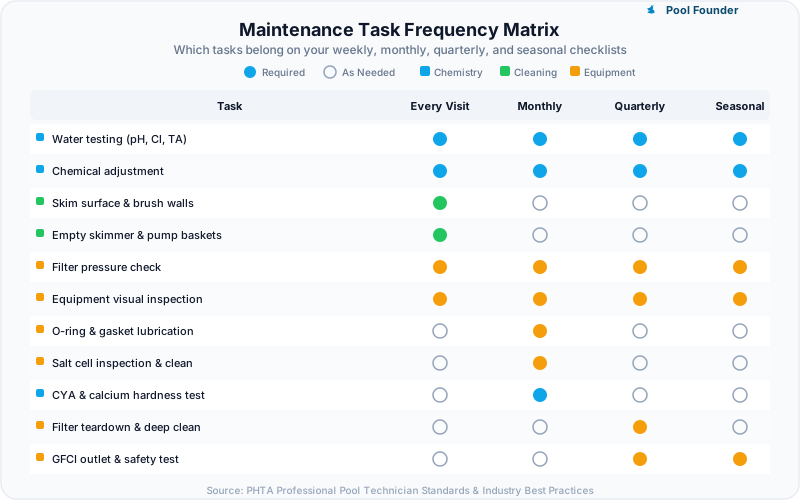
| Task | Every Visit | Monthly | Quarterly | Seasonal |
|---|---|---|---|---|
| Water testing (pH, Cl, TA) | Required | Required | Required | Required |
| Chemical adjustment | Required | Required | Required | Required |
| Skim surface and brush walls | Required | - | - | - |
| Empty skimmer and pump baskets | Required | - | - | - |
| Filter pressure check | Required | Required | Required | Required |
| Equipment visual inspection | Required | Required | Required | Required |
| O-ring and gasket lubrication | As needed | Required | - | - |
| Salt cell inspection and clean | - | Required | - | - |
| CYA and calcium hardness test | - | Required | - | - |
| Filter teardown and deep clean | - | As needed | Required | - |
| GFCI outlet test | - | - | Required | Required |
| Deck and drainage inspection | - | - | Required | - |
| Full plumbing connection check | - | - | Required | Required |
| Pool opening / closing procedure | - | - | - | Required |
How Do You Document Service Visits for Liability Protection?
Service documentation protects pool companies from significant liability exposure, with average premises liability settlements reaching $200,000 according to the Insurance Information Institute. A single slip-and-fall lawsuit near a pool can generate legal costs well into six figures, and the pool service company's first line of defense is proving exactly what was inspected, documented, and communicated on every visit. Courts have consistently ruled that pool service providers who cannot produce service records bear greater liability than those with comprehensive digital logs showing dates, times, readings, and customer notifications.
What Should Every Service Report Include?
GPS-verified timestamps, pre- and post-adjustment chemical readings, chemicals added with exact quantities, equipment status observations, issue photos, and customer notifications are the six documentation categories that transform a service visit from an undocumented memory into a legally defensible record.
- 1Date, time of arrival and departure, and technician name. Timestamps establish a verifiable service timeline. GPS-tagged check-ins add an additional layer of proof that the technician was physically present at the property.
- 2All chemical readings taken during the visit, both before adjustment and after adjustment when retesting is performed. Recording pre-adjustment readings demonstrates what the technician found, and post-adjustment readings demonstrate what they corrected.
- 3Chemicals added: type, product name, and exact quantity. This data serves three purposes: liability documentation (proving correct dosage), inventory tracking (forecasting chemical purchases), and trending (identifying pools that consistently require above-average chemical usage).
- 4Equipment status and observations. Record filter pressure, note any unusual pump sounds, document error codes on heaters or automation, and flag equipment that is approaching end of life. This turns every visit into a proactive maintenance check that generates repair revenue.
- 5Photos of any issues found. A photo of a cracked pump lid, a corroded heater connection, or a raised deck panel is worth more than any written description in a liability dispute. Photos also communicate urgency to the customer far more effectively than a text note.
- 6Customer notification when action is needed. If a repair is required, a safety concern is identified, or chemistry cannot be corrected in a single visit, the customer must be informed in writing (email or in-app notification). Documented notification proves the service company fulfilled its duty to inform.
How Does Digital Documentation Compare to Paper?
Paper-based service logs suffer from five critical weaknesses that digital pool service software eliminates entirely: they get lost, they become illegible, they cannot include photos, they lack verified timestamps, and they have no backup. A paper log left in a truck for six months is faded, coffee-stained, and inadmissible. A digital service record from the same visit is timestamped, geotagged, photo-attached, keyword-searchable, and backed up on cloud servers.
| Capability | Paper Logs | Digital Service Software |
|---|---|---|
| Timestamps | Handwritten (unverified) | Automatic (GPS-verified) |
| Photo documentation | Not possible | Unlimited per visit |
| Searchability | Manual page-by-page | Instant keyword/date search |
| Customer access | None (stays in truck) | Real-time customer portal |
| Backup | None (single copy) | Automatic cloud backup |
| Liability defense | Weak (easily disputed) | Strong (verified, timestamped, geotagged) |
| Chemical trending | Manual calculation | Automatic reports and alerts |
| Technician accountability | Difficult to verify | Complete audit trail |
75%
Of field service companies adopting digital documentation report improved employee productivity
Source: Gomocha field service research
Thorough documentation significantly reduces liability exposure. Over 70% of civil cases settle before trial when supported by well-prepared records, and cases with comprehensive documentation achieve 35% more successful settlements. Pool Founder's service logging captures all six documentation categories automatically during route completion. Technicians log chemical readings, add notes, and attach photos directly from the mobile app, and customers see their service history in real time through the customer portal. Every entry is timestamped and geotagged, creating the documentation trail that satisfies commercial pool health department requirements.
Commercial pool operators face mandatory documentation requirements from local health departments. Failure to produce service records on demand during a health inspection can result in fines of $500-$5,000 per violation and potential pool closure orders.
What Seasonal Maintenance Tasks Should Be on Your Schedule?
Seasonal transitions represent a significant revenue opportunity for pool service companies, with spring openings and fall closings each requiring a 45-60 minute comprehensive service visit that commands $250-500 premium pricing for inground pools according to HomeGuide and Angi. These visits are the highest-margin stops on the annual calendar because they combine skilled labor (plumbing, equipment commissioning, chemical loading) with parts and supply sales (covers, winterizing kits, replacement equipment discovered during opening). Companies that pre-schedule seasonal visits for their entire customer base in October (for closings) and February (for openings) capture 100% of this revenue before competitors begin soliciting the same customers.
What Does a Spring Pool Opening Checklist Include?
Spring pool openings follow an 8-step procedure that takes 45-90 minutes depending on pool condition after the off-season, with the primary goal of bringing all equipment and chemistry back to operational status without damaging components that have sat idle for months.
- 1Remove the winter cover and clean it before storage. Pump standing water off the cover first, remove leaves and debris, then fold and store in a dry location. Inspect the cover for tears or degradation and recommend replacement if needed (an easy upsell that costs the customer $200-800 and saves them from a contaminated pool next fall).
- 2Inspect all equipment after winter dormancy. Check the pump, filter, heater, salt cell, automation controller, and all plumbing unions for visible cracks, leaks, or freeze damage. Do not power on any equipment until this visual inspection is complete.
- 3Clean the filter thoroughly. Cartridge filters should be soaked in cleaning solution and rinsed. Sand filters should be backwashed. DE filters should be torn down, inspected, cleaned, and recharged. Starting the season with a clean filter establishes the baseline pressure reading.
- 4Fill the pool to the proper operating level (mid-skimmer). If the pool was drained below the skimmer for winter, fill with a garden hose. In areas with high-calcium fill water, consider using a pre-filter on the hose to reduce initial calcium loading.
- 5Prime the pump and check for leaks. Reinstall drain plugs in the pump, filter, heater, and chlorinator. Open suction and return valves. Fill the pump pot with water and start the pump. Watch for air leaks at every union and at the pump lid. A pump that will not prime after 2-3 minutes has a suction-side air leak that must be found and corrected.
- 6Shock the pool with a heavy initial dose of chlorine. Spring opening shock dosage is typically 2-3x the normal shock dose because the pool has had no active sanitizer for months. For a 15,000-gallon pool, use 4-6 lbs of calcium hypochlorite or 3-4 gallons of liquid chlorine.
- 7Balance all chemistry parameters in sequence: test everything, then adjust alkalinity, pH, chlorine, and CYA in order. Add calcium hardness if below 200 ppm. For saltwater pools, verify salt level and cell output.
- 8Run the system continuously for 24 hours and schedule a return visit to recheck chemistry and filtration. The first 24 hours of circulation clears the dead spots, distributes chemicals, and reveals any equipment problems that were not apparent during the initial startup.
What Does a Fall Pool Closing Checklist Include?
Fall pool closings protect the customer's investment against freeze damage, which can destroy pumps, crack filters, burst plumbing, and damage pool surfaces with repair costs ranging from $500 to $15,000 depending on the severity and which components fail.
- 1Lower the water level below the skimmer mouth and below all return jets in freeze-prone climates. In mild climates where freezing is rare, the water level can remain at normal operating height.
- 2Blow out all plumbing lines with compressed air to remove standing water. Start from the equipment pad and work outward to each skimmer, return, and drain. Any water left in plumbing lines will freeze, expand, and crack pipes. This is the most critical step of the closing process.
- 3Add winterizing chemicals: a long-lasting algaecide, a phosphate remover to starve any surviving algae of nutrients, and a winter chlorine shock dose. The goal is to maintain a residual sanitizer level through the winter months without active circulation.
- 4Drain all equipment: pump (remove drain plugs), filter (open drain and bleeder), heater (remove drain plugs and open gas shutoff), chlorinator (remove all chemical and drain), and salt cell (remove and store indoors). Store all drain plugs in the pump basket so they are easily found at spring opening.
- 5Install winter plugs in all skimmer and return fittings. Use an anti-freeze solution (propylene glycol, not automotive antifreeze) in any fittings where complete water removal is difficult. Plug the skimmer line to prevent rainwater from entering the plumbing.
- 6Install the safety cover or winter cover. For mesh safety covers, ensure all anchors are tight and springs are properly tensioned. For solid winter covers, install water bags or clips to secure the cover against wind. Inspect the cover for damage and recommend replacement if compromised.
- 7Perform a final equipment room inspection. Verify all power is off to pool equipment (or set a freeze protect cycle if the customer has automation with freeze protection). Take photos of the closed-up equipment for the service record. Note any repairs or replacements that should be scheduled for spring opening.
Pre-sell spring opening visits during the fall closing. The technician is already at the property, the customer is thinking about their pool, and booking now locks in revenue 4-5 months before the busy season.
Ready to streamline your pool service business?
Pool Founder gives you route optimization, automated invoicing, chemical tracking, and everything else you need to run a more profitable pool business.
Frequently Asked Questions
How long should a professional pool service visit take?
A standard residential pool service visit takes 15-20 minutes when following a structured 12-step sequence. Large residential pools require 25-35 minutes, pool and spa combos take 20-30 minutes, and commercial pools need 30-60 minutes depending on size and health department requirements. Technicians averaging more than 25 minutes on standard residential pools should audit their service sequence for inefficiencies.
What chemicals should a pool technician test on every visit?
Professional technicians test free chlorine, pH, and total alkalinity on every weekly visit. Cyanuric acid (CYA) and calcium hardness should be tested monthly. Saltwater pools also require a monthly salt level test. TDS (total dissolved solids) should be tested quarterly. All readings should be recorded digitally with before-and-after values when adjustments are made.
How often should pool filters be cleaned?
Pool filters should be cleaned when the pressure gauge reads 8-10 PSI above the pool's documented clean-filter baseline, not on a fixed calendar schedule. For most residential pools, this translates to backwashing sand and DE filters every 4-6 weeks during swimming season and performing a deep cartridge clean every 3-4 months. DE filters require a full teardown and grid inspection quarterly.
What documentation should pool service companies keep?
Every service visit should be documented with six data points: date and time (with GPS verification), all chemical readings before and after adjustment, chemicals added with type and quantity, equipment status observations, photos of any issues found, and customer notifications sent. Digital documentation with timestamps and geotagging provides the strongest liability protection and satisfies commercial pool health department compliance requirements.
What is the correct order for adding pool chemicals?
Always adjust chemicals in this order: total alkalinity first, then pH, then sanitizer (chlorine), then cyanuric acid. Alkalinity must be corrected first because it buffers pH. pH must be correct before adding chlorine because pH determines how effective chlorine is at sanitizing. At a pH of 7.2, about 63% of chlorine is active. At a pH of 8.0, only 21% is active. CYA is adjusted last because it changes slowly and the only way to reduce it is dilution.
How do you handle a green pool on a service route?
A green pool on a service route requires a shock protocol, not a standard chemical adjustment. Triple- or quadruple-shock the pool (3-4 lbs calcium hypochlorite per 10,000 gallons), brush all surfaces to expose algae to chlorine, and run the filter continuously for 24-48 hours. Check CYA first because levels above 70 ppm render shock treatment ineffective. Do not add algaecide during shock because high chlorine neutralizes most algaecide products. Schedule a return visit to recheck chemistry once the water clears.
What certifications do pool service technicians need?
Requirements vary by state and locality. The most recognized national certifications are the Certified Pool Operator (CPO) from the Pool and Hot Tub Alliance and the Aquatic Facility Operator (AFO). Many states require a contractor's license for repair work. Some municipalities require specific chemical handling certifications. At minimum, all technicians should complete CPO certification, which covers water chemistry, equipment operation, and health code compliance.
How many pools can one technician service per day?
A solo technician on an optimized residential route can service 18-24 pools per day at 15-20 minutes per stop, including drive time. This assumes a geographically tight route with average 5-8 minute drive times between stops. Technicians servicing large residential pools or pool-spa combos will complete 12-16 stops. Commercial routes may only allow 6-10 stops due to the 30-60 minute service time per location. Route optimization software can increase daily stops by 15-25% by reducing drive time.
Sources & References
- Gomocha Field Service Maintenance Checklist Research
- CDC Model Aquatic Health Code (MAHC)
- IPSSA Independent Pool & Spa Service Association
- PHTA Pool & Hot Tub Alliance Standards & Best Practices
- PHTA Certified Pool & Spa Operator (CPO) Certification
- Taylor Technologies Water Chemistry Reference
- Pentair Pool Equipment Maintenance
- Hayward Pool Maintenance Guidelines