The Math Behind Every Chemical Dose You Add to a Pool.
Pool chemical dosing is not guesswork. Every adjustment you make, whether it is raising chlorine by 2 ppm, lowering pH from 7.8 to 7.4, or bumping alkalinity up by 20 ppm, follows a formula based on pool volume and the concentration of the chemical you are using. Knowing these formulas lets you dose accurately on the first try, avoid wasting chemicals, and prevent overcorrection callbacks.
"Early in my career, I would just dump a cup of acid in and hope for the best," says Corey Adams, Pool Founder co-founder and 15-year pool service veteran. "Once I memorized the core dosing formulas, I stopped guessing. My chemical costs dropped and my water quality improved across every pool on my route." This guide covers the essential dosing calculations every pool technician needs, starting with pool volume and working through each major chemical adjustment.
All formulas in this guide assume standard chemical concentrations and are approximations. Real-world results vary based on water temperature, existing chemical levels, and product-specific concentrations. Always retest after dosing and before making additional adjustments.
How Do You Calculate Pool Volume in Gallons?
Every dosing formula starts with pool volume. If you get the volume wrong, every chemical dose is wrong. Most residential pools range from 8,000 to 25,000 gallons. Commercial pools can run 50,000 to 500,000 gallons or more. Here are the standard formulas by pool shape.
Pool Volume Formulas
| Pool Shape | Formula |
|---|---|
| Rectangular | Length x Width x Average Depth x 7.48 = gallons |
| Round | Diameter x Diameter x Average Depth x 5.9 = gallons |
| Oval | Long Diameter x Short Diameter x Average Depth x 5.9 = gallons |
| Kidney/Freeform | (Length x Width x Average Depth x 7.48) x 0.45 = gallons |
All measurements are in feet. Average depth equals the shallow end depth plus the deep end depth, divided by two. For pools with a gradual slope, this formula is accurate enough. For pools with a sharp drop-off or a large deep end, measure three points and average them.
Record the calculated volume for every pool on your route. You only need to calculate it once. Having it in your service software saves time on every future chemical adjustment.
How Do You Calculate Chlorine Dosing by PPM Target?
The chlorine dosing formula depends on the product you are using and its available chlorine percentage. The core formula calculates the weight of product needed to raise free chlorine by a target number of parts per million in a known volume of water.
Universal Chlorine Dosing Formula
Ounces of product = (Pool volume in gallons x Desired ppm increase x 0.00013) / Decimal available chlorine. For example, to raise chlorine by 2 ppm in a 15,000-gallon pool using 12.5% liquid chlorine: (15,000 x 2 x 0.00013) / 0.125 = 31.2 fluid ounces, or just under one quart.
Quick Reference: Liquid Chlorine (12.5% NaOCl)
| Pool Volume | +1 ppm | +2 ppm | +3 ppm | +5 ppm | +10 ppm (shock) |
|---|---|---|---|---|---|
| 10,000 gal | 10 oz | 20 oz | 31 oz | 52 oz | 104 oz |
| 15,000 gal | 16 oz | 31 oz | 47 oz | 78 oz | 156 oz |
| 20,000 gal | 21 oz | 42 oz | 62 oz | 104 oz | 208 oz |
| 30,000 gal | 31 oz | 62 oz | 94 oz | 156 oz | 312 oz |
These doses assume zero chlorine demand from organics, algae, or combined chlorine. In practice, a pool with visible algae or a high combined chlorine reading may need 2-3x the calculated dose to overcome demand and achieve breakpoint chlorination.
How Do You Calculate Muriatic Acid Dose for pH Adjustment?
Muriatic acid (31.45% hydrochloric acid) is the standard pH-lowering chemical for pool service. The dose needed depends on current pH, target pH, total alkalinity, and pool volume. Higher alkalinity means you need more acid to move pH because alkalinity acts as a buffer. According to the Indiana Department of Health chemical dosing guidelines, most pH adjustments in residential pools require 1-2 cups of muriatic acid per 10,000 gallons.
Muriatic Acid Dosing Chart (31.45% HCl)
| pH Drop Needed | 10,000 gal (TA 80) | 10,000 gal (TA 120) | 20,000 gal (TA 100) |
|---|---|---|---|
| 7.8 to 7.4 | 12 oz | 18 oz | 30 oz |
| 8.0 to 7.4 | 20 oz | 28 oz | 48 oz |
| 8.2 to 7.4 | 28 oz | 40 oz | 68 oz |
Always add acid with the pump running. Pour slowly into the deep end or in front of a return jet to distribute evenly. Never pour acid directly into the skimmer. Wait at least 30 minutes, ideally a full pump cycle, before retesting pH.
"I always underdose acid by about 20% and come back to retest. It is much easier to add a little more acid than it is to fix a pH crash to 6.8 that damages the plaster." - Corey Adams
How Do You Raise Total Alkalinity in a Pool?
Sodium bicarbonate (baking soda) is the standard chemical for raising total alkalinity without significantly affecting pH. The target range for total alkalinity is 80-120 ppm for most pool surfaces. Plaster pools perform best at 80-100 ppm, while vinyl and fiberglass pools can run 100-120 ppm.
Sodium Bicarbonate Dosing Formula
To raise alkalinity by 10 ppm in 10,000 gallons, add 1.4 pounds of sodium bicarbonate. The general formula is: Pounds of sodium bicarbonate = (Desired ppm increase / 10) x 1.4 x (Pool volume / 10,000). For a 20,000-gallon pool that needs a 30 ppm increase: (30 / 10) x 1.4 x (20,000 / 10,000) = 8.4 pounds.
| Pool Volume | +10 ppm | +20 ppm | +30 ppm | +40 ppm |
|---|---|---|---|---|
| 10,000 gal | 1.4 lbs | 2.8 lbs | 4.2 lbs | 5.6 lbs |
| 15,000 gal | 2.1 lbs | 4.2 lbs | 6.3 lbs | 8.4 lbs |
| 20,000 gal | 2.8 lbs | 5.6 lbs | 8.4 lbs | 11.2 lbs |
| 30,000 gal | 4.2 lbs | 8.4 lbs | 12.6 lbs | 16.8 lbs |
Broadcast sodium bicarbonate over the surface of the pool with the pump running. It dissolves readily and distributes quickly. Do not add more than 5 pounds per 10,000 gallons at a time. If you need a larger increase, split the dose across two visits to avoid temporarily clouding the water.
How Do You Adjust Calcium Hardness?
Calcium chloride (77% or 94% flake) is used to raise calcium hardness. The target range is 200-400 ppm for plaster pools and 150-250 ppm for vinyl and fiberglass. Low calcium hardness causes the water to become aggressive and etch plaster surfaces. The Langelier Saturation Index (LSI) depends heavily on calcium hardness, so getting this right protects the pool surface.
Calcium Chloride Dosing Formula (77% CaCl2)
To raise calcium hardness by 10 ppm in 10,000 gallons, add approximately 1.25 pounds of 77% calcium chloride. The formula is: Pounds of calcium chloride (77%) = (Desired ppm increase / 10) x 1.25 x (Pool volume / 10,000). For a 20,000-gallon pool needing a 50 ppm increase: (50 / 10) x 1.25 x (20,000 / 10,000) = 12.5 pounds.
| Pool Volume | +10 ppm | +25 ppm | +50 ppm |
|---|---|---|---|
| 10,000 gal | 1.25 lbs | 3.1 lbs | 6.25 lbs |
| 15,000 gal | 1.9 lbs | 4.7 lbs | 9.4 lbs |
| 20,000 gal | 2.5 lbs | 6.25 lbs | 12.5 lbs |
| 30,000 gal | 3.75 lbs | 9.4 lbs | 18.75 lbs |
Calcium chloride generates heat when dissolved. Always pre-dissolve in a bucket of pool water before adding to the pool. Never dump dry calcium chloride directly into the pool or through the skimmer. Add no more than 10 pounds per 10,000 gallons at a time.
How Do You Raise pH Without Affecting Alkalinity Too Much?
Soda ash (sodium carbonate) raises pH more aggressively than sodium bicarbonate and has a larger effect on alkalinity per dose. Use soda ash when pH is low but alkalinity is already in range or only slightly low. If both pH and alkalinity are low, sodium bicarbonate is the better choice because it primarily raises alkalinity with a gentler pH increase.
Soda Ash Dosing Formula
To raise pH by 0.2 units in 10,000 gallons, add approximately 6 ounces of soda ash. The exact amount varies with alkalinity, but this rule of thumb works for most residential pools with alkalinity in the 80-120 ppm range. For larger pools, scale proportionally: a 20,000-gallon pool needs about 12 ounces for the same 0.2 pH increase.
Dissolve soda ash in a bucket of water before adding it to the pool. Soda ash can cloud the water temporarily if added too quickly. Pour slowly near a return jet with the pump running. Do not add more than 1 pound per 10,000 gallons at a time.
How Do You Calculate Stabilizer (CYA) Dosing?
Cyanuric acid (stabilizer, conditioner) protects chlorine from UV degradation. The target range for residential pools is 30-50 ppm. CYA dissolves slowly, taking 3-7 days to fully dissolve in a sock placed in the skimmer basket. Do not try to achieve the target in one dose; plan for incremental additions.
CYA Dosing Formula
To raise CYA by 10 ppm in 10,000 gallons, add approximately 13 ounces (0.8 lbs) of granular cyanuric acid. The formula is: Ounces of CYA = (Desired ppm increase / 10) x 13 x (Pool volume / 10,000). For a 15,000-gallon pool needing a 20 ppm increase: (20 / 10) x 13 x (15,000 / 10,000) = 39 ounces, or about 2.4 pounds.
| Pool Volume | +10 ppm | +20 ppm | +30 ppm |
|---|---|---|---|
| 10,000 gal | 13 oz | 26 oz | 39 oz |
| 15,000 gal | 19.5 oz | 39 oz | 58.5 oz |
| 20,000 gal | 26 oz | 52 oz | 78 oz |
| 30,000 gal | 39 oz | 78 oz | 117 oz |
Place CYA in a fine mesh sock and hang it in front of a return jet, or place it in the skimmer basket with the pump running. Do not pour granular CYA directly into the pool. It sinks and can bleach plaster or stain surfaces. Retest CYA 7 days after adding, not sooner.
What Quick Reference Numbers Should Every Tech Memorize?
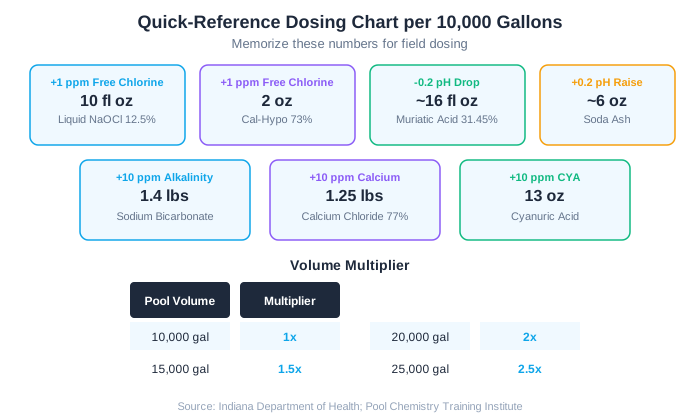
You do not need to run formulas in the field for every adjustment. Memorize these per-10,000-gallon quick-reference numbers and scale up or down based on pool volume. These are the most common adjustments you will make on a daily basis.
| Adjustment | Chemical | Amount per 10,000 gal |
|---|---|---|
| +1 ppm free chlorine | Liquid 12.5% NaOCl | 10 fl oz |
| +1 ppm free chlorine | Cal-hypo 73% | 2 oz (dry weight) |
| -0.2 pH (TA ~100) | Muriatic acid 31.45% | ~16 fl oz |
| +10 ppm alkalinity | Sodium bicarbonate | 1.4 lbs |
| +10 ppm calcium hardness | Calcium chloride 77% | 1.25 lbs |
| +10 ppm CYA | Cyanuric acid | 13 oz |
| +0.2 pH (TA ~100) | Soda ash | ~6 oz |
"I wrote these numbers on a laminated card and taped it inside my chemical caddy lid. After a few months, they were automatic. That card paid for itself on the first day by cutting my on-site time." - Corey Adams
Run a pool route?
The business side of what you just read.
Pricing, chemical costs, and the tools owners use to keep the numbers straight.
- Commercial pool service pricing2026 rate tables and the cost-plus formula
- Chemical cost per poolWhat chemicals actually cost per stop
- Chemical tracking softwareLog readings and dosing from the pool deck
- Pool service softwareRoutes, invoicing, and service reports in one app
- Free profit & rate calculatorsProfit per pool, minimum rate, break-even
Frequently Asked Questions
How do you calculate how much liquid chlorine to add to a pool?
Use the formula: Ounces = (Pool volume x Desired ppm increase x 0.00013) / 0.125. For a 15,000-gallon pool needing a 2 ppm increase with 12.5% liquid chlorine, that works out to about 31 fluid ounces.
How much muriatic acid lowers pH by 0.2 in a 10,000-gallon pool?
Approximately 12-18 fluid ounces of 31.45% muriatic acid, depending on total alkalinity. Higher alkalinity requires more acid because it buffers against pH change. At 80 ppm alkalinity, use about 12 oz. At 120 ppm, use about 18 oz.
What is the formula for raising total alkalinity?
Add 1.4 pounds of sodium bicarbonate per 10,000 gallons to raise total alkalinity by 10 ppm. Scale proportionally for larger pools or bigger adjustments. Do not add more than 5 pounds per 10,000 gallons at a time.
How long should you wait between chemical additions?
Wait at least 30 minutes with the pump running between different chemical additions. For acid, wait a full pump cycle (4-8 hours) before retesting pH. For CYA, wait a full 7 days before retesting since it dissolves slowly.
Why are pool chemical dosing charts only approximate?
Pool water chemistry involves multiple interacting variables. Temperature, existing chemical levels, total dissolved solids, and the buffering effect of alkalinity all influence how each chemical behaves. The formulas give you a solid starting point, but always retest after dosing.
How do you calculate pool volume for an irregularly shaped pool?
Break the pool into regular shapes (rectangles, circles), calculate each section separately, and add them together. For freeform pools, use the kidney formula: Length x Width x Average Depth x 7.48 x 0.45. When in doubt, round down to avoid overdosing chemicals.