You Cannot Dose a Pool You Cannot Measure
Every chemical dosing calculation starts with pool volume. Add too little chlorine because you underestimated volume, and the pool stays green. Add too much because you overestimated, and you bleach the plaster or burn the customer's eyes. Yet most pool techs rely on the homeowner's guess ("I think it's about 15,000 gallons") or a rough eyeball estimate. Both methods produce errors of 20% to 40%, which translates directly into dosing errors of the same magnitude.
This reference guide gives you the formulas, lookup tables, and estimation shortcuts to calculate pool volume and surface area in the field without pulling out a calculator. Bookmark it, print it, or save it to your phone. You will use it every time you encounter a new pool.
All calculations use the standard conversion factor of 7.48 gallons per cubic foot (rounded to 7.5 for field estimation). Surface area is in square feet. Depth measurements should use average depth unless a constant-depth pool.
How Do You Calculate Pool Volume?
Pool volume in gallons equals the pool's surface area in square feet multiplied by the average depth in feet multiplied by 7.5 (gallons per cubic foot). The formula is the same regardless of pool shape. What changes is how you calculate the surface area component.
The Universal Formula
Surface Area (sqft) x Average Depth (ft) x 7.5 = Volume in Gallons
How to Calculate Average Depth
For pools with a shallow end and deep end, add the shallow depth and deep depth and divide by two. A pool with a 3.5-foot shallow end and an 8-foot deep end has an average depth of 5.75 feet. For pools with a flat bottom at one depth, use that depth. For pools with a gradual slope, the shallow-plus-deep divided by two method is close enough for dosing purposes.
| Pool Shape | Surface Area Formula | Example |
|---|---|---|
| Rectangular | Length x Width | 16 x 32 = 512 sqft |
| Round/circular | 3.14 x Radius x Radius | 3.14 x 10 x 10 = 314 sqft (20ft dia) |
| Oval | 3.14 x Half-length x Half-width | 3.14 x 12 x 8 = 301 sqft (24x16) |
| Kidney/freeform | Length x Width x 0.75 | 30 x 15 x 0.75 = 338 sqft |
| L-shaped | Break into rectangles, add areas | Rectangle A + Rectangle B |
The 0.75 multiplier for kidney and freeform pools is an estimation shortcut. It assumes the curved shape reduces the total area by about 25% compared to the bounding rectangle. For billing and dosing, this is accurate enough. For exact volume on critical dosing, use a pool volume calculator app.
What Are the Volumes of Common Pool Sizes?
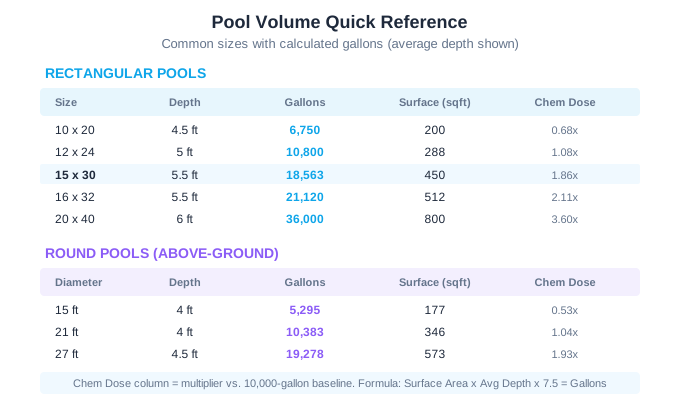
Instead of calculating every time, use this lookup table for the most common residential pool dimensions. These volumes assume the average depth shown, which covers the majority of standard residential pools built in the last 30 years.
Rectangular Pool Volume Table
| Dimensions | Avg. Depth | Volume (gal) | Surface Area |
|---|---|---|---|
| 10 x 20 | 4.5 ft | 6,750 | 200 sqft |
| 12 x 24 | 5 ft | 10,800 | 288 sqft |
| 14 x 28 | 5 ft | 14,700 | 392 sqft |
| 15 x 30 | 5.5 ft | 18,563 | 450 sqft |
| 16 x 32 | 5.5 ft | 21,120 | 512 sqft |
| 18 x 36 | 5.5 ft | 26,730 | 648 sqft |
| 20 x 40 | 6 ft | 36,000 | 800 sqft |
| 25 x 50 | 6 ft | 56,250 | 1,250 sqft |
Round Pool Volume Table
| Diameter | Avg. Depth | Volume (gal) | Surface Area |
|---|---|---|---|
| 12 ft | 4 ft | 3,392 | 113 sqft |
| 15 ft | 4 ft | 5,295 | 177 sqft |
| 18 ft | 4 ft | 7,630 | 254 sqft |
| 21 ft | 4 ft | 10,383 | 346 sqft |
| 24 ft | 4 ft | 13,560 | 452 sqft |
| 27 ft | 4.5 ft | 19,278 | 573 sqft |
| 30 ft | 4.5 ft | 23,826 | 707 sqft |
Round pools in the table above represent above-ground pool sizes. In-ground round pools are less common but use the same formula. Note that above-ground pools typically have a constant depth of 4 to 4.5 feet, simplifying the calculation.
How Do You Estimate Freeform Pool Volume?
Freeform, kidney, and custom-shaped pools are the hardest to calculate because they do not fit a simple geometric formula. Three estimation methods work in the field, ranging from quick-and-dirty to reasonably precise.
Method 1: The 0.75 Rectangle Method (Fastest)
Measure the longest length and widest width of the pool. Multiply length x width x average depth x 7.5 x 0.75. The 0.75 factor accounts for the area removed by the curves. Example: a 30-foot long, 15-foot wide freeform pool with 5-foot average depth: 30 x 15 x 5 x 7.5 x 0.75 = 12,656 gallons.
Method 2: The Section Method (More Accurate)
Break the pool into simple shapes (rectangles, circles, semicircles). Calculate each section separately and add them together. An L-shaped pool becomes two rectangles. A pool with a circular spa end becomes a rectangle plus a semicircle. This method gets within 5 to 10% of true volume.
Method 3: The Flow Meter Method (Most Accurate)
Attach a water flow meter to the fill hose and measure the gallons added from empty to full. This is the only method that gives exact volume. It is impractical for a quick service call but valuable when you are setting up a new account and want precise dosing data for the life of the service relationship. A basic flow meter costs $25 to $50 and pays for itself by preventing chemical over- or under-dosing.
How Does Pool Volume Affect Chemical Dosing?
Chemical dosing is directly proportional to pool volume. Doubling the volume doubles the chemical needed to achieve the same concentration change. This seems obvious, but the practical errors that result from incorrect volume estimates are significant and cumulative over time.
| Chemical | To Raise By | 10,000 gal | 15,000 gal | 20,000 gal | 25,000 gal |
|---|---|---|---|---|---|
| Liquid chlorine (12.5%) | 1 ppm FC | 10 oz | 15 oz | 20 oz | 25 oz |
| Muriatic acid (31.45%) | Lower pH 0.2 | 10 oz | 15 oz | 20 oz | 25 oz |
| Sodium bicarbonate | 10 ppm TA | 1.4 lb | 2.1 lb | 2.8 lb | 3.5 lb |
| Calcium chloride | 10 ppm CH | 1.2 lb | 1.8 lb | 2.4 lb | 3.0 lb |
| CYA (stabilizer) | 10 ppm | 0.8 lb | 1.2 lb | 1.7 lb | 2.1 lb |
| Salt (NaCl) | 200 ppm | 17 lb | 25 lb | 33 lb | 42 lb |
A tech who estimates a 15,000-gallon pool as 20,000 gallons will overdose every chemical by 33% on every visit. Over four visits in a month, that is 33% more chemicals consumed with no benefit, and potentially adverse effects like burning eyes from excess chlorine or etched plaster from excess acid. Getting volume right is not academic. It directly affects customer satisfaction and your chemical costs.
Record the calculated pool volume in your service app the first time you measure it. Every subsequent visit uses that number. You should only recalculate if the pool is remodeled, a spa is added, or the water level changes significantly (indicating a leak or drainage issue).
What Are Quick Field Estimation Shortcuts?
When you need a fast estimate and do not have a tape measure, these shortcuts get you within 15 to 20% of actual volume. They are not precise enough for critical dosing situations, but they work for general service planning, chemical purchasing, and quoting new accounts.
Five Field Shortcuts
- 1Count your paces along the length and width. One adult pace is approximately 2.5 to 3 feet. A pool that takes 12 paces to walk the length is roughly 30 to 36 feet long.
- 2Use your arm span. An average adult arm span is about 5.5 to 6 feet. Hold your arms out and estimate how many spans fit across the pool width.
- 3Check the equipment pad. The pump, filter, and heater sizing often indicate the pool volume they were designed for. A 400,000 BTU heater suggests a 20,000+ gallon pool.
- 4Look at the builder plate. Many pools have a metal plate near the equipment pad or skimmer that lists the original volume calculation from construction.
- 5Ask the homeowner for the original builder plans. Many keep them in a filing cabinet or the real estate disclosure documents. The plans include exact dimensions and calculated volume.
For above-ground pools, the volume is almost always printed on the box, in the owner's manual, or on a label somewhere on the pool wall or top rail. Most above-ground pool owners can tell you the exact model, which gives you the manufacturer's published volume. This is one advantage of above-ground pool service: the volume question is usually already answered.
Run a pool route?
The business side of what you just read.
Pricing, chemical costs, and the tools owners use to keep the numbers straight.
- Commercial pool service pricing2026 rate tables and the cost-plus formula
- Chemical cost per poolWhat chemicals actually cost per stop
- Chemical tracking softwareLog readings and dosing from the pool deck
- Pool service softwareRoutes, invoicing, and service reports in one app
- Free profit & rate calculatorsProfit per pool, minimum rate, break-even
Frequently Asked Questions
How do I calculate the volume of a rectangular pool?
Multiply length x width x average depth x 7.5. For average depth, add the shallow end depth to the deep end depth and divide by two. Example: a 16 x 32 pool with a 3.5-foot shallow end and 7.5-foot deep end has an average depth of 5.5 feet. Volume: 16 x 32 x 5.5 x 7.5 = 21,120 gallons.
How do I calculate the volume of a round pool?
Use the formula: 3.14 x radius x radius x depth x 7.5. The radius is half the diameter. For a 24-foot diameter pool at 4 feet deep: 3.14 x 12 x 12 x 4 x 7.5 = 13,565 gallons. Round pools are most common as above-ground installations with a constant depth, simplifying the calculation.
How many gallons per cubic foot of water?
One cubic foot of water contains 7.48 gallons (commonly rounded to 7.5 for pool calculations). This conversion factor is the foundation of all pool volume formulas. Multiply any pool volume in cubic feet (length x width x depth) by 7.5 to get gallons.
How do I estimate the volume of a kidney-shaped pool?
Use the 0.75 rectangle method: measure the longest length and widest width, then multiply length x width x average depth x 7.5 x 0.75. The 0.75 factor accounts for the area removed by the kidney curve. For more precision, break the pool into simpler shapes (rectangles and semicircles), calculate each section, and add them together.
Why does pool volume matter for chemical dosing?
Chemical dosing is directly proportional to pool volume. A tech who overestimates pool volume by 30% will overdose every chemical by 30% on every visit. Over time, this wastes chemicals, can damage pool surfaces (excess acid etches plaster), irritates swimmers (excess chlorine burns eyes), and erodes your profit margin. Getting volume right is the foundation of accurate chemistry management.
How do I find the volume of an existing pool I just started servicing?
Check these sources in order: builder plate on equipment pad or skimmer area, original construction plans (ask homeowner), equipment sizing labels (pumps, heaters, and filters are sized for specific volumes), or measure and calculate using the formulas above. For above-ground pools, check the product label, manual, or manufacturer website using the model number. Record the volume in your service app for all future visits.