Why Are Pool Techs Ignoring 3.6 Million Pools?
There are roughly 3.6 million above-ground residential pools in the United States, representing about 41% of all residential pools according to PHTA and industry census data. Most pool service companies ignore them entirely. The reasoning is usually some version of "the margins are too thin" or "those customers do their own maintenance." Both assumptions deserve a closer look, because the math has changed.
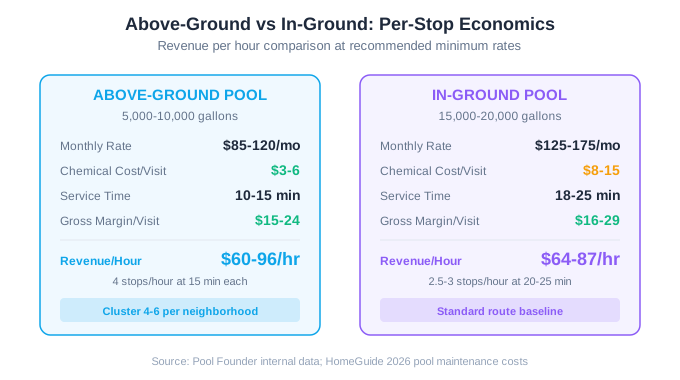
Above-ground pool owners spend less on chemicals per month, but they also take less time to service. A 5,000-gallon above-ground pool needs a fraction of the chemical volume of a 20,000-gallon in-ground pool, and a competent tech can complete the full service in 10 to 12 minutes. If you can stack three or four of them into a neighborhood cluster, the per-hour revenue starts looking comparable to your in-ground route stops.
This guide covers the business case for adding above-ground pools to your service route, including pricing models, chemistry adjustments for smaller water volumes, and how to identify the right customers.
How Big Is the Above-Ground Pool Market?
The above-ground pool market in the United States was valued at over $3.1 billion in 2025 and is growing at a 5.2% compound annual growth rate according to The Business Research Company. The pandemic-era boom drove a massive surge in above-ground pool purchases, with installations spiking over 500% in 2020 and 2021 per CAPE Analytics data. Those pools are now three to five years old, and their owners are discovering that maintaining water chemistry is harder than the box suggested.
3.6M+
Estimated above-ground residential pools in the U.S.
Source: PHTA, industry analysis (41% of 8.8M residential pools)
5.2%
Above-ground pool market CAGR through 2034
Source: The Business Research Company
The typical above-ground pool owner is not the same customer profile as your in-ground client. Household income skews lower, the pool was often purchased for under $5,000, and the owner initially planned to handle their own maintenance. After one or two seasons of green water, algae outbreaks, and frustration with test strips, a significant percentage of these owners start searching for affordable professional help.
What Types of Above-Ground Pools Can You Service?
| Pool Type | Typical Volume | Avg. Service Time | Serviceable? |
|---|---|---|---|
| Steel/resin wall (round) | 5,000-12,000 gal | 10-15 min | Yes, primary target |
| Steel/resin wall (oval) | 8,000-18,000 gal | 12-18 min | Yes, primary target |
| Semi-inground | 10,000-20,000 gal | 15-20 min | Yes, treat like in-ground |
| Intex/Bestway inflatable | 2,000-5,000 gal | 8-12 min | Case by case |
| Stock tank pools | 300-700 gal | N/A | Not recommended |
Steel and resin wall above-ground pools with proper filtration systems are your primary market. Semi-inground pools service identically to standard in-ground pools. Inflatable pools from brands like Intex and Bestway can be serviced, but the equipment is less reliable, and customer expectations around price are often unrealistically low. Stock tank pools are not worth your time.
How Should You Price Above-Ground Pool Service?
The biggest mistake companies make with above-ground pricing is discounting too aggressively. Yes, the pool is smaller. Yes, it uses fewer chemicals. But your drive time, truck wear, and overhead per stop are identical whether the pool holds 5,000 gallons or 25,000 gallons. Your minimum rate needs to cover the fixed cost of showing up.
| Service Level | Monthly Rate | What It Includes | Per-Visit Revenue |
|---|---|---|---|
| Chemical-only | $60-85/mo | Test, balance, add chems | $15-21/visit |
| Basic maintenance | $85-120/mo | Chems + skim, brush, basket | $21-30/visit |
| Full service | $100-150/mo | Everything + vacuum, filter | $25-38/visit |
| Seasonal (open/close) | $150-250 each | Startup or winterize | One-time |
Your chemical cost per visit on a 5,000 to 10,000-gallon above-ground pool runs $3 to $6, compared to $8 to $15 for a standard 15,000 to 20,000-gallon in-ground pool. That means your gross margin per stop can actually be higher on above-ground pools if your rate is set correctly. The key metric is revenue per hour, not revenue per pool.
Set a minimum monthly rate of $85 regardless of pool size. Below that threshold, the stop does not generate enough margin to justify the drive time and administrative overhead. If a customer balks at $85 per month, they are not your customer.
How Do You Bundle Above-Ground Pools for Route Density?
Above-ground pools tend to cluster in specific neighborhoods, particularly newer subdivisions and communities with smaller lot sizes. This creates a density opportunity. If you can pick up four to six above-ground pools within a two-mile radius, you have a micro-route that generates $400 to $700 per month in under 90 minutes of service time. Market to entire neighborhoods rather than individual homeowners. Door hangers, Nextdoor posts, and referral discounts work well in these concentrated areas.
How Does Chemistry Differ for Smaller Pool Volumes?
The fundamental chemistry is identical. Free chlorine, pH, total alkalinity, calcium hardness, and CYA all need to be in the same target ranges regardless of pool volume. What changes dramatically is the margin for error. A small dosing mistake in a 5,000-gallon pool has twice the concentration impact of the same mistake in a 10,000-gallon pool and four times the impact in a 20,000-gallon pool.
What Are the Chemistry Targets for Above-Ground Pools?
| Parameter | Target Range | AG-Specific Notes |
|---|---|---|
| Free chlorine | 2-4 ppm | Swings faster in small volumes, test every visit |
| pH | 7.2-7.6 | Easier to overshoot with acid, dose in smaller increments |
| Total alkalinity | 80-120 ppm | Buffer capacity matters more in small volumes |
| CYA | 30-50 ppm | Accumulates faster per tab in smaller volumes |
| Calcium hardness | 150-250 ppm | Vinyl liners do not need CH above 200 |
| Water temperature | Varies | Heats faster, loses heat faster, affects chlorine demand |
CYA accumulation is the number one chemistry issue with above-ground pools using trichlor tablets. Every 10 ppm of free chlorine delivered by trichlor adds approximately 6 ppm of CYA. In a 5,000-gallon pool using a single 3-inch tab per week, CYA can climb from 30 ppm to 100+ ppm in a single season. Once CYA exceeds 80 ppm, the chlorine becomes ineffective relative to the CYA ratio, and the only fix is a partial drain and refill.
For above-ground pools, consider liquid chlorine or a small salt system instead of trichlor tabs. It costs slightly more per visit but prevents the CYA accumulation problem that leads to green pools and customer complaints.
How Does Vinyl Liner Chemistry Differ?
Nearly all above-ground pools have vinyl liners, which changes two chemistry considerations. First, calcium hardness targets are lower. Vinyl does not etch or scale like plaster, so 150 to 250 ppm is fine versus the 200 to 400 ppm range for plaster pools. Second, the Langelier Saturation Index matters less for surface protection but still affects equipment longevity. Third, granular calcium hypochlorite must be pre-dissolved before adding to the pool. Undissolved granules sitting on a vinyl liner will bleach and damage the material within minutes.
What Equipment Do You Need for Above-Ground Service?
You do not need separate equipment for above-ground pools. Your existing test kit, chemical supply, and cleaning tools all work. The only additions are a few lower-cost items that make the service faster and more professional.
- Telescopic pole that reaches 8 feet (shorter than in-ground poles, faster to handle)
- Leaf skimmer with fine mesh (above-ground pools sit closer to landscaping and catch more debris)
- Vinyl liner-safe vacuum head (avoid wheeled heads that can snag liner seams)
- Pre-dissolving bucket for granular chemicals (never add undissolved granules directly to vinyl)
- Small dosing cups marked in ounces for precise chemical additions in small volumes
- Hose-end adapter for partial drains when CYA gets too high
Total additional equipment investment runs $50 to $150. The bigger operational consideration is understanding the pump and filter systems. Most above-ground pools use cartridge filters or small sand filters rated for 1,200 to 2,400 GPH. These filters need cleaning or replacement more frequently than the equipment on in-ground pools, which creates an upsell opportunity for filter maintenance packages.
How Do You Handle Above-Ground Pool Filtration?
Cartridge filters on above-ground pools should be cleaned every two to four weeks during peak season and replaced annually. A replacement cartridge costs $15 to $40 depending on the model. Offering a "filter included" annual plan at a $5 to $10 monthly premium locks in revenue and eliminates the customer excuse of "I forgot to buy a new filter." Sand filters on above-ground pools hold 50 to 100 pounds of sand and need replacement every three to five years, which is a $100 to $200 service call you can schedule proactively.
What Are the Common Mistakes When Adding Above-Ground Pools?
Corey Adams, Pool Founder co-founder and 15-year pool service veteran, has seen companies add above-ground pools to their routes and succeed or fail based on a handful of decisions. "The companies that struggle are the ones that treat above-ground pools as charity work. They price them at $50 a month, spend 15 minutes per stop, and then resent the customer when the margins are bad. The companies that do well charge a real rate, cluster the stops geographically, and treat the service with the same professionalism as their in-ground route."
Five Mistakes to Avoid
- 1Pricing below your minimum rate. Your truck costs the same to operate whether you are servicing a 5,000-gallon above-ground or a 20,000-gallon in-ground pool. Never go below $85 per month.
- 2Using trichlor tabs as the primary sanitizer. CYA accumulates too fast in small volumes. Switch to liquid chlorine or recommend a salt system.
- 3Skipping the filter service upsell. Above-ground pool filters need more frequent attention, and the customer rarely handles it themselves. Build it into the plan.
- 4Taking scattered one-off accounts. A single above-ground pool 20 minutes from your nearest route stop loses money regardless of the rate. Only add them in clusters.
- 5Ignoring the seasonal open/close opportunity. In seasonal markets, above-ground pool opening and closing services at $150 to $250 each represent pure margin because the customer has no idea how to do it properly.
How Do You Market Above-Ground Pool Service?
Traditional pool service marketing targets homeowners with in-ground pools, which means your messaging, imagery, and ad targeting all filter out above-ground pool owners. To reach this market, you need slightly different channels and copy.
Effective Marketing Channels for Above-Ground Pool Owners
- Nextdoor posts in neighborhoods with high above-ground pool density (free, highly targeted)
- Facebook groups for above-ground pool owners (these groups are large and active, with members constantly asking for help with green water)
- Door hangers in subdivisions where you spot above-ground pools from the street or satellite imagery
- Google Ads targeting "above ground pool service near me" and "above ground pool cleaning service" (low competition, low CPC)
- Partnerships with local pool supply stores that sell above-ground pool equipment and chemicals
Your messaging should address the specific pain point: "Tired of your above-ground pool turning green every two weeks? We service above-ground pools starting at $85/month, chemicals included." The target customer has already tried DIY maintenance and failed. They are not comparing you to other pool service companies. They are comparing you to spending another Saturday testing water and driving to the pool store.
Above-ground pool owners who convert to professional service have lower churn than in-ground customers in our experience, because they have already tried and failed at DIY. They know the value of the service because they have felt the pain of not having it.
Ready to streamline your pool service business?
Pool Founder gives you route optimization, automated invoicing, chemical tracking, and everything else you need to run a more profitable pool business.
Frequently Asked Questions
Is it profitable to service above-ground pools?
Yes, if priced correctly and clustered geographically. A 5,000 to 10,000-gallon above-ground pool costs $3 to $6 in chemicals per visit versus $8 to $15 for a standard in-ground pool, and takes 10 to 15 minutes to service. At a $100 per month rate with four weekly visits, your gross margin per stop can exceed in-ground pools. The key is maintaining a minimum rate of $85 per month and only adding accounts that fit your route density.
How many above-ground pools are in the United States?
Approximately 3.6 million above-ground residential pools exist in the U.S., representing about 41% of all residential swimming pools. The pandemic drove a massive surge in above-ground pool purchases in 2020 and 2021, with installations spiking over 500% according to CAPE Analytics. Many of these pools are now three to five years old with owners looking for professional maintenance help.
What chemicals do above-ground pools need?
Above-ground pools need the same chemicals as in-ground pools: a sanitizer (chlorine), pH adjuster (muriatic acid or sodium bisulfate), alkalinity increaser (sodium bicarbonate), and optionally CYA (cyanuric acid) for outdoor pools. The key difference is dosing volume. Use liquid chlorine instead of trichlor tabs when possible to prevent CYA accumulation in smaller water volumes. Always pre-dissolve granular chemicals before adding them to vinyl-lined pools.
How long does it take to service an above-ground pool?
A standard above-ground pool service visit takes 10 to 15 minutes for basic maintenance including chemical testing, balancing, skimming, brushing, and basket cleaning. Full-service visits that include vacuuming and filter inspection take 15 to 20 minutes. This is roughly 30% to 50% less time than a typical in-ground pool service stop, which is why revenue per hour can remain competitive even at a lower monthly rate.
What is the biggest chemistry challenge with above-ground pools?
CYA (cyanuric acid) accumulation from trichlor tablet use is the most common chemistry problem. In a 5,000-gallon pool, a single 3-inch trichlor tab per week can push CYA from 30 ppm to over 100 ppm in one season. Once CYA exceeds 80 ppm, chlorine becomes ineffective. The fix is a partial drain and refill, which is inconvenient and wastes water. Using liquid chlorine as the primary sanitizer avoids this problem entirely.
Should I offer seasonal open and close services for above-ground pools?
Absolutely. In seasonal markets, above-ground pool opening and closing services are high-margin revenue opportunities. Charge $150 to $250 per service. Most above-ground pool owners do not know how to properly winterize or open their pools, and improper winterization leads to liner damage, algae blooms at startup, and equipment failures. Offering these services also creates a natural touchpoint to sign customers up for ongoing seasonal maintenance.