Not All Pools Cost the Same to Service. Your Pricing Should Reflect That.
A 10,000-gallon fiberglass pool with a cartridge filter takes half the chemical cost and two-thirds the service time of a 25,000-gallon plaster pool with a DE filter. But most pool service companies charge them the same monthly rate. That is a pricing mistake that compounds over hundreds of stops per year.
Pool type, surface material, sanitization system, and equipment configuration all affect how long a stop takes and how much it costs in chemicals. Pricing by pool type is not about nickel-and-diming customers. It is about making sure every account on your route is profitable and that complex pools are not subsidized by simple ones.
$175 vs $750
annual chemical cost difference between fiberglass pools ($175) and concrete/plaster pools ($750)
Source: River Pools and Spas / HomeGuide 2026
Corey Adams, Pool Founder co-founder and 15-year pool service veteran, learned this lesson early. "I used to charge every pool the same rate. Then I tracked my actual time and chemical usage per stop for a month. My plaster pools cost me 40% more to service than my fiberglass pools. I was losing money on my biggest accounts without knowing it."
How Does Pool Surface Type Affect Service Costs?
Pool surface type is the single biggest driver of chemical cost variation. Rough surfaces like plaster and pebble demand more chemicals because they harbor algae and affect water chemistry faster than smooth surfaces like fiberglass. Here is what the numbers look like across the three main surface types.
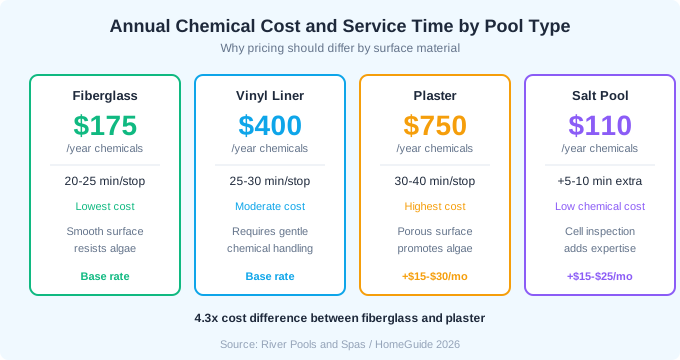
| Surface Type | Annual Chemical Cost | Service Time | Pricing Adjustment |
|---|---|---|---|
| Fiberglass | $175/year | 20-25 min | Base rate or slight discount |
| Vinyl liner | $400/year | 25-30 min | Base rate |
| Concrete/plaster | $750/year | 30-40 min | +$15-$30/month above base |
| Pebble/aggregate | $600-$800/year | 30-40 min | +$15-$30/month above base |
Fiberglass pools are the easiest and least expensive to maintain. The smooth, non-porous surface resists algae growth, holds fewer bacteria, and requires less chemical treatment. Fewer chemicals means less time dosing and testing. Most fiberglass pools can be serviced in 20-25 minutes.
Concrete and plaster pools are at the other end. The porous surface absorbs chemicals, promotes algae growth in rough spots, and gradually raises pH as the plaster leaches calcium. These pools consistently use more chlorine and acid than any other surface type. If you price them the same as fiberglass, you are giving away 10-15 minutes of labor and $40-$50 of chemicals per month.
Why Do Salt Pools Need a Price Premium?
Salt pools have lower chemical costs ($70-$150 per year versus $300-$600 for traditional chlorine) but require additional expertise, equipment inspection, and periodic maintenance that most pool service companies do not account for in their pricing.
The salt chlorine generator cell needs regular inspection and periodic cleaning. Calcium buildup on the cell plates reduces efficiency and shortens cell life. A replacement salt cell costs $200-$700, with professional installation running an additional $100-$250. If your tech is not inspecting the cell regularly, your customer is headed for a $400-$900 surprise.
- Cell inspection adds time. Checking the salt cell, cleaning buildup, and verifying output adds 5-10 minutes per visit that you do not spend on traditional chlorine pools.
- Salinity monitoring is required. Salt levels need to stay in a specific range (typically 2,700-3,400 ppm). Testing and adjusting adds a step to every service visit.
- Equipment corrosion risk. Salt is corrosive. Handrails, ladders, lighting fixtures, and even the pool deck around a salt pool need monitoring for corrosion that would not occur with a traditional chlorine pool.
- Expertise premium. Not every tech knows how to service salt systems. Your ability to troubleshoot a salt chlorine generator has real value that justifies a higher rate.
A reasonable salt pool premium is $15-$25/month above your standard rate. This covers the additional inspection time, salinity monitoring, and equipment expertise. Customers with salt pools chose them for a reason and generally understand they require specialized service.
How Should You Price Vinyl Liner Pools?
Vinyl liner pools fall in the middle of the pricing spectrum. Chemical costs average $400 per year, which is more than fiberglass but significantly less than plaster. Service time is comparable to fiberglass at 25-30 minutes per stop. The key pricing consideration with vinyl is the care required to avoid damaging the liner.
Vinyl liners are vulnerable to damage from improper chemical handling, aggressive brushing, and sharp-edged vacuum heads. A torn liner costs $3,000-$6,000 to replace. That liability risk should factor into your pricing, even though the day-to-day service cost is moderate.
- Chemical sensitivity: Granular chlorine poured directly on a vinyl liner can bleach and weaken the material. Techs must pre-dissolve or use liquid chlorine only. This adds a small amount of time but reduces damage risk.
- pH management is critical: Vinyl liners degrade faster when pH stays below 7.0 or above 7.8. Consistent pH monitoring protects the liner lifespan and reduces your liability.
- No aggressive brushing: Vinyl requires soft bristle brushes only. Your tech needs to know the difference. Using a stainless steel brush on vinyl is an expensive mistake.
- Wrinkle monitoring: Groundwater pressure can cause vinyl liners to shift and wrinkle. While this is not your responsibility, noting it in service reports protects you from blame.
Most pool service companies price vinyl pools at their standard base rate with no premium. This is reasonable for straightforward accounts. However, if the liner is old (10+ years) or the pool has above-ground plumbing that requires additional inspection, consider a modest surcharge of $5-$10/month.
How Do You Price Based on Pool Size and Volume?
Pool volume directly impacts chemical costs. A 20,000-gallon pool uses roughly twice the chemicals of a 10,000-gallon pool. Service time also increases with size because there is more surface area to brush, more water to test, and a larger area to skim.
| Pool Size | Monthly Chemical Cost | Service Time | Suggested Rate Range |
|---|---|---|---|
| Small (under 10K gal) | $10-$15 | 20-25 min | $100-$140 |
| Medium (10K-20K gal) | $15-$25 | 25-35 min | $130-$175 |
| Large (20K-30K gal) | $25-$40 | 35-45 min | $165-$220 |
| Extra large (30K+ gal) | $35-$55 | 40-55 min | $200-$275+ |
Pools with attached spas should be priced higher than standalone pools. A spa adds 5-10 minutes of service time (separate chemical treatment, jet inspection, cover check) and increases monthly chemical costs by $5-$10. A $15-$25/month spa surcharge is standard.
Do not eyeball pool size. Get the actual gallon volume from the homeowner, the pool builder records, or calculate it yourself. Underestimating pool size by 5,000 gallons means undercharging on chemicals every single month.
How Does Equipment Configuration Affect Pricing?
The pool equipment pad matters for pricing because different filter types, heaters, and automation systems affect your service time. A pool with a simple cartridge filter and no extras takes 25 minutes. A pool with a DE filter, gas heater, salt system, and automation controller takes 40 minutes because there is more to inspect and more that can go wrong.
- Cartridge filter: Standard. No pricing adjustment needed. Filter cleans billed as add-on service ($75-$150 per clean).
- DE filter: Backwashing takes 5-10 extra minutes when needed. Consider a $5-$10/month premium for pools with DE filters.
- Salt chlorine generator: Add $15-$25/month for cell inspection, salinity monitoring, and specialized knowledge.
- Gas or heat pump heater: Requires startup and shutdown inspection during seasonal transitions. Add $5-$10/month if the heater is in regular use.
- Automation system (Pentair, Hayward): Understanding and troubleshooting pool automation is a skill premium. Add $5-$15/month for pools with full automation.
- Water features (spillovers, fountains, bubblers): Each feature adds inspection time and potential maintenance issues. Add $5-$10/month per significant feature.
The cumulative effect of equipment surcharges can be significant. A pool with a salt system, DE filter, heater, and automation might carry $30-$55/month in premiums above your base rate. That is appropriate because those pools genuinely cost more to service and require more expertise.
How Do You Avoid Underpricing Complex Accounts?
The most common pricing mistake in pool service is quoting a flat rate before seeing the pool. A customer calls, says they have a pool, and you quote $150/month. Then you show up and find a 30,000-gallon plaster pool with a screened enclosure, a spa, a salt system, a DE filter, and a waterfall. You just committed to servicing a $220/month pool for $150.
- 1Always inspect before quoting. Drive by or visit every pool before committing to a price. Five minutes of inspection prevents months of underpriced service.
- 2Use a pricing checklist. Start with your base rate and add surcharges for pool size, surface type, salt system, equipment complexity, and access difficulty. Let the checklist build the price.
- 3Quote a range on the phone. "Our rates typically range from $130-$220 per month depending on pool size and equipment. I would need to see your pool to give you an exact quote." This sets expectations without locking you in.
- 4Review your route quarterly. Pools change. Customers add salt systems, install heaters, or expand their equipment. If a pool's service requirements increase, the price should follow.
Track your actual time per stop for one month. If any pool consistently takes 40+ minutes while you are charging your 30-minute rate, that account needs a price adjustment. Your route profitability depends on every stop pulling its weight.
Ready to streamline your pool service business?
Pool Founder gives you route optimization, automated invoicing, chemical tracking, and everything else you need to run a more profitable pool business.
Frequently Asked Questions
What pool type is cheapest to maintain?
Fiberglass pools are the cheapest to maintain. Annual chemical costs average $175 compared to $400 for vinyl and $750 for concrete/plaster. The smooth, non-porous surface resists algae and requires less chemical treatment. Service time is also shorter at 20-25 minutes per stop.
How much more should you charge for salt pools?
A reasonable salt pool premium is $15-$25/month above your standard rate. This covers salt cell inspection, salinity monitoring, equipment corrosion checks, and the specialized knowledge required to service salt chlorine generators. Salt cells cost $200-$700 to replace, so regular inspection protects your customer.
Should you charge more for plaster pools?
Yes. Plaster pools use roughly $750/year in chemicals versus $175 for fiberglass. They also take 30-40 minutes to service versus 20-25 for fiberglass. A surcharge of $15-$30/month for plaster pools accounts for higher chemical costs and longer service time.
How do you price a pool with a spa?
Pools with attached spas should carry a $15-$25/month surcharge. A spa adds 5-10 minutes of service time for separate chemical treatment, jet inspection, and cover check. Monthly chemical costs increase by $5-$10. The surcharge covers both the extra time and materials.
What is the most expensive pool type to maintain?
Concrete and plaster pools are the most expensive to maintain. They have the highest annual chemical costs ($750), the longest service times (30-40 minutes), and require acid washing every 3-5 years ($200-$600). Large plaster pools with DE filters and attached spas are the highest-cost accounts in most routes.
Should I quote a flat rate or price by pool type?
Price by pool type. A flat rate means your easy fiberglass pools subsidize your expensive plaster pools. Use a base rate with surcharges for surface type, pool size, salt system, and equipment complexity. This ensures every account on your route is individually profitable.