Picking the Wrong Shock Costs You Time, Money, and Callbacks
Pool shock is one of the most used and most misunderstood chemicals on a service route. There are four main types, each with different active ingredients, different available chlorine percentages, and different best-use cases. Using the wrong shock for the situation causes cloudy water, surface damage, CYA buildup, or wasted product. Knowing which shock to grab and how to dose it correctly separates professional service from guesswork.
Corey Adams, Pool Founder co-founder and 15-year pool service veteran, carries two types of shock on every truck. "Cal-hypo for routine shocking and breakpoint, liquid chlorine for green pools and demand situations. Dichlor stays on the truck for vinyl liner pools that need a gentle touch. I almost never use MPS because it does not kill algae and it messes with DPD test results for two days."
This guide covers calcium hypochlorite, sodium hypochlorite, dichlor, and potassium monopersulfate. You will learn the available chlorine content, dosing math, best use cases, and the mistakes that generate callbacks.
What Are the Four Main Types of Pool Shock?
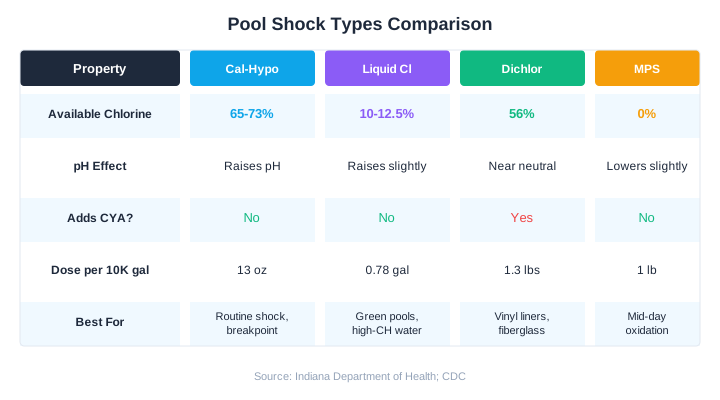
Pool shock products fall into four categories based on their active ingredient. Each has a different available chlorine percentage, pH impact, and set of tradeoffs. The table below is the reference you need on your truck.
| Shock Type | Active Ingredient | Available Chlorine | pH Effect | Adds CYA? | Dissolves |
|---|---|---|---|---|---|
| Cal-hypo | Calcium hypochlorite | 65-73% | Raises pH (product pH 10.8-11.8) | No | Must pre-dissolve or broadcast |
| Liquid chlorine | Sodium hypochlorite | 10-12.5% | Raises pH slightly | No | Liquid, instant |
| Dichlor | Sodium dichloro-s-triazinetrione | 56% | Near neutral (pH 6.5-7.0) | Yes (9 ppm CYA per 10 ppm FC) | Fast dissolving granular |
| MPS | Potassium monopersulfate | 0% (non-chlorine) | Lowers pH slightly | No | Fast dissolving granular |
Cal-hypo adds calcium to the water. In hard-water areas where calcium hardness already exceeds 300 ppm, repeated cal-hypo use can push CH above 400 ppm and cause scaling. Use liquid chlorine in high-calcium markets.
When Should You Use Each Type of Shock?
Each shock type has a best-fit scenario. Using the right one for the job saves product, prevents side effects, and reduces callbacks. Here is when to reach for each.
When Do You Use Calcium Hypochlorite (Cal-Hypo)?
Cal-hypo is the workhorse for routine weekly or biweekly shocking. At 65-73% available chlorine, it delivers the most chlorine per pound of any granular product. Use it for breakpoint chlorination, routine oxidation, and algae kills on plaster and concrete pools. Avoid it on vinyl liners unless you pre-dissolve it completely, as undissolved granules can bleach the liner.
When Do You Use Liquid Chlorine (Sodium Hypochlorite)?
Liquid chlorine at 12.5% is the best choice for green pool recoveries, high-demand situations, and pools with high calcium hardness. It adds no calcium, no CYA, and no residue. The drawback is weight and storage. A gallon weighs about 10 pounds, and it degrades in heat. Keep it in a cool, shaded area on the truck and use it within 30 days of purchase.
When Do You Use Dichlor?
Dichlor is pH-neutral and dissolves quickly, making it ideal for vinyl liner and fiberglass pools where you cannot risk undissolved granules or surface damage. The tradeoff is that dichlor adds cyanuric acid. Every 10 ppm of FC from dichlor adds approximately 9 ppm of CYA. Use it sparingly and monitor CYA levels. It is not a good choice for routine weekly shocking because CYA will accumulate past 50 ppm quickly.
When Do You Use MPS (Non-Chlorine Shock)?
Potassium monopersulfate oxidizes organic contaminants but does not kill algae or bacteria. Its only advantage is that swimmers can enter the pool 15 minutes after treatment. Use it for commercial pools that need mid-day oxidation without closing. Do not use MPS for breakpoint chlorination, algae treatment, or any situation where sanitizing is required. MPS also interferes with DPD chlorine tests for 24-48 hours, causing false high readings.
How Do You Calculate the Correct Shock Dose?
Shock dosing depends on three variables: pool volume in gallons, the target ppm increase, and the available chlorine percentage of the product. The standard dosing target for routine shocking is 10 ppm above current FC. For breakpoint chlorination, dose to 10 times the combined chlorine reading.
What Is the Dosing Formula for Each Shock Type?
| Shock Type | Amount per 1 ppm per 10,000 gal | Routine Dose (10 ppm rise) | Breakpoint Dose (varies) |
|---|---|---|---|
| Cal-hypo 73% | 1.3 oz by weight | 13 oz (about 0.8 lb) per 10,000 gal | Multiply by CC x 10 factor |
| Liquid chlorine 12.5% | 10 fl oz | 100 fl oz (0.78 gal) per 10,000 gal | Multiply by CC x 10 factor |
| Dichlor 56% | 2.1 oz by weight | 21 oz (1.3 lb) per 10,000 gal | Not recommended for breakpoint |
| MPS | 1 lb per 10,000 gal (oxidation only) | 1 lb per 10,000 gal | Does not achieve breakpoint |
Example: A 20,000-gallon pool with 2 ppm FC and 1 ppm CC needs breakpoint chlorination. Target FC = 10 x 1 ppm CC = 10 ppm. Additional chlorine needed = 10 - 2 = 8 ppm. Using 73% cal-hypo: 8 x 1.3 oz x 2 (for 20,000 gal) = 20.8 oz, or about 1.3 pounds. Using liquid chlorine: 8 x 10 oz x 2 = 160 oz, or 1.25 gallons.
Always calculate for the specific pool volume. Guessing "one bag per pool" leads to under-dosing small pools and over-dosing large ones. A 10,000-gallon pool and a 25,000-gallon pool need very different amounts. Measure once, dose right, avoid the callback.
What Are the Most Common Shocking Mistakes?
Shocking mistakes are one of the top causes of service callbacks. Most of them come from using the wrong product, dosing incorrectly, or skipping a critical step. Here are the mistakes Corey sees most often from new techs and competitors.
Underdosing: The Partial Shock Problem
Adding half the required dose is worse than not shocking at all for breakpoint chlorination. If you do not reach the breakpoint (10x combined chlorine), you end up in the chloramine formation zone of the breakpoint curve. This actually increases combined chlorine and makes the problem worse. Either hit the full calculated dose or do not attempt breakpoint.
Shocking During the Day Without CYA
UV light destroys unstabilized free chlorine within 2 to 3 hours. If you shock a pool at 10 AM with no cyanuric acid protection, you lose most of the dose to sunlight before it can work. Either shock in the evening, or ensure CYA is at 30-50 ppm before daytime treatment.
Other Common Mistakes to Avoid
- Broadcasting undissolved cal-hypo granules directly onto a vinyl liner, causing bleach spots
- Shocking with dichlor repeatedly, driving CYA above 70 ppm within a season
- Adding shock through the skimmer, which sends concentrated chlorine through the equipment and damages gaskets and seals
- Shocking without lowering pH first. At pH 8.0, only 22% of chlorine is in the active HOCl form, cutting effectiveness dramatically
- Using MPS to treat algae. MPS is an oxidizer, not a sanitizer. It does not kill algae.
- Not running the pump after shocking. The chlorine needs to circulate for at least 4 hours to reach every part of the pool.
The number one callback-generating mistake is adding shock through the skimmer. Concentrated chlorine sitting against equipment gaskets, O-rings, and heater internals causes premature failure. Always broadcast shock around the perimeter of the pool or pre-dissolve and pour.
How Should You Store and Handle Shock on the Truck?
Shock products are oxidizers, and improper storage creates safety hazards and product degradation. Keep cal-hypo and dichlor in sealed, dry containers away from any liquid chemicals, especially muriatic acid. Never store oxidizers and acids in the same compartment. The fumes can react and create toxic chlorine gas.
- Cal-hypo: Store in original sealed container in a cool, dry, ventilated area. Shelf life up to 12 months when stored properly. Keep away from any moisture, which can cause it to self-heat.
- Liquid chlorine: Store upright in a shaded area. Degrades in heat, losing about 1% concentration per month in summer. Use within 30 days for reliable potency.
- Dichlor: Similar storage to cal-hypo. Sealed, dry, ventilated. Stable shelf life of 12+ months.
- MPS: Store sealed and dry. Keep away from chlorine products to prevent cross-contamination.
- Never mix different shock types. Cal-hypo and dichlor (or trichlor) in the same container can cause a violent reaction.
Corey has a strict rule: acids on the left side of the truck, oxidizers on the right, and they never share a compartment. "One accidental splash of muriatic acid into a bag of cal-hypo produces chlorine gas. It is not theoretical. I have seen it happen on another crew." Follow SDS guidelines for every product on your truck.
How Do You Choose Between Shock Types for Different Pool Surfaces?
Pool surface material dictates which shock products are safe to use. Using the wrong product on the wrong surface causes staining, bleaching, and etching that costs real money to fix.
| Pool Surface | Cal-Hypo | Liquid Chlorine | Dichlor | Notes |
|---|---|---|---|---|
| White plaster | Yes | Yes | Yes | All types safe. Cal-hypo is most cost-effective. |
| Colored plaster/pebble | Pre-dissolve only | Yes (preferred) | Yes | Undissolved cal-hypo can cause light spots on dark finishes. |
| Vinyl liner | Pre-dissolve only | Yes (preferred) | Yes (preferred) | Never broadcast granular cal-hypo on vinyl. Bleach spots are permanent. |
| Fiberglass | Pre-dissolve only | Yes (preferred) | Yes | Concentrated granules can etch gel coat. |
| Tile/exposed aggregate | Yes | Yes | Yes | All types safe. Watch calcium levels in hard water areas. |
When in doubt, use liquid chlorine. It dissolves instantly, adds no calcium, adds no CYA, and cannot bleach or etch surfaces. The only downside is bulk and weight on the truck.
Run a pool route?
The business side of what you just read.
Pricing, chemical costs, and the tools owners use to keep the numbers straight.
- Commercial pool service pricing2026 rate tables and the cost-plus formula
- Chemical cost per poolWhat chemicals actually cost per stop
- Chemical tracking softwareLog readings and dosing from the pool deck
- Pool service softwareRoutes, invoicing, and service reports in one app
- Free profit & rate calculatorsProfit per pool, minimum rate, break-even
Frequently Asked Questions
How much shock do I need per 10,000 gallons?
For routine shocking to raise FC by 10 ppm: use 13 oz of 73% cal-hypo, or 0.78 gallons of 12.5% liquid chlorine, or 1.3 lbs of 56% dichlor per 10,000 gallons. For breakpoint chlorination, calculate the dose based on 10 times the combined chlorine reading minus the current free chlorine.
Can I use cal-hypo in a vinyl liner pool?
Only if you pre-dissolve it completely in a bucket of water before adding it to the pool. Never broadcast undissolved cal-hypo granules directly into a vinyl liner pool. Granules that settle on the liner will bleach the vinyl and cause permanent discoloration. Liquid chlorine or dichlor are safer choices for vinyl.
Why is my pool cloudy after shocking?
The most common cause is high calcium hardness combined with high pH after adding cal-hypo shock. Cal-hypo raises pH and adds calcium. If the water was already near saturation, the added calcium precipitates out as calcium carbonate, causing cloudiness. Use liquid chlorine instead in hard water areas, and always lower pH to 7.2 before shocking.
How long after shocking can swimmers enter the pool?
For chlorine-based shock (cal-hypo, liquid, dichlor), swimmers must wait until free chlorine drops to 5 ppm or below, which typically takes 8 to 24 hours depending on sunlight, CYA level, and dose. For MPS (non-chlorine shock), the standard wait time is 15 minutes after the product has fully dissolved.
Does pool shock go bad?
Yes. Liquid chlorine (sodium hypochlorite) degrades fastest, losing about 1% concentration per month in warm storage. Use it within 30 days. Cal-hypo granules last up to 12 months in a sealed, dry, cool container. Dichlor is similarly stable. Once any granular product absorbs moisture, its effectiveness drops significantly.
Should I lower pH before shocking?
Yes. Lower pH to 7.2 before adding any chlorine-based shock. At pH 7.2, approximately 65% of free chlorine is in the active HOCl form. At pH 8.0, only about 22% is active. Lowering pH before shocking makes the same dose significantly more effective and saves product.