Why Is Texas One of the Largest Pool Service Markets in the Country?
Texas is home to a massive installed base of residential swimming pools, with the state consistently ranking among the top three for total pool count alongside Florida and California. The four major Texas metros of Dallas-Fort Worth, Houston, Austin, and San Antonio collectively permitted 387 new residential pools in February 2026 alone, according to HBWeekly construction data. That steady new construction on top of an already large installed base means growing demand for pool service operators.
But Texas is not a single market. DFW pricing differs from Houston. Austin operates differently from San Antonio. Licensing requirements, chemical challenges from extreme heat, and market saturation vary significantly across the state. This guide covers what pool service operators need to know about the Texas market, whether you are starting a new business, expanding from another state, or growing within Texas.
How Big Is the Texas Pool Service Market?
Texas has one of the highest concentrations of residential pools in the United States. Pool ownership rates vary by metro: Houston estimates 15-20% of homes have pools, Dallas-Fort Worth runs 10-15%, Austin falls between 12-16%, and San Antonio averages 8-12%. Nationally, there are approximately 10.7 million swimming pools in the U.S. including 10.4 million residential pools, and Texas holds a significant share of that total.
| Metro Area | Pool Ownership Rate | New Permits (Feb 2026) | Market Character |
|---|---|---|---|
| Houston | 15-20% | Highest volume | Mature market, price competitive |
| Dallas-Fort Worth | 10-15% | Strong growth | Suburban expansion, premium pricing |
| Austin | 12-16% | Steady | Tech-affluent, higher willingness to pay |
| San Antonio | 8-12% | Moderate | Value-oriented, military community |
The Texas pool season runs roughly March through November, with many pools in southern Texas staying open year-round. That gives Texas operators a significantly longer active season than northern markets, which translates to more consistent revenue and fewer seasonal cash flow gaps.
What Does Pool Service Cost in Texas by Metro Area?
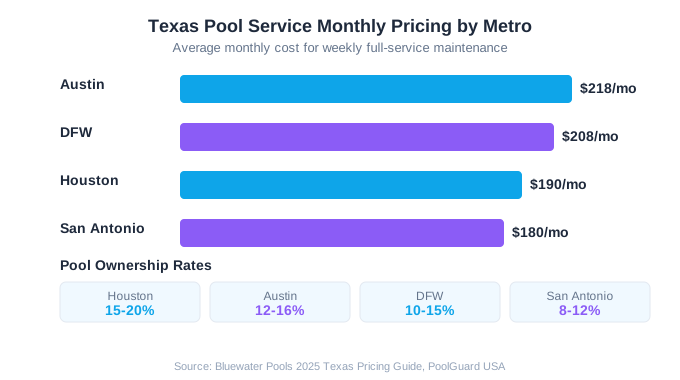
Weekly pool service pricing in Texas ranges from $125 to $300 per month depending on the metro area, pool size, and service level. The Dallas-Fort Worth metroplex averages $208/month for full-service weekly maintenance. Austin commands slightly higher rates at $218/month. Weekly residential visits in Austin and San Antonio typically run $45-$60 per visit including standard chemicals.
| Metro | Monthly Range (Weekly Service) | Average | Chemical-Only Service |
|---|---|---|---|
| Dallas-Fort Worth | $120-$300/mo | $208/mo | $80-$120/mo |
| Austin | $140-$300/mo | $218/mo | $90-$130/mo |
| Houston | $125-$275/mo | $190/mo | $75-$115/mo |
| San Antonio | $110-$250/mo | $180/mo | $70-$110/mo |
Houston tends to be the most price-competitive Texas market due to higher operator density. Austin supports premium pricing partly because of its higher cost of living and tech-industry demographics. San Antonio runs on the value end, influenced by military community expectations for straightforward pricing.
$208/mo
average monthly pool service cost in Dallas-Fort Worth
Source: Bluewater Pools 2025 Texas Pricing Guide
What Licenses and Certifications Do You Need in Texas?
Texas does not require a specific state license to perform basic residential pool cleaning and chemical service. However, the state mandates CPO (Certified Pool Operator) certification for anyone responsible for operating commercial or public pools and spas. If you plan to service apartment complexes, hotels, HOA pools, or any public facility, you must have a CPO on staff.
What Certifications Matter in Texas?
- CPO Certification (Pool & Hot Tub Alliance): Required for commercial pool work, $300-$400 for the two-day course, valid for five years
- Residential Appliance Installer License (RAIL): Required for replacing pumps, motors, heaters, and underwater lights in Texas
- Electrical license: Required for any electrical work on pool equipment beyond basic appliance replacement
- General business requirements: Sales tax permit, business registration, general liability insurance ($500K-$1M minimum)
The RAIL (Residential Appliance Installer License) requirement catches many Texas pool operators off guard. If you are replacing pumps, heaters, or lights, you need this license from the Texas Department of Licensing and Regulation. Operating without it carries fines and potential liability issues.
How Does Texas Heat Affect Pool Chemistry and Operations?
Texas heat creates chemical challenges that operators in cooler climates never deal with. When water temperatures exceed 85-90 degrees (common from June through September), chlorine consumption doubles or triples. Algae growth accelerates dramatically above 82 degrees. Evaporation rates of 1-2 inches per week concentrate minerals and CYA faster. These factors mean Texas pool techs use more chemicals per pool and visit more frequently than operators in moderate climates.
| Challenge | Cause | Operational Impact |
|---|---|---|
| Rapid chlorine consumption | Water temps above 85°F | Higher chemical cost per pool, may need 2x normal dose |
| Accelerated algae growth | Water temps above 82°F + sunlight | More frequent brush/vacuum, algaecide maintenance required |
| High evaporation | 1-2 inches/week in peak summer | Weekly water level checks, mineral concentration drift |
| CYA accumulation | Trichlor + reduced dilution from evaporation | More frequent partial drains, salt system advantage |
| Scale formation | High calcium in Texas municipal water | Monthly sequestrant treatment, regular tile cleaning |
| Equipment stress | Pumps/heaters run longer in heat | More repair calls, shorter equipment lifespan |
Smart Texas operators factor heat-related chemical costs into their pricing. A pool that costs $35/month in chemicals in a northern state might cost $55-$75/month in chemicals during a Texas summer. If your pricing does not account for that difference, your margins disappear from June through September.
What Is the Competitive Landscape in Major Texas Markets?
The Texas pool service market is fragmented, with thousands of small operators competing alongside national franchises and mid-size regional companies. Houston is the most saturated market with the highest number of pool service providers per capita. Austin is the fastest-growing market with new operators entering constantly. DFW offers the best balance of strong demand and room for new entrants, especially in rapidly growing suburbs like Frisco, McKinney, and Prosper.
How Do You Compete in a Saturated Texas Market?
- Focus on a specific geographic area (one or two zip codes) rather than trying to cover the entire metro
- Build route density in growing suburbs where competition has not yet concentrated
- Offer consistent service quality with photo documentation that customers can verify
- Get Google reviews aggressively from day one. Texas homeowners check reviews before hiring.
- Price appropriately for your market. Undercutting Houston rates when your costs are DFW-level loses money.
- Specialize in a niche: saltwater pools, commercial properties, or luxury homes
The operators who struggle in Texas are the ones trying to be the cheapest across a wide service area. The ones who thrive are building dense routes in specific neighborhoods and letting their reputation grow from there. Route density keeps drive time low and profit per hour high.
What Are the Biggest Opportunities in Texas Pool Service Right Now?
Texas is adding population faster than almost any other state, and that growth is driving pool construction in new suburban developments. The suburbs north of Dallas (Frisco, Celina, Prosper), the suburbs of Austin (Cedar Park, Round Rock, Georgetown), and the Katy/Sugar Land corridor west of Houston all have massive new-home construction with high pool attachment rates. These new neighborhoods are underserved by established pool companies because the communities are too new.
Where Else Are Opportunities Growing?
- Saltwater pool conversions: Texas homeowners are switching in growing numbers, creating service demand for operators who understand salt systems
- Energy-efficient equipment upgrades: Variable-speed pump mandates (DOE regulation) create upgrade opportunities for every single-speed pump in Texas
- Commercial service: Texas hotel and apartment construction continues, each needing ongoing pool maintenance with CPO oversight
- Automation retrofits: Smart pool controls, app-connected chemistry monitors, and LED lighting upgrades are in high demand in Austin and DFW
The DOE variable-speed pump regulation means every single-speed pump in Texas will eventually need replacement. That is a massive equipment upgrade opportunity for operators who position themselves as the knowledgeable choice for pump replacement and energy savings.
What Should Out-of-State Operators Know Before Entering Texas?
If you are relocating to Texas or expanding your pool service business into the state, there are several Texas-specific factors to plan for. First, the heat is not just uncomfortable. It fundamentally changes how you operate, how much chemical you use, and how you schedule your day. Most experienced Texas pool techs start routes at 6:30-7:00 AM and try to finish by 2:00 PM during peak summer.
- Texas has no state income tax, which improves take-home margins but does not eliminate franchise tax (business tax) obligations
- Workers comp is optional in Texas (one of the few states), but strongly recommended for pool service
- The RAIL license is required before you replace any pool equipment. Get it before you arrive.
- Municipal water chemistry varies dramatically across Texas. Well water in Hill Country is extremely hard; Dallas water is moderate; Houston water is soft.
- Hail damage to pool equipment (pumps, automation panels, heaters) is a real insurance claim category in Texas
- The market is year-round in southern Texas but semi-seasonal in DFW and the Panhandle (expect a slow period December-February)
Texas franchise tax applies to businesses with revenue over $2.47 million (as of 2025). Below that threshold, you file but owe nothing. Plan your business entity structure accordingly. Most pool service companies start well below this threshold.
Free starter kit
Start a pool service business with the numbers already run.
A short email series from an owner who started with $1,200 and a used truck. No software pitch, just the four things that decide whether year one works.
- Startup cost breakdownEvery line item from $2K bootstrap to fully equipped
- Pricing calculatorThe minimum you can charge per visit and still profit
- First-10-customers playbookDoor hangers, referrals, and the phone script that closes
- Licensing & insurance checklistWhat your state requires and which insurers pay claims
Already running routes? Try Pool Founder free
Frequently Asked Questions
Do you need a license to do pool service in Texas?
Basic residential pool cleaning and chemical service does not require a state license in Texas. However, CPO certification is required for commercial pool work, and a RAIL (Residential Appliance Installer License) is required for replacing pool equipment like pumps, heaters, and lights. You also need standard business registration and insurance.
How much do pool service companies charge in Texas?
Weekly pool service in Texas averages $180-$218/month depending on the metro area. Dallas-Fort Worth averages $208/month, Austin averages $218/month, Houston averages around $190/month, and San Antonio runs $180/month. Chemical-only service starts at $70-$130/month.
Is the Texas pool service market oversaturated?
Houston is the most competitive Texas market with the highest operator density. However, rapid suburban growth in DFW, Austin, and San Antonio continues to create underserved areas. New developments north of Dallas and in the Austin suburbs are particularly strong opportunities for new operators building routes.
How does Texas heat affect pool chemical costs?
When water temperatures exceed 85 degrees (common June through September in Texas), chlorine consumption doubles or triples compared to moderate climates. A pool that costs $35/month in chemicals up north may cost $55-$75/month in a Texas summer. Pricing must account for this increased chemical usage.
Is pool service year-round in Texas?
In Houston, San Antonio, and Austin, many pools operate year-round with reduced winter service. In DFW and the Panhandle, expect a slow period from December through February when some customers pause weekly service. Southern Texas is essentially a year-round market.