How Far Behind Is the Pool Service Industry on Technology?
The field service management software market hit $5.66 billion in 2025 and is growing to $9.68 billion by 2030. Almost half (48%) of field service employers now use software to track and dispatch technicians. But pool service sits well below that average. The industry is dominated by solo operators and small companies where a clipboard, a phone, and a spreadsheet still handle daily operations for the majority of businesses.
This data gap matters because technology adoption directly correlates with profitability, customer retention, and growth capacity. Pool companies using route optimization software reduce drive time by up to 30%. Automated billing reduces payment collection time by days. Digital service reports cut customer complaints and churn. The companies that adopt technology are pulling ahead, and the gap is widening.
48%
of field service employers use software to track and dispatch technicians
Source: Field Service Management Software Statistics
$5.66B
field service management software market size in 2025
Source: Mordor Intelligence
28%
of small businesses face implementation challenges due to limited IT resources
Source: Field Service Software Statistics
What Percentage of Pool Service Companies Use Business Software?
Across all field service industries, 48% of employers use management software. Pool service adoption is lower, estimated at 25-35% based on PHTA survey data and software vendor market analyses. The gap exists because pool service has more solo operators and micro-businesses (1-3 employees) than industries like HVAC or plumbing, where larger company sizes drive faster adoption.
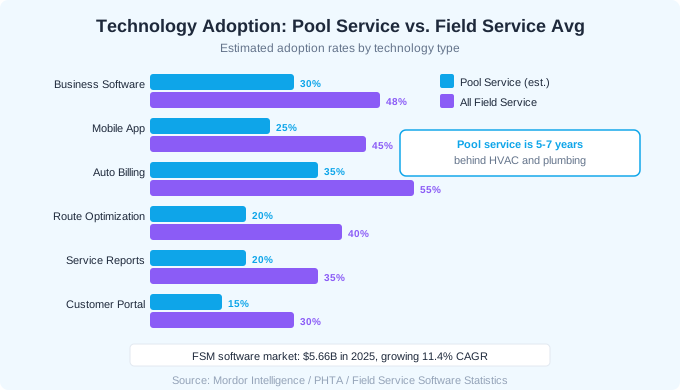
| Technology | Est. Pool Service Adoption | All Field Service Avg | Gap |
|---|---|---|---|
| Any business software | 25-35% | 48% | -13 to -23 points |
| Mobile app for technicians | 20-30% | 45% | -15 to -25 points |
| Automated invoicing/billing | 30-40% | 55% | -15 to -25 points |
| GPS / route optimization | 15-25% | 40% | -15 to -25 points |
| Digital service reports | 15-25% | 35% | -10 to -20 points |
| Customer portal | 10-20% | 30% | -10 to -20 points |
| Chemical tracking software | 10-15% | N/A (industry-specific) | N/A |
The pool service industry is roughly 5-7 years behind HVAC and plumbing in technology adoption. Those industries experienced their software adoption wave in the 2015-2020 period. Pool service is in the early-to-mid stages of that same transition now, accelerated by the post-2020 labor shortage and rising customer expectations for digital communication.
Why Does Pool Service Lag Other Home Service Industries?
Three structural factors explain the adoption gap. First, pool service has a higher concentration of owner-operators (1-person businesses) than HVAC, plumbing, or electrical. Solo operators see less immediate benefit from software because they handle scheduling, routing, and billing in their heads. Second, pool service has lower average ticket sizes ($125-175/month vs. $500-2,000 for HVAC repairs), which makes the per-customer ROI of software less obvious. Third, the seasonal nature of pool service in northern markets creates cash flow cycles that make recurring software subscriptions feel like a burden during off months.
- Higher percentage of solo operators: Estimated 60%+ of pool service businesses are 1-person operations.
- Lower average ticket: $150/month recurring vs. $500-2,000 for HVAC/plumbing service calls.
- Seasonal cash flow: Companies in northern states see 3-5 months of reduced or zero revenue.
- Low technology comfort: Many pool techs entered the trade to work outdoors, not to learn software.
- Fragmented market: Over 14,000 registered companies, most with under 5 employees, makes vendor penetration slow.
- Limited IT resources: 28% of small businesses cite limited IT support as a barrier to implementation.
Which Technologies Have the Highest Adoption in Pool Service?
Invoicing and billing software leads adoption because the pain point is immediate and obvious: getting paid faster. Companies using automated billing reduce payment collection times from 14+ days to 2-3 days. QuickBooks remains the most common accounting tool for pool service businesses, with many companies treating it as their primary "business software" even though it was not designed for field service.
| Technology | Adoption Level | Primary Driver | Key Benefit |
|---|---|---|---|
| Invoicing/billing | Highest | Cash flow acceleration | Get paid 5-10 days faster |
| Basic scheduling | High | Growing past 50 customers | Stop double-booking or missing stops |
| Google Maps (manual routing) | High | Free and familiar | Basic route visualization |
| Mobile payments | Medium | Customer expectation | Accept cards in the field |
| Route optimization software | Low-Medium | Fuel costs, time savings | Reduce drive time 20-30% |
| Digital service reports | Low | Customer retention | Reduce complaints and churn |
| Chemical tracking | Low | Compliance, efficiency | Automated chemical dosing logs |
| Customer-facing portal | Very Low | Customer self-service | Reduce inbound calls 30-40% |
The pattern is clear: pool companies adopt technology that solves an immediate pain point (getting paid, scheduling) before adopting technology that creates long-term strategic advantage (service reports, customer portals, chemical tracking). This is why billing is at 30-40% adoption while customer portals sit at 10-20%.
How Does GPS and Route Optimization Change Pool Service Operations?
GPS-enabled route optimization apps reduce travel time by up to 30%, which translates directly into either more stops per day or shorter days for technicians. For a pool company running 5 routes with 20 stops each, a 30% reduction in drive time saves 1.5-2 hours per route per day. That is either 3-4 additional stops (revenue) or a significant improvement in technician quality of life (retention).
| Metric | Without Route Optimization | With Route Optimization | Impact |
|---|---|---|---|
| Avg drive time per stop | 15-20 minutes | 10-14 minutes | 30% reduction |
| Stops per day | 18-22 | 22-28 | 3-6 more stops |
| Fuel cost per route/day | $35-50 | $25-35 | $10-15 saved daily |
| Monthly fuel savings (5 routes) | Baseline | $1,000-$1,500 saved | $12,000-$18,000/year |
| Technician overtime | Frequent | Rare | Lower labor costs |
Despite these clear benefits, only 15-25% of pool service companies use dedicated route optimization. Most still rely on Google Maps or route memory. The adoption barrier is not cost (most tools run $30-100/month per route) but the perceived effort of reorganizing existing routes. Companies that push through the initial setup see ROI within the first month.
GPS tracking also supports accountability. Companies using GPS report that technicians complete 15-20% more stops per day and that customer complaints about missed visits drop significantly because you can verify actual arrival and departure times.
What Is the ROI of Technology for Pool Service Companies?
The field service management market is growing at 11.4% CAGR through 2030, and the primary driver is ROI. Companies adopting FSM software report measurable improvements across operations: 30% less drive time, faster payment collection, fewer missed appointments, and lower customer churn. For a pool company with 100 customers, even modest improvements translate to thousands in annual savings and revenue.
| Technology | Monthly Cost | Est. Monthly Benefit | Payback Period |
|---|---|---|---|
| Route optimization | $50-100 | $300-500 in fuel + time savings | 1 month |
| Automated billing | $30-80 | $200-400 in faster collections | 1 month |
| Digital service reports | $30-60 | $150-300 in reduced churn | 1-2 months |
| Customer portal | $20-50 | $100-200 in reduced admin time | 1-2 months |
| Chemical tracking | $20-40 | $50-100 in chemical optimization | 2-3 months |
| Full FSM platform | $100-300 | $800-1,500 in combined benefits | 1 month |
The total technology cost for a pool service company with 100 customers typically runs $100-300/month for a comprehensive platform. The combined benefits of route efficiency, faster payments, lower churn, and reduced admin time easily exceed $1,000/month. That is why companies that adopt technology rarely go back to manual processes.
What Does the Future of Pool Service Technology Look Like?
Small and medium-sized businesses are projected to register the largest market share growth in field service management through 2030, driven by cloud-based solutions that eliminate the need for IT infrastructure. For pool service, the next wave includes AI-powered scheduling that automatically optimizes routes as customers cancel or are added, automated chemical dosing recommendations based on water test data, and customer self-service portals that reduce inbound phone calls by 30-40%.
- AI-driven route optimization: Automatically rebalances routes when customers cancel, are added, or techs call out sick.
- Smart water chemistry: IoT sensors that monitor pool chemistry in real-time and alert technicians before problems develop.
- Automated customer communication: Service reports, arrival notifications, and billing reminders sent without manual input.
- Integrated payment processing: Customers billed automatically with cards on file, eliminating manual invoicing entirely.
- Predictive maintenance: Equipment failure prediction based on service history data, enabling proactive repair scheduling.
- Voice-to-data entry: Technicians dictate service notes on their phone and the software logs the data automatically.
Corey Adams, Pool Founder co-founder and 15-year pool veteran: "When I started in pool service, we used a paper route sheet and a Thomas Guide. Now the companies still doing that are losing customers to competitors who send service reports with photos. Technology is not optional anymore. It is the baseline expectation."
Ready to streamline your pool service business?
Pool Founder gives you route optimization, automated invoicing, chemical tracking, and everything else you need to run a more profitable pool business.
Frequently Asked Questions
What percentage of pool service companies use software?
An estimated 25-35% of pool service companies use dedicated business management software, compared to 48% across all field service industries. Adoption is highest for billing/invoicing tools (30-40%) and lowest for customer-facing portals (10-20%). The gap is closing as cloud-based solutions become more affordable and easier to implement.
Why is pool service behind other industries in technology adoption?
Pool service has a higher concentration of solo operators (60%+), lower average ticket sizes ($150/month vs. $500+ for HVAC), and seasonal cash flow in northern markets. These factors make the ROI of software less immediately obvious than in industries with larger companies and higher per-job revenue.
How much does pool service software cost?
Pool service management software typically costs $50-300/month depending on features and number of routes. Basic scheduling and billing tools start around $30-50/month. Comprehensive platforms with route optimization, service reports, customer portals, and chemical tracking run $100-300/month.
Does GPS route optimization actually save money for pool companies?
Yes. GPS-enabled route optimization reduces travel time by up to 30%, which saves $1,000-1,500/month in fuel costs for a 5-route operation. It also enables 3-6 additional stops per day, increasing revenue capacity. Most companies see positive ROI within the first month of use.
What is the field service management software market size?
The global field service management software market was $5.66 billion in 2025, growing to $6.26 billion in 2026, and projected to reach $9.68 billion by 2030 at an 11.4% compound annual growth rate. Small and medium businesses are the fastest-growing adoption segment.
Sources & References
- Mordor Intelligence: Field Service Management Market Report
- GM Insights: Field Service Management Market Size 2025-2035
- Field Service Management Software Statistics: Trends & Growth 2025
- Technavio: FSM Software Market Growth Analysis 2026-2030
- PHTA: 2024 Business Operations Survey Report
- IBISWorld: Swimming Pools in the US Industry Report