You Can Not Improve What You Do Not Measure
Most pool service owners run their business on gut instinct. You know your truck is busy. You know you are making money. But when someone asks "What is your revenue per pool?" or "What is your customer churn rate?", you are guessing. That guesswork gets expensive fast. According to IBISWorld, the swimming pool cleaning services industry hit $8.8 billion in 2026 with 78,817 businesses competing for market share. The companies that pull ahead are the ones tracking a handful of numbers every month and making decisions based on data, not feelings.
The Skimmer 2025 State of Pool Service Report found that 25% of pool pros plan to reduce customer count and increase profitability per pool. You can not do that without knowing which pools are profitable and which ones are dragging you down. These 12 KPIs give you the scoreboard.
Corey Adams, Pool Founder co-founder and 15-year pool service veteran, tracks these KPIs across every route he manages. "I ran my business off gut feel for years. The day I started tracking revenue per pool and drive time percentage, I found $1,800 a month in wasted time I did not know about." This guide is built on that real-world experience plus data from IBISWorld, the Skimmer State of Pool Service Report, Pool Pro Magazine, and Bureau of Labor Statistics.
What Are the Most Important KPIs for a Pool Service Business?
The most important KPIs for a pool service business fall into three categories: financial health (revenue per pool, net profit margin, collection rate), operational efficiency (stops per day, drive time percentage, route density), and growth indicators (customer churn rate, upsell revenue, customer acquisition cost). Track all 12 monthly, but focus on the 3-4 that expose your biggest bottleneck right now.
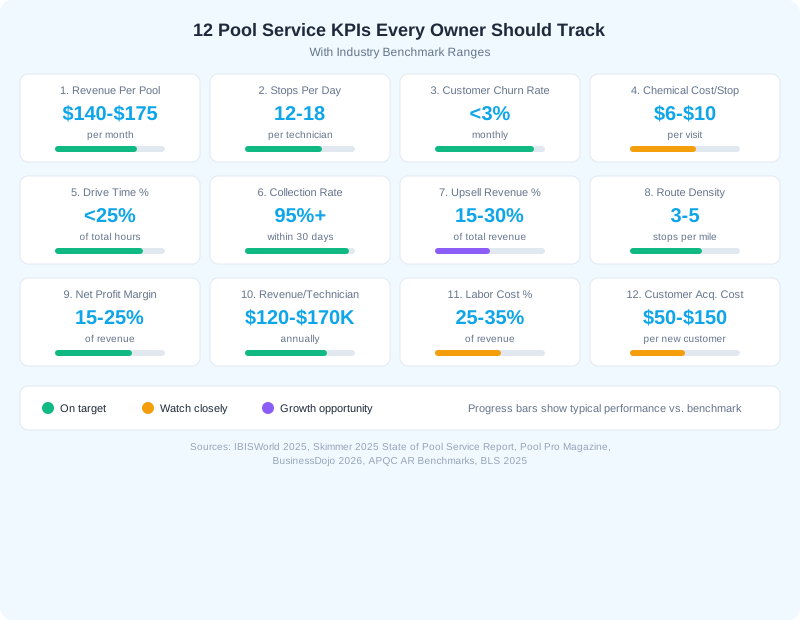
| Category | KPIs | Why It Matters |
|---|---|---|
| Financial Health | Revenue per pool, Net profit margin, Collection rate, Labor cost % | Shows whether you are making money or just staying busy |
| Operational Efficiency | Stops per day, Drive time %, Route density, Chemical cost per stop | Reveals wasted time and money hiding in your daily operations |
| Growth | Customer churn, Upsell revenue %, Customer acquisition cost, Revenue per tech | Tells you whether the business is growing or slowly shrinking |
What Is a Good Revenue Per Pool for Pool Service?
A good revenue per pool for weekly residential maintenance is $140 to $175 per month in 2026. According to the Cabana 2025 Pool Service Pricing Study, the national average for basic pool cleaning sits around $140 per month, with premium markets like Naples and Fort Myers averaging $157 per month. If your average is below $140, you are likely underpriced. If you are above $175 for standard residential service, you are in a strong position.
How Do You Calculate Revenue Per Pool?
Divide your total monthly recurring revenue by your active pool count. Only include recurring maintenance revenue, not one-time repairs or equipment sales. A 60-pool route at $150 per pool generates $9,000 per month in recurring revenue. If you add 10 pools at $120 each, your average drops to $8.57 per pool. That matters when you are deciding whether to take on discount customers.
| Tier | Monthly Rate | What It Signals |
|---|---|---|
| Below $120 | Danger zone | You are likely losing money after chemicals, drive time, and labor |
| $120-$140 | Below market | Raise prices 5-8% at next annual adjustment |
| $140-$175 | Market rate | Healthy range for most U.S. residential markets |
| $175+ | Premium | Strong position, common in FL, AZ, TX premium areas |
Corey's rule of thumb: "If I cannot net at least $35 per stop after chemicals, labor, and drive time, the pool is costing me money. Revenue per pool tells you where to look."
How Many Stops Per Day Should a Pool Tech Complete?
A pool technician should complete 12 to 18 stops per day for standard weekly residential maintenance. According to industry data from Superior Pool Routes and BusinessDojo, most efficient routes land in this range, with tight geographic clusters pushing closer to 18 and spread-out suburban routes falling to 12. Below 10 stops per day and your labor cost per pool is likely unsustainable.
What Factors Affect Stops Per Day?
- Route density: A tech driving 5 minutes between stops instead of 15 can service 3 to 5 more pools per day, adding $300 to $1,000 in daily revenue with virtually no cost increase (Superior Pool Routes).
- Service scope: Full-service stops with chemical balancing take 20-30 minutes. Skim-and-go stops take 10-15 minutes.
- Pool condition: Green pool recoveries, heavy debris after storms, and equipment diagnostics all cut into your daily count.
- Equipment load: Techs who carry the right chemicals and parts avoid supply runs that kill productivity.
15
Average stops per day for a well-optimized residential route
Source: Superior Pool Routes / BusinessDojo 2026
Track this number weekly per technician. If one tech averages 16 and another averages 11 with the same service scope, the problem is almost always route geography or time management, not speed. Route optimization software can help close that gap.
What Is a Good Customer Churn Rate for Pool Service?
A good customer churn rate for pool service is under 3% per month, which translates to roughly 70% or better annual retention. According to pool industry benchmarking data, monthly churn under 3% signals healthy retention and effective service delivery. If you are losing more than 3 out of every 100 customers per month, something is broken in your service quality, communication, or pricing.
How Do You Calculate Monthly Churn Rate?
Divide the number of customers who cancelled this month by the number of active customers at the start of the month. If you started March with 80 pools and lost 2, your monthly churn is 2.5%. That sounds small, but over 12 months it compounds. At 3% monthly churn, you need to add 36 new customers per year just to replace the ones walking out the door on a 100-pool route.
| Monthly Churn | Annual Retention | What It Means |
|---|---|---|
| Under 1% | ~88%+ | Excellent. You are delivering premium service and communicating well. |
| 1-2% | ~78-88% | Solid. Normal seasonal turnover for most markets. |
| 2-3% | ~70-78% | Acceptable, but investigate. Survey recent cancellations. |
| 3%+ | Below 70% | Red flag. Check pricing, service quality, and communication gaps. |
Track first-90-day churn separately. If new customers cancel within their first three months at a higher rate than your base, your onboarding process needs work. A welcome call, clear service expectations, and a first-visit follow-up photo report can cut first-90-day churn in half.
What Should Chemical Cost Per Stop Be?
Chemical cost per stop should run between $6 and $10 for standard weekly residential maintenance. Industry analysis from BusinessDojo pegs the average at approximately $8.25 per stop. If you are consistently above $10 per visit, you may be over-treating pools, dealing with persistent water chemistry issues, or paying retail for chemicals when you should be buying wholesale.
How Do You Track Chemical Cost Per Stop Accurately?
Divide your total monthly chemical spend by your total monthly service visits. If you spent $2,400 on chemicals and performed 300 stops, your cost per stop is $8.00. The key is tracking purchases, not usage estimates. Keep receipts in one place and reconcile monthly. Techs who dump extra chlorine "just to be safe" are the most common source of cost creep.
- Buy wholesale: Chemical costs remain 40-60% above pre-pandemic levels. Buying in bulk from a distributor instead of retail can save 15-25% per pool.
- Test first, treat second: Techs who test water chemistry before adding chemicals waste less product. Every unnecessary pound of trichlor is money in the pool instead of your pocket.
- Track by customer: Some pools consistently run hot on chemical cost due to size, sun exposure, or bather load. Price those pools accordingly.
- Flag anomalies: If one tech runs $12 per stop while others run $7, investigate before assuming they are doing better work.
What Is Drive Time Percentage and Why Does It Matter?
Drive time percentage is the share of your technician's workday spent behind the wheel instead of servicing pools. The benchmark is under 25% of total hours. According to field service industry data, routes exceeding 35% drive time need immediate geographic restructuring. Most well-optimized operations keep windshield time under 20%, while the average pool service route runs closer to 30%.
How Do You Calculate Drive Time Percentage?
Divide total drive time by total work hours. If a tech works 8 hours and spends 2.5 hours driving, their drive time percentage is 31%. That means nearly a third of their paid day produces zero revenue. On a 5-day week, that is 12.5 hours of windshield time, enough to service 8-10 more pools if the routes were tighter.
25%
Target drive time percentage for pool service routes
Source: Field Service Software IO / FieldLogix
Route optimization technology can cut average drive time by 15%, according to field service benchmarking data. That is real money. On a 5-tech operation where each tech earns $20 per hour, cutting drive time from 30% to 20% recovers 25 hours per week across the team. At a billing rate of $80 per hour, that is $2,000 in recovered capacity every single week.
What Collection Rate Should Pool Service Companies Target?
Pool service companies should target a collection rate of 95% or higher within 30 days of invoicing. According to APQC accounts receivable benchmarks, a Collection Effectiveness Index above 95% indicates excellent collection performance for service businesses. Below 90% means you have a serious cash flow problem, and every dollar stuck in accounts receivable is a dollar you cannot use to buy chemicals, pay techs, or grow.
How Do You Improve Collection Rate?
- Auto-charge on file: Move every customer to a card on file or ACH. Companies that auto-bill see collection rates above 98%.
- Invoice immediately: Send invoices the day service is completed, not at the end of the month. Every day you wait costs you money.
- Follow up at 7 days: An automated reminder at 7 days past due catches 80% of late payments before they become a problem.
- Suspend at 30 days: Customers who are 30+ days past due should receive a service suspension notice. It sounds harsh, but it protects your business.
| Collection Rate | Cash Flow Impact | Action Required |
|---|---|---|
| 98%+ | Excellent | Maintain current billing systems |
| 95-98% | Good | Review late payers, add auto-pay incentives |
| 90-95% | Concerning | Automate reminders, require cards on file for new customers |
| Below 90% | Critical | Overhaul billing process immediately, consider billing software |
The average B2B company writes off approximately 2% of receivables as uncollectible, according to APQC. If you are writing off more than 2% of billed revenue, your screening or collection process needs attention.
How Much Revenue Should Come From Upsells and Repairs?
Upsell and repair revenue should represent 15% to 30% of total revenue for a healthy pool service company. According to BusinessDojo, repairs and replacements typically make up 15% to 30% of total revenue on a well-managed operation. Equipment repair and renovation work are outpacing basic maintenance in revenue growth, driven by aging pool infrastructure and increasingly complex equipment.
What Are the Best Pool Service Upsell Opportunities?
- Energy-efficient pump upgrades: Variable-speed pumps save homeowners $50-$100 per month on electricity. The sell practically makes itself.
- Salt system conversions: Growing demand as homeowners move away from traditional chlorine.
- Automation and controllers: Smart pool controls let homeowners manage their pool from a phone.
- Safety covers and equipment: Seasonal upsell with high margins.
- Filter replacements and DE grid cleanings: Recurring upsell every 1-2 years per customer.
Service acceptance rates rise 25%+ when financing options are offered to homeowners. Homeowners are 2.5x more likely to approve a repair when financing is presented during the estimate, not after. If you are not offering financing on jobs over $500, you are leaving money on the table.
Track upsell revenue as a percentage of total revenue monthly. If you are below 15%, your techs either are not identifying opportunities in the field or do not have a simple way to create quotes on the spot. Photo documentation of equipment issues and one-tap quote creation from a mobile app make a measurable difference.
What Is Route Density and How Do You Measure It?
Route density measures how tightly your stops cluster along a route, typically expressed as stops per mile. A good benchmark for residential pool service is 3 to 5 stops per mile in suburban markets. Higher density means less driving, lower fuel costs, more stops per day, and better margins on every pool you service.
How Does Route Density Affect Profitability?
According to field service benchmarking data from CigoTracker, better routing cuts driving distance by 10% to 30%, depending on current route density. When your stops cluster, you convert distance into output. A tech with 3 stops per mile instead of 1 stop per mile can service nearly twice as many pools per day with similar drive time. The fuel savings alone add up to hundreds of dollars per month, but the real win is the extra capacity.
| Route Density | Market Type | Impact |
|---|---|---|
| 5+ stops/mile | Dense suburban/urban | Maximum efficiency, 16-18 stops/day achievable |
| 3-5 stops/mile | Typical suburban | Good efficiency, 12-16 stops/day |
| 1-3 stops/mile | Spread out suburban/rural | Acceptable if per-pool revenue is high enough to offset drive time |
| Below 1 stop/mile | Rural or scattered | Likely unprofitable unless pricing compensates for distance |
When you are deciding whether to take on a new customer, check where they sit relative to your existing route. A $130 per month pool that is 2 miles from your nearest cluster may cost you more in drive time than a $150 pool that is half a mile away from 5 other stops. Route density should influence your pricing and your decision to accept new accounts.
What Are the Financial KPIs Every Pool Service Owner Needs?
What Net Profit Margin Should a Pool Service Company Target?
A healthy net profit margin for pool service companies is 15% to 25%, according to IBISWorld and financial data from Sageworks/Abrigo. Owner-operators who handle their own routes often see margins above 30% before normalization, while companies with 10+ technicians typically operate between 10% and 15%. If your net margin is below 15% with a team, investigate labor costs, chemical waste, and route efficiency first.
What Should Labor Cost as a Percentage of Revenue Be?
Labor costs should stay between 25% and 35% of revenue for pool service companies. According to Pool Pro Magazine, maintaining labor costs below 35% of total expenses is a key benchmark. The PHTA reports that pool service wages have increased 11% since 2020, which puts additional pressure on this number. If your labor cost percentage is creeping above 35%, you need to raise prices, improve route density, or both.
How Much Revenue Should Each Technician Generate?
Each technician should generate $120,000 to $170,000 in annual revenue. A tech managing 70 to 100 pools at $140 to $175 per month generates $117,600 to $210,000 in recurring revenue alone, before repairs and upsells. If a technician generates less than $120,000 annually, their route is either too small, too spread out, or underpriced.
| KPI | Benchmark | Source |
|---|---|---|
| Net profit margin | 15-25% | IBISWorld / Sageworks |
| Labor cost % | 25-35% of revenue | Pool Pro Magazine |
| Revenue per tech | $120K-$170K/year | BusinessDojo / DealStream |
| Gross margin | 50-65% (maintenance) | IBISWorld 2025 |
What Is a Good Customer Acquisition Cost for Pool Service?
A good customer acquisition cost (CAC) for pool service is $50 to $150 per new customer. According to industry data, pool and spa companies pay the lowest cost per lead of any home services category through Google Ads at $45.15 per lead, compared to $129 for plumbing and $228 for roofing. Your actual CAC depends on your marketing mix, but the key metric is payback period: you should recoup your acquisition cost within 3 months of a customer starting service.
How Do You Calculate Customer Acquisition Cost?
Divide your total marketing and sales spend for the month by the number of new customers acquired. If you spent $1,200 on Google Ads, $300 on yard signs, and $200 on referral bonuses and gained 15 new customers, your CAC is $113. Track this monthly and by channel. You will likely discover that referrals cost $20-$30 per acquisition while paid ads cost $100-$150.
- Referral programs: Deliver 10x ROI with acquisition costs $23 lower than non-referred customers.
- Google Ads: $5.81 per click and $45.15 per lead for pool services. The best-performing home services ad category.
- Email marketing: Returns $36 for every $1 spent according to industry benchmarks.
- Google Business Profile: Free organic leads from map searches. Often the highest-ROI channel for local pool service.
The standard benchmark is an LTV:CAC ratio of at least 3:1. If your average customer stays 3 years at $150 per month ($5,400 lifetime value), your CAC should not exceed $1,800. Most pool service companies are well within this ratio. The real danger is not tracking it at all and overspending on marketing channels that do not convert.
How to Start Tracking These KPIs This Month
You do not need a dashboard on day one. Start with a spreadsheet and three numbers: revenue per pool, stops per day, and collection rate. These three KPIs expose the biggest problems in most pool service businesses. Once you have 30 days of data, add churn rate and drive time percentage. Build from there.
- 1Pull your total recurring revenue and active pool count. Divide revenue by pools. That is your revenue per pool. If it is below $140, you know where to focus.
- 2Count stops per tech per day for one week. Average it. If any tech is below 12, look at their route geography.
- 3Check your accounts receivable aging report. How much is outstanding past 30 days? Calculate your collection rate. If it is below 95%, fix billing first because nothing else matters if you are not collecting.
- 4Count cancellations for the past 3 months. Divide by starting customer count each month. That is your churn rate.
- 5Estimate drive time. Have each tech note their first stop time and last stop time, then subtract total service time. What is left is drive time plus breaks.
Pool service software automates most of this tracking. GPS data calculates drive time percentage automatically. Invoicing systems track collection rates. Customer databases calculate churn. The point is not to create more paperwork. The point is to see the numbers that are already hiding in your business and use them to make better decisions.
According to the Skimmer 2025 State of Pool Service Report, 60% of pool pros planned to grow their business by finding internal efficiencies. KPI tracking is how you find those efficiencies. The owners who measure these numbers consistently are the ones who scale from 40 pools to 200 without burning out.
Ready to streamline your pool service business?
Pool Founder gives you route optimization, automated invoicing, chemical tracking, and everything else you need to run a more profitable pool business.
Frequently Asked Questions
What is the single most important KPI for a pool service business?
Revenue per pool is the single most important KPI because it affects every other metric. If your revenue per pool is too low, your net margin, labor cost percentage, and revenue per technician all suffer. Most underperforming pool businesses have a pricing problem disguised as an operations problem.
How often should I review my pool service KPIs?
Review financial KPIs (revenue per pool, collection rate, net margin) monthly. Review operational KPIs (stops per day, drive time, route density) weekly. Review growth KPIs (churn rate, upsell revenue, CAC) monthly. A 15-minute weekly check and a 30-minute monthly deep dive is enough for most operations.
What is a normal customer churn rate for pool service?
A normal monthly churn rate for pool service is 1-3%, which translates to 70-88% annual retention. Seasonal markets may see slightly higher churn in off-months. If your monthly churn exceeds 3% consistently, investigate service quality, communication frequency, and pricing relative to competitors.
How many pools should one technician service per week?
One technician should service 60 to 90 pools per week (12-18 per day over 5 days), depending on service scope and route density. A full-service tech handling water chemistry typically services 60-75 pools weekly, while a skim-and-go operation can push 80-90. Below 60 pools per week suggests route density or efficiency problems.
What profit margin should a pool cleaning business make?
A healthy pool cleaning business should target 15-25% net profit margin, according to IBISWorld. Owner-operators often exceed 30% because they eliminate labor cost. Companies with employees typically run 10-20% net margin depending on team size and efficiency. If your margin is below 15% with a team, focus on raising prices, reducing drive time, and controlling chemical costs.
How do I reduce my customer acquisition cost for pool service?
The most cost-effective acquisition channels for pool service are referral programs ($20-$30 per acquisition), Google Business Profile optimization (free organic leads), and Google Ads ($45.15 per lead for pool services). Referral programs deliver 10x ROI compared to cold marketing. Focus 60-70% of your marketing budget on referrals and local SEO before spending on paid ads.
Sources & References
- IBISWorld — Swimming Pool Cleaning Services in the US 2025
- Skimmer — 2025 State of Pool Service Report
- Pool Pro Magazine — Maximizing Revenue with Strategic KPIs
- BusinessDojo — Profitability of Pool Technician Services 2026
- Superior Pool Routes — How to Set Technician Productivity Benchmarks
- APQC — Accounts Receivable and Collections Key Benchmarks
- CigoTracker — What Is Route Density and Why It Matters for Profitability
- Field Service Software IO — Windshield Time Definition and Benchmarks
- PHTA — Pool Industry Revenue and Margin Pressure Report 2025
- Pool Founder — Pool Service Industry Statistics 2026
- DealStream — Pool Service Business Rules of Thumb Guide