Why Do Most Pool Service Companies Stall Before 100 Pools?
Only 9% of pool service businesses ever hire their first employee. The rest stay solo, not because they lack ambition, but because the jump from 30 to 100 pools is where everything that used to work stops working. Your memory replaces a CRM. Text messages replace scheduling software. A shoebox of receipts replaces accounting. It holds together at 25 pools. By 40, cracks show. By 60, something breaks every week.
Corey Adams, Pool Founder co-founder and 15-year pool service veteran, watched this pattern play out hundreds of times. "Every owner I know hit the same walls at roughly the same pool counts," Corey says. "30 pools is where you realize you need software. 50 is where you realize you need help. 75 is where you need a second truck. And 100 is where you either build a real business or burn out trying to do everything yourself." The milestones are predictable. The mistakes at each one are avoidable.
This playbook walks through the four critical growth thresholds, what changes at each, what to put in place before you get there, and the real costs involved. All figures reflect 2026 data from IBISWorld, BLS, the Skimmer State of Pool Service Report, and PoolDial industry research.
What Does a 100-Pool Operation Actually Look Like?
A 100-pool residential service operation generates $180,000 to $300,000 in annual revenue depending on your market, service tier, and repair volume. At $150 per pool per month in recurring maintenance, the baseline is $180,000 annually. Add repair and equipment revenue, which typically represents 15% to 30% of total revenue for established operations, and you reach $210,000 to $300,000 or more.
At this size, you typically have 1.5 to 2 technicians (including yourself if you still run a route), two service vehicles, and enough recurring revenue to cover payroll, insurance, chemicals, and fuel with margin left over. Net profit margins for well-run pool service companies at this size range from 15% to 25%, according to IBISWorld and Sageworks benchmarks. That translates to $27,000 to $75,000 in net profit depending on your cost controls and pricing.
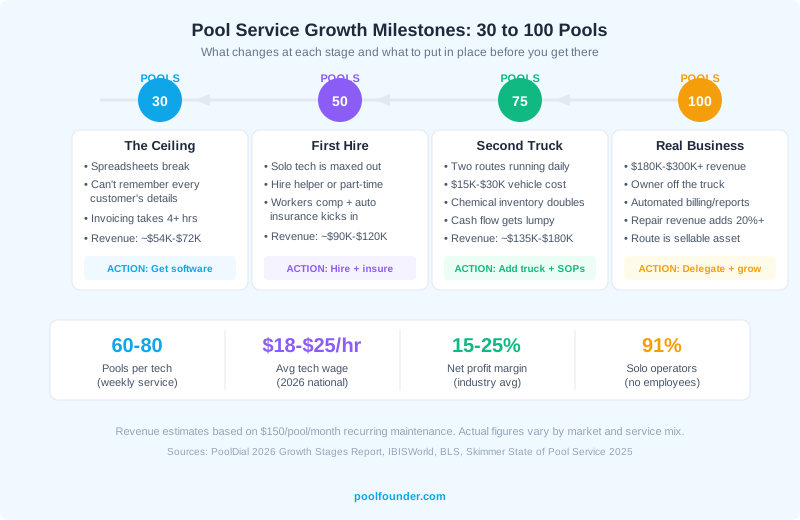
| Metric | 30 Pools | 50 Pools | 75 Pools | 100 Pools |
|---|---|---|---|---|
| Annual recurring revenue | $54K-$72K | $90K-$120K | $135K-$180K | $180K-$240K |
| Total revenue (with repairs) | $62K-$94K | $104K-$156K | $155K-$234K | $210K-$300K+ |
| Technicians needed | 1 (owner) | 1-1.5 | 1.5-2 | 2+ |
| Vehicles needed | 1 | 1 | 2 | 2 |
| Monthly overhead | $1,200-$1,800 | $3,500-$5,000 | $6,000-$9,000 | $8,000-$12,000 |
Revenue estimates assume $150/pool/month for recurring maintenance, which reflects a typical rate in Florida-style markets. Your market may be higher (California, Arizona) or lower (Midwest). Adjust accordingly.
The 30-Pool Milestone: Where Spreadsheets Break
At 30 pools, most solo operators hit the first operational ceiling. You can no longer keep every customer preference, gate code, equipment quirk, and billing detail in your head. Invoicing takes four or more hours per billing cycle. Scheduling is a mental exercise every morning. And if you get sick or take a day off, nothing has a system behind it.
What Breaks at 30 Pools?
The average pool professional spends 7.5 hours per week on paperwork, according to FieldProMax industry data. That is 390 hours per year, nearly 10 full work weeks, spent on tasks that do not generate revenue. At 30 pools, this overhead becomes the primary constraint on growth because every hour spent on admin is an hour you cannot spend servicing another pool or finding new customers.
- Customer details overflow your memory. Gate codes, chemical preferences, equipment models, pet warnings. At 30 pools, you start mixing up details between customers, and mistakes cost you callbacks or lost accounts.
- Manual invoicing eats your weekends. Thirty invoices per month is manageable. But tracking who paid, who is late, and who changed their service tier becomes a second job.
- Scheduling lives only in your head. If you get injured tomorrow, nobody knows which pools to hit or in what order. Your business has zero continuity.
- Water chemistry records are inconsistent. You might test at every stop, but without a system, historical trends are invisible. You cannot prove what you did if a customer disputes service quality.
What Should You Put in Place at 30 Pools?
Pool service software. Not a generic field service app, not a fancier spreadsheet. Software built for pool routes that handles scheduling, customer records, chemical logging, invoicing, and route sequencing in one place. This is the single highest-ROI investment you will make before hitting 50 pools.
"I see owners try to push through to 50 or 60 pools on spreadsheets and it always ends the same way," Corey says. "They start dropping balls. Missed stops. Wrong chemicals. Late invoices. Then they lose a customer or two and blame the growth instead of blaming the lack of systems. Get software at 30. You will wish you had it at 20."
Pool Founder costs $49/month for solo operators and includes everything: scheduling, invoicing, route optimization, customer portal, chemical tracking, and service reports. There is no feature gating. Compare that to the 7.5 hours per week you are spending on paperwork.
The 50-Pool Milestone: Your First Hire
A solo technician running optimized routes can handle 60 to 80 pools per week for residential service. But that ceiling assumes perfect health, no vacations, no equipment breakdowns, and zero callbacks. In reality, you should start planning your first hire when you hit 40 to 45 pools, because by the time you find, interview, and train someone, you will be at 50 or beyond. Our guide on going from solo to multi-tech covers every step of this transition.
When Should You Hire Your First Pool Technician?
The clearest signal is this: if five new customers called tomorrow, could you take them? If the honest answer is no, you are already behind on hiring. Pool industry veterans on The Pool Deck forum recommend the same test. The ideal timing is to hire during the off-season or a slower period so you have time to train properly. Hiring during peak season, when you are already overwhelmed, leads to rushed training and costly mistakes.
Corey recommends starting with a helper rather than a full technician. "Bring someone on part-time, ride with them for two to three weeks, and let them shadow you on your route. By the time you hand them 15 to 20 pools, they know your standards and your customers know their face. It is a much smoother transition than throwing a stranger onto a route solo."
How Much Does Your First Employee Actually Cost?
The loaded cost of a pool technician goes well beyond the hourly wage. National average pay ranges from $18 to $25 per hour depending on market and experience, according to Glassdoor and ZipRecruiter 2026 data. But the total cost per employee includes payroll taxes, insurance, vehicle use, and supplies.
| Cost Category | Monthly Cost | Annual Cost |
|---|---|---|
| Technician wages (full-time, $20/hr) | $3,200-$3,500 | $38,400-$42,000 |
| Payroll taxes (FICA, FUTA, SUTA) | $320-$420 | $3,800-$5,000 |
| Workers compensation insurance | $115-$165 | $1,380-$1,980 |
| Additional commercial auto insurance | $150-$250 | $1,800-$3,000 |
| Chemical supplies (for their route) | $400-$600 | $4,800-$7,200 |
| Uniforms, tools, phone | $50-$100 | $600-$1,200 |
$4,200-$5,000/mo
Total loaded cost of one full-time pool technician
Source: BLS, Glassdoor, Insureon, industry averages
At 50 pools generating $7,500 per month in recurring revenue, a single employee consumes roughly 55% to 65% of gross revenue before you account for fuel, chemicals for your own route, vehicle payments, or software. This is why profit margins dip during the 40 to 65 pool range. You are paying for capacity you have not fully filled yet. It recovers once you push past 70 pools and both routes are generating full revenue.
Workers comp insurance for pool service typically runs $2 to $4 per $100 of payroll depending on your state. Budget $115 to $165 per month per technician. Florida and California sit at the higher end of that range.
The 75-Pool Milestone: Second Truck and Real Systems
By 75 pools, you are running two routes daily, or close to it. Your first technician is handling 30 to 40 pools independently, you are running 35 to 40 yourself, and you need a second fully stocked service vehicle. This is the milestone where your business stops being "you with a helper" and starts becoming an operation with real overhead, real logistics, and real management requirements.
How Much Does a Second Pool Service Truck Cost?
A reliable used service truck costs $10,000 to $20,000, and a new truck with a basic service body or ladder rack setup costs $25,000 to $35,000. The vehicle itself is the largest single expense, but you also need to budget for outfitting, insurance, and inventory. Total cost to put a second truck on the road is typically $15,000 to $30,000 depending on whether you buy new or used.
| Second Truck Expense | Cost Range | Notes |
|---|---|---|
| Used truck (Ford F-150/250, Nissan Frontier) | $10,000-$20,000 | Low miles, service-ready |
| New truck with rack/body | $25,000-$35,000 | Dedicated pool service setup |
| Chemical inventory to stock | $500-$1,000 | Full set of tabs, acid, shock, algaecide |
| Tools and equipment (duplicate set) | $1,500-$3,000 | Pole, net, brushes, test kit, vacuum |
| Commercial auto insurance (additional vehicle) | $150-$250/mo | Bundled fleet rate lowers per-vehicle cost |
| Fuel (monthly) | $400-$600 | Depends on route density |
What Systems Need to Be in Place at 75 Pools?
At 75 pools, you cannot manage by walking around. You need visibility into what your technician is doing without being there. This is where software shifts from "nice to have" to "non-negotiable." You need real-time route tracking so you know where your tech is. You need service reports sent automatically to customers so you are not fielding "did someone come today?" calls. You need automated invoicing so billing does not consume your evenings.
- Standard operating procedures (SOPs). Write down exactly how you service a pool, step by step. Your technician should produce the same result whether you are watching or not.
- Chemical inventory tracking. Two trucks means two sets of inventory. Without tracking, you discover you are out of tabs at the worst possible time.
- Automated billing and autopay. At 75 invoices per month, manual billing is a guaranteed cash flow delay. Automated billing with autopay enrollment gets you paid faster.
- Customer communication system. Service reports, appointment reminders, and follow-ups should be automatic. Your customers should hear from your business even when you are in the field.
- GPS and route tracking. You need to know your tech completed every stop and stayed on route. Trust but verify.
"The 75-pool mark is where I see the biggest gap between owners who systemized and owners who didn't," Corey says. "The ones with systems add pools steadily. The ones without systems stay at 70 to 80 for years because they cannot handle more complexity." Our growth milestones guide maps what to build at each stage.
The 100-Pool Milestone: Owner Off the Truck
Reaching 100 pools is a meaningful operational milestone. You have $180,000 to $300,000 in annual revenue, two routes running daily, a proven hiring and training process, and recurring income that makes your business a sellable asset. Pool routes typically sell for 10 to 14 times monthly gross revenue, meaning a 100-pool book at $150 per pool per month is worth $150,000 to $210,000 as an asset. Keeping that base requires intentional effort; our customer retention strategies guide covers what works.
Should the Owner Still Be on a Route at 100 Pools?
This is the biggest strategic decision at the 100-pool milestone. Many owners keep running 40 to 50 pools themselves because it saves the cost of a second full-time technician. But running a route means you are not selling, not managing, and not building the business. The math often favors hiring a second technician so you can focus on sales, customer retention, and operations.
"I know owners running 100 pools who are still on the truck at 6 AM every day," Corey says. "They are making good money but they have built themselves a job, not a business. The owners who get past 100, to 150, 200, and beyond, are the ones who got off the truck and spent their time on growth."
What Does Cash Flow Look Like at 100 Pools?
Cash flow becomes more predictable but also more complex at 100 pools. Monthly recurring revenue of $15,000 provides a strong baseline, but your monthly expenses are now $8,000 to $12,000 including payroll, insurance, fuel, chemicals, vehicle payments, and software. The margin for error is tighter than when you were solo, and seasonal fluctuations hit harder because your fixed costs are higher.
| Monthly P&L (100 pools) | Amount | % of Revenue |
|---|---|---|
| Recurring maintenance revenue | $15,000 | 100% |
| Repair and equipment revenue | $2,500-$4,500 | +17-30% |
| Technician payroll (1 full-time) | $3,500-$4,500 | 23-30% |
| Insurance (WC, auto, GL) | $400-$600 | 3-4% |
| Chemicals and supplies | $1,200-$1,800 | 8-12% |
| Fuel (2 trucks) | $800-$1,200 | 5-8% |
| Vehicle payments/maintenance | $600-$1,000 | 4-7% |
| Software and tools | $100-$200 | <1% |
| Net profit | $3,000-$6,000 | 20-33% |
Automated billing is critical at this stage. Businesses that automate billing see up to 30% improvement in on-time payments, according to industry data. With 100 customers, even a small percentage paying late creates meaningful cash flow gaps. Enrolling customers in autopay at signup, rather than trying to convert them later, is the single most effective cash flow practice for growing pool companies.
How Does Cash Flow Change as You Scale?
The most dangerous cash flow period in a pool service business is not the start. It is the 40 to 65 pool range, where you have hired your first employee but have not yet filled their route. You are paying full-time wages for part-time productivity, and every slow week feels like the business is going backward. This is the "growth dip" that causes many owners to stall.
What Is the Growth Dip and How Do You Survive It?
When you hire your first technician at 45 to 50 pools, your monthly expenses jump by $4,200 to $5,000 for loaded payroll alone, plus vehicle costs if you add a truck. But your revenue only increases as you add new pools. For the first three to six months, profit margins compress or disappear entirely. This is normal and expected, but you need to plan for it.
- Build a cash reserve before hiring. Three months of operating expenses, roughly $12,000 to $15,000, gives you runway to fill the new route without panicking.
- Have a sales pipeline ready. Do not hire and then start marketing. Start marketing 60 to 90 days before you need the capacity. New pool customers take 2 to 4 weeks to close from first contact.
- Enroll every new customer in autopay. Repeat customers outspend new customers by 67%, and automated payments eliminate the cash flow drag of manual invoice chasing.
- Add repair revenue actively. Repairs and equipment replacements can represent 15% to 30% of total revenue. Your technicians are already on-site. Train them to identify and sell repair work.
The growth dip is temporary. Once both routes are at 60+ pools, margins recover to 20% or higher. The owners who quit during the dip often had the customers lined up but could not handle the cash flow pressure of investing ahead of revenue.
What Breaks If You Do Not Systematize?
Growing without systems does not just slow you down. It actively damages your business. The failure modes are predictable and expensive, and they compound the longer you wait to address them. Here is what Corey has seen go wrong most often in pool companies that try to muscle through growth without software and SOPs.
What Are the Most Common Scaling Failures?
- Customer churn from inconsistency. When a new tech services a pool differently than you did, customers notice. Without documented SOPs and service reports proving what was done, you lose accounts to "the new guy messed up my pool."
- Missed stops and double bookings. 94% of pool businesses report missing appointments monthly when relying on manual scheduling. Each callback costs an average of $85 in unbilled time and fuel.
- Invoice leakage. Without automated billing, pools get serviced but never invoiced. At 75 pools, even missing 3% of invoices costs you $4,000+ per year in lost revenue.
- Untracked chemical usage. Two trucks burning through chemicals with no inventory system means surprise stockouts, emergency supply runs, and no ability to spot waste or theft.
- No proof of service. When a customer calls and says "nobody came this week," you need timestamped, GPS-verified service reports. Without them, the customer is always right and you eat the cost.
- Owner burnout. The most common outcome is the simplest. The owner gets tired of doing everything, stops growing, and settles at 50 to 60 pools forever.
Nearly 50% of small businesses fail within five years. In pool service, the failure is rarely about demand. The market is growing at 4.2% annually with 10.4 million residential pools in the U.S. The failure is operational. Owners grow faster than their systems can support, quality drops, customers leave, and the business contracts back to whatever size the owner can manage alone.
A Stage-by-Stage Action Checklist
Here is the compressed version of everything above. Print it, save it, or bookmark it. Each action item should be in place before you cross the threshold, not after.
What Should Be in Place Before 30 Pools?
- 1Pool service software for scheduling, invoicing, and customer records
- 2Standardized service process at every stop (test, skim, brush, vacuum, chemicals, report)
- 3Online payment acceptance (credit card or ACH)
- 4Basic bookkeeping system (QuickBooks or similar)
- 5General liability and commercial auto insurance
What Should Be in Place Before 50 Pools?
- 1Written job description and pay structure for your first hire
- 2Workers compensation insurance policy (required in most states once you have employees)
- 330-day training plan for new technicians
- 4$12,000-$15,000 cash reserve to fund the growth dip
- 5Active marketing pipeline generating 5-10 new leads per month
- 6Autopay enrollment process for all new customers
What Should Be in Place Before 75 Pools?
- 1Second vehicle purchased, insured, and stocked with chemicals and tools
- 2Written SOPs for every service type (weekly maintenance, green pool recovery, filter clean, etc.)
- 3Automated service reports sent to customers after every visit
- 4Chemical inventory tracking across both trucks
- 5GPS route tracking and service verification for your technician
- 6Fleet insurance policy covering both vehicles
What Should Be in Place Before 100 Pools?
- 1Decision: are you staying on the truck or getting off to manage and sell?
- 2Automated billing with 80%+ of customers on autopay
- 3Repair and equipment upsell process for field technicians
- 4Monthly P&L review to track profit margins by route
- 5Customer retention system: regular communication, service reports, annual equipment reviews
- 6Documented processes for hiring, training, and onboarding a third technician
Ready to streamline your pool service business?
Pool Founder gives you route optimization, automated invoicing, chemical tracking, and everything else you need to run a more profitable pool business.
Frequently Asked Questions
How many pools can one technician service per day?
A trained pool technician can service 12 to 16 pools per day on an optimized residential route. That translates to 60 to 80 pools per week for full-time service. Route density, service scope, and drive time are the biggest variables. Tight suburban routes in a single zip code push toward the higher end, while spread-out rural routes sit closer to 10 to 12 per day.
How much revenue does a 100-pool route generate?
A 100-pool residential route at $150 per pool per month generates $180,000 in annual recurring revenue. Including repair and equipment work, which typically adds 15% to 30%, total revenue reaches $210,000 to $300,000 per year. Markets like Arizona and California with higher service rates can push significantly above these numbers.
When should I hire my first pool technician?
Plan your first hire when you reach 40 to 45 pools. By the time you find, interview, and train someone, you will be at 50 pools. The clearest signal is this: if five new customers called tomorrow, you could not take them. Start with a part-time helper who rides along on your route for two to three weeks before running pools independently.
How much does it cost to add a second pool service truck?
A reliable used truck costs $10,000 to $20,000, plus $2,000 to $4,000 to outfit with tools, chemicals, and a rack setup. Add $150 to $250 per month in commercial auto insurance. Total cost to put a second truck on the road is $15,000 to $30,000 depending on new versus used, plus ongoing monthly insurance and fuel costs of $550 to $850.
What pool service software do I need to scale to 100 pools?
You need software that handles scheduling, route optimization, invoicing with autopay, customer records, chemical tracking, and automated service reports. Generic field service apps miss pool-specific workflows like chemical logging and filter clean scheduling. Pool Founder includes all of these features at $49 per month for solo operators and $99 per month for teams up to 3 technicians.
What is the profit margin on a 100-pool operation?
Well-run pool service companies at the 100-pool level achieve 15% to 25% net profit margins according to IBISWorld. On $180,000 to $240,000 in recurring revenue, that is $27,000 to $60,000 in net profit before repair revenue. Margins dip during the 40 to 65 pool growth phase when you are paying for a technician but have not yet filled their route.
Sources & References
- IBISWorld - Swimming Pool Cleaning Services Industry Report 2025
- PoolDial - The 5 Stages of Pool Service Business Growth
- Skimmer - 2025 State of Pool Service Report
- Glassdoor - Pool Technician Average Salary 2026
- Insureon - Workers Compensation Insurance Costs
- Insureon - Commercial Auto Insurance Average Costs
- KMF Business Advisors - Pool Service Business Profitability 2026
- DealStream - Pool Service Business Rules of Thumb Guide
- FieldProMax - 5 Reasons You Need Pool Maintenance Software
- PoolMagazine - The State of Pool Service in 2026