Do You Need a License to Start a Pool Service Business?
Pool service licensing requirements vary dramatically by state. Some states like Florida and California require specific contractor licenses with examinations, experience requirements, and continuing education. Others like Texas have minimal pool-specific requirements. And many states have no state-level pool service licensing at all, though cities and counties may impose local requirements. Knowing what your state requires before you start, and before you expand into a new state, prevents fines, work stoppages, and legal liability.
Corey Adams, Pool Founder co-founder and 15-year pool service veteran, emphasizes due diligence. "I have talked to guys who ran their business for two years before finding out they needed a contractor license. One got caught on a commercial job and had to shut down until he got licensed. That took months. Check your state requirements first. It takes an afternoon of research and saves you from a disaster down the road."
This guide covers state-level requirements as of early 2026. Local city and county requirements may add additional licensing, permitting, or certification requirements. Always verify with your local government and state licensing board before starting operations.
How Do Pool Service Licensing Requirements Break Down by State?
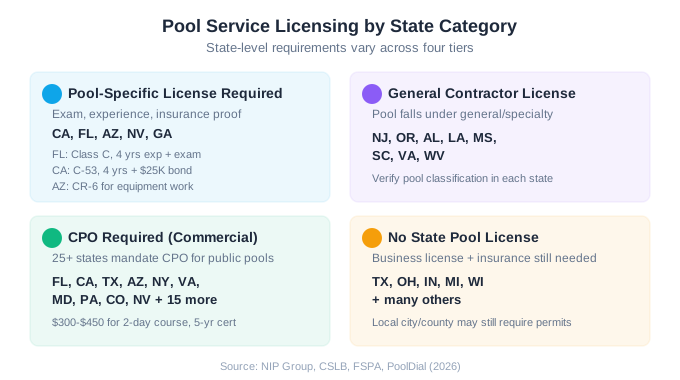
States fall into three general categories: states with specific pool contractor licensing, states with general contractor licensing that includes pool service, and states with no state-level pool service licensing requirement. The level of regulation often correlates with the size of the state's pool market.
| Category | States | What It Means |
|---|---|---|
| Specific pool contractor license required | California, Florida, Arizona, Nevada, Georgia (specialty) | State issues a pool-specific license. Requires exam, experience, and/or insurance proof. |
| General contractor license covers pool service | New Jersey, Oregon, Alabama, Louisiana, Mississippi, South Carolina, Virginia, West Virginia | Pool service falls under a general or specialty contractor license. Verify the classification. |
| CPO or equivalent required for commercial pools | 25+ states mandate CPO for public/commercial pool operators | Service techs managing commercial pool water chemistry typically need CPO certification. |
| No state-level pool service license | Texas, Ohio, Indiana, Michigan, Wisconsin, and many others | No state pool service license exists. Basic business license and insurance may still be required locally. |
Even in states with no pool service license requirement, you still need a general business license from your city or county, liability insurance (required by most customers), and compliance with OSHA if you have employees. "No license required" does not mean "no requirements."
What Are the Requirements in the Largest Pool Markets?
Florida
Florida has the most structured pool service licensing system in the country. Three classes of swimming pool contractor license exist: Class A (commercial pool and spa contractor), Class B (residential pool and spa contractor), and Class C (swimming pool/spa servicing contractor). The Class C license is what most pool service companies need. It covers non-structural repair and equipment servicing of pools.
- Requires 4 years of experience, with at least 1 year as a supervisor or foreman
- Written examination on pool service methods, safety, and business practices
- Proof of liability insurance and workers compensation (if applicable)
- Administered by the Florida Department of Business and Professional Regulation (DBPR)
California
California requires a C-53 Swimming Pool Contractor license from the Contractors State License Board (CSLB) for pool construction, major repair, and renovation work. Pool maintenance and cleaning without structural work or equipment installation may not require a C-53, but any work involving equipment repair, replacement, or installation typically does.
- 4 years of journeyman-level experience required
- Written examination on trade knowledge and California law
- Pre-licensing coursework on safety and construction law (as of 2025)
- Contractor bond of $25,000 required
- Proof of liability insurance
Arizona
Arizona issues a CR-6 Swimming Pool Service and Repair license through the Registrar of Contractors. Basic pool cleaning without equipment work does not require a contractor license, but any equipment repair, replacement, or installation does. The CR-6 license covers service, maintenance, and repair of existing swimming pools and spas.
Texas
Texas does not have a state-level pool service license. Pool cleaning and basic maintenance can be performed with a standard business license. However, the Texas Department of Licensing and Regulation (TDLR) requires a Residential Appliance Installer License for certain equipment installation work. Some municipalities have additional local requirements.
Georgia
Georgia does not issue a standalone pool contractor license. Pool service falls under the general contractor licensing board with a pool/spa specialty category for construction and major renovation. Basic cleaning and maintenance services do not require a state contractor license, though local business licensing applies.
Which States Require CPO Certification for Commercial Pools?
Certified Pool Operator (CPO) certification, administered by the Pool and Hot Tub Alliance (PHTA), is required in 25+ states for operators of public and commercial pools. Even in states without a statewide mandate, many counties and cities impose local CPO requirements. If you service any commercial, HOA, apartment, or municipal pools, CPO certification is effectively mandatory.
States with Statewide CPO Requirements
States that explicitly require CPO or an equivalent approved certification for public pool operators include Florida, California, Texas, Arizona, New York, Virginia, Maryland, Pennsylvania, Massachusetts, New Jersey, Georgia, North Carolina, South Carolina, Colorado, Nevada, Oregon, Washington, Minnesota, Iowa, Missouri, Nebraska, New Mexico, Montana, Maine, and Delaware. Some states accept alternative certifications such as the Aquatic Facility Operator (AFO) credential.
States with No Statewide CPO Requirement
Sixteen states have no statewide CPO certification requirement: Connecticut, Hawaii, Illinois, Indiana, Kansas, Kentucky, Louisiana, Mississippi, North Dakota, Ohio, Oklahoma, Rhode Island, South Dakota, Tennessee, Vermont, and Wisconsin. However, local jurisdictions in these states may still require CPO certification.
CPO certification costs $300-$450, takes 2 days to complete, and is valid for 5 years. Even if your state does not require it, CPO certification demonstrates professional competence and is required by many commercial clients before they will contract with you. Our CPO Certification Guide covers the exam, study tips, and renewal process.
What Local Licensing Requirements Should You Check?
State-level licensing is only part of the picture. Many cities and counties impose their own requirements that apply in addition to or instead of state requirements. These local requirements vary widely and change frequently.
Common Local Requirements
- City business license or occupational license: Required in most municipalities. Cost is typically $50-$300 annually. Apply through your city clerk or licensing office.
- County contractor registration: Some counties require contractors to register even when the state does not have a licensing requirement.
- Health department permits: Required in some jurisdictions for commercial pool service, particularly for water treatment and chemical handling.
- Vehicle permits: Some cities require permits for commercial vehicles hauling hazardous materials (pool chemicals) within city limits.
- Home-based business permits: If you operate from a home office, check zoning requirements and home-based business permit requirements.
The best approach is to contact your city clerk, county licensing office, and state contractor licensing board before starting operations. Ask specifically about pool service, pool maintenance, and pool cleaning requirements. Get the requirements in writing if possible.
What Insurance Is Required by State for Pool Service?
Many states tie insurance requirements to contractor licensing. Even in states without pool-specific licensing, insurance may be required by other business regulations, customer contracts, or common sense.
| Insurance Type | State Requirement | Practical Requirement |
|---|---|---|
| General liability | Required in FL, CA, AZ, NV, and most states with contractor licensing | Required by virtually all commercial customers and HOAs regardless of state law |
| Workers compensation | Required in most states when you have 1+ employees (varies by state) | Required by law in 48 states once you have employees. TX and OK allow opt-out. |
| Commercial auto | Required in all 50 states for vehicles used in business | Your personal auto will deny work-related claims. Commercial auto is non-negotiable. |
| Contractor bond | Required in CA ($25,000), FL, AZ, and some other licensed states | Protects customers against contractor failure. May be required by large commercial contracts. |
Even if your state does not legally require general liability insurance, operating without it is reckless. One slip-and-fall claim, one chemical spill, or one property damage incident can generate a six-figure claim. GL insurance at $67/month is the cheapest risk management tool in your business.
How Do You Verify Current Requirements for Your State?
Licensing requirements change. States update regulations, add new certification requirements, and adjust fee structures. Relying on a blog post (including this one) as your sole source is risky. Here is how to verify the current requirements for your specific state.
Verification Steps
- 1State contractor licensing board website: Search for "[your state] contractor licensing board" and look for pool, swimming pool, or specialty contractor categories.
- 2State Department of Business Regulation: If there is no specific contractor board, the department of business regulation or department of professional regulation handles licensing.
- 3State pool and spa association: Your state's pool and spa trade association (often affiliated with PHTA) maintains current licensing guidance and can answer questions directly.
- 4PHTA state requirements map: The Pool and Hot Tub Alliance publishes state-by-state regulation summaries for the pool industry.
- 5Local SCORE or SBA office: Free business mentorship organizations can help navigate local licensing and permitting requirements.
Budget half a day for this research when starting a new business or expanding into a new state. The time investment prevents months of delays if you discover mid-operation that you need a license you do not have.
Free starter kit
Start a pool service business with the numbers already run.
A short email series from an owner who started with $1,200 and a used truck. No software pitch, just the four things that decide whether year one works.
- Startup cost breakdownEvery line item from $2K bootstrap to fully equipped
- Pricing calculatorThe minimum you can charge per visit and still profit
- First-10-customers playbookDoor hangers, referrals, and the phone script that closes
- Licensing & insurance checklistWhat your state requires and which insurers pay claims
Already running routes? Try Pool Founder free
Frequently Asked Questions
Do I need a license to clean pools in my state?
It depends on your state and the scope of your services. States like Florida and California require specific contractor licenses for pool service. Many other states have no state-level pool service license. However, even in states without pool-specific licensing, you typically need a general business license, and equipment repair or installation may require a separate contractor license. Verify with your state licensing board.
Which states require CPO certification for pool service?
Over 25 states require CPO (Certified Pool Operator) or equivalent certification for operators of public and commercial pools. Major states include Florida, California, Texas, Arizona, New York, and Virginia. Sixteen states have no statewide CPO requirement, though local jurisdictions may still require it. Even where not required, CPO is often demanded by commercial clients.
What happens if I operate without a required pool service license?
Penalties vary by state but can include fines of $500-$10,000+, work stoppages, contract voidance, and in some states misdemeanor criminal charges. In California, unlicensed contracting is a misdemeanor punishable by fines up to $15,000. In Florida, unlicensed contracting can result in fines, criminal prosecution, and inability to collect payment for work performed.
Do I need a different license for commercial vs residential pool service?
In some states, yes. Florida distinguishes between residential (Class B) and commercial (Class A) pool contractors. California's C-53 license covers both. In states without specific pool licensing, commercial pools typically require CPO certification that is not required for residential-only service. Check your state's specific classifications.
How long does it take to get a pool service license?
Timeline varies significantly. In Florida, the process takes 2-6 months including gathering experience documentation, studying, and passing the exam. California C-53 licensing takes 3-6 months. CPO certification takes 2 days of training plus the exam. General business licenses are usually issued within 1-4 weeks. Plan ahead and start the licensing process well before you plan to begin operations.
Sources & References
- NIP Group: State Requirements for Swimming Pool Contractors
- CSLB: C-53 Swimming Pool Contractor Classification
- FSPA: Florida Swimming Pool Contractor Licensing
- PoolDial: CPO Certification Requirements by State
- Pool Installer Authority: Licensing Requirements by State
- Wolters Kluwer: Pool Maintenance Licensing Requirements