Why Is a Written Pool Service Contract the Single Most Important Document in Your Business?
The U.S. pool service industry generates between $7.2 billion and $8.8 billion in annual revenue, yet a significant percentage of operators still run their businesses on handshake agreements, verbal promises, and text message confirmations. This is a catastrophic business risk. A written pool service contract is not just a formality. It is the legal backbone of your revenue, the document that protects you from liability claims, the mechanism that stabilizes your cash flow, and the single biggest factor that determines what your business is worth when you eventually sell it.
Pool service businesses with formal contracts retain 80-90% of their customers annually. Businesses without written agreements experience 15-25% annual churn, meaning a 60-pool route can lose 9 to 15 accounts every year with no contractual recourse. That churn costs $10,000-$25,000 in lost annual revenue and an additional $3,000-$7,000 in marketing and onboarding costs to replace those customers. A well-drafted contract does not just prevent disputes. It builds the kind of predictable, documented revenue stream that acquirers and lenders will pay a premium for.
80-90%
Annual customer retention rate for pool businesses using formal service contracts
Source: Industry surveys, DealStream
This guide covers every clause your pool service contract needs, explains the legal and financial reasoning behind each one, and provides the specific language and structures that protect your business. Whether you service 20 pools or 2,000, the principles are the same. Read it cover to cover before drafting or revising your agreement.
Why Does Every Pool Service Business Need a Written Contract?
A pool service contract serves four critical business functions: it stabilizes cash flow by creating legally binding payment obligations, it limits your liability exposure by defining exactly what you are and are not responsible for, it sets clear customer expectations that reduce disputes and callbacks, and it directly impacts your company valuation when it comes time to sell. Ignore any one of these and you are leaving money on the table or exposing yourself to risk that could end your business overnight.
Cash Flow Stability and Revenue Predictability
Without a contract, customers can cancel at any time, skip payments with no consequence, and dispute charges after the fact. A written agreement converts your revenue from unpredictable to contractual. When a customer signs a 12-month agreement at $175 per month, you can forecast $2,100 in revenue from that account. Multiply that across 80 accounts and you have $168,000 in contractually committed annual revenue. Banks will lend against that. Acquirers will value it. Your stress level during slow months drops dramatically when you know exactly what your accounts receivable should be.
Contracts also give you legal standing to collect on unpaid invoices. Without a signed agreement, your options in small claims court are limited to proving the existence of a verbal agreement, which is difficult, time-consuming, and unreliable. With a signed contract that specifies payment terms, late fees, and consequences for non-payment, you have an enforceable document that courts take seriously.
Liability Protection
Pool service involves working with hazardous chemicals on other people's property, around expensive equipment, near pets and children, and in conditions (wet surfaces, electrical equipment, enclosed pump rooms) that create real injury and property damage risk. Without a contract that explicitly limits your liability, defines your scope of responsibility, and requires customers to maintain their own insurance, a single incident can result in a lawsuit that pierces through to your personal assets if your business entity protections are not properly documented.
A well-drafted contract includes a liability limitation clause, an indemnification provision, a requirement that the customer disclose known hazards, and a clear definition of what constitutes your responsibility versus the homeowner's. These clauses do not make you immune to lawsuits, but they significantly reduce your exposure and give your insurance company the documentation they need to defend you effectively.
Setting Customer Expectations
Most customer disputes in pool service stem from mismatched expectations, not from bad service. The customer thought you were cleaning the pool deck. You thought your job ended at the waterline. The customer expected you to fix a leaking pump valve. You expected them to call a repair specialist. The customer assumed you would come on the same day every week. You assumed flexibility within a service window. A contract that explicitly defines what is included, what is excluded, and how scheduling works eliminates these disputes before they start.
The most common customer complaint in pool service is not about quality. It is about unmet expectations. A detailed scope-of-services clause reduces dispute-related callbacks by 30-50% in the first year because both parties agree upfront on exactly what the service includes.
Business Valuation Impact
When you sell a pool service business, the buyer is purchasing your customer base and the revenue it generates. Businesses with documented contracts and customer retention rates above 85% command 3-4x annual revenue in valuation multiples. Businesses without contracts, or with retention below 75%, typically sell for 1-2x annual revenue. For a business generating $300,000 in annual revenue, that is the difference between a $900,000 sale and a $300,000 sale. Contracts are not just legal documents. They are financial instruments that directly determine your net worth.
3-4x
Valuation multiple for pool businesses with 85%+ contract-based retention
Source: DealStream, BusinessDojo
What Should a Pool Service Contract Include?
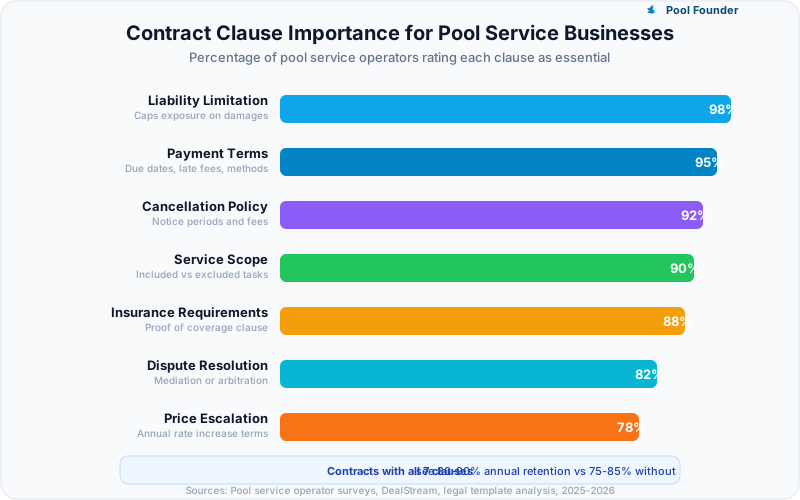
A comprehensive pool service contract contains seven essential clause categories. Missing any one of them creates a gap that customers, attorneys, or acquirers will eventually exploit. Below is each clause category with explanations of what it should contain and why it matters for your business.
Scope of Services
The scope of services clause is the most important section of your contract because it defines exactly what the customer is paying for. This clause should be exhaustively specific. List every task that is included in the standard service visit: skimming the surface, brushing walls and tile, vacuuming the pool floor, emptying skimmer and pump baskets, testing water chemistry (specify which parameters: free chlorine, pH, alkalinity, stabilizer, calcium hardness), adding chemicals as needed, backwashing the filter (specify frequency), and inspecting equipment for visible damage.
Equally important is what the scope excludes. Explicitly state that the standard service does not include equipment repairs, filter deep cleaning or replacement, drain and refill, acid washing, tile cleaning, deck maintenance, pool cover installation or removal, or any work on connected water features unless specifically added as a line item. The more specific you are about exclusions, the fewer disputes you will face.
- Surface skimming and debris removal
- Brushing walls, steps, and tile line
- Vacuuming pool floor (manual or automatic)
- Empty skimmer baskets and pump strainer basket
- Test and adjust water chemistry (chlorine, pH, alkalinity, CYA, calcium)
- Add chemicals as needed to maintain safe water balance
- Backwash or clean filter per manufacturer schedule
- Visual inspection of pump, filter, heater, and automation equipment
- Written service report per visit (digital or paper)
Service Frequency and Scheduling
Specify the number of visits per month (typically four for weekly service), the general day of the week or service window, and your policy on rescheduling due to holidays, weather, or access issues. Avoid committing to a specific time of day unless you charge a premium for guaranteed time slots. Include language that allows reasonable schedule flexibility, such as: "Service will be performed on the designated day of the week, generally between 7:00 AM and 5:00 PM, with the specific arrival time varying based on route conditions and weather."
Define what happens when a scheduled visit cannot be completed. If a gate is locked, a dog is loose in the yard, or the customer has blocked access to the pool, state clearly whether you will attempt a return visit, charge for the missed visit, or credit the customer. Most successful operators charge for missed visits caused by customer access issues because the drive time, chemical loading, and route disruption cost you money regardless of whether you can physically service the pool.
Contract Term and Renewal
Define the initial contract period (month-to-month, 6 months, or 12 months), the start and end dates, and the renewal terms. Annual contracts provide the most stability and are preferred for business valuation purposes, but month-to-month agreements with a 30-day cancellation notice are more common in the industry because they reduce customer resistance at sign-up. A good middle ground is a 12-month initial term that converts to month-to-month after the first year with 30 days written notice required for cancellation.
For maximum business valuation, use 12-month contracts with automatic annual renewal. Acquirers heavily discount month-to-month agreements because there is no guarantee the customer will stay after the sale. An auto-renewing annual contract with a 30-day cancellation window gives customers flexibility while demonstrating committed revenue to a buyer.
Chemical Responsibility Clause
Define who supplies the chemicals and how chemical costs are handled. The three common models are: chemicals included in the monthly service fee, chemicals billed separately at cost-plus markup, or customer provides their own chemicals. Most professional operators include standard chemicals (chlorine, acid, stabilizer) in their service fee and charge separately for specialty chemicals (phosphate remover, metal sequestrant, algaecide treatments). Whichever model you use, spell it out in the contract so there are no surprises on the first invoice.
If you include chemicals, add language that allows pricing adjustments for abnormal chemical consumption. Pools with heavy tree coverage, high bather loads, or older plaster surfaces consume significantly more chemicals than average. Your contract should allow you to adjust pricing with 30 days notice if chemical costs for a specific pool exceed a reasonable threshold, typically 15-20% above your per-pool chemical budget.
Access and Property Conditions
Require the customer to provide reliable access to the pool area on each scheduled service day. Specify how access will be granted: gate code, hidden key, smart lock code, or unlocked gate. Include language that requires the customer to notify you of any changes to access methods at least 48 hours before the next scheduled visit. Define the customer's responsibility to maintain a safe and accessible path to the pool, free from hazards, aggressive animals, and obstructions.
Dispute Resolution
Include a dispute resolution clause that specifies how disagreements will be handled. Most pool service contracts benefit from a three-step process: first, direct communication between the parties to attempt informal resolution within 15 days; second, mediation with a mutually agreed-upon mediator within 30 days; third, binding arbitration or small claims court in the county where the service is performed. A dispute resolution clause keeps minor disagreements from turning into expensive lawsuits and demonstrates to customers that you have a fair, structured process for handling issues.
How Should You Structure Pricing and Payment Terms in Your Contract?
Your pricing and payment clause is where revenue protection meets customer clarity. Ambiguous payment terms lead to late payments, disputed invoices, and cash flow problems that can cripple a growing pool service business. This section of your contract should leave zero room for interpretation on what is owed, when it is due, and what happens when payment is late.
Payment Schedule Options
The three standard payment structures for pool service are monthly flat-rate billing (most common), per-visit billing, and prepaid quarterly or annual billing. Monthly flat-rate billing is the industry standard because it smooths revenue across months with different visit counts, simplifies bookkeeping for both parties, and creates the predictable recurring revenue that maximizes business valuation. Per-visit billing makes sense for one-time or irregular services but creates variable income that is harder to forecast and less attractive to buyers.
| Payment Model | Pros | Cons | Best For |
|---|---|---|---|
| Monthly flat rate | Predictable revenue, simple billing, valuation-friendly | Customers may question months with fewer visits | Weekly service contracts, majority of accounts |
| Per-visit billing | Transparent, easy for customers to understand | Variable income, more invoicing work, lower valuation | Biweekly service, seasonal-only accounts |
| Prepaid quarterly | Cash flow boost, lower churn, committed customer | Refund obligations if customer cancels early | Premium accounts, high-trust relationships |
| Prepaid annual | Maximum cash flow, lowest churn, highest valuation signal | Large refund risk, customer resistance | Long-term loyal customers, small percentage of base |
Due Dates and Late Fees
Specify a clear due date for each invoice, typically the 1st of the month for that month's service or Net 15 from the invoice date. Define a grace period (5-7 days is standard), after which a late fee applies. Late fees in pool service typically range from $15-$25 per occurrence or 1.5% per month on the outstanding balance, whichever is greater. Check your state's usury laws to ensure your late fee structure is legally enforceable. Some states cap late fees or interest rates on service contracts.
Include language specifying when you will suspend service for non-payment. A common structure is: late fee applied after 7 days past due, written notice of intent to suspend service after 15 days past due, service suspension after 30 days past due, and contract termination after 60 days past due. This escalation gives customers multiple opportunities to cure the default while protecting you from providing free service.
Always include a clause that makes the customer responsible for any collection costs, including reasonable attorney fees, if you have to pursue unpaid balances. This language alone reduces late payments by 20-30% because customers take payment obligations more seriously when they know non-payment has real financial consequences beyond the late fee.
Accepted Payment Methods
Specify which payment methods you accept: credit card on file (strongly recommended as the default), ACH bank transfer, check, or cash. The most efficient and reliable method is credit card autopay or ACH autopay, set up at contract signing and charged automatically on the 1st of each month. Autopay reduces your collection burden to near zero and eliminates the need to chase payments. Include language in your contract that authorizes automatic recurring charges and requires the customer to keep a valid payment method on file.
If you accept checks, specify that returned check fees (typically $25-$35) will be charged to the customer in addition to any late fees. If you accept cash, specify that cash payments must be made in exact change and that you are not responsible for providing receipts beyond your standard digital invoice system.
Price Adjustment Clauses
Include a clause that allows you to adjust pricing with 30 days written notice for the following reasons: annual cost-of-living increase, chemical cost increases exceeding 10% from your supplier, addition of services requested by the customer, or changes in pool conditions that increase service time or chemical consumption. Without a price adjustment clause, you are locked into your original pricing for the entire contract term, which can erode your margins if chemical costs spike or labor rates increase. A 3-5% annual escalation clause is reasonable and expected by most customers.
Seasonal Pricing Considerations
If you operate in a market with distinct pool seasons, your contract should address seasonal pricing. The two common approaches are year-round flat-rate billing (the annual cost divided by 12, regardless of whether the pool is winterized for 3-4 months) and seasonal billing (full rate during active months, reduced rate or no charge during winterized months). Year-round billing is strongly preferred because it eliminates the revenue cliff in winter months, simplifies your cash flow forecasting, and reduces the risk of customers canceling during the off-season and not returning in spring.
What Liability and Insurance Clauses Protect Your Business?
Liability and insurance clauses are the legal shield that stands between a bad day on the job and a business-ending lawsuit. Pool service involves inherent risks: chemical burns, property damage, slip-and-fall injuries, equipment failure, and water contamination. Your contract must address these risks head-on with specific, enforceable language that limits your exposure and ensures both parties carry appropriate insurance coverage.
General Liability Insurance Requirements
General liability insurance for pool and spa cleaning businesses costs approximately $67 per month, or about $800 per year, based on Insureon median data. This covers third-party bodily injury, property damage, and personal injury claims arising from your business operations. Every pool service contract should state that you carry general liability insurance with minimum coverage of $1,000,000 per occurrence and $2,000,000 aggregate, and should offer to provide a certificate of insurance upon request. Many commercial accounts and HOAs will require this as a condition of doing business.
~$67/mo
Median general liability insurance cost for pool service businesses
Source: Insureon
Workers Compensation Coverage
If you have employees, workers compensation insurance is legally required in most states and costs approximately $136 per month, or $1,627 per year, based on Insureon median data for cleaning services. Your contract should confirm that you carry workers compensation coverage for all employees performing services on the customer's property. Even if you are a sole proprietor with no employees, mentioning workers compensation in your contract signals professionalism and can prevent customers from worrying about their own liability if you are injured on their property.
~$136/mo
Median workers compensation insurance cost for pool service businesses
Source: Insureon
Limitation of Liability Clause
A limitation of liability clause caps the maximum amount you can be held responsible for in the event of a covered claim. The most common structure limits your total liability to the amount the customer has paid under the contract in the preceding 12 months. For a customer paying $175 per month, your maximum exposure would be $2,100, not an unlimited amount determined by a jury. This clause does not protect you from gross negligence or intentional misconduct, but it prevents a $200-per-month customer from suing you for $500,000 over a stained pool deck.
Include language that excludes consequential, incidental, and indirect damages. This means if a chemical imbalance damages a pool surface, you may be liable for the direct cost of resurfacing, but not for the customer's claim that they lost $20,000 in rental income because their vacation home pool was unusable. Without this exclusion, your liability exposure is effectively unlimited.
Indemnification Provision
An indemnification clause requires each party to hold the other harmless for claims arising from their own negligence or breach of the contract. In practical terms, this means if a customer's dog bites you while you are servicing the pool, the customer agrees to cover your medical costs and any legal expenses. Conversely, if your technician damages the customer's pool equipment through negligence, you agree to cover the repair cost. Mutual indemnification is fair, enforceable, and expected in professional service contracts.
Property Damage and Pre-Existing Conditions
Include a clause that requires you to document the condition of the pool, equipment, and surrounding property at the start of the contract. This pre-existing condition inventory protects you from claims that your service caused damage that was already present. Take dated photos of the pool surface, equipment, deck, and any existing damage during your initial assessment. Reference this documentation in the contract with language such as: "The condition of the pool and equipment at the commencement of this agreement is documented in the initial assessment report dated [date], which is incorporated by reference into this agreement."
Take timestamped photos of every pool before your first service visit and store them permanently. This 10-minute habit protects you from thousands of dollars in false property damage claims. Include the photos as an addendum to the signed contract.
Customer Insurance Requirements
Your contract should require the customer to maintain homeowner's insurance that covers their pool and pool equipment. This is not about protecting you. It is about ensuring that if a covered event (storm damage, equipment failure, freeze damage) occurs, the customer has a path to recovery that does not involve blaming your service. Include language that states: "Customer warrants that they maintain homeowner's insurance with coverage for the swimming pool, pool equipment, and surrounding structures. Contractor is not responsible for damage covered under the customer's homeowner's insurance policy."
How Do You Handle Contract Termination and Cancellation?
The cancellation clause is where many pool service contracts fail. Either they are too restrictive (trapping unhappy customers who then leave negative reviews), too permissive (allowing customers to cancel with no notice, destroying your route density), or too vague (creating disputes about what constitutes proper cancellation and what the customer owes). A well-structured cancellation clause balances business protection with customer fairness, and 30 days written notice has emerged as the industry standard.
Standard Cancellation Notice Period
Thirty days written notice is the most common and widely accepted cancellation period in the pool service industry. This gives you enough time to fill the route slot with a new customer while being short enough that customers do not feel trapped. Written notice should be required via email, certified mail, or your customer portal, not via phone call, text message, or voicemail, because written documentation prevents disputes about when notice was given and what was communicated.
During the 30-day notice period, all terms of the contract remain in effect: you continue to provide service, and the customer continues to pay. The service does not stop on the day the customer gives notice. It stops 30 days later. This protects you from customers who try to cancel and immediately stop payment while expecting one or two more service visits.
Early Termination Fees
If you use annual contracts, an early termination fee compensates you for the revenue you expected to earn for the remainder of the term. Common structures include: a flat fee (typically one or two months of service), a percentage of the remaining contract value (typically 25-50%), or the remaining balance minus a discount (such as 75% of the remaining months). Early termination fees must be reasonable and proportional to your actual damages, or courts may find them unenforceable as penalty clauses. The safest approach is a flat fee equal to one month of service, which courts consistently uphold as a reasonable liquidated damages provision.
| Termination Fee Structure | Example (on $175/mo, 8 months remaining) | Enforceability | Customer Acceptance |
|---|---|---|---|
| One month flat fee | $175 | High, widely upheld | High, perceived as fair |
| Two months flat fee | $350 | Moderate, depends on jurisdiction | Moderate |
| 25% of remaining value | $350 | Moderate to high | Moderate |
| 50% of remaining value | $700 | Lower, may be seen as punitive | Low, may deter sign-ups |
| Full remaining balance | $1,400 | Low, likely unenforceable | Very low, will lose customers |
Prorated Refunds for Prepaid Service
If a customer prepays for a quarter or year and cancels mid-period, your contract must specify how refunds are calculated. The standard approach is to refund the unused portion minus the early termination fee and any discount the customer received for prepaying. For example, if a customer prepaid $1,800 for an annual contract (a 15% discount from the $175/month rate), and cancels after 6 months, you would calculate: ($1,800 / 12 months) x 6 remaining months = $900 unused, minus $175 early termination fee, equals $725 refund. Spell out this math in the contract so there are no surprises.
Automatic Renewal Terms
Automatic renewal clauses state that the contract renews for an additional term (typically 12 months or converts to month-to-month) unless the customer provides written cancellation notice within a specified window before the renewal date, typically 30-60 days. Many states have specific laws governing auto-renewal clauses in consumer contracts, including requirements for advance notice of the renewal and clear disclosure of the auto-renewal terms at the time of initial signing. Check your state's auto-renewal statute before including this clause, and ensure your contract clearly discloses the renewal terms in a conspicuous manner.
Send a renewal reminder email 45-60 days before the contract renewal date. This is not just good customer service. Several states legally require advance notice of auto-renewal, and failing to provide it can void the renewal and expose you to consumer protection penalties.
Contractor Right to Terminate
Your contract should also reserve your right to terminate the agreement under specific conditions: non-payment after the cure period, unsafe conditions on the property, hostile or threatening behavior from the customer or household members, repeated access issues that prevent service, and material breach of any contract term. Include a clause allowing immediate termination without notice for safety threats, and 15-30 days notice for other cause-based terminations. Having a documented right to fire bad customers is essential for protecting your technicians and your business reputation.
What Special Circumstances Should Your Contract Address?
Standard contract clauses cover the routine aspects of pool service, but the situations that generate the most disputes, liability claims, and customer frustration are the non-routine ones. Aggressive dogs, locked gates, storm damage, pre-existing equipment failures, and liability for chemical-related injuries all require specific contract language. Addressing these upfront prevents reactive, emotional negotiations when something goes wrong.
Aggressive Pets and Animal Hazards
This is one of the most overlooked clauses in pool service contracts, and one of the most important. Dog bites account for a significant number of service worker injuries, and pool technicians enter backyards where animals may feel territorial. Your contract should require the customer to secure all pets inside the home or in a separate enclosed area during the service window. Include language that states the technician has the right to skip the service visit without penalty if animals are loose in the pool area, and that the skipped visit will be billed at the normal rate because the technician drove to the property and attempted service.
Go further by requiring the customer to disclose the presence of any animals on the property at contract signing, including breed, temperament, and containment method. If a technician is bitten or injured by an animal, the customer should be liable under the indemnification clause, and you should have the right to immediately terminate the contract. Do not be shy about this clause. It protects your employees, your insurance rates, and your ability to hire and retain technicians who feel safe on the job.
Locked Gates and Access Issues
Include specific language addressing what happens when your technician arrives and cannot access the pool. Define "access failure" broadly: locked gate with no working code, gate code changed without notice, vehicle blocking the service path, construction obstructing access, or any condition that prevents the technician from safely reaching the pool. State that the customer will be charged the full service rate for access failures caused by the customer, that the technician will leave a door hanger or send a notification, and that the customer must contact you within 24 hours to arrange a make-up visit at your discretion and availability.
The locked gate clause is your second most important revenue protection clause after the payment terms. A single locked gate on a 10-stop route day wastes 15-30 minutes of drive time and disrupts your entire schedule. Billing for access failures is not punitive. It covers your real costs and incentivizes customers to maintain reliable access.
Weather Cancellations and Force Majeure
Define how weather affects your service obligation. Light rain should not cancel a pool service visit since your technician is already working with water. However, lightning, severe thunderstorms, tropical storms, and extreme heat advisories create genuine safety risks. Your contract should specify that weather cancellations are at the technician's discretion, that you will make reasonable efforts to reschedule weather-cancelled visits within the same service week, and that the customer will not be credited for weather cancellations that cannot be rescheduled if the total monthly visit count still meets the contract minimum (typically three out of four visits per month).
Include a force majeure clause that covers extended service disruptions caused by hurricanes, floods, droughts with water restrictions, pandemics, government orders, or supplier shortages that prevent you from obtaining necessary chemicals. This clause should suspend both parties' obligations for the duration of the force majeure event and allow either party to terminate without penalty if the disruption exceeds 30-60 days.
Pre-Existing Equipment Damage and Wear
Pool equipment fails. Pump motors burn out, filter tanks crack, heater exchangers corrode, and automation systems malfunction. When equipment fails during the term of your service contract, the customer's first instinct is often to blame the pool service company. Your contract needs a clear clause stating that you are not responsible for equipment failure due to normal wear and tear, manufacturer defects, age, improper installation by others, or pre-existing conditions documented in the initial assessment. Include language that you will notify the customer of any equipment issues you observe during service visits, but that notification does not create an obligation to repair or replace the equipment.
Chemical Safety and Responsibility
Define who is responsible for chemical-related outcomes. If you supply and apply the chemicals, your contract should state that you follow manufacturer guidelines and industry-standard dosing protocols, that you are responsible for maintaining water chemistry within safe ranges during the service period, and that you are not responsible for chemical imbalances that occur between service visits due to heavy pool usage, rainfall, or other factors outside your control. If the customer self-treats the pool between your visits (adding shock, algaecide, or any other chemicals), include a clause that waives your liability for any adverse reactions, staining, or equipment damage caused by the customer's chemical additions.
Pool Parties, Heavy Use Events, and Seasonal Changes
Include a clause that addresses the customer's responsibility to notify you of pool parties, extended family visits, or any event that will result in significantly higher-than-normal bather loads. Heavy use can deplete sanitizer levels, spike combined chlorine, and increase debris faster than your standard service frequency can handle. Your contract should state that extra service visits needed due to heavy-use events will be billed at your standard per-visit rate, and that you are not responsible for water quality issues resulting from events that the customer did not notify you about in advance.
How Do Contracts Affect Your Pool Business Valuation?
If you plan to sell your pool service business someday, and you should, because pool routes are one of the most sellable small business assets in the home-service industry, then your contracts are not just legal documents. They are the primary evidence of your company's value. Acquirers do not buy your truck, your chemicals, or your equipment. They buy your customer base and the predictable revenue it generates. Contracts are the proof that revenue is committed, not hoped for.
Retention Metrics That Drive Valuation
The single most important metric in a pool service business acquisition is customer retention rate. Businesses with documented annual retention above 85%, meaning fewer than 15% of customers cancel per year, command valuation multiples of 3-4x annual revenue. Businesses with retention between 75-85% typically sell for 2-3x. Below 75%, you are looking at 1-2x at best, with many buyers walking away entirely because the customer base is considered unstable. A 10-20% premium on business valuation applies to businesses that can document retention above 80% through signed contracts and historical data.
| Annual Retention Rate | Typical Valuation Multiple | Example Value ($300K Revenue) | Contract Status |
|---|---|---|---|
| 90%+ | 3.5-4x annual revenue | $1,050,000-$1,200,000 | Strong contracts, auto-renewal, documented history |
| 85-90% | 3-3.5x annual revenue | $900,000-$1,050,000 | Formal contracts, good documentation |
| 75-85% | 2-3x annual revenue | $600,000-$900,000 | Mix of contracts and verbal agreements |
| Below 75% | 1-2x annual revenue | $300,000-$600,000 | Mostly verbal, no documentation |
10-20%
Valuation premium for pool businesses with documented retention above 80%
Source: DealStream
What Acquirers Look for in Your Contracts
When a buyer conducts due diligence on your pool service business, they will review every customer contract. They are looking for: signed agreements (not just invoicing records), clear service terms that the buyer can continue without renegotiation, auto-renewal clauses that extend the relationship beyond the sale, reasonable cancellation terms that give the new owner time to build relationships, and consistent pricing that demonstrates healthy margins. If your contracts are unsigned, incomplete, or inconsistent across customers, the buyer will discount your valuation or add contingency clauses to the purchase agreement that reduce your proceeds.
- Signed agreements for 85%+ of active customers
- Consistent contract terms across the customer base
- Auto-renewal clauses that survive ownership transfer
- Cancellation terms requiring 30+ days written notice
- Documented payment history showing on-time collection
- Assignment clause allowing contract transfer to the buyer
- Customer contact information and service history per account
The Assignment Clause: Making Your Contracts Transferable
Perhaps the most commonly missing clause in pool service contracts is the assignment clause, and it is the one that matters most when you sell. An assignment clause states that you may assign the contract to a successor, affiliate, or purchaser of the business, and that the customer's obligations continue under the new ownership. Without this clause, every customer technically has the right to terminate their contract when ownership changes, which can cause 20-40% customer loss immediately after a sale and is the number one deal-killer in pool service business acquisitions.
Add an assignment clause to every contract you sign from today forward, and update existing contracts at renewal. A simple sentence, "This agreement may be assigned by Contractor to any successor, purchaser, or affiliate without the consent of Customer," can add six figures to your eventual sale price by giving the buyer confidence that your customers will transfer.
Building Documented Systems That Add Value
Contracts are the foundation, but they are most valuable when part of a broader documented system. Buyers pay premium multiples for businesses that have: standardized contracts signed by every customer, a CRM or pool service software with complete service history, documented standard operating procedures for service visits, a customer onboarding process that includes a signed contract and initial pool assessment, and automated billing with high autopay adoption. These systems signal a business that will run smoothly under new ownership, which is exactly what buyers are paying for. Each additional layer of documentation and systematization moves your valuation multiple upward within the ranges above.
Ready to streamline your pool service business?
Pool Founder gives you route optimization, automated invoicing, chemical tracking, and everything else you need to run a more profitable pool business.
Frequently Asked Questions
Do I need a lawyer to draft my pool service contract?
You do not need a lawyer to create an initial contract, and many successful pool businesses start with a well-researched template adapted to their state. However, spending $500-$1,500 on a one-time attorney review is strongly recommended once your business reaches 30-50 accounts. An attorney can identify clauses that may not be enforceable in your state, add jurisdiction-specific language for auto-renewal disclosures, ensure your liability limitation clause meets local requirements, and review your indemnification language. Think of it as an investment: a $1,000 attorney review protects a customer base worth $100,000 or more. Use resources from ContractsCounsel or Rocket Lawyer as starting points, but get a local attorney to review before you scale.
Should I use month-to-month contracts or annual agreements?
Both have a place in your business. Month-to-month contracts with a 30-day cancellation notice are easier to sell to new customers and reduce sign-up resistance, making them ideal for customer acquisition. Annual contracts with auto-renewal provide stronger revenue predictability and command higher valuation multiples, making them ideal for business value. The best strategy is to start new customers on month-to-month agreements to build trust, then offer a 5-10% discount for switching to an annual contract after 6-12 months of service. This approach maximizes both customer acquisition and long-term retention. Businesses that achieve 60-70% of customers on annual contracts with the remainder on month-to-month with 30-day notice consistently command the highest valuations.
Are digital contracts and e-signatures legally valid?
Yes. Under the federal ESIGN Act and the Uniform Electronic Transactions Act (adopted in 47 states plus DC), electronic signatures and digital contracts are legally equivalent to paper contracts and wet signatures for pool service agreements. Using digital contracts through platforms like DocuSign, PandaDoc, or your pool service software has significant advantages: faster signing turnaround, automatic storage and retrieval, timestamped audit trails that prove when the document was signed, and the ability to send contracts remotely instead of requiring an in-person meeting. Digital contracts are actually more defensible in court than paper contracts because the electronic audit trail provides stronger evidence of when, where, and by whom the document was signed.
What should I do if a customer refuses to sign a contract?
First, understand why they are refusing. Most resistance comes from fear of being locked in, not from objection to the contract itself. Offer a month-to-month agreement with a 30-day cancellation clause and explain that the contract protects them as much as it protects you by documenting exactly what services they will receive, what they will pay, and what to do if there is a problem. If a customer still refuses to sign any written agreement, you have a business decision to make. Servicing a customer without a contract means you have no legal recourse for unpaid invoices, no liability protection, and no documentation for business valuation. Some operators choose to accept the risk for otherwise excellent customers, but best practice is to require a signed agreement from every customer, even if it is a simple one-page document covering scope, pricing, and cancellation terms.
Can I change contract terms in the middle of an agreement?
You can modify contract terms mid-agreement only if your original contract includes a modification clause and you follow the process it specifies. The standard approach is to include language allowing amendments with 30 days written notice for changes to pricing, service scope, or scheduling, and requiring written consent from both parties for material changes to liability, cancellation, or payment terms. When you need to raise prices or adjust services, send a written notice specifying the change, the effective date (at least 30 days out), and a statement that continued use of the service after the effective date constitutes acceptance of the new terms. For significant changes, have the customer sign an addendum to the original contract. Never make unilateral changes to cancellation terms, liability clauses, or payment structures without explicit written customer consent, as courts may void the entire contract if material terms are changed without proper agreement.
How do I handle contracts when I acquire or sell a pool route?
When acquiring a route, review every existing customer contract for assignment clauses, remaining term, pricing, and any unusual commitments the previous owner made. If contracts include an assignment clause, the transfer is straightforward: the seller assigns the contracts to you, and you assume all obligations. If contracts lack assignment clauses, you will need to sign new agreements with each customer, which creates a risk window where customers can decline to continue service. When selling, having assignable contracts with consistent terms across your customer base dramatically simplifies the transaction and maximizes your sale price. Include an assignment clause in every new contract, and update existing contracts at renewal to add one. A clean, assignable contract portfolio is the single biggest differentiator between a $200,000 sale and a $600,000 sale for the same revenue base.