What Are the Insurance Requirements for Running a Pool Service Business?
Insurance is not optional for pool service businesses. It is a legal requirement in most states, a contractual requirement for most commercial and HOA accounts, and the only thing standing between a single bad day and the end of your company. Pool service operators handle corrosive chemicals on other people's property, drive commercial vehicles between 15 to 30 stops per day, and work around water where the consequences of an accident can be severe. A cracked muriatic acid jug that eats through a $90,000 travertine deck, an employee who slips on wet coping and breaks a wrist, a fender bender with $40,000 in vehicle damage on the way to a route stop. These are not hypothetical scenarios. They are Tuesday for an uninsured pool company.
The cost of proper insurance coverage is manageable. A solo operator can secure general liability and commercial auto for roughly $2,760 to $3,500 per year, and even a mid-size operation with four to ten technicians typically spends between $11,700 and $23,900 annually for comprehensive coverage. That works out to 2% to 4% of gross revenue for most pool businesses. Compare that to the $100,000 or more a single uninsured liability claim can cost, and insurance stops looking like an expense and starts looking like the cheapest protection you will ever buy.
This guide covers every insurance requirement for pool service businesses in 2026, including which policies are legally mandatory, how requirements vary by state, what you should budget based on your business size, and how to get coverage quickly. All cost figures come from Insureon, The Hartford, and SPPA median premium data for pool and spa service companies.
What Insurance Is Legally Required for Pool Service Businesses?
Pool service businesses face three categories of insurance: policies that are legally mandated by state or federal law, policies that are not technically required by law but are effectively mandatory because customers and contracts demand them, and optional policies that address industry-specific risks. Understanding which category each policy falls into helps you prioritize your spending and avoid operating with dangerous coverage gaps.
General Liability Insurance
General liability insurance covers third-party bodily injury, property damage, and personal injury claims. While not technically mandated by state law in most jurisdictions, general liability is effectively required because virtually every commercial customer, HOA, and property management company requires proof of GL coverage before they will sign a service contract. Many residential customers in affluent neighborhoods also ask for certificates of insurance. The standard policy provides $1 million per occurrence and $2 million aggregate coverage, which is the minimum threshold most commercial accounts require.
$67/mo
Median general liability premium for pool service businesses
Source: Insureon
The median cost for general liability insurance for pool cleaners is approximately $67 per month, or $800 per year, according to Insureon data. However, premiums range from roughly $760 to $1,300 per year depending on your state, revenue, number of employees, and claims history. Businesses in high-cost states like California and Florida or those with prior claims can expect premiums at the higher end of that range. General liability covers common pool service risks like a customer tripping over your vacuum hose, accidental damage to pool tile or coping during cleaning, and third-party injuries on a property while you are present.
Standard general liability policies contain pollution exclusions that apply to chemical releases. Since pool service inherently involves handling chlorine, muriatic acid, and other hazardous chemicals, your GL policy may deny claims related to chemical spills or fumes. Ask your insurer about adding a pollution liability endorsement, which typically costs $200 to $500 per year, to close this gap.
Workers Compensation Insurance
Workers compensation insurance is legally required in most states as soon as you hire your first employee. It covers medical expenses, rehabilitation costs, and lost wages for employees who are injured on the job. Pool service is physically demanding work involving chemical handling, heavy lifting, driving, and working in heat, which makes on-the-job injuries more common than in many other service trades. Workers comp protects both your employees and your business, because without it, you are personally liable for the full cost of any workplace injury.
The median workers compensation premium for pool service businesses is approximately $136 per month, or $1,627 per year, based on Insureon data. Workers comp premiums are calculated as a rate per $100 of payroll, and pool service companies typically pay between $2 and $4 per $100 of payroll depending on the state and their experience modification rate. Four monopolistic states, North Dakota, Ohio, Washington, and Wyoming, require employers to purchase workers comp exclusively through the state fund rather than through private insurers.
Commercial Auto Insurance
Commercial auto insurance is legally required in all 50 states if you use a vehicle for business purposes. This is not optional or debatable. Your personal auto insurance policy contains a business use exclusion that will deny any claim arising from an accident that occurs while you are driving to or from a service stop, transporting chemicals, or performing any other work-related driving. If you are driving a truck with your company logo, pool equipment, and chemicals, and you cause an accident, your personal insurer will deny the claim and you will be personally liable for all damages.
$173/mo
Median commercial auto premium for pool service businesses
Source: Insureon
The median commercial auto insurance premium is approximately $173 per month, or $2,075 per year. Commercial auto covers vehicle damage, liability for injuries you cause to others, medical payments, and uninsured or underinsured motorist coverage. Given that pool service technicians drive 80 to 150 miles per day across their routes, commercial auto represents one of your highest-frequency risk exposures and one of the most important policies to carry.
Business Owner's Policy (BOP)
A Business Owner's Policy bundles general liability with commercial property insurance at a discount, typically 15% to 20% less than purchasing each policy separately. The median BOP costs approximately $76 per month, or $907 per year. While not legally required, a BOP is worth considering if you own or lease office space, maintain a chemical storage facility, or have significant equipment inventory beyond what you carry on your truck. The commercial property component covers your physical assets, inventory, and business personal property against fire, theft, vandalism, and certain natural disasters.
| Policy Type | Monthly Cost | Annual Cost | Legally Required? |
|---|---|---|---|
| General Liability | ~$67 | ~$800 | No, but effectively required by customers and contracts |
| Workers Compensation | ~$136 | ~$1,627 | Yes, in most states with 1+ employees |
| Commercial Auto | ~$173 | ~$2,075 | Yes, in all 50 states for business vehicles |
| Business Owner's Policy | ~$76 | ~$907 | No, but recommended if you have property or significant equipment |
What Are the Insurance Requirements by State?
Insurance requirements for pool service businesses vary significantly by state. Some states mandate specific coverage types and minimum limits, while others leave coverage decisions largely to the business owner. Contractor licensing requirements also differ, and in many states a valid contractor license requires proof of insurance as a condition of licensure. The following table summarizes requirements for the six states with the highest concentration of residential pools and pool service businesses.
| State | GL Required for License? | Workers Comp Threshold | Contractor License Needed? | Special Requirements |
|---|---|---|---|---|
| Florida | Yes, for contractors | 1+ employees (construction and non-construction) | Yes, through DBPR for pool construction | Pool maintenance-only businesses may not need a contractor license, but GL is required for commercial contracts |
| Texas | No state mandate | Not required (voluntary), but heavily recommended | Yes, TDLR license for pool electrical work | Texas is unique in not mandating workers comp, but you lose significant legal protections without it |
| California | Yes, for C-53 license | 1+ employees | Yes, C-53 Swimming Pool Contractor license for construction and repair | Chemical-only maintenance may not require C-53, but most established businesses carry it |
| Arizona | Yes, for ROC license | 1+ employees | Yes, ROC license required for pool construction and major repair | Residential maintenance-only operators may be exempt from contractor licensing |
| Georgia | No state mandate | 3+ employees | No state pool-specific license | Local municipalities may impose their own licensing and insurance requirements |
| Nevada | Yes, for contractor license | 1+ employees | Yes, NSCB license for pool construction | Contractors must carry a surety bond in addition to liability insurance |
Several important patterns emerge from the state-by-state requirements. First, workers compensation is required in almost every state once you have employees, with thresholds ranging from one employee in most states to three employees in Georgia. Texas stands alone as the only major pool market that does not mandate workers comp, though operating without it in Texas exposes you to direct employee lawsuits with no cap on damages, which arguably makes voluntary coverage even more important there. Second, contractor licensing requirements usually apply to pool construction and major repair work rather than routine chemical maintenance and cleaning. A solo operator performing weekly cleaning service may not need a contractor license in many states, but the moment you start performing equipment repairs, plumbing, or electrical work, licensing becomes mandatory.
Even in states where general liability insurance is not technically required by law, operating without it effectively locks you out of HOA contracts, commercial accounts, and property management relationships. These are the most profitable and stable customer segments in pool service. Carrying at least $1 million per occurrence and $2 million aggregate in GL coverage is the standard the industry expects.
The four monopolistic workers compensation states, North Dakota, Ohio, Washington, and Wyoming, require employers to purchase coverage through the state-administered fund rather than through private insurance carriers. If you operate in one of these states, you cannot shop for workers comp on the open market. You must apply through the state workers compensation agency, and rates are set by the state based on your industry classification and payroll. Pool service businesses are typically classified under NCCI code 9014 (Janitorial Services) or 9015 (Building Maintenance) for workers comp purposes, though some states use industry-specific codes for pool contractors.
How Much Should You Budget for Insurance as a New Pool Business?
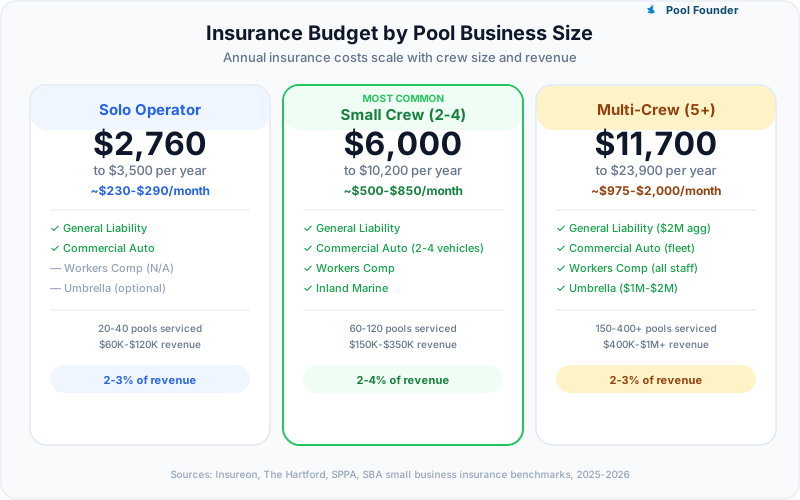
Your total insurance budget depends primarily on two factors: your business size and whether you have employees. Solo operators with no employees need only general liability and commercial auto, while businesses with technicians must add workers compensation and may benefit from additional coverages. The following breakdown shows realistic annual insurance budgets for three common pool business sizes, using median premium data from Insureon and industry benchmarks.
Solo Operator (No Employees)
A solo pool service operator needs general liability and commercial auto insurance at minimum. This is the most affordable insurance profile and covers the core risks of working on customer properties and driving between stops. Most solo operators earn $50,000 to $85,000 in annual revenue, making insurance costs roughly 2% to 4% of revenue at this stage.
| Coverage | Annual Cost | Notes |
|---|---|---|
| General Liability ($1M/$2M) | $760-$900 | Lower end of range with no employees and clean claims history |
| Commercial Auto | $1,800-$2,200 | Single vehicle, clean driving record |
| Pollution Endorsement | $200-$400 | Recommended add-on to GL for chemical handling |
| Total Annual Budget | $2,760-$3,500 | Roughly $230-$290 per month |
Small Team (1-3 Technicians)
Once you hire your first employee, workers compensation becomes mandatory in most states and your general liability premiums increase to reflect the additional risk exposure of having employees on customer properties. Commercial auto costs also rise because you are now insuring multiple drivers. Businesses at this stage typically generate $150,000 to $350,000 in annual revenue.
| Coverage | Annual Cost | Notes |
|---|---|---|
| General Liability ($1M/$2M) | $900-$1,300 | Higher premiums with employees and increased revenue |
| Workers Compensation | $1,200-$3,200 | Based on $2-$4 per $100 of payroll for 1-3 employees |
| Commercial Auto | $2,400-$4,500 | Multiple vehicles and drivers increase costs |
| Pollution Endorsement | $300-$500 | Scales slightly with number of employees handling chemicals |
| Total Annual Budget | $4,800-$9,500 | Roughly $400-$790 per month |
Mid-Size Operation (4-10 Technicians)
At this scale, your insurance needs become more complex and typically benefit from a more structured approach. A Business Owner's Policy replaces your standalone GL and property coverage at a discount, umbrella coverage becomes important to protect against catastrophic claims, and your workers comp and commercial auto premiums reflect a significantly larger payroll and fleet. Businesses at this stage generate $400,000 to $1,000,000 or more in annual revenue.
| Coverage | Annual Cost | Notes |
|---|---|---|
| BOP (GL + Property) | $1,200-$2,000 | Bundled discount vs standalone GL + property |
| Workers Compensation | $4,000-$9,000 | $2-$4 per $100 of payroll for 4-10 employees |
| Commercial Auto (Fleet) | $5,000-$10,000 | Fleet policy for 4-10 vehicles |
| Umbrella ($1M) | $800-$1,500 | Extends limits on all underlying policies |
| Pollution Liability | $400-$800 | Standalone policy justified at this scale |
| Inland Marine | $300-$600 | Covers tools and equipment in transit |
| Total Annual Budget | $11,700-$23,900 | Roughly $975-$1,990 per month |
2%-4%
Typical insurance cost as a percentage of annual revenue for pool service businesses
Source: Insureon, The Hartford, Industry Benchmarks
Regardless of your business size, insurance should represent approximately 2% to 4% of gross revenue. If your insurance costs exceed 5% of revenue, you may be over-insured for your risk profile or paying inflated premiums that could be reduced by shopping competitively or adjusting deductibles. Conversely, if you are spending less than 1.5% of revenue on insurance, you likely have coverage gaps that could prove catastrophic in the event of a claim.
What Happens If You Operate Without Proper Insurance?
Operating a pool service business without proper insurance creates a cascade of financial, legal, and business risks that compound over time. Many new operators view insurance as an optional expense they can defer until the business is more established. This is a dangerous miscalculation. The risks of operating uninsured are immediate, severe, and often irreversible.
Legal Penalties and Fines
Operating without required insurance carries direct legal consequences in most states. Workers compensation violations are treated most seriously because they affect employee welfare. In California, failure to carry workers comp when required is a criminal misdemeanor punishable by fines up to $10,000 and up to one year in county jail. In Florida, uninsured employers face a stop-work order that shuts down your business immediately, plus a penalty of twice the amount you would have paid in premiums during the uninsured period. Driving a commercial vehicle without commercial auto insurance can result in license suspension, vehicle impoundment, and personal liability for all accident damages with no policy to backstop you.
Unlimited Personal Liability
Without insurance, every liability claim comes directly out of your personal assets. Even if you have formed an LLC, courts can and do pierce the corporate veil when a business owner knowingly operates without required insurance, because it demonstrates a disregard for legal obligations that undermines the liability protection the LLC would otherwise provide. A single property damage claim from a chemical spill, a bodily injury claim from a customer who slips near your work area, or a vehicle accident on the way to a stop can generate six-figure liability that attaches to your personal bank accounts, home equity, and future earnings.
Loss of Commercial Contracts and Revenue
The most profitable segments of the pool service market, HOA accounts, commercial properties, property management portfolios, and municipal facilities, universally require proof of insurance as a condition of doing business. Without a current certificate of insurance showing at least $1 million per occurrence in general liability coverage, you cannot bid on these accounts. Many residential customers in higher-income neighborhoods also request proof of insurance, and failing to provide it costs you the trust and credibility needed to compete on anything other than price. In practical terms, operating without insurance limits you to price-sensitive residential customers who do not ask questions, which is the least profitable and highest-churn segment of the market.
- State fines and penalties, including potential criminal charges for workers comp violations in states like California and Florida
- Stop-work orders that force immediate business shutdown until compliance is achieved
- Personal liability for all claims with no insurance backstop, regardless of LLC status
- Inability to bid on HOA, commercial, and property management contracts that require certificates of insurance
- Loss of customer trust and credibility in competitive markets where insured competitors actively advertise their coverage
- Disqualification from subcontractor relationships with larger pool service companies and general contractors
- Potential difficulty obtaining insurance in the future, as carriers view prior uninsured periods as a red flag
If you are currently operating without insurance, do not wait until renewal season to get covered. Most commercial insurance policies can be bound within 24 to 48 hours of application, and online platforms like Insureon can generate quotes in minutes. Every day you operate uninsured is a day where a single incident can end your business permanently.
How to Get Pool Service Business Insurance
Getting proper insurance coverage for a pool service business is a straightforward process that most operators can complete within one to two weeks. The key is to start with a clear understanding of what coverage you need based on your state requirements and business size, then systematically compare options from multiple sources to get the best combination of coverage and price.
Step 1: Assess Your Coverage Needs
Before requesting quotes, determine exactly which policies you need. At minimum, every pool service business needs general liability and commercial auto insurance. If you have any employees, add workers compensation to the list. Consider whether you need pollution liability coverage based on the types of chemicals you handle and whether your general liability policy includes or excludes pollution-related claims. If you own or lease office or storage space, evaluate whether a Business Owner's Policy makes more sense than standalone general liability. Make a list of every coverage type you need and the minimum limits required by your state and your largest customer contracts.
Step 2: Gather Your Business Information
Insurance applications require specific information about your business. Have the following ready before you start requesting quotes: your business legal name and entity type, your EIN or Social Security number, your annual revenue or projected revenue, the number of employees and their total annual payroll, a list of vehicles used for business purposes including VINs and driver information, a description of services you perform such as cleaning only, equipment repair, construction, or plumbing and electrical, your claims history for the past three to five years, and any professional licenses or certifications you hold such as CPO (Certified Pool Operator) or state contractor licenses.
Step 3: Get Quotes from Multiple Sources
The pool service insurance market has several strong options for obtaining competitive quotes. Using multiple sources ensures you are seeing a representative range of premiums and coverage options rather than accepting the first quote you receive.
- Insureon: The largest online insurance marketplace for small businesses. Allows you to compare quotes from multiple carriers in one application. Particularly strong for general liability, BOP, and workers comp.
- SPPA (Swimming Pool and Spa Association): Offers group insurance programs specifically designed for pool service professionals. Membership may provide access to discounted rates and industry-specific coverage options.
- The Hartford: A major commercial insurer with specific pool and spa contractor insurance programs. Strong for workers comp and BOP policies, and often competitive for businesses with five or more employees.
- Local independent insurance agents: An independent agent represents multiple carriers and can shop your coverage across 10 to 20 companies simultaneously. Particularly valuable if you have a complex risk profile, prior claims, or need coverage in a monopolistic workers comp state.
- Industry associations: State pool trade associations often negotiate group insurance rates for their members. These programs can offer lower premiums than individual policies, especially for general liability and professional liability coverage.
Step 4: Compare Quotes Carefully
When comparing insurance quotes, do not focus solely on premium price. The cheapest policy is not always the best value. Compare the following across each quote: coverage limits per occurrence and aggregate, deductible amounts, exclusions especially for pollution and professional liability and subcontractor work, whether the policy is claims-made or occurrence-based where occurrence is better for long-term protection, the insurer's AM Best financial strength rating where A- or better is recommended, and the ease of obtaining certificates of insurance for your customers. A policy that costs $200 less per year but excludes chemical spill coverage is not a savings. It is a liability.
Step 5: Review and Renew Annually
Insurance is not a set-it-and-forget-it purchase. Review your coverage annually, ideally 60 to 90 days before renewal, to ensure your limits still match your business size and risk profile. As your revenue grows, your customer count increases, and you add employees and vehicles, your coverage needs will change. Key triggers for a mid-year policy review include hiring your first employee, adding a new vehicle to your fleet, taking on your first commercial or HOA account that requires higher coverage limits, expanding into new services like equipment repair or renovation, and any claim or near-miss incident that reveals a coverage gap.
Ask every insurer you contact whether they offer a pay-as-you-go workers compensation option. Traditional workers comp policies require an upfront annual premium based on estimated payroll, then perform an audit at year-end that can result in a large additional payment. Pay-as-you-go programs charge based on actual payroll each pay period, which improves cash flow and eliminates audit surprises. This is especially valuable for seasonal pool businesses where payroll fluctuates significantly between summer and winter.
Free starter kit
Start a pool service business with the numbers already run.
A short email series from an owner who started with $1,200 and a used truck. No software pitch, just the four things that decide whether year one works.
- Startup cost breakdownEvery line item from $2K bootstrap to fully equipped
- Pricing calculatorThe minimum you can charge per visit and still profit
- First-10-customers playbookDoor hangers, referrals, and the phone script that closes
- Licensing & insurance checklistWhat your state requires and which insurers pay claims
Already running routes? Try Pool Founder free
Frequently Asked Questions
What are the best pool liability insurance companies for rates and coverage in 2026?
The best pool liability insurance companies in 2026 are Insureon (largest online marketplace with quotes from multiple carriers in one application), The Hartford (specific pool and spa contractor programs with strong workers comp), SPPA/Swimming Pool and Spa Professionals Alliance (industry-specific group insurance programs with negotiated rates for pool professionals), and local independent insurance agents who can shop your coverage across 10-20 carriers simultaneously. For the best rates, get quotes from at least three sources, maintain a clean claims history, and consider bundling policies with a single carrier for 10-20% multi-policy discounts. Solo operators should expect to pay $2,760-$3,500 per year for general liability plus commercial auto coverage.
What is the average cost of small business insurance for a swimming pool company?
The average cost of small business insurance for a swimming pool company depends on business size. A solo operator pays approximately $2,760-$3,500 per year for general liability ($800/year median) and commercial auto ($2,075/year median). A small crew with 1-3 technicians pays $4,800-$9,500 per year including workers compensation. A mid-size operation with 4-10 technicians pays $11,700-$23,900 per year for a comprehensive package including BOP, workers comp, fleet auto, umbrella, and pollution coverage. Insurance typically represents 2-4% of gross annual revenue for pool service businesses. These figures are based on median premium data from Insureon and The Hartford for pool and spa service companies.
What is the average pool liability insurance cost in 2026?
The average pool liability insurance cost in 2026 is approximately $67 per month or $800 per year for general liability coverage with $1 million per occurrence and $2 million aggregate limits, based on Insureon median premium data. Premiums range from $760 to $1,300 per year depending on your state, revenue, number of employees, and claims history. Businesses in higher-cost states like California and Florida typically pay toward the upper end. Adding commercial auto ($173/month median) brings the total minimum coverage cost for a solo operator to approximately $230-$290 per month.
Do I need insurance to start a pool cleaning business?
Yes. At minimum, you need general liability insurance and commercial auto insurance to operate legally and responsibly. General liability protects you against property damage and bodily injury claims on customer properties, and it is required by nearly every commercial customer, HOA, and property management company before they will sign a service contract. Commercial auto insurance is legally required in all 50 states if you use a vehicle for business purposes. Your personal auto policy will deny any claim that occurs while you are driving for work. If you have any employees, workers compensation insurance is also legally required in most states. The total cost for a solo operator to carry GL and commercial auto starts at approximately $2,760 per year.
How much does pool service business insurance cost per month?
Monthly insurance costs vary by business size. A solo operator typically pays $230 to $290 per month for general liability and commercial auto. A small business with one to three technicians pays $400 to $790 per month for GL, workers comp, and commercial auto. A mid-size operation with four to ten technicians pays $975 to $1,990 per month for a comprehensive package including BOP, workers comp, fleet auto, umbrella, and pollution coverage. The median premiums from Insureon data are approximately $67 per month for general liability, $136 per month for workers compensation, and $173 per month for commercial auto. Your actual costs will depend on your state, revenue, claims history, and the number of employees and vehicles you insure.
What happens if a pool technician damages a customer's property and I do not have insurance?
Without insurance, you are personally liable for the full cost of the damage. Pool service property damage claims commonly involve chemical staining or etching of pool surfaces and decks, cracked tile from equipment contact, damaged pool equipment from incorrect servicing, and water damage from plumbing errors. These claims routinely range from $5,000 to $50,000, and a major chemical spill affecting a premium pool deck can exceed $100,000. Without general liability insurance, the customer can sue you personally, and even if you have formed an LLC, courts may pierce the corporate veil if you were knowingly operating without required insurance. A $67 per month general liability policy with $1 million per occurrence coverage eliminates this risk entirely.
Does my personal auto insurance cover my pool service truck?
No. Personal auto insurance policies contain business use exclusions that deny coverage for any accident that occurs while you are driving for work purposes. This means if you are driving to a service stop, transporting pool chemicals, or performing any business-related errand, your personal auto insurer will deny the claim. You need a commercial auto insurance policy, which costs a median of $173 per month or $2,075 per year. Commercial auto covers liability for injuries and property damage you cause, damage to your own vehicle, medical payments, and uninsured motorist coverage. Given that pool technicians drive 80 to 150 miles per day on their routes, commercial auto represents one of your highest-frequency risk exposures.
Do I need workers compensation insurance if I am a sole proprietor with no employees?
In most states, sole proprietors with no employees are not legally required to carry workers compensation insurance. However, there are important exceptions and considerations. Some states, including California, allow sole proprietors to voluntarily opt into workers comp coverage, which can provide valuable protection if you are injured on the job and cannot work. Additionally, some commercial customers and general contractors require all subcontractors to carry workers comp regardless of employee count, so lacking coverage can lock you out of certain contracts. If you hire your first employee, even a part-time helper, workers comp becomes mandatory in most states immediately. The moment you bring on any help, budget for workers comp at approximately $2 to $4 per $100 of payroll.