Most Pool Companies Earn 75% of Revenue in Six Months
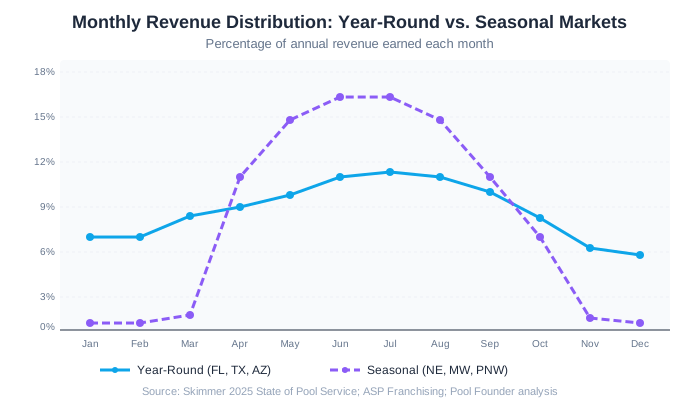
Pool service revenue does not arrive evenly across twelve months. In seasonal markets, 75 to 80% of annual revenue concentrates into six months (April through September), leaving six months where fixed costs continue but income drops to a fraction of peak levels. Even in year-round markets like Florida and Arizona, revenue swings 30 to 40% between peak summer months and slower winter periods. Understanding this pattern, month by month, is the difference between a company that builds cash reserves and one that scrambles for a line of credit every December.
According to the Skimmer 2025 State of Pool Service Report and ASP Franchising, managing seasonal revenue fluctuations is one of the top operational challenges for pool service business owners. Seventy-six percent of pool professionals planned price increases in 2025, with seasonal cash flow pressure cited as a primary driver. The data below maps typical revenue distribution by month for both year-round and seasonal markets.
Revenue percentages represent the share of total annual revenue earned in each month. Chemical cost multipliers show how chemical expenses change relative to the annual average. Data is based on industry reports, franchisee data from ASP, and Pool Founder internal analysis.
75-80%
Share of annual revenue earned in peak six months (seasonal markets)
Source: ASP Franchising, industry analysis
What Does Monthly Revenue Look Like for Year-Round Markets?
Year-round markets (Florida, Texas, Arizona, Southern California) bill twelve months per year, which smooths the revenue curve. But "year-round" does not mean "flat." Summer months still generate more revenue due to higher chemical demand, more service calls, and add-on work like green pool recoveries and equipment repairs driven by heat stress. Winter months see reduced chemical usage, fewer callbacks, and a drop in new customer acquisition.
| Month | Revenue % | Chemical Cost | Service Notes |
|---|---|---|---|
| January | 6.5% | 0.7x | Slowest month. Focus on equipment inspections, route optimization |
| February | 6.5% | 0.7x | New customer prospecting begins. Quote spring startups |
| March | 8% | 0.85x | Temperature rises, chemical demand increases. Spring cleanup calls begin |
| April | 9% | 1.0x | Full season ramp. All pools active, callbacks begin climbing |
| May | 10% | 1.1x | Peak acquisition month. New customers calling, add-on services selling |
| June | 11% | 1.3x | Peak chemical demand. CYA issues surface, green pool calls spike |
| July | 11.5% | 1.4x | Highest revenue month. Maximum chemical use, most callbacks |
| August | 11% | 1.35x | Still peak. Equipment failures from heat stress generate repair revenue |
| September | 9.5% | 1.1x | Gradual slowdown. Chemical demand dropping but service scope unchanged |
| October | 7.5% | 0.85x | Shoulder season. Some accounts reduce to bi-weekly in cooler areas |
| November | 5.5% | 0.65x | Reduced chemical use. Holiday scheduling challenges |
| December | 5% | 0.6x | Lowest activity. Focus on renewals, price increase letters |
In year-round markets, the ratio between the best month (July at 11.5%) and worst month (December at 5%) is about 2.3:1. This is manageable with proper planning, but it still means your December revenue is less than half your July revenue while your fixed costs (truck payment, insurance, software, rent) remain constant.
2.3:1
Peak-to-trough monthly revenue ratio in year-round markets
Source: Pool Founder analysis
How Does Revenue Change in Seasonal Markets?
Seasonal markets (Northeast, Midwest, Pacific Northwest, Mid-Atlantic) compress annual revenue into 6 to 8 billing months. Pools are opened in April or May, closed in September or October, and sit dormant through winter. This creates a dramatic revenue spike during the season and near-zero pool service income during the off-season, forcing companies to either build reserves, diversify services, or carry debt through winter.
| Month | Revenue % | Chemical Cost | Service Notes |
|---|---|---|---|
| January | 0-1% | N/A | No pool service. Equipment maintenance, off-season projects |
| February | 0-1% | N/A | Marketing push for spring bookings. Early bird pricing |
| March | 2-3% | N/A | Some cover removals in warm years. Booking pool openings |
| April | 10-12% | 0.8x | Pool opening season. Startup chemistry, cover removal, inspection |
| May | 14-16% | 1.0x | Full service begins. Heavy chemical demand as pools stabilize |
| June | 16-18% | 1.3x | Peak month. Maximum pools active, highest chemical use |
| July | 16-18% | 1.4x | Co-peak with June. Green pool calls, equipment repairs |
| August | 14-16% | 1.3x | Still strong. Algae season continues, back-to-school slowdown starts |
| September | 10-12% | 1.0x | Season winding down. Pool closings begin in northern areas |
| October | 5-8% | 0.6x | Closing season. Winterization, cover installation, equipment prep |
| November | 0-2% | N/A | Last closings. Shift to off-season revenue (snowplowing, repairs) |
| December | 0-1% | N/A | Off-season. Equipment rebuilds, training, planning |
The seasonal revenue curve is severe. June and July together can represent 32 to 36% of total annual revenue, while November through March produces less than 5%. A seasonal pool company grossing $300,000 per year earns roughly $50,000 per month in June/July but under $3,000 per month from December through February. The challenge is not revenue. It is cash flow management.
How Do Chemical Costs Vary by Season?
Chemical costs do not scale linearly with revenue. They spike disproportionately during peak summer months when higher water temperatures, UV intensity, and bather loads all increase chemical demand simultaneously. A pool that uses $12 in chemicals per visit in March might need $18 to $22 per visit in July. This 50 to 80% increase in chemical cost per pool is the hidden margin compressor that catches unprepared companies off guard.
| Cost Driver | Winter | Spring/Fall | Peak Summer |
|---|---|---|---|
| Chlorine demand | Low | Moderate | Very high (2-3x winter) |
| Acid demand | Low | Moderate | High (heat raises pH faster) |
| CYA monitoring | N/A | Monthly | Critical (tabs + UV degrade balance) |
| Shock frequency | Rarely | Monthly | Bi-weekly to weekly |
| Algaecide | None | Preventive | Reactive (green pool calls) |
| Chemical cost/pool/visit | $5-8 | $8-12 | $12-22 |
| Cost multiplier | 0.6-0.7x | 0.85-1.0x | 1.3-1.4x |
According to the Skimmer 2025 report, 55% of pool service companies bill monthly with chemicals included, while 20% bill monthly "plus chems." The report notes that separating chemicals from the service rate makes it easier to maintain margins as chemical costs fluctuate. If you include chemicals in your monthly rate, your summer margin compression can be 5 to 10 percentage points worse than your winter margin, even though revenue is higher.
55%
Pool service companies that include chemicals in their monthly rate
Source: Skimmer 2025 State of Pool Service Report
How Should You Manage Seasonal Cash Flow?
Seasonal revenue is not a problem to solve. It is a reality to manage. The companies that thrive through seasonal cycles use a combination of annual billing structures, cash reserves, and diversified revenue to bridge the gap between their last closing in October and their first opening in April.
Five Cash Flow Management Strategies
- 1Annual billing with equal monthly payments. Charge $2,400 per year ($200/month for 12 months) instead of $300/month for 8 months. The customer pays the same total but spreads it evenly, giving you winter income.
- 2Build a three-month cash reserve. Your minimum reserve should cover November through January fixed costs (rent, insurance, truck payments, loan payments). For a company with $15,000/month in fixed costs, that is $45,000.
- 3Offer off-season services. Pool equipment repairs, heater maintenance, cover installations, and even non-pool services like gutter cleaning or holiday lighting keep techs employed and revenue flowing.
- 4Pre-sell spring openings in September. Offer a 5% early-bird discount on pool openings booked before December 1. This locks in revenue commitment and gives you a booking calendar to plan spring staffing.
- 5Use seasonal pricing. Charge a premium during peak months (June-August) to build the reserves needed for the off-season. A $20/month summer surcharge across 100 pools generates $6,000 in three months.
The worst financial decision a seasonal pool company can make is hiring for peak demand and carrying that labor cost through winter. Staff up with seasonal workers or subcontractors for June through August, and keep your year-round team lean enough to sustain through the off-season.
What Revenue Benchmarks Should You Target by Month?
The following benchmarks show target monthly revenue for a solo operator with 80 pools and a small company with 200 pools across both year-round and seasonal markets. Use these to calibrate your own revenue expectations and identify months where you are underperforming.
| Metric | Solo (80 pools, year-round) | Small Co (200 pools, year-round) | Solo (80 pools, seasonal) |
|---|---|---|---|
| Annual revenue | $120,000-144,000 | $300,000-360,000 | $96,000-120,000 |
| Peak month (July) | $13,800-16,560 | $34,500-41,400 | $15,360-21,600 |
| Trough month (Dec/Jan) | $6,000-7,200 | $15,000-18,000 | $0-1,200 |
| Average monthly | $10,000-12,000 | $25,000-30,000 | $8,000-10,000 |
| Chemical cost (annual) | $14,400-21,600 | $36,000-54,000 | $9,600-14,400 |
| Chemical % of revenue | 12-15% | 12-15% | 10-12% |
Chemical costs as a percentage of revenue should stay between 10% and 15%. If your chemical spend exceeds 15% of revenue, either your chemical purchasing is inefficient (buying retail instead of wholesale), your pool volumes are miscalculated (overdosing), or your rates are too low relative to the chemical demand of your pool mix. Our chemical cost per pool analysis breaks down these benchmarks further.
Ready to streamline your pool service business?
Pool Founder gives you route optimization, automated invoicing, chemical tracking, and everything else you need to run a more profitable pool business.
Frequently Asked Questions
What is the best month for pool service revenue?
July is typically the highest revenue month for pool service companies in both year-round and seasonal markets, representing 11 to 18% of total annual revenue depending on market type. June is a close second. These months see maximum pool usage, highest chemical demand, most callback requests, and peak equipment failure rates from heat stress.
What percentage of revenue comes from chemicals?
Chemical costs typically represent 10 to 15% of total pool service revenue. This percentage spikes to 15 to 18% during peak summer months when chlorine and acid demand are highest, and drops to 8 to 10% during cooler months. Companies that include chemicals in their monthly rate experience margin compression during summer if they do not adjust rates for seasonal demand.
How do seasonal pool companies survive the off-season?
Four primary strategies: annual billing that spreads payments across 12 months even though service runs 7 to 8 months, cash reserves built from peak-season profits (target three months of fixed costs), off-season services like equipment repairs and cover installations, and diversification into non-pool services. The most financially stable companies use all four.
Should I charge more during peak summer months?
A summer surcharge of $15 to $25 per month during June through August is becoming more common and is easy to justify based on increased chemical costs (50-80% higher), longer service times (heat, algae), and higher callback frequency. Across 100 pools, a $20 summer surcharge generates $6,000 in three months. Frame it as a "summer chemistry supplement" tied to the real cost increase.
How much should pool companies keep in cash reserves?
Minimum three months of fixed operating costs. For a seasonal company with $15,000 per month in fixed costs (truck payments, insurance, rent, software, loan payments), that is $45,000 in reserve. Year-round companies should target two months of fixed costs. Build reserves during peak months by setting aside 10 to 15% of gross revenue from April through September.