Why Do Seasonal Pool Companies Need a Different Pricing Strategy?
Seasonal pool service companies face a pricing challenge that year-round operators never deal with: compressing 12 months of fixed costs into 5 to 8 months of revenue. Your truck payments, insurance premiums, software subscriptions, and warehouse rent do not pause for winter. If you price based solely on active-season costs, you end up short by December. If you price too high during the season, customers shop around. The solution is a seasonal pricing strategy that accounts for your full annual cost structure and gives customers clear, predictable pricing they can budget for.
According to Angi 2026 data, pool openings cost $150 to $400 and closings cost $200 to $500 depending on pool size and region. Weekly seasonal maintenance runs $125 to $300 per month. The companies that build these into a single annual package retain more customers, generate higher per-customer revenue, and smooth out cash flow compared to companies that quote everything as individual line items.
Corey Adams, Pool Founder co-founder and 15-year pool service veteran, built seasonal pricing packages that increased per-customer revenue by 15-20% compared to unbundled pricing. His approach: "Stop selling individual services. Sell a complete seasonal solution. Customers want to write one check and not think about their pool."
How Do You Calculate Your True Cost Per Pool for Seasonal Service?
Before setting any prices, you need to know your actual cost per pool per season. Most seasonal operators underestimate this number because they forget to include off-season fixed costs, seasonal chemical variation, and the labor cost of opening and closing. Start with your total annual expenses and work backward to a per-pool cost.
Annual Cost Calculation
| Cost Category | Monthly Cost | Annual Cost | Notes |
|---|---|---|---|
| Truck payment + fuel | $600 - $1,200 | $7,200 - $14,400 | 12 months, does not pause |
| Insurance (GL, auto, workers comp) | $375 - $700 | $4,500 - $8,400 | 12 months, does not pause |
| Software and tools | $50 - $200 | $600 - $2,400 | 12 months |
| Chemical cost per pool (season) | -- | $300 - $600 | 5-8 months active |
| Labor per pool per visit | -- | $15 - $25/visit | 20-32 visits per season |
| Opening labor + materials per pool | -- | $150 - $300 | Once per season |
| Closing labor + materials per pool | -- | $150 - $350 | Once per season |
For a seasonal company with 60 pools, $12,000 in annual fixed overhead, and an active season of 6 months (24 weekly visits), the fixed cost per pool per year is $200. Add $500 in chemicals, $500 in labor (24 visits at roughly $20 per visit), $200 for opening, and $250 for closing. Your cost per pool is approximately $1,650 per season. Your price needs to be well above that to generate profit.
Many seasonal companies forget to allocate off-season fixed costs to their pool count. If you have $3,000 per month in fixed expenses during 4 off-season months, that is $12,000 that must be covered by in-season revenue. Divide it across your active pool count and add it to your per-pool cost.
What Seasonal Pricing Tiers Should You Offer?
Tiered pricing gives customers choices while steering most of them toward the mid-tier package that generates the best margin. A three-tier model works for most seasonal pool service companies: a basic chemical-only service, a standard full-service package, and a premium all-inclusive package.
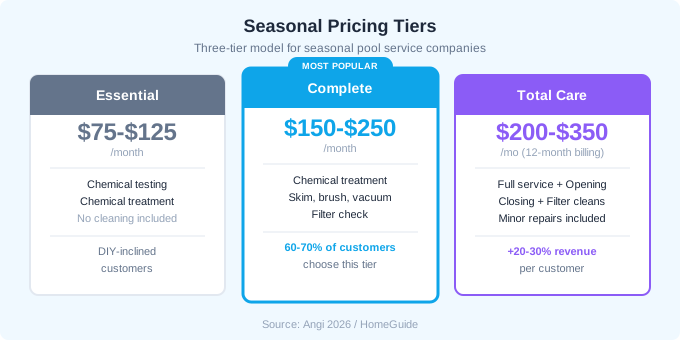
| Tier | What Is Included | Monthly Price Range | Target Customer |
|---|---|---|---|
| Basic (Chemical Only) | Weekly chemical testing and treatment, no cleaning | $75 - $125/mo | DIY-inclined customers who handle their own cleaning |
| Standard (Full Service) | Weekly chemical treatment + skim, brush, vacuum, filter check | $150 - $250/mo | Most residential customers |
| Premium (All-Inclusive) | Full service + opening, closing, filter cleans, minor repairs included | $200 - $350/mo (12-month billing) | Customers who want zero hassle |
Why Three Tiers Work
- The basic tier captures customers who would otherwise go DIY entirely. Some revenue is better than no revenue.
- The standard tier is where 60-70% of customers land. It is your bread and butter.
- The premium tier generates 20-30% higher revenue per customer through bundling. Even if only 20% of customers choose it, the margin impact is significant.
- Showing three options anchors the customer against the premium price, making the standard tier feel like a reasonable middle ground.
Name your tiers something that conveys value, not just price level. "Essential," "Complete," and "Total Care" work better than "Basic," "Standard," and "Premium." The customer picking "Essential" feels like they are making a smart choice, not a cheap one.
How Should You Price Pool Opening Services?
Pool openings are your highest-revenue single-visit service. According to Angi 2026 data, professional pool openings cost $150 to $400 depending on pool size, equipment complexity, and market. For a seasonal company, spring openings represent both a major revenue event and a customer retention opportunity. A smooth opening builds trust that carries through the season.
Opening Pricing by Pool Type
| Pool Type | Price Range | Included Work | Time Per Opening |
|---|---|---|---|
| Standard residential (up to 20K gal) | $200 - $300 | Cover removal, equipment reconnection, startup, chemistry | 45-60 min |
| Large residential (20K-40K gal) | $275 - $375 | Above + heater startup, longer chemistry adjustment | 60-75 min |
| Residential with salt system | $300 - $400 | Above + salt cell install, calibration | 60-90 min |
| Complex (automation, spa, water features) | $350 - $500 | Full system programming, all equipment startup | 75-120 min |
Opening Pricing Tips
- Include a follow-up visit: The opening visit gets the pool running. A follow-up visit 3 to 5 days later confirms chemistry is stable. Build this into your opening price rather than charging separately.
- Charge extra for late bookings: Add a 15-25% surcharge for openings booked after your recommended window. This encourages early booking and rewards customers who plan ahead.
- Offer early-bird discounts: A 10% discount for openings booked before March 1 fills your spring calendar earlier and improves cash flow.
- Bundle with seasonal service: Discount the opening by $50 to $100 when the customer also signs up for seasonal weekly service. The recurring revenue is worth far more than the one-time discount.
How Should You Price Pool Closing Services?
Pool closings cost $200 to $500 per pool according to Angi 2026 data, with significant regional variation. Northeast and Midwest companies charge $350 to $600 for in-ground closings because the process is more intensive, requiring full line blowouts with commercial compressors, antifreeze, and heavy-duty covers rated for snow loads. Southern seasonal companies charge $200 to $350 for lighter winterization.
Closing Pricing by Region
| Region | Standard Closing | Complex Pool Closing | Key Cost Driver |
|---|---|---|---|
| Northeast (NY, NJ, CT, MA, PA) | $350 - $500 | $500 - $750 | Full blowout, heavy antifreeze, Gizzmo |
| Midwest (OH, MI, IL, WI, MN) | $350 - $500 | $500 - $700 | Early timeline, intensive blowout |
| Mid-Atlantic (MD, VA, DE, NC) | $250 - $400 | $400 - $550 | Moderate blowout, less antifreeze |
| Upper South (TN, KY, MO) | $200 - $350 | $350 - $450 | Lighter winterization, some year-round |
| Pacific Northwest (OR, WA) | $250 - $400 | $400 - $550 | Rain management + freeze protection |
Add-On Revenue Opportunities
- Safety cover installation: $75 to $150 if not included in the base price
- Cover cleaning before storage: $50 to $100
- Salt cell removal and cleaning: $50 to $75
- Equipment pad winterization addendum (heater, automation): $50 to $100
- Midwinter check (December or January): $50 to $75 per visit to verify cover condition and water level
How Do Seasonal Maintenance Packages Work?
The most profitable seasonal pricing model bundles opening, weekly service, and closing into a single annual package with monthly billing. This approach generates higher per-customer revenue, improves retention, smooths cash flow, and eliminates the awkward conversations about what is and is not included.
Sample Seasonal Package Structure
| Package Component | Standalone Price | Bundled Into Package | Customer Savings |
|---|---|---|---|
| Spring opening | $275 | Included | -- |
| Weekly service (6 months) | $1,200 ($200/mo) | Included | -- |
| Fall closing | $375 | Included | -- |
| Two filter cleanings | $150 ($75 each) | Included | -- |
| Standalone total | $2,000 | -- | -- |
| Package price (12 monthly payments) | -- | $1,750 ($145.83/mo) | $250 savings (12.5%) |
Why 12-Month Billing Works
- Cash flow smoothing: You receive $145.83 per month year-round instead of $200 per month for 6 months and $0 for 6 months. This covers off-season fixed costs.
- Customer retention: Customers on annual billing are significantly less likely to cancel because they are already paying through the off-season and feel invested.
- Reduced seasonal churn: Customers who pay monthly year-round do not have the natural "decision point" at the start of each season where they might shop for a new provider.
- Simplified communication: One price, one package, no surprises. The customer knows exactly what they pay and what they get.
Offer a 10-15% discount for annual package customers compared to buying each service individually. The discount is worth it because bundled customers have higher retention rates, lower administrative costs, and predictable revenue.
How Do You Handle Seasonal Price Increases?
Seasonal companies should raise prices annually, just like year-round companies. The timing is different: announce increases in February or March before the season starts, not mid-season when customers are actively receiving service and more likely to shop competitors.
Seasonal Price Increase Strategy
- 1Calculate your cost increase: Review chemical costs, fuel, insurance premiums, and labor rates. The Bureau of Labor Statistics reported 2.7% CPI inflation in 2025. Your costs likely increased 3-5% or more.
- 2Set the increase at 3-7% annually: This covers inflation and keeps your margins stable. A $200/month service goes to $206-$214. Most customers accept this without complaint.
- 3Send the notice in February: 30 to 45 days before the season begins. Include the new rate, the effective date, and a brief explanation referencing cost increases in chemicals, fuel, and insurance.
- 4Apply the increase to packages, not line items: Increase the monthly package price rather than raising the cost of individual services. This is cleaner and easier for customers to process.
- 5Offer a loyalty discount or early-bird rate: Customers who renew their annual package before March 1 get last year is rate or a reduced increase. This rewards loyalty and locks in renewals early.
Expect 2-5% cancellation from any price increase. On a route of 60 pools, that is 1 to 3 customers. The revenue increase from the remaining 57 to 59 customers at the higher rate more than offsets the loss. Do not avoid price increases out of fear of losing a few accounts.
What Off-Season Revenue Strategies Complement Seasonal Pricing?
Even with 12-month billing, seasonal companies benefit from additional off-season revenue streams that fill the gap between closing season (November) and opening season (April). These services use your existing equipment, skills, and customer relationships.
Off-Season Revenue Opportunities
- Midwinter pool checks: A monthly drive-by to check cover condition, water level, and equipment pad status. Charge $50 to $75 per visit. Quick stops that generate revenue and demonstrate year-round care.
- Equipment repair and replacement: Off-season is the ideal time for pump replacements, filter upgrades, and heater installations. Customers save on emergency repair costs, and you fill weeks that would otherwise be idle.
- Hot tub and spa service: Many pool customers also have hot tubs that run year-round. Adding spa service to your portfolio provides 12-month recurring revenue.
- Cover repair and replacement: Safety covers and winter covers need periodic replacement. Sell and install covers during the off-season when you have availability.
- Pre-season equipment inspections: Offer a discounted equipment checkup in March before opening season. Identify needed repairs before they become opening-day emergencies.
The goal is not to replace in-season revenue but to cover off-season fixed costs. If your off-season fixed costs are $3,000 per month and you generate $1,500 to $2,000 per month in off-season services, you have cut your cash flow gap significantly.
Ready to streamline your pool service business?
Pool Founder gives you route optimization, automated invoicing, chemical tracking, and everything else you need to run a more profitable pool business.
Frequently Asked Questions
How much should I charge for seasonal pool service?
Standard full-service seasonal maintenance runs $150 to $250 per month for the active season. An all-inclusive annual package including opening, weekly service, and closing typically runs $1,500 to $2,500 per season depending on pool size and region, billed as monthly payments.
Should I bill monthly year-round or only during pool season?
Twelve-month billing is strongly recommended. It smooths cash flow to cover off-season fixed costs, increases customer retention, and eliminates the annual decision point where customers might shop for a new provider. Offer a 10-15% discount for annual packages.
How much do pool openings and closings cost?
Pool openings range from $150 to $400 and closings from $200 to $500 according to Angi 2026 data. Northeast and Midwest closings are at the higher end ($350 to $600) due to intensive winterization requirements.
How do I set prices for a new seasonal pool service company?
Calculate your full annual costs (including off-season fixed expenses), divide by your pool count, add your target profit margin (15-25%), and verify the result is competitive in your market. Start with a cost-plus approach and adjust based on demand.
When should seasonal pool companies raise prices?
Announce price increases in February or March, 30 to 45 days before the season starts. Annual increases of 3-7% keep pace with inflation. Send written notice with the new rate and effective date. Expect 2-5% customer loss, which is offset by the revenue increase.
Sources & References
- Angi: Pool Closing Costs (2026 Data)
- Angi: Pool Maintenance Costs (2026 Data)
- HomeGuide: Pool Maintenance Costs (2026)
- Bluewater Pools: Pool Closing Costs (2026)
- Bureau of Labor Statistics: Consumer Price Index (2025)